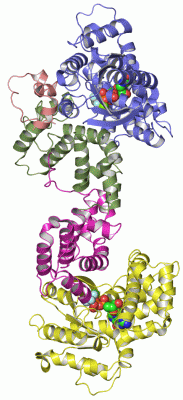
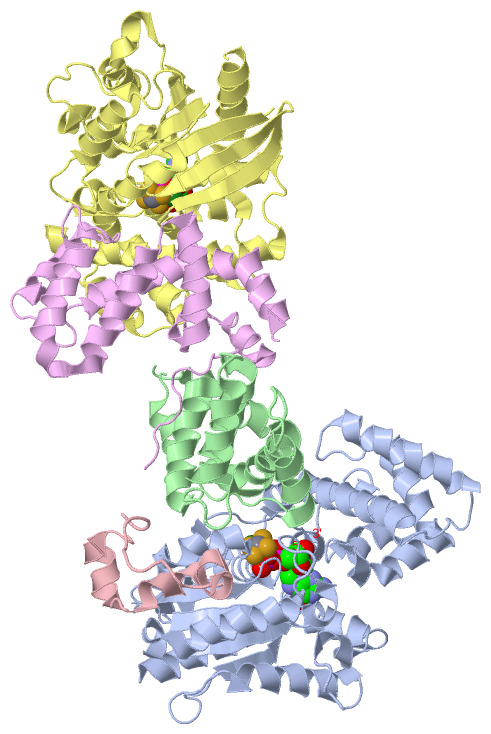
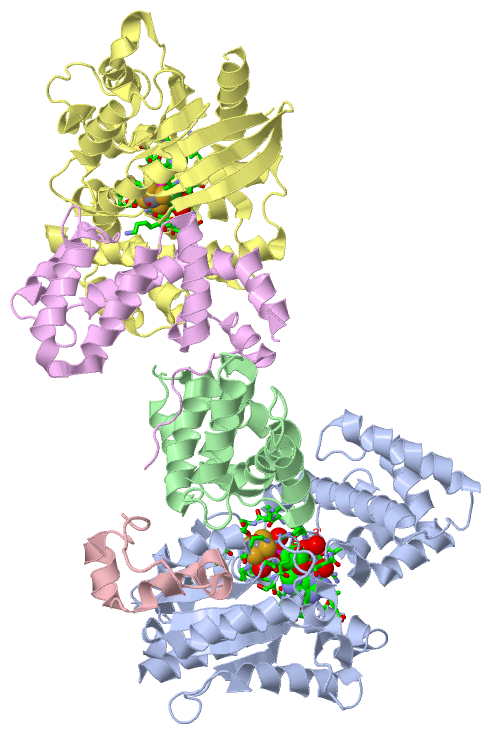
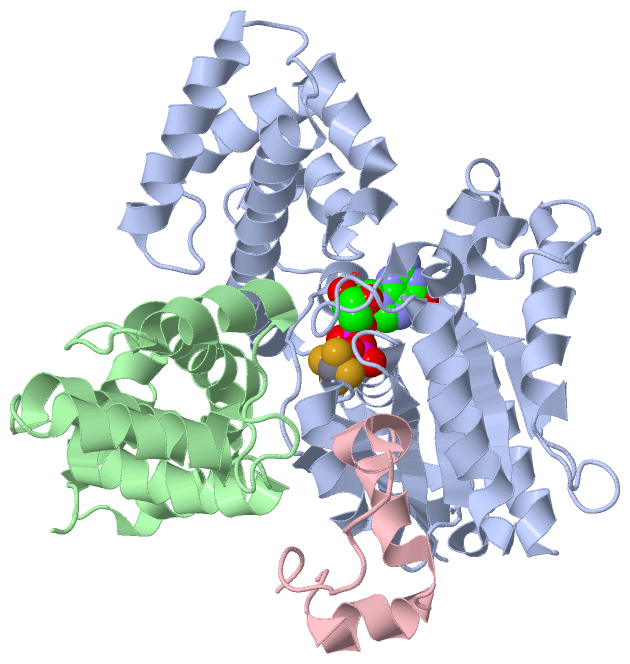
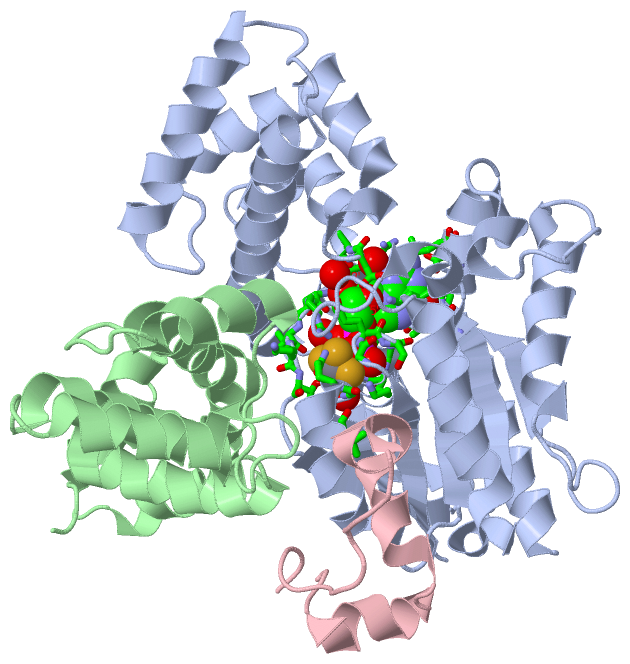
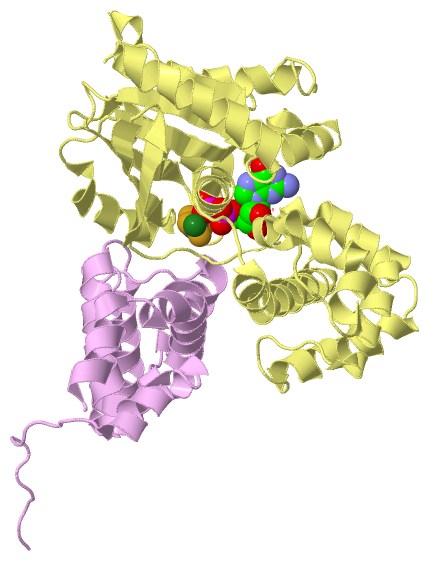
Asymmetric Unit(hide GO term definitions)
Chain A,D ( GNAI1_RAT | P10824)
| molecular function |
|---|
| | GO:0031683 | | G-protein beta/gamma-subunit complex binding | | Interacting selectively and non-covalently with a complex of G-protein beta/gamma subunits. |
| | GO:0001664 | | G-protein coupled receptor binding | | Interacting selectively and non-covalently with a G-protein coupled receptor. |
| | GO:0031821 | | G-protein coupled serotonin receptor binding | | Interacting selectively and non-covalently with a metabotropic serotonin receptor. |
| | GO:0019003 | | GDP binding | | Interacting selectively and non-covalently with GDP, guanosine 5'-diphosphate. |
| | GO:0005525 | | GTP binding | | Interacting selectively and non-covalently with GTP, guanosine triphosphate. |
| | GO:0032794 | | GTPase activating protein binding | | Interacting selectively and non-covalently with a GTPase activating protein. |
| | GO:0003924 | | GTPase activity | | Catalysis of the reaction: GTP + H2O = GDP + phosphate. |
| | GO:0019001 | | guanyl nucleotide binding | | Interacting selectively and non-covalently with guanyl nucleotides, any compound consisting of guanosine esterified with (ortho)phosphate. |
| | GO:0000287 | | magnesium ion binding | | Interacting selectively and non-covalently with magnesium (Mg) ions. |
| | GO:0046872 | | metal ion binding | | Interacting selectively and non-covalently with any metal ion. |
| | GO:0000166 | | nucleotide binding | | Interacting selectively and non-covalently with a nucleotide, any compound consisting of a nucleoside that is esterified with (ortho)phosphate or an oligophosphate at any hydroxyl group on the ribose or deoxyribose. |
| | GO:0005515 | | protein binding | | Interacting selectively and non-covalently with any protein or protein complex (a complex of two or more proteins that may include other nonprotein molecules). |
| | GO:0004871 | | signal transducer activity | | Conveys a signal across a cell to trigger a change in cell function or state. A signal is a physical entity or change in state that is used to transfer information in order to trigger a response. |
| biological process |
|---|
| | GO:0007186 | | G-protein coupled receptor signaling pathway | | A series of molecular signals that proceeds with an activated receptor promoting the exchange of GDP for GTP on the alpha-subunit of an associated heterotrimeric G-protein complex. The GTP-bound activated alpha-G-protein then dissociates from the beta- and gamma-subunits to further transmit the signal within the cell. The pathway begins with receptor-ligand interaction, or for basal GPCR signaling the pathway begins with the receptor activating its G protein in the absence of an agonist, and ends with regulation of a downstream cellular process, e.g. transcription. The pathway can start from the plasma membrane, Golgi or nuclear membrane (PMID:24568158 and PMID:16902576). |
| | GO:0007188 | | adenylate cyclase-modulating G-protein coupled receptor signaling pathway | | The series of molecular signals generated as a consequence of a G-protein coupled receptor binding to its physiological ligand, where the pathway proceeds through activation or inhibition of adenylyl cyclase activity and a subsequent change in the concentration of cyclic AMP (cAMP). |
| | GO:0007049 | | cell cycle | | The progression of biochemical and morphological phases and events that occur in a cell during successive cell replication or nuclear replication events. Canonically, the cell cycle comprises the replication and segregation of genetic material followed by the division of the cell, but in endocycles or syncytial cells nuclear replication or nuclear division may not be followed by cell division. |
| | GO:0051301 | | cell division | | The process resulting in division and partitioning of components of a cell to form more cells; may or may not be accompanied by the physical separation of a cell into distinct, individually membrane-bounded daughter cells. |
| | GO:1904322 | | cellular response to forskolin | | Any process that results in a change in state or activity of a cell (in terms of movement, secretion, enzyme production, gene expression, etc.) as a result of a forskolin stimulus. |
| | GO:0050805 | | negative regulation of synaptic transmission | | Any process that stops, prevents, or reduces the frequency, rate or extent of synaptic transmission, the process of communication from a neuron to a target (neuron, muscle, or secretory cell) across a synapse. |
| | GO:0043949 | | regulation of cAMP-mediated signaling | | Any process which modulates the frequency, rate or extent of cAMP-mediated signaling, a series of molecular signals in which a cell uses cyclic AMP to convert an extracellular signal into a response. |
| | GO:0007165 | | signal transduction | | The cellular process in which a signal is conveyed to trigger a change in the activity or state of a cell. Signal transduction begins with reception of a signal (e.g. a ligand binding to a receptor or receptor activation by a stimulus such as light), or for signal transduction in the absence of ligand, signal-withdrawal or the activity of a constitutively active receptor. Signal transduction ends with regulation of a downstream cellular process, e.g. regulation of transcription or regulation of a metabolic process. Signal transduction covers signaling from receptors located on the surface of the cell and signaling via molecules located within the cell. For signaling between cells, signal transduction is restricted to events at and within the receiving cell. |
| cellular component |
|---|
| | GO:0005813 | | centrosome | | A structure comprised of a core structure (in most organisms, a pair of centrioles) and peripheral material from which a microtubule-based structure, such as a spindle apparatus, is organized. Centrosomes occur close to the nucleus during interphase in many eukaryotic cells, though in animal cells it changes continually during the cell-division cycle. |
| | GO:0005737 | | cytoplasm | | All of the contents of a cell excluding the plasma membrane and nucleus, but including other subcellular structures. |
| | GO:0005856 | | cytoskeleton | | Any of the various filamentous elements that form the internal framework of cells, and typically remain after treatment of the cells with mild detergent to remove membrane constituents and soluble components of the cytoplasm. The term embraces intermediate filaments, microfilaments, microtubules, the microtrabecular lattice, and other structures characterized by a polymeric filamentous nature and long-range order within the cell. The various elements of the cytoskeleton not only serve in the maintenance of cellular shape but also have roles in other cellular functions, including cellular movement, cell division, endocytosis, and movement of organelles. |
| | GO:0070062 | | extracellular exosome | | A vesicle that is released into the extracellular region by fusion of the limiting endosomal membrane of a multivesicular body with the plasma membrane. Extracellular exosomes, also simply called exosomes, have a diameter of about 40-100 nm. |
| | GO:0005834 | | heterotrimeric G-protein complex | | Any of a family of heterotrimeric GTP-binding and hydrolyzing proteins; they belong to a superfamily of GTPases that includes monomeric proteins such as EF-Tu and RAS. Heterotrimeric G-proteins consist of three subunits; the alpha subunit contains the guanine nucleotide binding site and possesses GTPase activity; the beta and gamma subunits are tightly associated and function as a beta-gamma heterodimer; extrinsic plasma membrane proteins (cytoplasmic face) that function as a complex to transduce signals from G-protein coupled receptors to an effector protein. |
| | GO:0005622 | | intracellular | | The living contents of a cell; the matter contained within (but not including) the plasma membrane, usually taken to exclude large vacuoles and masses of secretory or ingested material. In eukaryotes it includes the nucleus and cytoplasm. |
| | GO:0005765 | | lysosomal membrane | | The lipid bilayer surrounding the lysosome and separating its contents from the cell cytoplasm. |
| | GO:0016020 | | membrane | | A lipid bilayer along with all the proteins and protein complexes embedded in it an attached to it. |
| | GO:0045121 | | membrane raft | | Any of the small (10-200 nm), heterogeneous, highly dynamic, sterol- and sphingolipid-enriched membrane domains that compartmentalize cellular processes. Small rafts can sometimes be stabilized to form larger platforms through protein-protein and protein-lipid interactions. |
| | GO:0005815 | | microtubule organizing center | | An intracellular structure that can catalyze gamma-tubulin-dependent microtubule nucleation and that can anchor microtubules by interacting with their minus ends, plus ends or sides. |
| | GO:0030496 | | midbody | | A thin cytoplasmic bridge formed between daughter cells at the end of cytokinesis. The midbody forms where the contractile ring constricts, and may persist for some time before finally breaking to complete cytokinesis. |
| | GO:0005634 | | nucleus | | A membrane-bounded organelle of eukaryotic cells in which chromosomes are housed and replicated. In most cells, the nucleus contains all of the cell's chromosomes except the organellar chromosomes, and is the site of RNA synthesis and processing. In some species, or in specialized cell types, RNA metabolism or DNA replication may be absent. |
| | GO:0005886 | | plasma membrane | | The membrane surrounding a cell that separates the cell from its external environment. It consists of a phospholipid bilayer and associated proteins. |
| | GO:0043234 | | protein complex | | A stable macromolecular complex composed (only) of two or more polypeptide subunits along with any covalently attached molecules (such as lipid anchors or oligosaccharide) or non-protein prosthetic groups (such as nucleotides or metal ions). Prosthetic group in this context refers to a tightly bound cofactor. The component polypeptide subunits may be identical. |
Chain A,D ( GNAT1_BOVIN | P04695)
| molecular function |
|---|
| | GO:0031683 | | G-protein beta/gamma-subunit complex binding | | Interacting selectively and non-covalently with a complex of G-protein beta/gamma subunits. |
| | GO:0001664 | | G-protein coupled receptor binding | | Interacting selectively and non-covalently with a G-protein coupled receptor. |
| | GO:0019003 | | GDP binding | | Interacting selectively and non-covalently with GDP, guanosine 5'-diphosphate. |
| | GO:0005525 | | GTP binding | | Interacting selectively and non-covalently with GTP, guanosine triphosphate. |
| | GO:0003924 | | GTPase activity | | Catalysis of the reaction: GTP + H2O = GDP + phosphate. |
| | GO:0000035 | | acyl binding | | Interacting selectively and non-covalently with an acyl group, any group formally derived by removal of the hydroxyl group from the acid function of a carboxylic acid. |
| | GO:0019001 | | guanyl nucleotide binding | | Interacting selectively and non-covalently with guanyl nucleotides, any compound consisting of guanosine esterified with (ortho)phosphate. |
| | GO:0000166 | | nucleotide binding | | Interacting selectively and non-covalently with a nucleotide, any compound consisting of a nucleoside that is esterified with (ortho)phosphate or an oligophosphate at any hydroxyl group on the ribose or deoxyribose. |
| | GO:0005515 | | protein binding | | Interacting selectively and non-covalently with any protein or protein complex (a complex of two or more proteins that may include other nonprotein molecules). |
| | GO:0019901 | | protein kinase binding | | Interacting selectively and non-covalently with a protein kinase, any enzyme that catalyzes the transfer of a phosphate group, usually from ATP, to a protein substrate. |
| | GO:0004871 | | signal transducer activity | | Conveys a signal across a cell to trigger a change in cell function or state. A signal is a physical entity or change in state that is used to transfer information in order to trigger a response. |
| biological process |
|---|
| | GO:0007186 | | G-protein coupled receptor signaling pathway | | A series of molecular signals that proceeds with an activated receptor promoting the exchange of GDP for GTP on the alpha-subunit of an associated heterotrimeric G-protein complex. The GTP-bound activated alpha-G-protein then dissociates from the beta- and gamma-subunits to further transmit the signal within the cell. The pathway begins with receptor-ligand interaction, or for basal GPCR signaling the pathway begins with the receptor activating its G protein in the absence of an agonist, and ends with regulation of a downstream cellular process, e.g. transcription. The pathway can start from the plasma membrane, Golgi or nuclear membrane (PMID:24568158 and PMID:16902576). |
| | GO:0007188 | | adenylate cyclase-modulating G-protein coupled receptor signaling pathway | | The series of molecular signals generated as a consequence of a G-protein coupled receptor binding to its physiological ligand, where the pathway proceeds through activation or inhibition of adenylyl cyclase activity and a subsequent change in the concentration of cyclic AMP (cAMP). |
| | GO:0008283 | | cell proliferation | | The multiplication or reproduction of cells, resulting in the expansion of a cell population. |
| | GO:0071257 | | cellular response to electrical stimulus | | Any process that results in a change in state or activity of a cell (in terms of movement, secretion, enzyme production, gene expression, etc.) as a result of an electrical stimulus. |
| | GO:0050908 | | detection of light stimulus involved in visual perception | | The series of events involved in visual perception in which a light stimulus is received and converted into a molecular signal. |
| | GO:0042462 | | eye photoreceptor cell development | | Development of a photoreceptor, a sensory cell in the eye that reacts to the presence of light. They usually contain a pigment that undergoes a chemical change when light is absorbed, thus stimulating a nerve. |
| | GO:0051344 | | negative regulation of cyclic-nucleotide phosphodiesterase activity | | Any process that stops or reduces the rate of cyclic nucleotide phosphodiesterase activity, the catalysis of the reaction: nucleotide 3',5'-cyclic phosphate + H2O = nucleotide 5'-phosphate. |
| | GO:0007602 | | phototransduction | | The sequence of reactions within a cell required to convert absorbed photons into a molecular signal. |
| | GO:0007603 | | phototransduction, visible light | | The sequence of reactions within a cell required to convert absorbed photons from visible light into a molecular signal. A visible light stimulus is electromagnetic radiation that can be perceived visually by an organism; for organisms lacking a visual system, this can be defined as light with a wavelength within the range 380 to 780 nm. |
| | GO:0022400 | | regulation of rhodopsin mediated signaling pathway | | Any process that modulates the frequency, rate or extent of rhodopsin-mediated signaling. |
| | GO:0009416 | | response to light stimulus | | Any process that results in a change in state or activity of a cell or an organism (in terms of movement, secretion, enzyme production, gene expression, etc.) as a result of a light stimulus, electromagnetic radiation of wavelengths classified as infrared, visible or ultraviolet light. |
| | GO:0050896 | | response to stimulus | | Any process that results in a change in state or activity of a cell or an organism (in terms of movement, secretion, enzyme production, gene expression, etc.) as a result of a stimulus. The process begins with detection of the stimulus and ends with a change in state or activity or the cell or organism. |
| | GO:0060041 | | retina development in camera-type eye | | The process whose specific outcome is the progression of the retina over time, from its formation to the mature structure. The retina is the innermost layer or coating at the back of the eyeball, which is sensitive to light and in which the optic nerve terminates. |
| | GO:0016056 | | rhodopsin mediated signaling pathway | | The series of molecular signals generated as a consequence of excitation of rhodopsin by a photon and the events that convert the absorbed photons into a cellular response. |
| | GO:0050917 | | sensory perception of umami taste | | The series of events required to receive an umami taste stimulus, convert it to a molecular signal, and recognize and characterize the signal. Umami taste is the savory taste of meats and other foods that are rich in glutamates. This is a neurological process. |
| | GO:0007165 | | signal transduction | | The cellular process in which a signal is conveyed to trigger a change in the activity or state of a cell. Signal transduction begins with reception of a signal (e.g. a ligand binding to a receptor or receptor activation by a stimulus such as light), or for signal transduction in the absence of ligand, signal-withdrawal or the activity of a constitutively active receptor. Signal transduction ends with regulation of a downstream cellular process, e.g. regulation of transcription or regulation of a metabolic process. Signal transduction covers signaling from receptors located on the surface of the cell and signaling via molecules located within the cell. For signaling between cells, signal transduction is restricted to events at and within the receiving cell. |
| | GO:0007601 | | visual perception | | The series of events required for an organism to receive a visual stimulus, convert it to a molecular signal, and recognize and characterize the signal. Visual stimuli are detected in the form of photons and are processed to form an image. |
| cellular component |
|---|
| | GO:0005834 | | heterotrimeric G-protein complex | | Any of a family of heterotrimeric GTP-binding and hydrolyzing proteins; they belong to a superfamily of GTPases that includes monomeric proteins such as EF-Tu and RAS. Heterotrimeric G-proteins consist of three subunits; the alpha subunit contains the guanine nucleotide binding site and possesses GTPase activity; the beta and gamma subunits are tightly associated and function as a beta-gamma heterodimer; extrinsic plasma membrane proteins (cytoplasmic face) that function as a complex to transduce signals from G-protein coupled receptors to an effector protein. |
| | GO:0032391 | | photoreceptor connecting cilium | | The portion of the photoreceptor cell cilium linking the photoreceptor inner and outer segments. It's considered to be equivalent to the ciliary transition zone. |
| | GO:0097381 | | photoreceptor disc membrane | | Ovally-shaped membranous stack located inside the photoreceptor outer segment, and containing densely packed molecules of the photoreceptor protein rhodopsin that traverse the lipid bilayer. Disc membranes are apparently derived from the plasma membrane in the region of the cilium that connects the photoreceptor outer segment to the inner segment. |
| | GO:0001917 | | photoreceptor inner segment | | The inner segment of a vertebrate photoreceptor containing mitochondria, ribosomes and membranes where opsin molecules are assembled and passed to be part of the outer segment discs. |
| | GO:0001750 | | photoreceptor outer segment | | The outer segment of a vertebrate photoreceptor that contains discs of photoreceptive membranes. |
| | GO:0042622 | | photoreceptor outer segment membrane | | The membrane surrounding the outer segment of a vertebrate photoreceptor. |
Chain B,E ( RGS9_BOVIN | O46469)
| molecular function |
|---|
| | GO:0005096 | | GTPase activator activity | | Binds to and increases the activity of a GTPase, an enzyme that catalyzes the hydrolysis of GTP. |
| | GO:0005515 | | protein binding | | Interacting selectively and non-covalently with any protein or protein complex (a complex of two or more proteins that may include other nonprotein molecules). |
| | GO:0004871 | | signal transducer activity | | Conveys a signal across a cell to trigger a change in cell function or state. A signal is a physical entity or change in state that is used to transfer information in order to trigger a response. |
| biological process |
|---|
| | GO:0007186 | | G-protein coupled receptor signaling pathway | | A series of molecular signals that proceeds with an activated receptor promoting the exchange of GDP for GTP on the alpha-subunit of an associated heterotrimeric G-protein complex. The GTP-bound activated alpha-G-protein then dissociates from the beta- and gamma-subunits to further transmit the signal within the cell. The pathway begins with receptor-ligand interaction, or for basal GPCR signaling the pathway begins with the receptor activating its G protein in the absence of an agonist, and ends with regulation of a downstream cellular process, e.g. transcription. The pathway can start from the plasma membrane, Golgi or nuclear membrane (PMID:24568158 and PMID:16902576). |
| | GO:0035556 | | intracellular signal transduction | | The process in which a signal is passed on to downstream components within the cell, which become activated themselves to further propagate the signal and finally trigger a change in the function or state of the cell. |
| | GO:0009968 | | negative regulation of signal transduction | | Any process that stops, prevents, or reduces the frequency, rate or extent of signal transduction. |
| | GO:0043547 | | positive regulation of GTPase activity | | Any process that activates or increases the activity of a GTPase. |
| | GO:0022400 | | regulation of rhodopsin mediated signaling pathway | | Any process that modulates the frequency, rate or extent of rhodopsin-mediated signaling. |
| | GO:0050896 | | response to stimulus | | Any process that results in a change in state or activity of a cell or an organism (in terms of movement, secretion, enzyme production, gene expression, etc.) as a result of a stimulus. The process begins with detection of the stimulus and ends with a change in state or activity or the cell or organism. |
| | GO:0007601 | | visual perception | | The series of events required for an organism to receive a visual stimulus, convert it to a molecular signal, and recognize and characterize the signal. Visual stimuli are detected in the form of photons and are processed to form an image. |
| cellular component |
|---|
| | GO:0005737 | | cytoplasm | | All of the contents of a cell excluding the plasma membrane and nucleus, but including other subcellular structures. |
| | GO:0005834 | | heterotrimeric G-protein complex | | Any of a family of heterotrimeric GTP-binding and hydrolyzing proteins; they belong to a superfamily of GTPases that includes monomeric proteins such as EF-Tu and RAS. Heterotrimeric G-proteins consist of three subunits; the alpha subunit contains the guanine nucleotide binding site and possesses GTPase activity; the beta and gamma subunits are tightly associated and function as a beta-gamma heterodimer; extrinsic plasma membrane proteins (cytoplasmic face) that function as a complex to transduce signals from G-protein coupled receptors to an effector protein. |
| | GO:0016020 | | membrane | | A lipid bilayer along with all the proteins and protein complexes embedded in it an attached to it. |
| | GO:0097381 | | photoreceptor disc membrane | | Ovally-shaped membranous stack located inside the photoreceptor outer segment, and containing densely packed molecules of the photoreceptor protein rhodopsin that traverse the lipid bilayer. Disc membranes are apparently derived from the plasma membrane in the region of the cilium that connects the photoreceptor outer segment to the inner segment. |
| | GO:0005886 | | plasma membrane | | The membrane surrounding a cell that separates the cell from its external environment. It consists of a phospholipid bilayer and associated proteins. |
Chain C ( CNRG_BOVIN | P04972)
| molecular function |
|---|
| | GO:0047555 | | 3',5'-cyclic-GMP phosphodiesterase activity | | Catalysis of the reaction: guanosine 3',5'-cyclic phosphate + H2O = guanosine 5'-phosphate. |
| | GO:0004114 | | 3',5'-cyclic-nucleotide phosphodiesterase activity | | Catalysis of the reaction: nucleoside 3',5'-cyclic phosphate + H2O = nucleoside 5'-phosphate. |
| | GO:0030553 | | cGMP binding | | Interacting selectively and non-covalently with cGMP, the nucleotide cyclic GMP (guanosine 3',5'-cyclophosphate). |
| | GO:0016787 | | hydrolase activity | | Catalysis of the hydrolysis of various bonds, e.g. C-O, C-N, C-C, phosphoric anhydride bonds, etc. Hydrolase is the systematic name for any enzyme of EC class 3. |
| biological process |
|---|
| | GO:0000187 | | activation of MAPK activity | | The initiation of the activity of the inactive enzyme MAP kinase (MAPK). |
| | GO:0045745 | | positive regulation of G-protein coupled receptor protein signaling pathway | | Any process that activates or increases the frequency, rate or extent of G-protein coupled receptor protein signaling pathway activity. |
| | GO:0045742 | | positive regulation of epidermal growth factor receptor signaling pathway | | Any process that activates or increases the frequency, rate or extent of epidermal growth factor receptor signaling pathway activity. |
| | GO:0050896 | | response to stimulus | | Any process that results in a change in state or activity of a cell or an organism (in terms of movement, secretion, enzyme production, gene expression, etc.) as a result of a stimulus. The process begins with detection of the stimulus and ends with a change in state or activity or the cell or organism. |
| | GO:0016056 | | rhodopsin mediated signaling pathway | | The series of molecular signals generated as a consequence of excitation of rhodopsin by a photon and the events that convert the absorbed photons into a cellular response. |
| | GO:0007601 | | visual perception | | The series of events required for an organism to receive a visual stimulus, convert it to a molecular signal, and recognize and characterize the signal. Visual stimuli are detected in the form of photons and are processed to form an image. |
| cellular component |
|---|
| | GO:0097381 | | photoreceptor disc membrane | | Ovally-shaped membranous stack located inside the photoreceptor outer segment, and containing densely packed molecules of the photoreceptor protein rhodopsin that traverse the lipid bilayer. Disc membranes are apparently derived from the plasma membrane in the region of the cilium that connects the photoreceptor outer segment to the inner segment. |
|

 Description