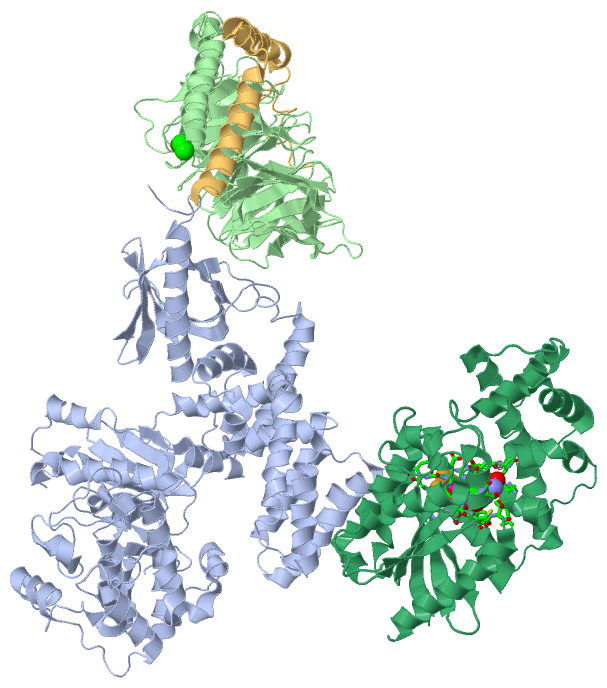
Asymmetric/Biological Unit(hide GO term definitions)
Chain A ( ARBK1_BOVIN | P21146)
| molecular function |
|---|
| | GO:0005524 | | ATP binding | | Interacting selectively and non-covalently with ATP, adenosine 5'-triphosphate, a universally important coenzyme and enzyme regulator. |
| | GO:0031755 | | Edg-2 lysophosphatidic acid receptor binding | | Interacting selectively and non-covalently with an Edg-2 lysophosphatidic acid receptor. |
| | GO:0004703 | | G-protein coupled receptor kinase activity | | Catalysis of the reaction: ATP + G-protein coupled receptor = ADP + G-protein coupled receptor phosphate. |
| | GO:0031694 | | alpha-2A adrenergic receptor binding | | Interacting selectively and non-covalently with an alpha-2A adrenergic receptor. |
| | GO:0047696 | | beta-adrenergic receptor kinase activity | | Catalysis of the reaction: ATP + beta-adrenergic receptor = ADP + phospho-beta-adrenergic receptor. |
| | GO:0016301 | | kinase activity | | Catalysis of the transfer of a phosphate group, usually from ATP, to a substrate molecule. |
| | GO:0000166 | | nucleotide binding | | Interacting selectively and non-covalently with a nucleotide, any compound consisting of a nucleoside that is esterified with (ortho)phosphate or an oligophosphate at any hydroxyl group on the ribose or deoxyribose. |
| | GO:0005515 | | protein binding | | Interacting selectively and non-covalently with any protein or protein complex (a complex of two or more proteins that may include other nonprotein molecules). |
| | GO:0004672 | | protein kinase activity | | Catalysis of the phosphorylation of an amino acid residue in a protein, usually according to the reaction: a protein + ATP = a phosphoprotein + ADP. |
| | GO:0004674 | | protein serine/threonine kinase activity | | Catalysis of the reactions: ATP + protein serine = ADP + protein serine phosphate, and ATP + protein threonine = ADP + protein threonine phosphate. |
| | GO:0016740 | | transferase activity | | Catalysis of the transfer of a group, e.g. a methyl group, glycosyl group, acyl group, phosphorus-containing, or other groups, from one compound (generally regarded as the donor) to another compound (generally regarded as the acceptor). Transferase is the systematic name for any enzyme of EC class 2. |
| biological process |
|---|
| | GO:0007213 | | G-protein coupled acetylcholine receptor signaling pathway | | Any series of molecular signals initiated by an acetylcholine receptor on the surface of the target cell binding to one of its physiological ligands, and proceeding with the activated receptor promoting the exchange of GDP for GTP on the alpha-subunit of an associated heterotrimeric G-protein complex. The GTP-bound activated alpha-G-protein then dissociates from the beta- and gamma-subunits to further transmit the signal within the cell. The pathway begins with receptor-ligand interaction and ends with regulation of a downstream cellular process, e.g. transcription. |
| | GO:0002031 | | G-protein coupled receptor internalization | | The process that results in the uptake of a G-protein coupled receptor into an endocytic vesicle. |
| | GO:0007186 | | G-protein coupled receptor signaling pathway | | A series of molecular signals that proceeds with an activated receptor promoting the exchange of GDP for GTP on the alpha-subunit of an associated heterotrimeric G-protein complex. The GTP-bound activated alpha-G-protein then dissociates from the beta- and gamma-subunits to further transmit the signal within the cell. The pathway begins with receptor-ligand interaction, or for basal GPCR signaling the pathway begins with the receptor activating its G protein in the absence of an agonist, and ends with regulation of a downstream cellular process, e.g. transcription. The pathway can start from the plasma membrane, Golgi or nuclear membrane (PMID:24568158 and PMID:16902576). |
| | GO:0060048 | | cardiac muscle contraction | | Muscle contraction of cardiac muscle tissue. |
| | GO:0002029 | | desensitization of G-protein coupled receptor protein signaling pathway | | The process that stops, prevents, or reduces the frequency, rate or extent of G-protein coupled receptor protein signaling pathway activity after prolonged stimulation with an agonist of the pathway. |
| | GO:0006886 | | intracellular protein transport | | The directed movement of proteins in a cell, including the movement of proteins between specific compartments or structures within a cell, such as organelles of a eukaryotic cell. |
| | GO:0045988 | | negative regulation of striated muscle contraction | | Any process that stops, prevents, or reduces the frequency, rate or extent of striated muscle contraction. |
| | GO:0003108 | | negative regulation of the force of heart contraction by chemical signal | | Any process which decreases the force of heart muscle contraction mediated by chemical signaling, hormonal, autocrine or paracrine. |
| | GO:0018105 | | peptidyl-serine phosphorylation | | The phosphorylation of peptidyl-serine to form peptidyl-O-phospho-L-serine. |
| | GO:0016310 | | phosphorylation | | The process of introducing a phosphate group into a molecule, usually with the formation of a phosphoric ester, a phosphoric anhydride or a phosphoric amide. |
| | GO:0006468 | | protein phosphorylation | | The process of introducing a phosphate group on to a protein. |
| | GO:0009966 | | regulation of signal transduction | | Any process that modulates the frequency, rate or extent of signal transduction. |
| | GO:0007165 | | signal transduction | | The cellular process in which a signal is conveyed to trigger a change in the activity or state of a cell. Signal transduction begins with reception of a signal (e.g. a ligand binding to a receptor or receptor activation by a stimulus such as light), or for signal transduction in the absence of ligand, signal-withdrawal or the activity of a constitutively active receptor. Signal transduction ends with regulation of a downstream cellular process, e.g. regulation of transcription or regulation of a metabolic process. Signal transduction covers signaling from receptors located on the surface of the cell and signaling via molecules located within the cell. For signaling between cells, signal transduction is restricted to events at and within the receiving cell. |
| cellular component |
|---|
| | GO:0005737 | | cytoplasm | | All of the contents of a cell excluding the plasma membrane and nucleus, but including other subcellular structures. |
| | GO:0005829 | | cytosol | | The part of the cytoplasm that does not contain organelles but which does contain other particulate matter, such as protein complexes. |
| | GO:0016020 | | membrane | | A lipid bilayer along with all the proteins and protein complexes embedded in it an attached to it. |
| | GO:0005886 | | plasma membrane | | The membrane surrounding a cell that separates the cell from its external environment. It consists of a phospholipid bilayer and associated proteins. |
Chain B ( GBB1_BOVIN | P62871)
| molecular function |
|---|
| | GO:0003924 | | GTPase activity | | Catalysis of the reaction: GTP + H2O = GDP + phosphate. |
| | GO:0051020 | | GTPase binding | | Interacting selectively and non-covalently with a GTPase, any enzyme that catalyzes the hydrolysis of GTP. |
| | GO:0005515 | | protein binding | | Interacting selectively and non-covalently with any protein or protein complex (a complex of two or more proteins that may include other nonprotein molecules). |
| | GO:0032403 | | protein complex binding | | Interacting selectively and non-covalently with any protein complex (a complex of two or more proteins that may include other nonprotein molecules). |
| | GO:0004871 | | signal transducer activity | | Conveys a signal across a cell to trigger a change in cell function or state. A signal is a physical entity or change in state that is used to transfer information in order to trigger a response. |
| biological process |
|---|
| | GO:0007186 | | G-protein coupled receptor signaling pathway | | A series of molecular signals that proceeds with an activated receptor promoting the exchange of GDP for GTP on the alpha-subunit of an associated heterotrimeric G-protein complex. The GTP-bound activated alpha-G-protein then dissociates from the beta- and gamma-subunits to further transmit the signal within the cell. The pathway begins with receptor-ligand interaction, or for basal GPCR signaling the pathway begins with the receptor activating its G protein in the absence of an agonist, and ends with regulation of a downstream cellular process, e.g. transcription. The pathway can start from the plasma membrane, Golgi or nuclear membrane (PMID:24568158 and PMID:16902576). |
| | GO:0007191 | | adenylate cyclase-activating dopamine receptor signaling pathway | | The series of molecular signals generated as a consequence of a dopamine receptor binding to its physiological ligand, where the pathway proceeds with activation of adenylyl cyclase and a subsequent increase in the concentration of cyclic AMP (cAMP). |
| | GO:0008283 | | cell proliferation | | The multiplication or reproduction of cells, resulting in the expansion of a cell population. |
| | GO:0071870 | | cellular response to catecholamine stimulus | | Any process that results in a change in state or activity of a cell (in terms of movement, secretion, enzyme production, gene expression, etc.) as a result of a catecholamine stimulus. A catecholamine is any of a group of biogenic amines that includes 4-(2-aminoethyl)pyrocatechol [4-(2-aminoethyl)benzene-1,2-diol] and derivatives formed by substitution. |
| | GO:0071380 | | cellular response to prostaglandin E stimulus | | Any process that results in a change in state or activity of a cell (in terms of movement, secretion, enzyme production, gene expression, etc.) as a result of a prostagladin E stimulus. |
| | GO:0007200 | | phospholipase C-activating G-protein coupled receptor signaling pathway | | The series of molecular signals generated as a consequence of a G-protein coupled receptor binding to its physiological ligand, where the pathway proceeds with activation of phospholipase C (PLC) and a subsequent increase in the concentration of inositol trisphosphate (IP3) and diacylglycerol (DAG). |
| | GO:0022400 | | regulation of rhodopsin mediated signaling pathway | | Any process that modulates the frequency, rate or extent of rhodopsin-mediated signaling. |
| | GO:0060041 | | retina development in camera-type eye | | The process whose specific outcome is the progression of the retina over time, from its formation to the mature structure. The retina is the innermost layer or coating at the back of the eyeball, which is sensitive to light and in which the optic nerve terminates. |
| | GO:0016056 | | rhodopsin mediated signaling pathway | | The series of molecular signals generated as a consequence of excitation of rhodopsin by a photon and the events that convert the absorbed photons into a cellular response. |
| | GO:0050909 | | sensory perception of taste | | The series of events required for an organism to receive a gustatory stimulus, convert it to a molecular signal, and recognize and characterize the signal. Gustation involves the direct detection of chemical composition, usually through contact with chemoreceptor cells. This is a neurological process. |
| | GO:0007165 | | signal transduction | | The cellular process in which a signal is conveyed to trigger a change in the activity or state of a cell. Signal transduction begins with reception of a signal (e.g. a ligand binding to a receptor or receptor activation by a stimulus such as light), or for signal transduction in the absence of ligand, signal-withdrawal or the activity of a constitutively active receptor. Signal transduction ends with regulation of a downstream cellular process, e.g. regulation of transcription or regulation of a metabolic process. Signal transduction covers signaling from receptors located on the surface of the cell and signaling via molecules located within the cell. For signaling between cells, signal transduction is restricted to events at and within the receiving cell. |
| cellular component |
|---|
| | GO:0070062 | | extracellular exosome | | A vesicle that is released into the extracellular region by fusion of the limiting endosomal membrane of a multivesicular body with the plasma membrane. Extracellular exosomes, also simply called exosomes, have a diameter of about 40-100 nm. |
| | GO:1903561 | | extracellular vesicle | | Any vesicle that is part of the extracellular region. |
| | GO:0005834 | | heterotrimeric G-protein complex | | Any of a family of heterotrimeric GTP-binding and hydrolyzing proteins; they belong to a superfamily of GTPases that includes monomeric proteins such as EF-Tu and RAS. Heterotrimeric G-proteins consist of three subunits; the alpha subunit contains the guanine nucleotide binding site and possesses GTPase activity; the beta and gamma subunits are tightly associated and function as a beta-gamma heterodimer; extrinsic plasma membrane proteins (cytoplasmic face) that function as a complex to transduce signals from G-protein coupled receptors to an effector protein. |
| | GO:0005622 | | intracellular | | The living contents of a cell; the matter contained within (but not including) the plasma membrane, usually taken to exclude large vacuoles and masses of secretory or ingested material. In eukaryotes it includes the nucleus and cytoplasm. |
| | GO:0005765 | | lysosomal membrane | | The lipid bilayer surrounding the lysosome and separating its contents from the cell cytoplasm. |
| | GO:0016020 | | membrane | | A lipid bilayer along with all the proteins and protein complexes embedded in it an attached to it. |
| | GO:0043209 | | myelin sheath | | An electrically insulating fatty layer that surrounds the axons of many neurons. It is an outgrowth of glial cells: Schwann cells supply the myelin for peripheral neurons while oligodendrocytes supply it to those of the central nervous system. |
| | GO:0097381 | | photoreceptor disc membrane | | Ovally-shaped membranous stack located inside the photoreceptor outer segment, and containing densely packed molecules of the photoreceptor protein rhodopsin that traverse the lipid bilayer. Disc membranes are apparently derived from the plasma membrane in the region of the cilium that connects the photoreceptor outer segment to the inner segment. |
| | GO:0001750 | | photoreceptor outer segment | | The outer segment of a vertebrate photoreceptor that contains discs of photoreceptive membranes. |
Chain G ( GBG2_BOVIN | P63212)
| molecular function |
|---|
| | GO:0031681 | | G-protein beta-subunit binding | | Interacting selectively and non-covalently with a G-protein beta subunit. |
| | GO:0003924 | | GTPase activity | | Catalysis of the reaction: GTP + H2O = GDP + phosphate. |
| | GO:0004871 | | signal transducer activity | | Conveys a signal across a cell to trigger a change in cell function or state. A signal is a physical entity or change in state that is used to transfer information in order to trigger a response. |
| biological process |
|---|
| | GO:0007186 | | G-protein coupled receptor signaling pathway | | A series of molecular signals that proceeds with an activated receptor promoting the exchange of GDP for GTP on the alpha-subunit of an associated heterotrimeric G-protein complex. The GTP-bound activated alpha-G-protein then dissociates from the beta- and gamma-subunits to further transmit the signal within the cell. The pathway begins with receptor-ligand interaction, or for basal GPCR signaling the pathway begins with the receptor activating its G protein in the absence of an agonist, and ends with regulation of a downstream cellular process, e.g. transcription. The pathway can start from the plasma membrane, Golgi or nuclear membrane (PMID:24568158 and PMID:16902576). |
| | GO:0007191 | | adenylate cyclase-activating dopamine receptor signaling pathway | | The series of molecular signals generated as a consequence of a dopamine receptor binding to its physiological ligand, where the pathway proceeds with activation of adenylyl cyclase and a subsequent increase in the concentration of cyclic AMP (cAMP). |
| | GO:0008283 | | cell proliferation | | The multiplication or reproduction of cells, resulting in the expansion of a cell population. |
| | GO:0071870 | | cellular response to catecholamine stimulus | | Any process that results in a change in state or activity of a cell (in terms of movement, secretion, enzyme production, gene expression, etc.) as a result of a catecholamine stimulus. A catecholamine is any of a group of biogenic amines that includes 4-(2-aminoethyl)pyrocatechol [4-(2-aminoethyl)benzene-1,2-diol] and derivatives formed by substitution. |
| | GO:0071380 | | cellular response to prostaglandin E stimulus | | Any process that results in a change in state or activity of a cell (in terms of movement, secretion, enzyme production, gene expression, etc.) as a result of a prostagladin E stimulus. |
| | GO:0007165 | | signal transduction | | The cellular process in which a signal is conveyed to trigger a change in the activity or state of a cell. Signal transduction begins with reception of a signal (e.g. a ligand binding to a receptor or receptor activation by a stimulus such as light), or for signal transduction in the absence of ligand, signal-withdrawal or the activity of a constitutively active receptor. Signal transduction ends with regulation of a downstream cellular process, e.g. regulation of transcription or regulation of a metabolic process. Signal transduction covers signaling from receptors located on the surface of the cell and signaling via molecules located within the cell. For signaling between cells, signal transduction is restricted to events at and within the receiving cell. |
| cellular component |
|---|
| | GO:0070062 | | extracellular exosome | | A vesicle that is released into the extracellular region by fusion of the limiting endosomal membrane of a multivesicular body with the plasma membrane. Extracellular exosomes, also simply called exosomes, have a diameter of about 40-100 nm. |
| | GO:0005834 | | heterotrimeric G-protein complex | | Any of a family of heterotrimeric GTP-binding and hydrolyzing proteins; they belong to a superfamily of GTPases that includes monomeric proteins such as EF-Tu and RAS. Heterotrimeric G-proteins consist of three subunits; the alpha subunit contains the guanine nucleotide binding site and possesses GTPase activity; the beta and gamma subunits are tightly associated and function as a beta-gamma heterodimer; extrinsic plasma membrane proteins (cytoplasmic face) that function as a complex to transduce signals from G-protein coupled receptors to an effector protein. |
| | GO:0016020 | | membrane | | A lipid bilayer along with all the proteins and protein complexes embedded in it an attached to it. |
| | GO:0005886 | | plasma membrane | | The membrane surrounding a cell that separates the cell from its external environment. It consists of a phospholipid bilayer and associated proteins. |
Chain Q ( GNAQ_MOUSE | P21279)
| molecular function |
|---|
| | GO:0031683 | | G-protein beta/gamma-subunit complex binding | | Interacting selectively and non-covalently with a complex of G-protein beta/gamma subunits. |
| | GO:0001664 | | G-protein coupled receptor binding | | Interacting selectively and non-covalently with a G-protein coupled receptor. |
| | GO:0005525 | | GTP binding | | Interacting selectively and non-covalently with GTP, guanosine triphosphate. |
| | GO:0005096 | | GTPase activator activity | | Binds to and increases the activity of a GTPase, an enzyme that catalyzes the hydrolysis of GTP. |
| | GO:0003924 | | GTPase activity | | Catalysis of the reaction: GTP + H2O = GDP + phosphate. |
| | GO:0047391 | | alkylglycerophosphoethanolamine phosphodiesterase activity | | Catalysis of the reaction: H2O + 1-alkyl-sn-glycero-3-phosphoethanolamine = ethanolamine + 1-alkyl-sn-glycerol 3-phosphate. |
| | GO:0019001 | | guanyl nucleotide binding | | Interacting selectively and non-covalently with guanyl nucleotides, any compound consisting of guanosine esterified with (ortho)phosphate. |
| | GO:0046872 | | metal ion binding | | Interacting selectively and non-covalently with any metal ion. |
| | GO:0000166 | | nucleotide binding | | Interacting selectively and non-covalently with a nucleotide, any compound consisting of a nucleoside that is esterified with (ortho)phosphate or an oligophosphate at any hydroxyl group on the ribose or deoxyribose. |
| | GO:0005515 | | protein binding | | Interacting selectively and non-covalently with any protein or protein complex (a complex of two or more proteins that may include other nonprotein molecules). |
| | GO:0004871 | | signal transducer activity | | Conveys a signal across a cell to trigger a change in cell function or state. A signal is a physical entity or change in state that is used to transfer information in order to trigger a response. |
| | GO:0031826 | | type 2A serotonin receptor binding | | Interacting selectively and non-covalently with a type 2A serotonin receptor. |
| biological process |
|---|
| | GO:0007186 | | G-protein coupled receptor signaling pathway | | A series of molecular signals that proceeds with an activated receptor promoting the exchange of GDP for GTP on the alpha-subunit of an associated heterotrimeric G-protein complex. The GTP-bound activated alpha-G-protein then dissociates from the beta- and gamma-subunits to further transmit the signal within the cell. The pathway begins with receptor-ligand interaction, or for basal GPCR signaling the pathway begins with the receptor activating its G protein in the absence of an agonist, and ends with regulation of a downstream cellular process, e.g. transcription. The pathway can start from the plasma membrane, Golgi or nuclear membrane (PMID:24568158 and PMID:16902576). |
| | GO:0001508 | | action potential | | A process in which membrane potential cycles through a depolarizing spike, triggered in response to depolarization above some threshold, followed by repolarization. This cycle is driven by the flow of ions through various voltage gated channels with different thresholds and ion specificities. |
| | GO:0007189 | | adenylate cyclase-activating G-protein coupled receptor signaling pathway | | The series of molecular signals generated as a consequence of a G-protein coupled receptor binding to its physiological ligand, where the pathway proceeds through activation of adenylyl cyclase activity and a subsequent increase in the concentration of cyclic AMP (cAMP). |
| | GO:0048066 | | developmental pigmentation | | The developmental process that results in the deposition of coloring matter in an organism, tissue or cell. |
| | GO:0042733 | | embryonic digit morphogenesis | | The process, occurring in the embryo, by which the anatomical structures of the digit are generated and organized. A digit is one of the terminal divisions of an appendage, such as a finger or toe. |
| | GO:0021884 | | forebrain neuron development | | The process whose specific outcome is the progression of a neuron that resides in the forebrain, from its initial commitment to its fate, to the fully functional differentiated cell. |
| | GO:0007215 | | glutamate receptor signaling pathway | | A series of molecular signals initiated by the binding of glutamate to a glutamate receptor on the surface of a target cell, and ending with regulation of a downstream cellular process, e.g. transcription. |
| | GO:0007507 | | heart development | | The process whose specific outcome is the progression of the heart over time, from its formation to the mature structure. The heart is a hollow, muscular organ, which, by contracting rhythmically, keeps up the circulation of the blood. |
| | GO:0042711 | | maternal behavior | | Female behaviors associated with the care and rearing of offspring. |
| | GO:0006469 | | negative regulation of protein kinase activity | | Any process that stops, prevents, or reduces the frequency, rate or extent of protein kinase activity. |
| | GO:0016322 | | neuron remodeling | | The developmentally regulated remodeling of neuronal projections such as pruning to eliminate the extra dendrites and axons projections set up in early stages of nervous system development. |
| | GO:0060158 | | phospholipase C-activating dopamine receptor signaling pathway | | The series of molecular signals generated as a consequence of a dopamine receptor binding to its physiological ligand, where the pathway proceeds with activation of phospholipase C (PLC) and a subsequent release of inositol trisphosphate (IP3) and diacylglycerol (DAG). |
| | GO:0043547 | | positive regulation of GTPase activity | | Any process that activates or increases the activity of a GTPase. |
| | GO:0009791 | | post-embryonic development | | The process whose specific outcome is the progression of the organism over time, from the completion of embryonic development to the mature structure. See embryonic development. |
| | GO:0070208 | | protein heterotrimerization | | The formation of a protein heterotrimer, a macromolecular structure consisting of three noncovalently associated subunits, of which not all are identical. |
| | GO:0050821 | | protein stabilization | | Any process involved in maintaining the structure and integrity of a protein and preventing it from degradation or aggregation. |
| | GO:0035412 | | regulation of catenin import into nucleus | | Any process that modulates the rate, frequency or extent of the directed movement of a catenin protein from the cytoplasm into the nucleus. |
| | GO:0050796 | | regulation of insulin secretion | | Any process that modulates the frequency, rate or extent of the regulated release of insulin. |
| | GO:0045634 | | regulation of melanocyte differentiation | | Any process that modulates the frequency, rate or extent of melanocyte differentiation. |
| | GO:0007165 | | signal transduction | | The cellular process in which a signal is conveyed to trigger a change in the activity or state of a cell. Signal transduction begins with reception of a signal (e.g. a ligand binding to a receptor or receptor activation by a stimulus such as light), or for signal transduction in the absence of ligand, signal-withdrawal or the activity of a constitutively active receptor. Signal transduction ends with regulation of a downstream cellular process, e.g. regulation of transcription or regulation of a metabolic process. Signal transduction covers signaling from receptors located on the surface of the cell and signaling via molecules located within the cell. For signaling between cells, signal transduction is restricted to events at and within the receiving cell. |
| | GO:0001501 | | skeletal system development | | The process whose specific outcome is the progression of the skeleton over time, from its formation to the mature structure. The skeleton is the bony framework of the body in vertebrates (endoskeleton) or the hard outer envelope of insects (exoskeleton or dermoskeleton). |
| cellular component |
|---|
| | GO:0044297 | | cell body | | The portion of a cell bearing surface projections such as axons, dendrites, cilia, or flagella that includes the nucleus, but excludes all cell projections. |
| | GO:0030425 | | dendrite | | A neuron projection that has a short, tapering, often branched, morphology, receives and integrates signals from other neurons or from sensory stimuli, and conducts a nerve impulse towards the axon or the cell body. In most neurons, the impulse is conveyed from dendrites to axon via the cell body, but in some types of unipolar neuron, the impulse does not travel via the cell body. |
| | GO:0070062 | | extracellular exosome | | A vesicle that is released into the extracellular region by fusion of the limiting endosomal membrane of a multivesicular body with the plasma membrane. Extracellular exosomes, also simply called exosomes, have a diameter of about 40-100 nm. |
| | GO:0005834 | | heterotrimeric G-protein complex | | Any of a family of heterotrimeric GTP-binding and hydrolyzing proteins; they belong to a superfamily of GTPases that includes monomeric proteins such as EF-Tu and RAS. Heterotrimeric G-proteins consist of three subunits; the alpha subunit contains the guanine nucleotide binding site and possesses GTPase activity; the beta and gamma subunits are tightly associated and function as a beta-gamma heterodimer; extrinsic plasma membrane proteins (cytoplasmic face) that function as a complex to transduce signals from G-protein coupled receptors to an effector protein. |
| | GO:0005765 | | lysosomal membrane | | The lipid bilayer surrounding the lysosome and separating its contents from the cell cytoplasm. |
| | GO:0016020 | | membrane | | A lipid bilayer along with all the proteins and protein complexes embedded in it an attached to it. |
| | GO:0031965 | | nuclear membrane | | Either of the lipid bilayers that surround the nucleus and form the nuclear envelope; excludes the intermembrane space. |
| | GO:0005634 | | nucleus | | A membrane-bounded organelle of eukaryotic cells in which chromosomes are housed and replicated. In most cells, the nucleus contains all of the cell's chromosomes except the organellar chromosomes, and is the site of RNA synthesis and processing. In some species, or in specialized cell types, RNA metabolism or DNA replication may be absent. |
| | GO:0005886 | | plasma membrane | | The membrane surrounding a cell that separates the cell from its external environment. It consists of a phospholipid bilayer and associated proteins. |
|

 Description