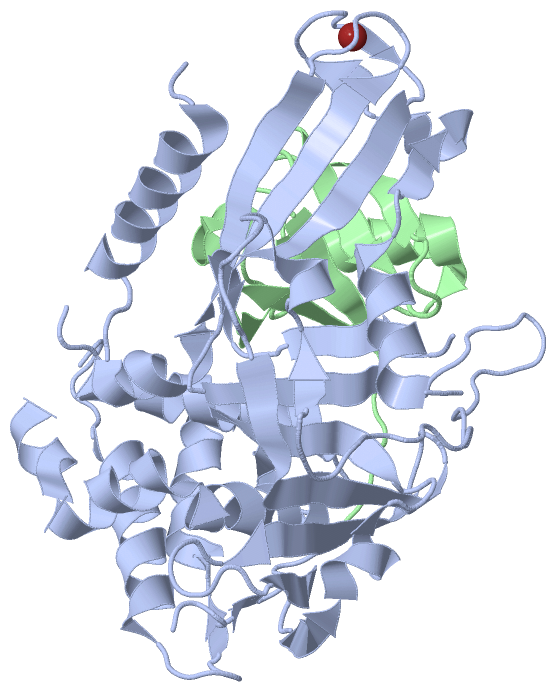
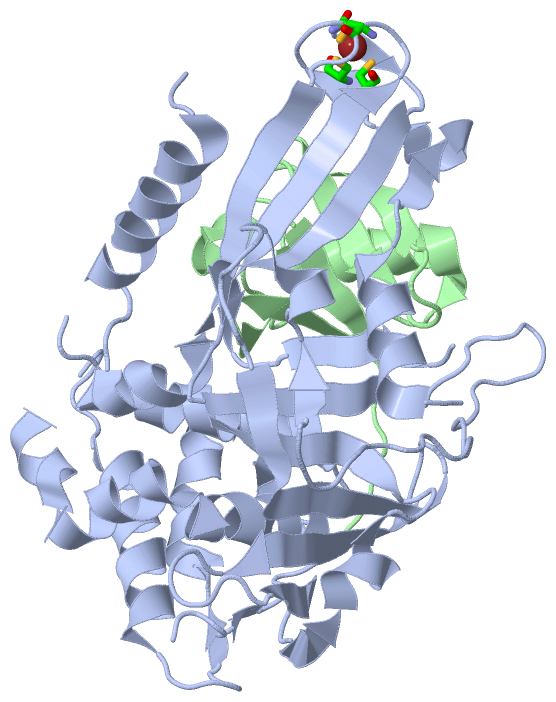
Asymmetric/Biological Unit(hide GO term definitions)
Chain A ( UBP2_HUMAN | O75604)
| molecular function |
|---|
| | GO:0030332 | | cyclin binding | | Interacting selectively and non-covalently with cyclins, proteins whose levels in a cell varies markedly during the cell cycle, rising steadily until mitosis, then falling abruptly to zero. As cyclins reach a threshold level, they are thought to drive cells into G2 phase and thus to mitosis. |
| | GO:0004197 | | cysteine-type endopeptidase activity | | Catalysis of the hydrolysis of internal, alpha-peptide bonds in a polypeptide chain by a mechanism in which the sulfhydryl group of a cysteine residue at the active center acts as a nucleophile. |
| | GO:0008234 | | cysteine-type peptidase activity | | Catalysis of the hydrolysis of peptide bonds in a polypeptide chain by a mechanism in which the sulfhydryl group of a cysteine residue at the active center acts as a nucleophile. |
| | GO:0016787 | | hydrolase activity | | Catalysis of the hydrolysis of various bonds, e.g. C-O, C-N, C-C, phosphoric anhydride bonds, etc. Hydrolase is the systematic name for any enzyme of EC class 3. |
| | GO:0042802 | | identical protein binding | | Interacting selectively and non-covalently with an identical protein or proteins. |
| | GO:0046872 | | metal ion binding | | Interacting selectively and non-covalently with any metal ion. |
| | GO:0008233 | | peptidase activity | | Catalysis of the hydrolysis of a peptide bond. A peptide bond is a covalent bond formed when the carbon atom from the carboxyl group of one amino acid shares electrons with the nitrogen atom from the amino group of a second amino acid. |
| | GO:0005515 | | protein binding | | Interacting selectively and non-covalently with any protein or protein complex (a complex of two or more proteins that may include other nonprotein molecules). |
| | GO:0004843 | | thiol-dependent ubiquitin-specific protease activity | | Catalysis of the thiol-dependent hydrolysis of a peptide bond formed by the C-terminal glycine of ubiquitin and another protein. |
| | GO:0036459 | | thiol-dependent ubiquitinyl hydrolase activity | | Catalysis of the thiol-dependent hydrolysis of an ester, thioester, amide, peptide or isopeptide bond formed by the C-terminal glycine of ubiquitin. |
| | GO:0031625 | | ubiquitin protein ligase binding | | Interacting selectively and non-covalently with a ubiquitin protein ligase enzyme, any of the E3 proteins. |
| biological process |
|---|
| | GO:0007049 | | cell cycle | | The progression of biochemical and morphological phases and events that occur in a cell during successive cell replication or nuclear replication events. Canonically, the cell cycle comprises the replication and segregation of genetic material followed by the division of the cell, but in endocycles or syncytial cells nuclear replication or nuclear division may not be followed by cell division. |
| | GO:0048512 | | circadian behavior | | The specific behavior of an organism that recurs with a regularity of approximately 24 hours. |
| | GO:0032922 | | circadian regulation of gene expression | | Any process that modulates the frequency, rate or extent of gene expression such that an expression pattern recurs with a regularity of approximately 24 hours. |
| | GO:0043153 | | entrainment of circadian clock by photoperiod | | The synchronization of a circadian rhythm to photoperiod, the intermittent cycle of light (day) and dark (night). |
| | GO:0045475 | | locomotor rhythm | | The rhythm of the locomotor activity of an organism during its 24 hour activity cycle. |
| | GO:0007517 | | muscle organ development | | The process whose specific outcome is the progression of the muscle over time, from its formation to the mature structure. The muscle is an organ consisting of a tissue made up of various elongated cells that are specialized to contract and thus to produce movement and mechanical work. |
| | GO:0048642 | | negative regulation of skeletal muscle tissue development | | Any process that stops, prevents, or reduces the frequency, rate or extent of skeletal muscle tissue development. |
| | GO:0000122 | | negative regulation of transcription from RNA polymerase II promoter | | Any process that stops, prevents, or reduces the frequency, rate or extent of transcription from an RNA polymerase II promoter. |
| | GO:0045931 | | positive regulation of mitotic cell cycle | | Any process that activates or increases the rate or extent of progression through the mitotic cell cycle. |
| | GO:0048643 | | positive regulation of skeletal muscle tissue development | | Any process that activates, maintains or increases the rate of skeletal muscle tissue development. |
| | GO:0016579 | | protein deubiquitination | | The removal of one or more ubiquitin groups from a protein. |
| | GO:0050821 | | protein stabilization | | Any process involved in maintaining the structure and integrity of a protein and preventing it from degradation or aggregation. |
| | GO:0006508 | | proteolysis | | The hydrolysis of proteins into smaller polypeptides and/or amino acids by cleavage of their peptide bonds. |
| | GO:0048511 | | rhythmic process | | Any process pertinent to the generation and maintenance of rhythms in the physiology of an organism. |
| | GO:0006511 | | ubiquitin-dependent protein catabolic process | | The chemical reactions and pathways resulting in the breakdown of a protein or peptide by hydrolysis of its peptide bonds, initiated by the covalent attachment of a ubiquitin group, or multiple ubiquitin groups, to the protein. |
| cellular component |
|---|
| | GO:0005938 | | cell cortex | | The region of a cell that lies just beneath the plasma membrane and often, but not always, contains a network of actin filaments and associated proteins. |
| | GO:0005813 | | centrosome | | A structure comprised of a core structure (in most organisms, a pair of centrioles) and peripheral material from which a microtubule-based structure, such as a spindle apparatus, is organized. Centrosomes occur close to the nucleus during interphase in many eukaryotic cells, though in animal cells it changes continually during the cell-division cycle. |
| | GO:0005737 | | cytoplasm | | All of the contents of a cell excluding the plasma membrane and nucleus, but including other subcellular structures. |
| | GO:0005654 | | nucleoplasm | | That part of the nuclear content other than the chromosomes or the nucleolus. |
| | GO:0005634 | | nucleus | | A membrane-bounded organelle of eukaryotic cells in which chromosomes are housed and replicated. In most cells, the nucleus contains all of the cell's chromosomes except the organellar chromosomes, and is the site of RNA synthesis and processing. In some species, or in specialized cell types, RNA metabolism or DNA replication may be absent. |
| | GO:0048471 | | perinuclear region of cytoplasm | | Cytoplasm situated near, or occurring around, the nucleus. |
Chain B ( UBB_BOVIN | P0CG53)
| molecular function |
|---|
| | GO:0005515 | | protein binding | | Interacting selectively and non-covalently with any protein or protein complex (a complex of two or more proteins that may include other nonprotein molecules). |
| cellular component |
|---|
| | GO:0005737 | | cytoplasm | | All of the contents of a cell excluding the plasma membrane and nucleus, but including other subcellular structures. |
| | GO:0005634 | | nucleus | | A membrane-bounded organelle of eukaryotic cells in which chromosomes are housed and replicated. In most cells, the nucleus contains all of the cell's chromosomes except the organellar chromosomes, and is the site of RNA synthesis and processing. In some species, or in specialized cell types, RNA metabolism or DNA replication may be absent. |
Chain B ( UBC_BOVIN | P0CH28)
| cellular component |
|---|
| | GO:0005737 | | cytoplasm | | All of the contents of a cell excluding the plasma membrane and nucleus, but including other subcellular structures. |
| | GO:0005634 | | nucleus | | A membrane-bounded organelle of eukaryotic cells in which chromosomes are housed and replicated. In most cells, the nucleus contains all of the cell's chromosomes except the organellar chromosomes, and is the site of RNA synthesis and processing. In some species, or in specialized cell types, RNA metabolism or DNA replication may be absent. |
Chain B ( RL40_BOVIN | P63048)
| molecular function |
|---|
| | GO:0003735 | | structural constituent of ribosome | | The action of a molecule that contributes to the structural integrity of the ribosome. |
| biological process |
|---|
| | GO:0006412 | | translation | | The cellular metabolic process in which a protein is formed, using the sequence of a mature mRNA or circRNA molecule to specify the sequence of amino acids in a polypeptide chain. Translation is mediated by the ribosome, and begins with the formation of a ternary complex between aminoacylated initiator methionine tRNA, GTP, and initiation factor 2, which subsequently associates with the small subunit of the ribosome and an mRNA or circRNA. Translation ends with the release of a polypeptide chain from the ribosome. |
| cellular component |
|---|
| | GO:0005737 | | cytoplasm | | All of the contents of a cell excluding the plasma membrane and nucleus, but including other subcellular structures. |
| | GO:0005622 | | intracellular | | The living contents of a cell; the matter contained within (but not including) the plasma membrane, usually taken to exclude large vacuoles and masses of secretory or ingested material. In eukaryotes it includes the nucleus and cytoplasm. |
| | GO:0030529 | | intracellular ribonucleoprotein complex | | An intracellular macromolecular complex containing both protein and RNA molecules. |
| | GO:0043209 | | myelin sheath | | An electrically insulating fatty layer that surrounds the axons of many neurons. It is an outgrowth of glial cells: Schwann cells supply the myelin for peripheral neurons while oligodendrocytes supply it to those of the central nervous system. |
| | GO:0005634 | | nucleus | | A membrane-bounded organelle of eukaryotic cells in which chromosomes are housed and replicated. In most cells, the nucleus contains all of the cell's chromosomes except the organellar chromosomes, and is the site of RNA synthesis and processing. In some species, or in specialized cell types, RNA metabolism or DNA replication may be absent. |
| | GO:0005840 | | ribosome | | An intracellular organelle, about 200 A in diameter, consisting of RNA and protein. It is the site of protein biosynthesis resulting from translation of messenger RNA (mRNA). It consists of two subunits, one large and one small, each containing only protein and RNA. Both the ribosome and its subunits are characterized by their sedimentation coefficients, expressed in Svedberg units (symbol: S). Hence, the prokaryotic ribosome (70S) comprises a large (50S) subunit and a small (30S) subunit, while the eukaryotic ribosome (80S) comprises a large (60S) subunit and a small (40S) subunit. Two sites on the ribosomal large subunit are involved in translation, namely the aminoacyl site (A site) and peptidyl site (P site). Ribosomes from prokaryotes, eukaryotes, mitochondria, and chloroplasts have characteristically distinct ribosomal proteins. |
Chain B ( RS27A_BOVIN | P62992)
| molecular function |
|---|
| | GO:0046872 | | metal ion binding | | Interacting selectively and non-covalently with any metal ion. |
| | GO:0003735 | | structural constituent of ribosome | | The action of a molecule that contributes to the structural integrity of the ribosome. |
| biological process |
|---|
| | GO:0006412 | | translation | | The cellular metabolic process in which a protein is formed, using the sequence of a mature mRNA or circRNA molecule to specify the sequence of amino acids in a polypeptide chain. Translation is mediated by the ribosome, and begins with the formation of a ternary complex between aminoacylated initiator methionine tRNA, GTP, and initiation factor 2, which subsequently associates with the small subunit of the ribosome and an mRNA or circRNA. Translation ends with the release of a polypeptide chain from the ribosome. |
| cellular component |
|---|
| | GO:0005737 | | cytoplasm | | All of the contents of a cell excluding the plasma membrane and nucleus, but including other subcellular structures. |
| | GO:0030529 | | intracellular ribonucleoprotein complex | | An intracellular macromolecular complex containing both protein and RNA molecules. |
| | GO:0043209 | | myelin sheath | | An electrically insulating fatty layer that surrounds the axons of many neurons. It is an outgrowth of glial cells: Schwann cells supply the myelin for peripheral neurons while oligodendrocytes supply it to those of the central nervous system. |
| | GO:0005634 | | nucleus | | A membrane-bounded organelle of eukaryotic cells in which chromosomes are housed and replicated. In most cells, the nucleus contains all of the cell's chromosomes except the organellar chromosomes, and is the site of RNA synthesis and processing. In some species, or in specialized cell types, RNA metabolism or DNA replication may be absent. |
| | GO:0005840 | | ribosome | | An intracellular organelle, about 200 A in diameter, consisting of RNA and protein. It is the site of protein biosynthesis resulting from translation of messenger RNA (mRNA). It consists of two subunits, one large and one small, each containing only protein and RNA. Both the ribosome and its subunits are characterized by their sedimentation coefficients, expressed in Svedberg units (symbol: S). Hence, the prokaryotic ribosome (70S) comprises a large (50S) subunit and a small (30S) subunit, while the eukaryotic ribosome (80S) comprises a large (60S) subunit and a small (40S) subunit. Two sites on the ribosomal large subunit are involved in translation, namely the aminoacyl site (A site) and peptidyl site (P site). Ribosomes from prokaryotes, eukaryotes, mitochondria, and chloroplasts have characteristically distinct ribosomal proteins. |
|

 Description