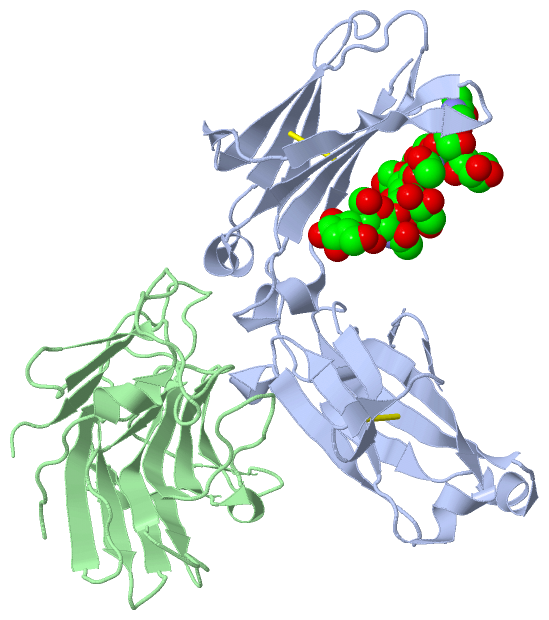
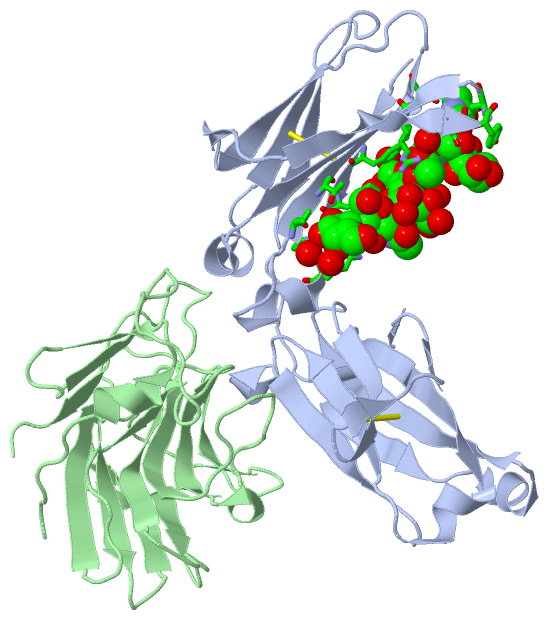
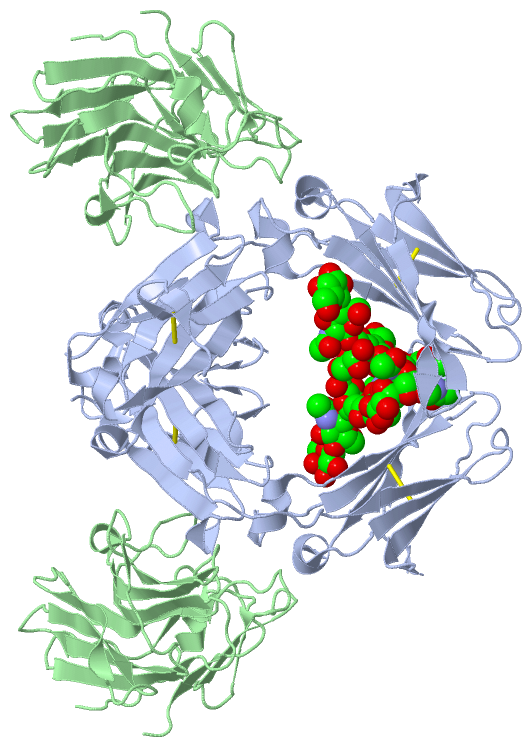
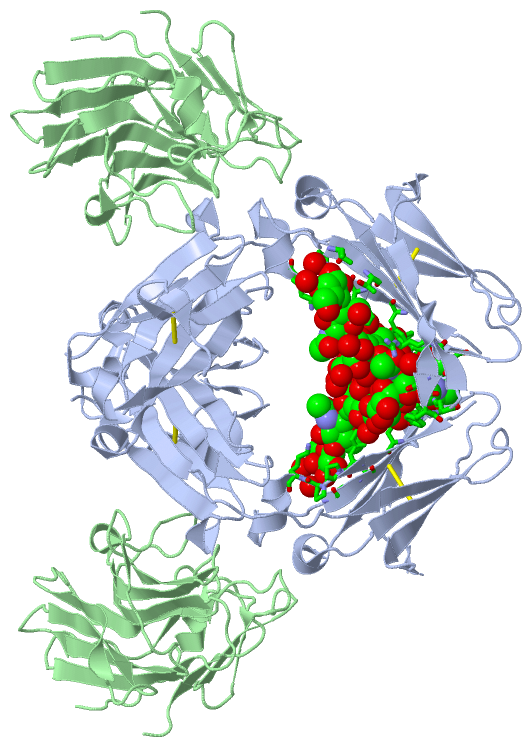
Asymmetric Unit(hide GO term definitions)
Chain A ( GCAA_MOUSE | P01863)
| molecular function |
|---|
| | GO:0003823 | | antigen binding | | Interacting selectively and non-covalently with an antigen, any substance which is capable of inducing a specific immune response and of reacting with the products of that response, the specific antibody or specifically sensitized T-lymphocytes, or both. Binding may counteract the biological activity of the antigen. |
| | GO:0034987 | | immunoglobulin receptor binding | | Interacting selectively and non-covalently with one or more specific sites on an immunoglobulin receptor molecule. |
| biological process |
|---|
| | GO:0050853 | | B cell receptor signaling pathway | | A series of molecular signals initiated by the cross-linking of an antigen receptor on a B cell. |
| | GO:0006958 | | complement activation, classical pathway | | Any process involved in the activation of any of the steps of the classical pathway of the complement cascade which allows for the direct killing of microbes, the disposal of immune complexes, and the regulation of other immune processes. |
| | GO:0042742 | | defense response to bacterium | | Reactions triggered in response to the presence of a bacterium that act to protect the cell or organism. |
| | GO:0045087 | | innate immune response | | Innate immune responses are defense responses mediated by germline encoded components that directly recognize components of potential pathogens. |
| | GO:0006911 | | phagocytosis, engulfment | | The internalization of bacteria, immune complexes and other particulate matter or of an apoptotic cell by phagocytosis, including the membrane and cytoskeletal processes required, which involves one of three mechanisms: zippering of pseudopods around a target via repeated receptor-ligand interactions, sinking of the target directly into plasma membrane of the phagocytosing cell, or induced uptake via an enhanced membrane ruffling of the phagocytosing cell similar to macropinocytosis. |
| | GO:0006910 | | phagocytosis, recognition | | The initial step in phagocytosis involving adhesion to bacteria, immune complexes and other particulate matter, or an apoptotic cell and based on recognition of factors such as bacterial cell wall components, opsonins like complement and antibody or protein receptors and lipids like phosphatidyl serine, and leading to intracellular signaling in the phagocytosing cell. |
| | GO:0050871 | | positive regulation of B cell activation | | Any process that activates or increases the frequency, rate or extent of B cell activation. |
| cellular component |
|---|
| | GO:0072562 | | blood microparticle | | A phospholipid microvesicle that is derived from any of several cell types, such as platelets, blood cells, endothelial cells, or others, and contains membrane receptors as well as other proteins characteristic of the parental cell. Microparticles are heterogeneous in size, and are characterized as microvesicles free of nucleic acids. |
| | GO:0009897 | | external side of plasma membrane | | The leaflet of the plasma membrane that faces away from the cytoplasm and any proteins embedded or anchored in it or attached to its surface. |
| | GO:0042571 | | immunoglobulin complex, circulating | | An immunoglobulin complex that is secreted into extracellular space and found in mucosal areas or other tissues or circulating in the blood or lymph. In its canonical form, a circulating immunoglobulin complex is composed of two identical heavy chains and two identical light chains, held together by disulfide bonds. Some forms of are polymers of the basic structure and contain additional components such as J-chain and the secretory component. |
Chain A ( IGHG1_MOUSE | P01868)
| molecular function |
|---|
| | GO:0003823 | | antigen binding | | Interacting selectively and non-covalently with an antigen, any substance which is capable of inducing a specific immune response and of reacting with the products of that response, the specific antibody or specifically sensitized T-lymphocytes, or both. Binding may counteract the biological activity of the antigen. |
| biological process |
|---|
| | GO:0019731 | | antibacterial humoral response | | An immune response against bacteria mediated through a body fluid. Examples of this process are the antibacterial humoral responses in Mus musculus and Drosophila melanogaster. |
| | GO:0001788 | | antibody-dependent cellular cytotoxicity | | Cytolysis of target cells by natural killer cells, eosinophils, neutrophils, monocytes, or macrophages following engagement of antibodies bound to the target cells by Fc receptors on the effector cells. |
| | GO:0006958 | | complement activation, classical pathway | | Any process involved in the activation of any of the steps of the classical pathway of the complement cascade which allows for the direct killing of microbes, the disposal of immune complexes, and the regulation of other immune processes. |
| | GO:0042742 | | defense response to bacterium | | Reactions triggered in response to the presence of a bacterium that act to protect the cell or organism. |
| | GO:0002455 | | humoral immune response mediated by circulating immunoglobulin | | An immune response dependent upon secreted immunoglobulin. An example of this process is found in Mus musculus. |
| | GO:0016064 | | immunoglobulin mediated immune response | | An immune response mediated by immunoglobulins, whether cell-bound or in solution. |
| | GO:0006911 | | phagocytosis, engulfment | | The internalization of bacteria, immune complexes and other particulate matter or of an apoptotic cell by phagocytosis, including the membrane and cytoskeletal processes required, which involves one of three mechanisms: zippering of pseudopods around a target via repeated receptor-ligand interactions, sinking of the target directly into plasma membrane of the phagocytosing cell, or induced uptake via an enhanced membrane ruffling of the phagocytosing cell similar to macropinocytosis. |
| | GO:0006910 | | phagocytosis, recognition | | The initial step in phagocytosis involving adhesion to bacteria, immune complexes and other particulate matter, or an apoptotic cell and based on recognition of factors such as bacterial cell wall components, opsonins like complement and antibody or protein receptors and lipids like phosphatidyl serine, and leading to intracellular signaling in the phagocytosing cell. |
| | GO:0050778 | | positive regulation of immune response | | Any process that activates or increases the frequency, rate or extent of the immune response, the immunological reaction of an organism to an immunogenic stimulus. |
| | GO:0050766 | | positive regulation of phagocytosis | | Any process that activates or increases the frequency, rate or extent of phagocytosis. |
| | GO:0001812 | | positive regulation of type I hypersensitivity | | Any process that activates or increases the frequency, rate or extent of type I hypersensitivity, a type of inflammatory response. |
| | GO:0001798 | | positive regulation of type IIa hypersensitivity | | Any process that activates or increases the frequency, rate or extent of type IIa hypersensitivity, a type of inflammatory response. |
| cellular component |
|---|
| | GO:0009897 | | external side of plasma membrane | | The leaflet of the plasma membrane that faces away from the cytoplasm and any proteins embedded or anchored in it or attached to its surface. |
| | GO:0005576 | | extracellular region | | The space external to the outermost structure of a cell. For cells without external protective or external encapsulating structures this refers to space outside of the plasma membrane. This term covers the host cell environment outside an intracellular parasite. |
| | GO:0005615 | | extracellular space | | That part of a multicellular organism outside the cells proper, usually taken to be outside the plasma membranes, and occupied by fluid. |
| | GO:0042571 | | immunoglobulin complex, circulating | | An immunoglobulin complex that is secreted into extracellular space and found in mucosal areas or other tissues or circulating in the blood or lymph. In its canonical form, a circulating immunoglobulin complex is composed of two identical heavy chains and two identical light chains, held together by disulfide bonds. Some forms of are polymers of the basic structure and contain additional components such as J-chain and the secretory component. |
Chain B ( RO52_MOUSE | Q62191)
| molecular function |
|---|
| | GO:0003677 | | DNA binding | | Any molecular function by which a gene product interacts selectively and non-covalently with DNA (deoxyribonucleic acid). |
| | GO:0003723 | | RNA binding | | Interacting selectively and non-covalently with an RNA molecule or a portion thereof. |
| | GO:0042802 | | identical protein binding | | Interacting selectively and non-covalently with an identical protein or proteins. |
| | GO:0016874 | | ligase activity | | Catalysis of the joining of two substances, or two groups within a single molecule, with the concomitant hydrolysis of the diphosphate bond in ATP or a similar triphosphate. |
| | GO:0046872 | | metal ion binding | | Interacting selectively and non-covalently with any metal ion. |
| | GO:0005515 | | protein binding | | Interacting selectively and non-covalently with any protein or protein complex (a complex of two or more proteins that may include other nonprotein molecules). |
| | GO:0004842 | | ubiquitin-protein transferase activity | | Catalysis of the transfer of ubiquitin from one protein to another via the reaction X-Ub + Y --> Y-Ub + X, where both X-Ub and Y-Ub are covalent linkages. |
| | GO:0008270 | | zinc ion binding | | Interacting selectively and non-covalently with zinc (Zn) ions. |
| biological process |
|---|
| | GO:0007049 | | cell cycle | | The progression of biochemical and morphological phases and events that occur in a cell during successive cell replication or nuclear replication events. Canonically, the cell cycle comprises the replication and segregation of genetic material followed by the division of the cell, but in endocycles or syncytial cells nuclear replication or nuclear division may not be followed by cell division. |
| | GO:0045087 | | innate immune response | | Innate immune responses are defense responses mediated by germline encoded components that directly recognize components of potential pathogens. |
| | GO:0032088 | | negative regulation of NF-kappaB transcription factor activity | | Any process that stops, prevents, or reduces the frequency, rate or extent of the activity of the transcription factor NF-kappaB. |
| | GO:0090086 | | negative regulation of protein deubiquitination | | Any process that decreases the frequency, rate or extent of protein deubiquitination. Protein deubiquitination is the removal of one or more ubiquitin groups from a protein. |
| | GO:1902187 | | negative regulation of viral release from host cell | | Any process that stops, prevents or reduces the frequency, rate or extent of viral release from host cell. |
| | GO:0032897 | | negative regulation of viral transcription | | Any process that stops, prevents, or reduces the frequency, rate or extent of viral transcription. |
| | GO:0051091 | | positive regulation of DNA-binding transcription factor activity | | Any process that activates or increases the frequency, rate or extent of activity of a transcription factor, any factor involved in the initiation or regulation of transcription. |
| | GO:0010508 | | positive regulation of autophagy | | Any process that activates, maintains or increases the rate of autophagy. Autophagy is the process in which cells digest parts of their own cytoplasm. |
| | GO:0045787 | | positive regulation of cell cycle | | Any process that activates or increases the rate or extent of progression through the cell cycle. |
| | GO:0051865 | | protein autoubiquitination | | The ubiquitination by a protein of one or more of its own amino acid residues, or residues on an identical protein. Ubiquitination occurs on the lysine residue by formation of an isopeptide crosslink. |
| | GO:0031648 | | protein destabilization | | Any process that decreases the stability of a protein, making it more vulnerable to degradative processes or aggregation. |
| | GO:0006513 | | protein monoubiquitination | | Addition of a single ubiquitin group to a protein. |
| | GO:0000209 | | protein polyubiquitination | | Addition of multiple ubiquitin groups to a protein, forming a ubiquitin chain. |
| | GO:0070206 | | protein trimerization | | The formation of a protein trimer, a macromolecular structure consisting of three noncovalently associated identical or nonidentical subunits. |
| | GO:0016567 | | protein ubiquitination | | The process in which one or more ubiquitin groups are added to a protein. |
| | GO:0034341 | | response to interferon-gamma | | Any process that results in a change in state or activity of a cell or an organism (in terms of movement, secretion, enzyme production, gene expression, etc.) as a result of an interferon-gamma stimulus. Interferon-gamma is also known as type II interferon. |
| cellular component |
|---|
| | GO:0000932 | | P-body | | A focus in the cytoplasm where mRNAs may become inactivated by decapping or some other mechanism. Protein and RNA localized to these foci are involved in mRNA degradation, nonsense-mediated mRNA decay (NMD), translational repression, and RNA-mediated gene silencing. |
| | GO:0019005 | | SCF ubiquitin ligase complex | | A ubiquitin ligase complex in which a cullin from the Cul1 subfamily and a RING domain protein form the catalytic core; substrate specificity is conferred by a Skp1 adaptor and an F-box protein. SCF complexes are involved in targeting proteins for degradation by the proteasome. The best characterized complexes are those from yeast and mammals (with core subunits named Cdc53/Cul1, Rbx1/Hrt1/Roc1). |
| | GO:0005776 | | autophagosome | | A double-membrane-bounded compartment that engulfs endogenous cellular material as well as invading microorganisms to target them to the lytic vacuole/lysosome for degradation as part of macroautophagy. |
| | GO:0005737 | | cytoplasm | | All of the contents of a cell excluding the plasma membrane and nucleus, but including other subcellular structures. |
| | GO:0031410 | | cytoplasmic vesicle | | A vesicle found in the cytoplasm of a cell. |
| | GO:0005622 | | intracellular | | The living contents of a cell; the matter contained within (but not including) the plasma membrane, usually taken to exclude large vacuoles and masses of secretory or ingested material. In eukaryotes it includes the nucleus and cytoplasm. |
| | GO:0005634 | | nucleus | | A membrane-bounded organelle of eukaryotic cells in which chromosomes are housed and replicated. In most cells, the nucleus contains all of the cell's chromosomes except the organellar chromosomes, and is the site of RNA synthesis and processing. In some species, or in specialized cell types, RNA metabolism or DNA replication may be absent. |
|

 Description