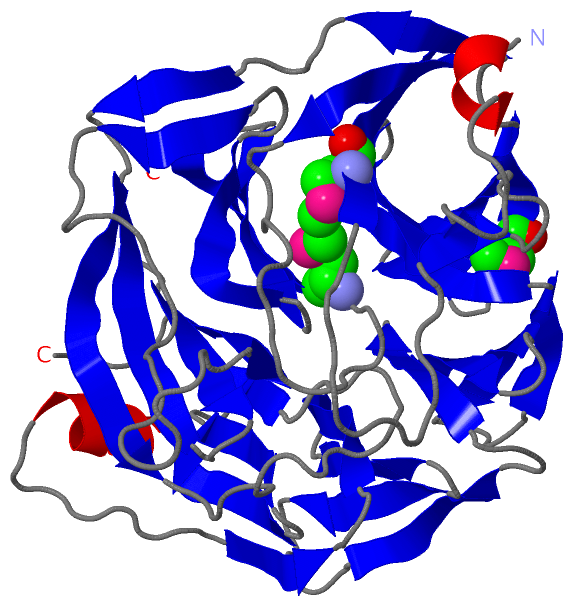
| molecular function |
|---|
| | GO:0000774 | | adenyl-nucleotide exchange factor activity | | Stimulates the hydrolysis and exchange of adenyl nucleotides by other proteins. |
| | GO:0005487 | | nucleocytoplasmic transporter activity | | Enables the directed movement of substances between the nucleus and the cytoplasm of a cell. |
| | GO:0005515 | | protein binding | | Interacting selectively and non-covalently with any protein or protein complex (a complex of two or more proteins that may include other nonprotein molecules). |
| biological process |
|---|
| | GO:0006607 | | NLS-bearing protein import into nucleus | | The directed movement of a protein bearing a nuclear localization signal (NLS) from the cytoplasm into the nucleus, across the nuclear membrane. |
| | GO:0051028 | | mRNA transport | | The directed movement of mRNA, messenger ribonucleic acid, into, out of or within a cell, or between cells, by means of some agent such as a transporter or pore. |
| | GO:0097064 | | ncRNA export from nucleus | | The directed movement of a non-coding RNA transcript (ncRNA) from the nucleus to the cytoplasm. |
| | GO:0031081 | | nuclear pore distribution | | Any process that establishes the spatial arrangement of nuclear pores within the nuclear envelope. |
| | GO:0016973 | | poly(A)+ mRNA export from nucleus | | The directed movement of poly(A)+ mRNA out of the nucleus into the cytoplasm. |
| | GO:0006611 | | protein export from nucleus | | The directed movement of a protein from the nucleus into the cytoplasm. |
| | GO:0015031 | | protein transport | | The directed movement of proteins into, out of or within a cell, or between cells, by means of some agent such as a transporter or pore. |
| | GO:0050790 | | regulation of catalytic activity | | Any process that modulates the activity of an enzyme. |
| | GO:0000055 | | ribosomal large subunit export from nucleus | | The directed movement of a ribosomal large subunit from the nucleus into the cytoplasm. |
| | GO:0000056 | | ribosomal small subunit export from nucleus | | The directed movement of a ribosomal small subunit from the nucleus into the cytoplasm. |
| | GO:0006810 | | transport | | The directed movement of substances (such as macromolecules, small molecules, ions) or cellular components (such as complexes and organelles) into, out of or within a cell, or between cells, or within a multicellular organism by means of some agent such as a transporter, pore or motor protein. |
| cellular component |
|---|
| | GO:0016020 | | membrane | | A lipid bilayer along with all the proteins and protein complexes embedded in it an attached to it. |
| | GO:0031965 | | nuclear membrane | | Either of the lipid bilayers that surround the nucleus and form the nuclear envelope; excludes the intermembrane space. |
| | GO:0005643 | | nuclear pore | | Any of the numerous similar discrete openings in the nuclear envelope of a eukaryotic cell, where the inner and outer nuclear membranes are joined. |
| | GO:0044613 | | nuclear pore central transport channel | | The central substructure of the nuclear pore complex (NPC), through which nucleocytoplasmic transport of RNAs, proteins and small molecules occurs. The central transport channel is filled with FG-nucleoporins, which form a selective barrier and provide a series of binding sites for transporter proteins. Characterized S. cerevisiae FG-nucleoporins include Nup159p, Nup145Np, Nup116p, Nup100p, Nsp1p, Nup57p, Nup49p, Nup42p, Nup53p, Nup59p/Asm4p, Nup60p and Nup1. Characterized vertebrate FG-nucleoporins include Nup214, Nup98, Nup62, Nup54, Nup58/45, NLP1, and Nup153. |
| | GO:0044614 | | nuclear pore cytoplasmic filaments | | Filamentous extensions on cytoplasmic face of the nuclear pore complex (NPC). In S. cerevisiae, Nup159p, Nup82p, and Nup42p contribute to the cytoplasmic filaments. In vertebrates, Nup358 is a major component. |
| | GO:0005634 | | nucleus | | A membrane-bounded organelle of eukaryotic cells in which chromosomes are housed and replicated. In most cells, the nucleus contains all of the cell's chromosomes except the organellar chromosomes, and is the site of RNA synthesis and processing. In some species, or in specialized cell types, RNA metabolism or DNA replication may be absent. |

 Description