Show PDB file:   
         Plain Text   HTML   (compressed file size)
QuickSearch:   
by PDB,NDB,UniProt,PROSITE Code or Search Term(s)  
(-)Asym./Biol. Unit
(-)Asym./Biol. Unit - sites
collapse expand < >
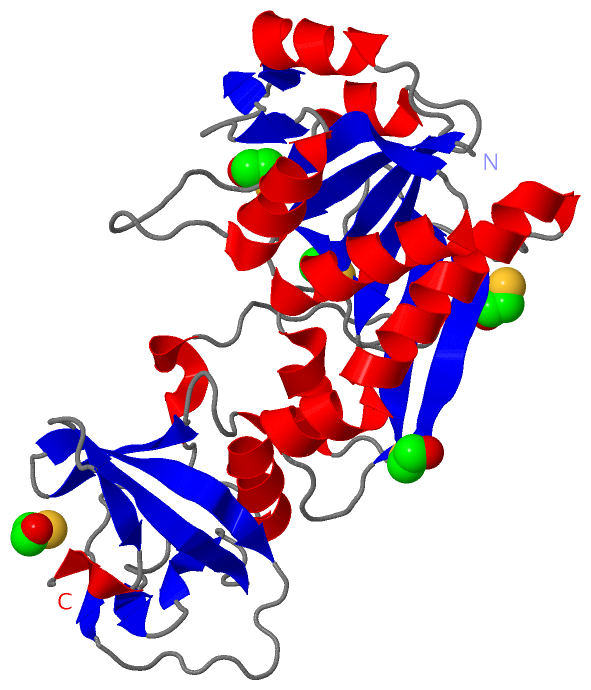
Image Asym./Biol. Unit
Asym./Biol. Unit  (Jmol Viewer)
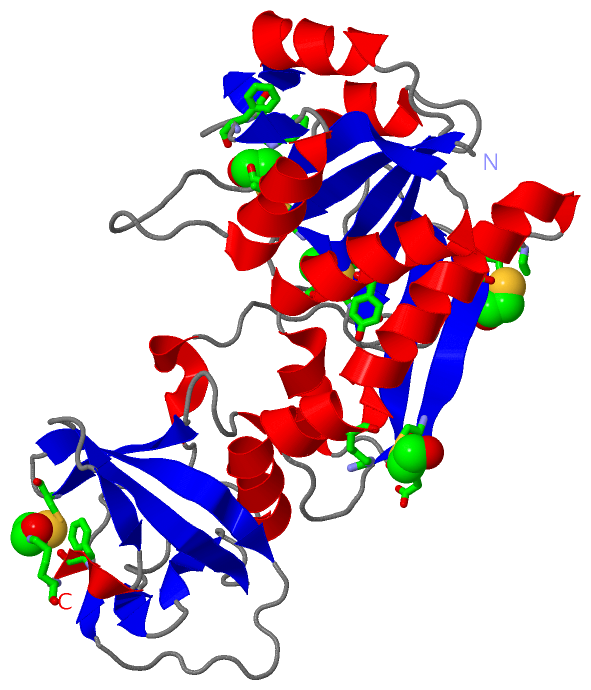
Image Asym./Biol. Unit - sites
Asym./Biol. Unit - sites  (Jmol Viewer)

(-) Description

Title :  CRYSTAL STRUCTURE OF THE N TERMINAL HYDROLASE DOMAIN OF 10-FORMYLTETRAHYDROFOLATE DEHYDROGENASE
 
Authors :  A. A. Chumanevich, S. A. Krupenko, C. Davies
Date :  13 Jan 04  (Deposition) - 27 Jan 04  (Release) - 24 Feb 09  (Revision)
Method :  X-RAY DIFFRACTION
Resolution :  2.30
Chains :  Asym./Biol. Unit :  A
Keywords :  Rossmann Fold, Hydrolase, Oxidoreductase (Keyword Search: [Gene Ontology, PubMed, Web (Google))
 
Reference :  A. A. Chumanevich, S. A. Krupenko, C. Davies
The Crystal Structure Of The Hydrolase Domain Of 10-Formyltetrahydrofolate Dehydrogenase: Mechanism Of Hydrolysis And Its Interplay With The Dehydrogenase Domain.
J. Biol. Chem. V. 279 14355 2004
PubMed-ID: 14729668  |  Reference-DOI: 10.1074/JBC.M313934200
(for further references see the PDB file header)

(-) Compounds

Molecule 1 - 10-FORMYLTETRAHYDROFOLATE DEHYDROGENASE
    ChainsA
    EC Number1.5.1.6
    EngineeredYES
    Expression SystemSPODOPTERA FRUGIPERDA
    Expression System CommonFALL ARMYWORM
    Expression System PlasmidPVL1393
    Expression System StrainHIGH FIVE
    Expression System Taxid7108
    Expression System Vector TypeBACULOVIRUS
    FragmentNT-FDH,RESIDUES 1-310
    GeneFTHFD
    MutationYES
    Organism CommonNORWAY RAT
    Organism ScientificRATTUS NORVEGICUS
    Organism Taxid10116
    Synonym10-FTHFDH, FBP-CI

 Structural Features

(-) Chains, Units

  1
Asymmetric/Biological Unit A

Summary Information (see also Sequences/Alignments below)

(-) Ligands, Modified Residues, Ions  (1, 5)

Asymmetric/Biological Unit (1, 5)
No.NameCountTypeFull Name
1BME5Ligand/IonBETA-MERCAPTOETHANOL

(-) Sites  (5, 5)

Asymmetric Unit (5, 5)
No.NameEvidenceResiduesDescription
1AC1SOFTWARETYR A:105 , HIS A:106 , GLY A:115 , ASP A:142BINDING SITE FOR RESIDUE BME A 311
2AC2SOFTWARELEU A:147 , PRO A:189 , CYS A:191BINDING SITE FOR RESIDUE BME A 312
3AC3SOFTWARECYS A:238 , PHE A:305 , LYS A:307BINDING SITE FOR RESIDUE BME A 313
4AC4SOFTWARECYS A:152 , GLU A:153 , ARG A:166BINDING SITE FOR RESIDUE BME A 314
5AC5SOFTWARETHR A:31 , PHE A:56 , TRP A:59 , CYS A:86 , GLN A:88BINDING SITE FOR RESIDUE BME A 315

(-) SS Bonds  (0, 0)

(no "SS Bond" information available for 1S3I)

(-) Cis Peptide Bonds  (3, 3)

Asymmetric/Biological Unit
No.Residues
1Gly A:7 -Gln A:8
2Leu A:110 -Pro A:111
3Val A:230 -Pro A:231

 Sequence-Structure Mapping

(-) SAPs(SNPs)/Variants  (0, 0)

(no "SAP(SNP)/Variant" information available for 1S3I)

(-) PROSITE Motifs  (1, 1)

Asymmetric/Biological Unit (1, 1)
 PROSITEUniProtKBPDB
No.IDACDescriptionIDLocationCountLocation
1GARTPS00373 Phosphoribosylglycinamide formyltransferase active site.AL1L1_RAT131-154  1A:131-154

(-) Exons   (0, 0)

(no "Exon" information available for 1S3I)

(-) Sequences/Alignments

Asymmetric/Biological Unit
   Reformat: Number of residues per line =  ('0' or empty: single-line sequence representation)
  Number of residues per labelling interval =   
  UniProt sequence: complete  aligned part    
   Show mapping: SCOP domains CATH domains Pfam domains Secondary structure (by author)
SAPs(SNPs) PROSITE motifs Exons
(details for a mapped element are shown in a popup box when the mouse pointer rests over it)
Chain A from PDB  Type:PROTEIN  Length:307
 aligned with AL1L1_RAT | P28037 from UniProtKB/Swiss-Prot  Length:902

    Alignment length:307
                                    10        20        30        40        50        60        70        80        90       100       110       120       130       140       150       160       170       180       190       200       210       220       230       240       250       260       270       280       290       300       
            AL1L1_RAT     1 MKIAVIGQSLFGQEVYCQLRKEGHEVVGVFTIPDKDGKADPLGLEAEKDGVPVFKFPRWRARGQALPEVVAKYQALGAELNVLPFCSQFIPMEVINAPRHGSIIYHPSLLPRHRGASAINWTLIHGDKKGGFTIFWADDGLDTGDLLLQKECEVLPDDTVSTLYNRFLFPEGIKGMVQAVRLIAEGTAPRCPQSEEGATYEGIQKKETAKINWDQPAEAIHNWIRGNDKVPGAWTEACGQKLTFFNSTLNTSGLSTQGEALPIPGAHRPGVVTKAGLILFGNDDRMLLVKNIQLEDGKMMPASQFFK 307
               SCOP domains d1s3ia2 A:1-203 10-formyltetrahydrofolate dehydrogenase domain 1                                                                                                                                           d1s3ia1 A:204-307 10-formyltetrahydrofolate dehydrogenase domain 2                                       SCOP domains
               CATH domains 1s3iA01 A:1-205  [code=3.40.50.170, no name defined]                                                                                                                                                         1s3iA02 A:206-307 Methionyl-tRNA Fmet Formyltransferase; Chain A, domain 2                             CATH domains
               Pfam domains Formyl_trans_N-1s3iA02 A:1-180                                                                                                                                                      -----------------------Formyl_trans_C-1s3iA01 A:204-307                                                                         Pfam domains
         Sec.struct. author .eeeeee.hhhhhhhhhhhhhh..eeeeee.........hhhhhhhhhhh..ee.....ee..eehhhhhhhhhh....eeeeee.....hhhhhh.....eeeee..........hhhhhhhhh...eeeeeeee.........eeeeeeee.....hhhhhhhhhhhhhhhhhhhhhhhhhhhh..................hhhhhh.....hhhhhhhhhhh......eeeee..eeeeeeeee..........ee..........eee..eeeee.....eeeeeeeee....eee.hhh.. Sec.struct. author
                 SAPs(SNPs) ------------------------------------------------------------------------------------------------------------------------------------------------------------------------------------------------------------------------------------------------------------------------------------------------------------------- SAPs(SNPs)
                    PROSITE ----------------------------------------------------------------------------------------------------------------------------------GART  PDB: A:131-154    --------------------------------------------------------------------------------------------------------------------------------------------------------- PROSITE
                 Transcript ------------------------------------------------------------------------------------------------------------------------------------------------------------------------------------------------------------------------------------------------------------------------------------------------------------------- Transcript
                 1s3i A   1 MKIAVIGQSLFGQEVYCQLRKEGHEVVGVFTIPDKDGKADPDGLEAEKDGVPVFKFPRWRARGQALPEVVAKYQALGAELNVLPFCSQFIPMEVINAPRHGSIIYHPSLLPRHRGASAINWTLIHGDKKGGFTIFWADDGLDTGDLLLQKECEVLPDDTVSTLYNRFLFPEGIKGMVQAVRLIAEGTAPRCPQSEEGATYEGIQKKETAKINWDQPAEAIHNWIRGNDKVPGAWTEACGQKLTFFNSTLNTSGLSTQGEALPIPGAHRPGVVTKAGLILFGNDDRMLLVKNIQLEDGKMMPASQFFK 307
                                    10        20        30        40        50        60        70        80        90       100       110       120       130       140       150       160       170       180       190       200       210       220       230       240       250       260       270       280       290       300       

   Legend:   → Mismatch (orange background)
  - → Gap (green background, '-', border residues have a numbering label)
    → Modified Residue (blue background, lower-case, 'x' indicates undefined single-letter code, labelled with number + name)
  x → Chemical Group (purple background, 'x', labelled with number + name, e.g. ACE or NH2)
  extra numbering lines below/above indicate numbering irregularities and modified residue names etc., number ends below/above '|'

 Classification and Annotation

(-) SCOP Domains  (2, 2)

Asymmetric/Biological Unit

(-) CATH Domains  (2, 2)

Asymmetric/Biological Unit
(-)
Class: Alpha Beta (26913)

(-) Pfam Domains  (2, 2)

Asymmetric/Biological Unit

(-) Gene Ontology  (19, 19)

Asymmetric/Biological Unit(hide GO term definitions)
Chain A   (AL1L1_RAT | P28037)
molecular function
    GO:0047105    4-trimethylammoniobutyraldehyde dehydrogenase activity    Catalysis of the reaction: NAD+ + 4-trimethylammoniobutanal = NADH + 4-trimethylammoniobutanoate.
    GO:0033721    aldehyde dehydrogenase (NADP+) activity    Catalysis of the reaction: an aldehyde + NADP+ + H2O = an acid + NADPH + H+.
    GO:0004030    aldehyde dehydrogenase [NAD(P)+] activity    Catalysis of the reaction: an aldehyde + NAD(P)+ + H2O = an acid + NAD(P)H + H+.
    GO:0019145    aminobutyraldehyde dehydrogenase activity    Catalysis of the reaction: 4-aminobutanal + NAD+ + H2O = 4-aminobutanoate + NADH + 2 H+.
    GO:0003824    catalytic activity    Catalysis of a biochemical reaction at physiological temperatures. In biologically catalyzed reactions, the reactants are known as substrates, and the catalysts are naturally occurring macromolecular substances known as enzymes. Enzymes possess specific binding sites for substrates, and are usually composed wholly or largely of protein, but RNA that has catalytic activity (ribozyme) is often also regarded as enzymatic.
    GO:0016155    formyltetrahydrofolate dehydrogenase activity    Catalysis of the reaction: 10-formyltetrahydrofolate + H(2)O + NADP(+) = (6S)-5,6,7,8-tetrahydrofolate + CO(2) + H(+) + NADPH.
    GO:0016742    hydroxymethyl-, formyl- and related transferase activity    Catalysis of the transfer of a hydroxymethyl- or formyl group from one compound (donor) to another (acceptor).
    GO:0016491    oxidoreductase activity    Catalysis of an oxidation-reduction (redox) reaction, a reversible chemical reaction in which the oxidation state of an atom or atoms within a molecule is altered. One substrate acts as a hydrogen or electron donor and becomes oxidized, while the other acts as hydrogen or electron acceptor and becomes reduced.
    GO:0016620    oxidoreductase activity, acting on the aldehyde or oxo group of donors, NAD or NADP as acceptor    Catalysis of an oxidation-reduction (redox) reaction in which an aldehyde or ketone (oxo) group acts as a hydrogen or electron donor and reduces NAD or NADP.
    GO:0032403    protein complex binding    Interacting selectively and non-covalently with any protein complex (a complex of two or more proteins that may include other nonprotein molecules).
biological process
    GO:0009258    10-formyltetrahydrofolate catabolic process    The chemical reactions and pathways resulting in the breakdown of 10-formyltetrahydrofolate, the formylated derivative of tetrahydrofolate.
    GO:0009058    biosynthetic process    The chemical reactions and pathways resulting in the formation of substances; typically the energy-requiring part of metabolism in which simpler substances are transformed into more complex ones.
    GO:0008152    metabolic process    The chemical reactions and pathways, including anabolism and catabolism, by which living organisms transform chemical substances. Metabolic processes typically transform small molecules, but also include macromolecular processes such as DNA repair and replication, and protein synthesis and degradation.
    GO:0006730    one-carbon metabolic process    The chemical reactions and pathways involving the transfer of one-carbon units in various oxidation states.
    GO:0055114    oxidation-reduction process    A metabolic process that results in the removal or addition of one or more electrons to or from a substance, with or without the concomitant removal or addition of a proton or protons.
    GO:0046654    tetrahydrofolate biosynthetic process    The chemical reactions and pathways resulting in the formation of tetrahydrofolate, 5,6,7,8-tetrahydrofolic acid, a folate derivative bearing additional hydrogens on the pterin group.
cellular component
    GO:0005737    cytoplasm    All of the contents of a cell excluding the plasma membrane and nucleus, but including other subcellular structures.
    GO:0005829    cytosol    The part of the cytoplasm that does not contain organelles but which does contain other particulate matter, such as protein complexes.
    GO:0043234    protein complex    A stable macromolecular complex composed (only) of two or more polypeptide subunits along with any covalently attached molecules (such as lipid anchors or oligosaccharide) or non-protein prosthetic groups (such as nucleotides or metal ions). Prosthetic group in this context refers to a tightly bound cofactor. The component polypeptide subunits may be identical.

 Visualization

(-) Interactive Views

Asymmetric/Biological Unit
  Complete Structure
    Jena3D(integrated viewing of ligand, site, SAP, PROSITE, SCOP information)
    WebMol | AstexViewer[tm]@PDBe
(Java Applets, require no local installation except for Java; loading may be slow)
    STRAP
(Java WebStart application, automatic local installation, requires Java; full application with system access!)
    RasMol
(require local installation)
    Molscript (VRML)
(requires installation of a VRML viewer; select preferred view via VRML and generate a mono or stereo PDF format file)
 
  Ligands, Modified Residues, Ions
    BME  [ RasMol | Jena3D ]  +environment [ RasMol | Jena3D ]
 
  Sites
    AC1  [ RasMol ]  +environment [ RasMol ]
    AC2  [ RasMol ]  +environment [ RasMol ]
    AC3  [ RasMol ]  +environment [ RasMol ]
    AC4  [ RasMol ]  +environment [ RasMol ]
    AC5  [ RasMol ]  +environment [ RasMol ]
 
  Cis Peptide Bonds
    Gly A:7 - Gln A:8   [ RasMol ]  
    Leu A:110 - Pro A:111   [ RasMol ]  
    Val A:230 - Pro A:231   [ RasMol ]  
 

(-) Still Images

Jmol
  protein: cartoon or spacefill or dots and stick; nucleic acid: cartoon and stick; ligands: spacefill; active site: stick
Molscript
  protein, nucleic acid: cartoon; ligands: spacefill; active site: ball and stick

 Databases and Analysis Tools

(-) Databases

Access by PDB/NDB ID
  1s3i
    Family and Domain InformationProDom | SYSTERS
    General Structural InformationGlycoscienceDB | MMDB | NDB | OCA | PDB | PDBe | PDBj | PDBsum | PDBWiki | PQS | PROTEOPEDIA
    Orientation in MembranesOPM
    Protein SurfaceSURFACE
    Secondary StructureDSSP (structure derived) | HSSP (homology derived)
    Structural GenomicsGeneCensus
    Structural NeighboursCE | VAST
    Structure ClassificationCATH | Dali | SCOP
    Validation and Original DataBMRB Data View | BMRB Restraints Grid | EDS | PROCHECK | RECOORD | WHAT_CHECK
 
Access by UniProt ID/Accession number
  AL1L1_RAT | P28037
    Comparative Protein Structure ModelsModBase
    Genomic InformationEnsembl
    Protein-protein InteractionDIP
    Sequence, Family and Domain InformationInterPro | Pfam | SMART | UniProtKB/SwissProt
 
Access by Enzyme Classificator   (EC Number)
  1.5.1.6
    General Enzyme InformationBRENDA | EC-PDB | Enzyme | IntEnz
    PathwayKEGG | MetaCyc
 
Access by Disease Identifier   (MIM ID)
  (no 'MIM ID' available)
    Disease InformationOMIM
 
Access by GenAge ID
  (no 'GenAge ID' available)
    Age Related InformationGenAge

(-) Analysis Tools

Access by PDB/NDB ID
    Domain InformationXDom
    Interatomic Contacts of Structural UnitsCSU
    Ligand-protein ContactsLPC
    Protein CavitiescastP
    Sequence and Secondary StructurePDBCartoon
    Structure AlignmentSTRAP(Java WebStart application, automatic local installation, requires Java; full application with system access!)
    Structure and Sequence BrowserSTING
 
Access by UniProt ID/Accession number
  AL1L1_RAT | P28037
    Protein Disorder PredictionDisEMBL | FoldIndex | GLOBPLOT (for more information see DisProt)

 Related Entries

(-) Entries Sharing at Least One Protein Chain (UniProt ID)

UniProtKB/Swiss-Prot
        AL1L1_RAT | P280372o2p 2o2q 2o2r 3rhj 3rhl 3rhm 3rho 3rhp 3rhq 3rhr 4gnz 4go0 4go2

(-) Related Entries Specified in the PDB File

(no "Related Entries Specified in the PDB File" available for 1S3I)