Show PDB file:   
         Plain Text   HTML   (compressed file size)
QuickSearch:   
by PDB,NDB,UniProt,PROSITE Code or Search Term(s)  
(-)Asym./Biol. Unit - manually
(-)Asym./Biol. Unit
collapse expand < >
Image Asym./Biol. Unit - manually
Asym./Biol. Unit - manually  (Jmol Viewer)
Image Asym./Biol. Unit
Asym./Biol. Unit  (Jmol Viewer)

(-) Description

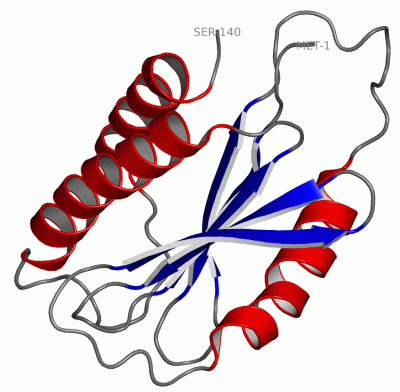
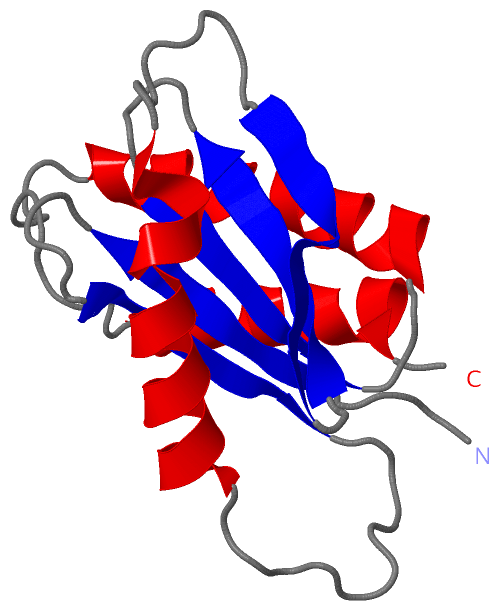
Title :  CRYSTAL STURCTURE OF SEDL AT 2.4 ANGSTROMS RESOLUTION
 
Authors :  S. B. Jang, Y. -G. Kim, Y. -S. Cho, B. -H. Oh
Date :  16 Sep 02  (Deposition) - 15 Oct 02  (Release) - 24 Feb 09  (Revision)
Method :  X-RAY DIFFRACTION
Resolution :  2.40
Chains :  Asym./Biol. Unit :  A
Keywords :  Transport, Sedl, Sedt, Endoplasmic Reticulum, Golgi, Vesicle Transport (Keyword Search: [Gene Ontology, PubMed, Web (Google))
 
Reference :  S. B. Jang, Y. -G. Kim, Y. -S. Cho, P. -G. Suh, K. -H. Kim, B. -H. Oh
Crystal Structure Of Sedl And Its Implications For A Genetic Disease Spondyloepiphyseal Dysplasia Tarda
J. Biol. Chem. V. 277 49863 2002
PubMed-ID: 12361953  |  Reference-DOI: 10.1074/JBC.M207436200

(-) Compounds

Molecule 1 - SEDLIN
    ChainsA
    EngineeredYES
    Expression SystemESCHERICHIA COLI
    Expression System PlasmidPET15B
    Expression System StrainBL21(DE3)
    Expression System Taxid469008
    Organism CommonMOUSE
    Organism ScientificMUS MUSCULUS
    Organism Taxid10090
    SynonymSEDL

 Structural Features

(-) Chains, Units

  1
Asymmetric/Biological Unit A

Summary Information (see also Sequences/Alignments below)

(-) Ligands, Modified Residues, Ions  (0, 0)

(no "Ligand,Modified Residues,Ions" information available for 1H3Q)

(-) Sites  (0, 0)

(no "Site" information available for 1H3Q)

(-) SS Bonds  (0, 0)

(no "SS Bond" information available for 1H3Q)

(-) Cis Peptide Bonds  (0, 0)

(no "Cis Peptide Bond" information available for 1H3Q)

 Sequence-Structure Mapping

(-) SAPs(SNPs)/Variants  (0, 0)

(no "SAP(SNP)/Variant" information available for 1H3Q)

(-) PROSITE Motifs  (0, 0)

(no "PROSITE Motif" information available for 1H3Q)

(-) Exons   (0, 0)

(no "Exon" information available for 1H3Q)

(-) Sequences/Alignments

Asymmetric/Biological Unit
   Reformat: Number of residues per line =  ('0' or empty: single-line sequence representation)
  Number of residues per labelling interval =   
  UniProt sequence: complete  aligned part    
   Show mapping: SCOP domains CATH domains Pfam domains Secondary structure (by author)
SAPs(SNPs) PROSITE motifs Exons
(details for a mapped element are shown in a popup box when the mouse pointer rests over it)
Chain A from PDB  Type:PROTEIN  Length:140
 aligned with TPPC2_MOUSE | Q9CQP2 from UniProtKB/Swiss-Prot  Length:140

    Alignment length:140
                                    10        20        30        40        50        60        70        80        90       100       110       120       130       140
          TPPC2_MOUSE     1 MSGSFYFVIVGHHDNPVFEMEFLPPGKAESKDDHRHLNQFIAHAALDLVDENMWLSNNMYLKTVDKFNEWFVSAFVTAGHMRFIMLHDVRQEDGIKNFFTDVYDLYIKFAMNPFYEPNSPIRSSAFDRKVQFLGKKHLLS 140
               SCOP domains d1h3qa_ A: Sedlin (SEDL)                                                                                                                     SCOP domains
               CATH domains 1h3qA00 A:1-140  [code=3.30.450.70, no name defined]                                                                                         CATH domains
               Pfam domains -------------------------------------------------------------------------------------------------------------------------------------------- Pfam domains
         Sec.struct. author ....eeeeee.....eeeeeee...........hhhhhhhhhhhhhhhhh........eeeeeeeee..eeeeeee.....eeeeee...hhhhhhhhhhhhhhhhhhhhh...........hhhhhhhhhhhhhhhh.. Sec.struct. author
                 SAPs(SNPs) -------------------------------------------------------------------------------------------------------------------------------------------- SAPs(SNPs)
                    PROSITE -------------------------------------------------------------------------------------------------------------------------------------------- PROSITE
                 Transcript -------------------------------------------------------------------------------------------------------------------------------------------- Transcript
                 1h3q A   1 MSGSFYFVIVGHHDNPVFEMEFLPPGKAESKDDHRHLNQFIAHAALDLVDENMWLSNNMYLKTVDKFNEWFVSAFVTAGHMRFIMLHDVRQEDGIKNFFTDVYDLYIKFAMNPFYEPNSPIRSSAFDRKVQFLGKKHLLS 140
                                    10        20        30        40        50        60        70        80        90       100       110       120       130       140

   Legend:   → Mismatch (orange background)
  - → Gap (green background, '-', border residues have a numbering label)
    → Modified Residue (blue background, lower-case, 'x' indicates undefined single-letter code, labelled with number + name)
  x → Chemical Group (purple background, 'x', labelled with number + name, e.g. ACE or NH2)
  extra numbering lines below/above indicate numbering irregularities and modified residue names etc., number ends below/above '|'

 Classification and Annotation

(-) SCOP Domains  (1, 1)

Asymmetric/Biological Unit

(-) CATH Domains  (1, 1)

Asymmetric/Biological Unit
(-)
Class: Alpha Beta (26913)

(-) Pfam Domains  (0, 0)

(no "Pfam Domain" information available for 1H3Q)

(-) Gene Ontology  (16, 16)

Asymmetric/Biological Unit(hide GO term definitions)
Chain A   (TPPC2_MOUSE | Q9CQP2)
molecular function
    GO:0044325    ion channel binding    Interacting selectively and non-covalently with one or more specific sites on an ion channel, a protein complex that spans a membrane and forms a water-filled channel across the phospholipid bilayer allowing selective ion transport down its electrochemical gradient.
    GO:0005515    protein binding    Interacting selectively and non-covalently with any protein or protein complex (a complex of two or more proteins that may include other nonprotein molecules).
    GO:0008134    transcription factor binding    Interacting selectively and non-covalently with a transcription factor, any protein required to initiate or regulate transcription.
biological process
    GO:0006888    ER to Golgi vesicle-mediated transport    The directed movement of substances from the endoplasmic reticulum (ER) to the Golgi, mediated by COP II vesicles. Small COP II coated vesicles form from the ER and then fuse directly with the cis-Golgi. Larger structures are transported along microtubules to the cis-Golgi.
    GO:0006355    regulation of transcription, DNA-templated    Any process that modulates the frequency, rate or extent of cellular DNA-templated transcription.
    GO:0001501    skeletal system development    The process whose specific outcome is the progression of the skeleton over time, from its formation to the mature structure. The skeleton is the bony framework of the body in vertebrates (endoskeleton) or the hard outer envelope of insects (exoskeleton or dermoskeleton).
    GO:0006351    transcription, DNA-templated    The cellular synthesis of RNA on a template of DNA.
    GO:0006810    transport    The directed movement of substances (such as macromolecules, small molecules, ions) or cellular components (such as complexes and organelles) into, out of or within a cell, or between cells, or within a multicellular organism by means of some agent such as a transporter, pore or motor protein.
    GO:0016192    vesicle-mediated transport    A cellular transport process in which transported substances are moved in membrane-bounded vesicles; transported substances are enclosed in the vesicle lumen or located in the vesicle membrane. The process begins with a step that directs a substance to the forming vesicle, and includes vesicle budding and coating. Vesicles are then targeted to, and fuse with, an acceptor membrane.
cellular component
    GO:0005794    Golgi apparatus    A compound membranous cytoplasmic organelle of eukaryotic cells, consisting of flattened, ribosome-free vesicles arranged in a more or less regular stack. The Golgi apparatus differs from the endoplasmic reticulum in often having slightly thicker membranes, appearing in sections as a characteristic shallow semicircle so that the convex side (cis or entry face) abuts the endoplasmic reticulum, secretory vesicles emerging from the concave side (trans or exit face). In vertebrate cells there is usually one such organelle, while in invertebrates and plants, where they are known usually as dictyosomes, there may be several scattered in the cytoplasm. The Golgi apparatus processes proteins produced on the ribosomes of the rough endoplasmic reticulum; such processing includes modification of the core oligosaccharides of glycoproteins, and the sorting and packaging of proteins for transport to a variety of cellular locations. Three different regions of the Golgi are now recognized both in terms of structure and function: cis, in the vicinity of the cis face, trans, in the vicinity of the trans face, and medial, lying between the cis and trans regions.
    GO:0030008    TRAPP complex    A large complex that acts as a tethering factor involved in transporting vesicles from the ER through the Golgi to the plasma membrane. A TRAPP (transport protein particle) complex has a core set of proteins which are joined by specific subunits depending on the cellular component where a given TRAPP complex is active.
    GO:0005737    cytoplasm    All of the contents of a cell excluding the plasma membrane and nucleus, but including other subcellular structures.
    GO:0005783    endoplasmic reticulum    The irregular network of unit membranes, visible only by electron microscopy, that occurs in the cytoplasm of many eukaryotic cells. The membranes form a complex meshwork of tubular channels, which are often expanded into slitlike cavities called cisternae. The ER takes two forms, rough (or granular), with ribosomes adhering to the outer surface, and smooth (with no ribosomes attached).
    GO:0005622    intracellular    The living contents of a cell; the matter contained within (but not including) the plasma membrane, usually taken to exclude large vacuoles and masses of secretory or ingested material. In eukaryotes it includes the nucleus and cytoplasm.
    GO:0005634    nucleus    A membrane-bounded organelle of eukaryotic cells in which chromosomes are housed and replicated. In most cells, the nucleus contains all of the cell's chromosomes except the organellar chromosomes, and is the site of RNA synthesis and processing. In some species, or in specialized cell types, RNA metabolism or DNA replication may be absent.
    GO:0048471    perinuclear region of cytoplasm    Cytoplasm situated near, or occurring around, the nucleus.

 Visualization

(-) Interactive Views

Asymmetric/Biological Unit
  Complete Structure
    Jena3D(integrated viewing of ligand, site, SAP, PROSITE, SCOP information)
    WebMol | AstexViewer[tm]@PDBe
(Java Applets, require no local installation except for Java; loading may be slow)
    STRAP
(Java WebStart application, automatic local installation, requires Java; full application with system access!)
    RasMol
(require local installation)
    Molscript (VRML)
(requires installation of a VRML viewer; select preferred view via VRML and generate a mono or stereo PDF format file)
 
  Ligands, Modified Residues, Ions
(no "Ligands, Modified Residues, Ions" information available for 1h3q)
 
  Sites
(no "Sites" information available for 1h3q)
 
  Cis Peptide Bonds
(no "Cis Peptide Bonds" information available for 1h3q)
 

(-) Still Images

Jmol
  protein: cartoon or spacefill or dots and stick; nucleic acid: cartoon and stick; ligands: spacefill; active site: stick
Molscript
  protein, nucleic acid: cartoon; ligands: spacefill; active site: ball and stick

 Databases and Analysis Tools

(-) Databases

Access by PDB/NDB ID
  1h3q
    Family and Domain InformationProDom | SYSTERS
    General Structural InformationGlycoscienceDB | MMDB | NDB | OCA | PDB | PDBe | PDBj | PDBsum | PDBWiki | PQS | PROTEOPEDIA
    Orientation in MembranesOPM
    Protein SurfaceSURFACE
    Secondary StructureDSSP (structure derived) | HSSP (homology derived)
    Structural GenomicsGeneCensus
    Structural NeighboursCE | VAST
    Structure ClassificationCATH | Dali | SCOP
    Validation and Original DataBMRB Data View | BMRB Restraints Grid | EDS | PROCHECK | RECOORD | WHAT_CHECK
 
Access by UniProt ID/Accession number
  TPPC2_MOUSE | Q9CQP2
    Comparative Protein Structure ModelsModBase
    Genomic InformationEnsembl
    Protein-protein InteractionDIP
    Sequence, Family and Domain InformationInterPro | Pfam | SMART | UniProtKB/SwissProt
 
Access by Enzyme Classificator   (EC Number)
  (no 'Enzyme Classificator' available)
    General Enzyme InformationBRENDA | EC-PDB | Enzyme | IntEnz
    PathwayKEGG | MetaCyc
 
Access by Disease Identifier   (MIM ID)
  (no 'MIM ID' available)
    Disease InformationOMIM
 
Access by GenAge ID
  (no 'GenAge ID' available)
    Age Related InformationGenAge

(-) Analysis Tools

Access by PDB/NDB ID
    Domain InformationXDom
    Interatomic Contacts of Structural UnitsCSU
    Ligand-protein ContactsLPC
    Protein CavitiescastP
    Sequence and Secondary StructurePDBCartoon
    Structure AlignmentSTRAP(Java WebStart application, automatic local installation, requires Java; full application with system access!)
    Structure and Sequence BrowserSTING
 
Access by UniProt ID/Accession number
  TPPC2_MOUSE | Q9CQP2
    Protein Disorder PredictionDisEMBL | FoldIndex | GLOBPLOT (for more information see DisProt)

 Related Entries

(-) Entries Sharing at Least One Protein Chain (UniProt ID)

UniProtKB/Swiss-Prot
        TPPC2_MOUSE | Q9CQP22j3w

(-) Related Entries Specified in the PDB File

(no "Related Entries Specified in the PDB File" available for 1H3Q)