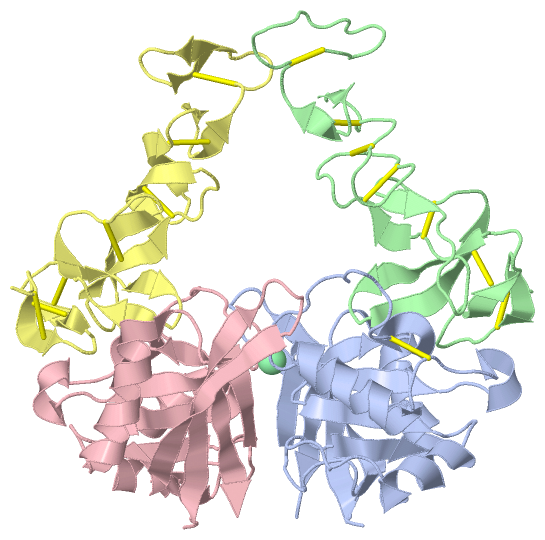
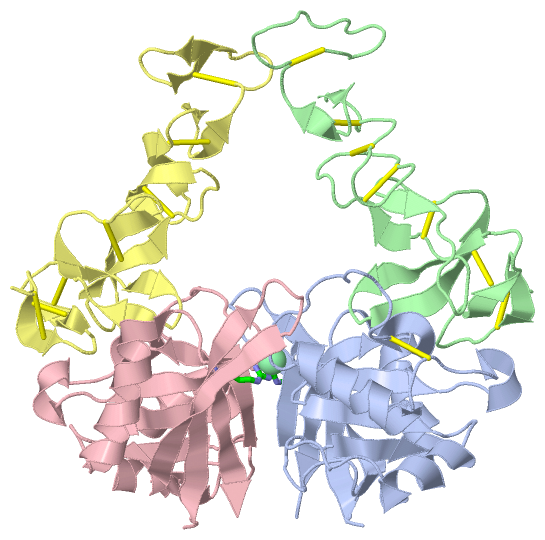
Asymmetric/Biological Unit(hide GO term definitions)
Chain A,C ( ZNRF3_MOUSE | Q5SSZ7)
| molecular function |
|---|
| | GO:0005109 | | frizzled binding | | Interacting selectively and non-covalently with the frizzled (fz) receptor. |
| | GO:0016874 | | ligase activity | | Catalysis of the joining of two substances, or two groups within a single molecule, with the concomitant hydrolysis of the diphosphate bond in ATP or a similar triphosphate. |
| | GO:0046872 | | metal ion binding | | Interacting selectively and non-covalently with any metal ion. |
| | GO:0004842 | | ubiquitin-protein transferase activity | | Catalysis of the transfer of ubiquitin from one protein to another via the reaction X-Ub + Y --> Y-Ub + X, where both X-Ub and Y-Ub are covalent linkages. |
| | GO:0008270 | | zinc ion binding | | Interacting selectively and non-covalently with zinc (Zn) ions. |
| biological process |
|---|
| | GO:0038018 | | Wnt receptor catabolic process | | The chemical reactions and pathways resulting in the breakdown of a Wnt receptor. Internalized Wnt receptors can be recycled to the plasma membrane or sorted to lysosomes for protein degradation. |
| | GO:0016055 | | Wnt signaling pathway | | The series of molecular signals initiated by binding of a Wnt protein to a frizzled family receptor on the surface of the target cell and ending with a change in cell state. |
| | GO:0060071 | | Wnt signaling pathway, planar cell polarity pathway | | The series of molecular signals initiated by binding of a Wnt protein to a receptor on the surface of the target cell where activated receptors signal via downstream effectors including C-Jun N-terminal kinase (JNK) to modulate cytoskeletal elements and control cell polarity. |
| | GO:0060070 | | canonical Wnt signaling pathway | | The series of molecular signals initiated by binding of a Wnt protein to a frizzled family receptor on the surface of the target cell, followed by propagation of the signal via beta-catenin, and ending with a change in transcription of target genes. In this pathway, the activated receptor signals via downstream effectors that result in the inhibition of beta-catenin phosphorylation, thereby preventing degradation of beta-catenin. Stabilized beta-catenin can then accumulate and travel to the nucleus to trigger changes in transcription of target genes. |
| | GO:0030178 | | negative regulation of Wnt signaling pathway | | Any process that stops, prevents, or reduces the frequency, rate or extent of the Wnt signaling pathway. |
| | GO:0090090 | | negative regulation of canonical Wnt signaling pathway | | Any process that decreases the rate, frequency, or extent of the Wnt signaling pathway through beta-catenin, the series of molecular signals initiated by binding of a Wnt protein to a frizzled family receptor on the surface of the target cell, followed by propagation of the signal via beta-catenin, and ending with a change in transcription of target genes. |
| | GO:2000051 | | negative regulation of non-canonical Wnt signaling pathway | | Any process that stops, prevents, or reduces the frequency, rate or extent of non-canonical Wnt signaling pathway. |
| | GO:0016567 | | protein ubiquitination | | The process in which one or more ubiquitin groups are added to a protein. |
| | GO:0072089 | | stem cell proliferation | | The multiplication or reproduction of stem cells, resulting in the expansion of a stem cell population. A stem cell is a cell that retains the ability to divide and proliferate throughout life to provide progenitor cells that can differentiate into specialized cells. |
| | GO:0006511 | | ubiquitin-dependent protein catabolic process | | The chemical reactions and pathways resulting in the breakdown of a protein or peptide by hydrolysis of its peptide bonds, initiated by the covalent attachment of a ubiquitin group, or multiple ubiquitin groups, to the protein. |
| cellular component |
|---|
| | GO:0016021 | | integral component of membrane | | The component of a membrane consisting of the gene products and protein complexes having at least some part of their peptide sequence embedded in the hydrophobic region of the membrane. |
| | GO:0005887 | | integral component of plasma membrane | | The component of the plasma membrane consisting of the gene products and protein complexes having at least some part of their peptide sequence embedded in the hydrophobic region of the membrane. |
| | GO:0016020 | | membrane | | A lipid bilayer along with all the proteins and protein complexes embedded in it an attached to it. |
| | GO:0005886 | | plasma membrane | | The membrane surrounding a cell that separates the cell from its external environment. It consists of a phospholipid bilayer and associated proteins. |
Chain B,D ( RSPO2_MOUSE | Q8BFU0)
| molecular function |
|---|
| | GO:0008201 | | heparin binding | | Interacting selectively and non-covalently with heparin, any member of a group of glycosaminoglycans found mainly as an intracellular component of mast cells and which consist predominantly of alternating alpha-(1->4)-linked D-galactose and N-acetyl-D-glucosamine-6-sulfate residues. |
| | GO:0005102 | | receptor binding | | Interacting selectively and non-covalently with one or more specific sites on a receptor molecule, a macromolecule that undergoes combination with a hormone, neurotransmitter, drug or intracellular messenger to initiate a change in cell function. |
| biological process |
|---|
| | GO:0016055 | | Wnt signaling pathway | | The series of molecular signals initiated by binding of a Wnt protein to a frizzled family receptor on the surface of the target cell and ending with a change in cell state. |
| | GO:0030282 | | bone mineralization | | The deposition of hydroxyapatite, a form of calcium phosphate with the formula Ca10(PO4)6(OH)2, in bone tissue. |
| | GO:0071542 | | dopaminergic neuron differentiation | | The process in which a neuroblast acquires the specialized structural and functional features of a dopaminergic neuron, a neuron that secretes dopamine. |
| | GO:0035115 | | embryonic forelimb morphogenesis | | The process, occurring in the embryo, by which the anatomical structures of the forelimb are generated and organized. The forelimbs are the front limbs of an animal, e.g. the arms of a human. |
| | GO:0035116 | | embryonic hindlimb morphogenesis | | The process, occurring in the embryo, by which the anatomical structures of the hindlimbs are generated and organized. The hindlimbs are the posterior limbs of an animal. |
| | GO:0060441 | | epithelial tube branching involved in lung morphogenesis | | The process in which a highly ordered sequence of patterning events generates the branched epithelial tubes of the lung, consisting of reiterated combinations of bud outgrowth, elongation, and dichotomous subdivision of terminal units. |
| | GO:0060437 | | lung growth | | The increase in size or mass of a lung. In all air-breathing vertebrates the lungs are developed from the ventral wall of the oesophagus as a pouch which divides into two sacs. In amphibians and many reptiles the lungs retain very nearly this primitive sac-like character, but in the higher forms the connection with the esophagus becomes elongated into the windpipe and the inner walls of the sacs become more and more divided, until, in the mammals, the air spaces become minutely divided into tubes ending in small air cells, in the walls of which the blood circulates in a fine network of capillaries. In mammals the lungs are more or less divided into lobes, and each lung occupies a separate cavity in the thorax. |
| | GO:0042489 | | negative regulation of odontogenesis of dentin-containing tooth | | Any process that stops, prevents, or reduces the frequency, rate or extent of the formation and development of teeth, the hard, bony appendages which are borne on the jaws, or on other bones in the walls of the mouth or pharynx. |
| | GO:0001649 | | osteoblast differentiation | | The process whereby a relatively unspecialized cell acquires the specialized features of an osteoblast, a mesodermal or neural crest cell that gives rise to bone. |
| | GO:0090263 | | positive regulation of canonical Wnt signaling pathway | | Any process that increases the rate, frequency, or extent of the Wnt signaling pathway through beta-catenin, the series of molecular signals initiated by binding of a Wnt protein to a frizzled family receptor on the surface of the target cell, followed by propagation of the signal via beta-catenin, and ending with a change in transcription of target genes. |
| | GO:0050896 | | response to stimulus | | Any process that results in a change in state or activity of a cell or an organism (in terms of movement, secretion, enzyme production, gene expression, etc.) as a result of a stimulus. The process begins with detection of the stimulus and ends with a change in state or activity or the cell or organism. |
| | GO:0060535 | | trachea cartilage morphogenesis | | The process in which the anatomical structures of cartilage in the trachea are generated and organized. |
| cellular component |
|---|
| | GO:0009986 | | cell surface | | The external part of the cell wall and/or plasma membrane. |
| | GO:0005576 | | extracellular region | | The space external to the outermost structure of a cell. For cells without external protective or external encapsulating structures this refers to space outside of the plasma membrane. This term covers the host cell environment outside an intracellular parasite. |
|

 Description