Asymmetric Unit(hide GO term definitions)
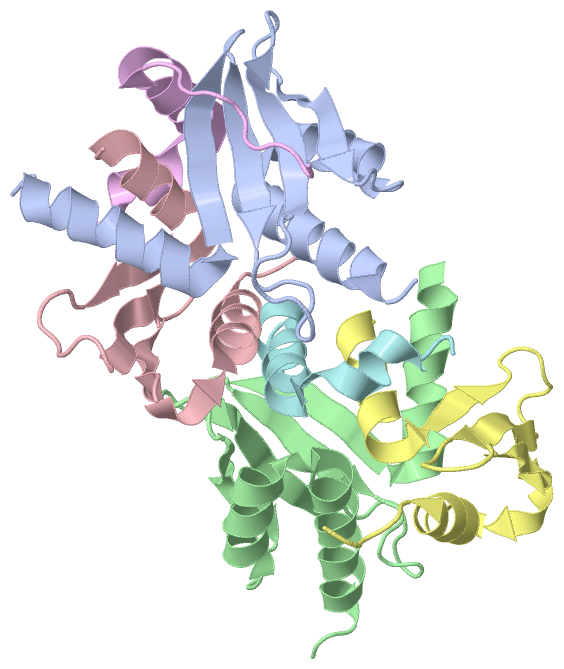
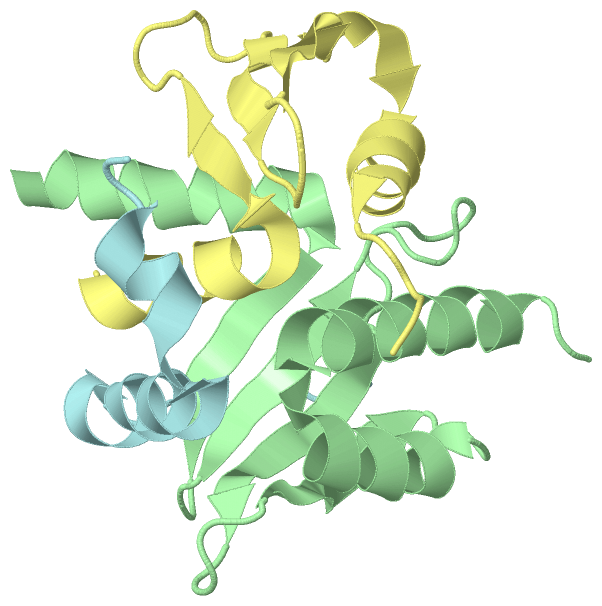
Chain A,B ( E1C4Y2_CHICK | E1C4Y2)
| biological process |
|---|
| | GO:0007059 | | chromosome segregation | | The process in which genetic material, in the form of chromosomes, is organized into specific structures and then physically separated and apportioned to two or more sets. In eukaryotes, chromosome segregation begins with the condensation of chromosomes, includes chromosome separation, and ends when chromosomes have completed movement to the spindle poles. |
| | GO:0007052 | | mitotic spindle organization | | A process that is carried out at the cellular level which results in the assembly, arrangement of constituent parts, or disassembly of the microtubule spindle during a mitotic cell cycle. |
| cellular component |
|---|
| | GO:0031262 | | Ndc80 complex | | A protein complex conserved among eukaryotes that forms part of the kinetochore and plays an essential role in forming stable kinetochore-microtubule attachments. The complex contains proteins known in several species, including budding and fission yeasts, as Ndc80p, Nuf2p, Spc24p, and Spc25p. In vertebrates it is part of the outer plate of the kinetochore. |
| | GO:0000777 | | condensed chromosome kinetochore | | A multisubunit complex that is located at the centromeric region of a condensed chromosome and provides an attachment point for the spindle microtubules. |
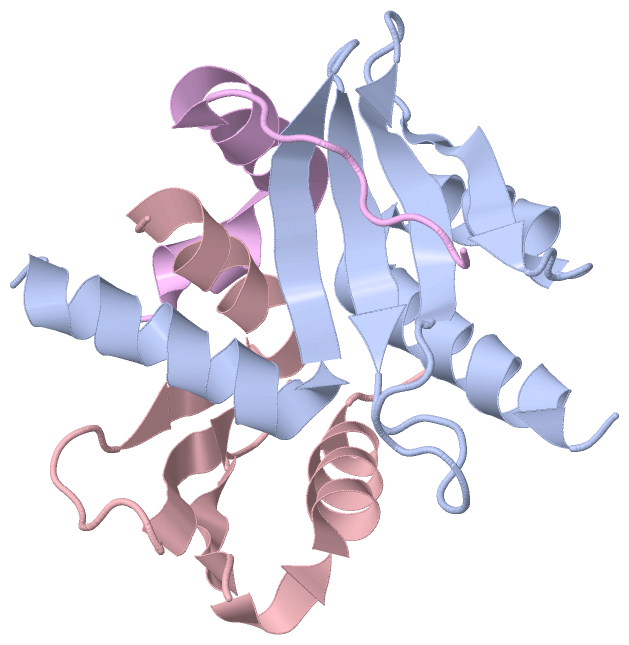
Chain E,F ( CENPT_CHICK | F1NPG5)
| molecular function |
|---|
| | GO:0003677 | | DNA binding | | Any molecular function by which a gene product interacts selectively and non-covalently with DNA (deoxyribonucleic acid). |
| | GO:0005515 | | protein binding | | Interacting selectively and non-covalently with any protein or protein complex (a complex of two or more proteins that may include other nonprotein molecules). |
| | GO:0046982 | | protein heterodimerization activity | | Interacting selectively and non-covalently with a nonidentical protein to form a heterodimer. |
| biological process |
|---|
| | GO:0007049 | | cell cycle | | The progression of biochemical and morphological phases and events that occur in a cell during successive cell replication or nuclear replication events. Canonically, the cell cycle comprises the replication and segregation of genetic material followed by the division of the cell, but in endocycles or syncytial cells nuclear replication or nuclear division may not be followed by cell division. |
| | GO:0051301 | | cell division | | The process resulting in division and partitioning of components of a cell to form more cells; may or may not be accompanied by the physical separation of a cell into distinct, individually membrane-bounded daughter cells. |
| | GO:0051276 | | chromosome organization | | A process that is carried out at the cellular level that results in the assembly, arrangement of constituent parts, or disassembly of chromosomes, structures composed of a very long molecule of DNA and associated proteins that carries hereditary information. This term covers covalent modifications at the molecular level as well as spatial relationships among the major components of a chromosome. |
| | GO:0007059 | | chromosome segregation | | The process in which genetic material, in the form of chromosomes, is organized into specific structures and then physically separated and apportioned to two or more sets. In eukaryotes, chromosome segregation begins with the condensation of chromosomes, includes chromosome separation, and ends when chromosomes have completed movement to the spindle poles. |
| | GO:0051382 | | kinetochore assembly | | The aggregation, arrangement and bonding together of a set of components to form the kinetochore, a multisubunit complex that is located at the centromeric region of DNA and provides an attachment point for the spindle microtubules. |
| | GO:0000278 | | mitotic cell cycle | | Progression through the phases of the mitotic cell cycle, the most common eukaryotic cell cycle, which canonically comprises four successive phases called G1, S, G2, and M and includes replication of the genome and the subsequent segregation of chromosomes into daughter cells. In some variant cell cycles nuclear replication or nuclear division may not be followed by cell division, or G1 and G2 phases may be absent. |
| cellular component |
|---|
| | GO:0005694 | | chromosome | | A structure composed of a very long molecule of DNA and associated proteins (e.g. histones) that carries hereditary information. |
| | GO:0000775 | | chromosome, centromeric region | | The region of a chromosome that includes the centromeric DNA and associated proteins. In monocentric chromosomes, this region corresponds to a single area of the chromosome, whereas in holocentric chromosomes, it is evenly distributed along the chromosome. |
| | GO:0000777 | | condensed chromosome kinetochore | | A multisubunit complex that is located at the centromeric region of a condensed chromosome and provides an attachment point for the spindle microtubules. |
| | GO:0000776 | | kinetochore | | A multisubunit complex that is located at the centromeric region of DNA and provides an attachment point for the spindle microtubules. |
| | GO:0005634 | | nucleus | | A membrane-bounded organelle of eukaryotic cells in which chromosomes are housed and replicated. In most cells, the nucleus contains all of the cell's chromosomes except the organellar chromosomes, and is the site of RNA synthesis and processing. In some species, or in specialized cell types, RNA metabolism or DNA replication may be absent. |
|

 Description