Show PDB file:   
         Plain Text   HTML   (compressed file size)
QuickSearch:   
by PDB,NDB,UniProt,PROSITE Code or Search Term(s)  
(-)Asym./Biol. Unit
(-)Asym./Biol. Unit - sites
collapse expand < >
Image Asym./Biol. Unit
Asym./Biol. Unit  (Jmol Viewer)
Image Asym./Biol. Unit - sites
Asym./Biol. Unit - sites  (Jmol Viewer)

(-) Description

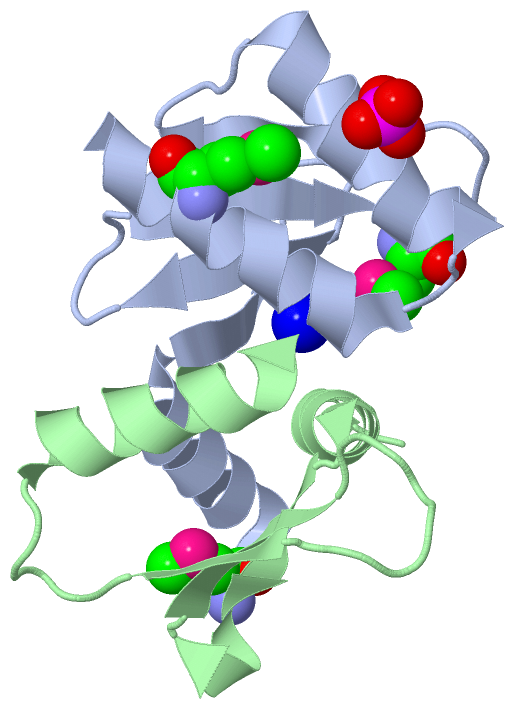
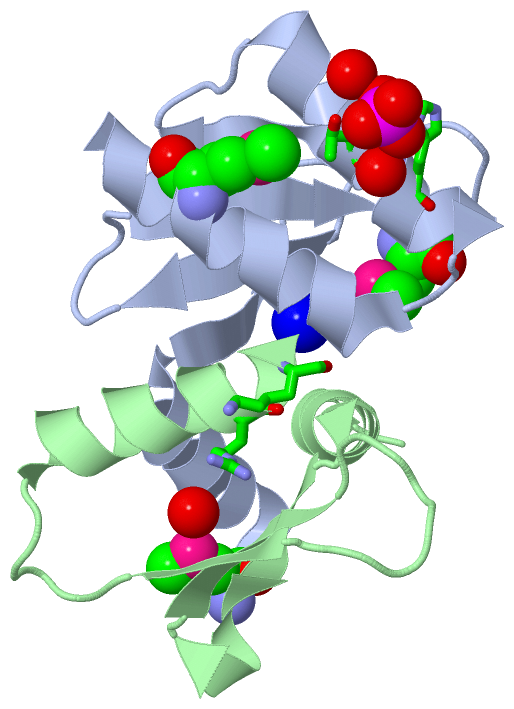
Title :  CRYSTAL STRUCTURE OF THE YEAST KINETOCHORE SPC24/SPC25 GLOBULAR DOMAIN
 
Authors :  R. R. Wei, S. C. Harrison
Date :  25 Jan 06  (Deposition) - 13 Jun 06  (Release) - 24 Feb 09  (Revision)
Method :  X-RAY DIFFRACTION
Resolution :  1.90
Chains :  Asym./Biol. Unit :  A,B
Keywords :  Alpha-Beta, Complex, Coiled-Coil, Structural Protein, Protein Binding (Keyword Search: [Gene Ontology, PubMed, Web (Google))
 
Reference :  R. R. Wei, S. C. Harrison, J. R. Schnell, J. J. Chou
Atomic Structure Of The Kinetochore Spc24P/Spc25P Globular Domain Reveals A Novel Fold
To Be Published
PubMed: search
(for further references see the PDB file header)

(-) Compounds

Molecule 1 - HYPOTHETICAL 25.2 KDA PROTEIN IN AFG3-SEB2 INTERGENIC REGION
    ChainsA
    EngineeredYES
    Expression SystemESCHERICHIA COLI
    Expression System Cell LineROSETTA
    Expression System PlasmidPET3ATR
    Expression System Taxid562
    Expression System Vector TypePLASMID
    FragmentSPC25P GLOBULAR DOMAIN
    GeneYER018C
    Organism CommonBAKER'S YEAST
    Organism ScientificSACCHAROMYCES CEREVISIAE
    Organism Taxid4932
 
Molecule 2 - HYPOTHETICAL 24.6 KDA PROTEIN IN ILV2-ADE17 INTERGENIC REGION
    ChainsB
    EngineeredYES
    Expression SystemESCHERICHIA COLI
    Expression System Cell LineROSETTA
    Expression System PlasmidPET3ATR
    Expression System Taxid562
    Expression System Vector TypePLASMID
    FragmentSPC24P GLOBULAR DOMAIN
    GeneYMR117C, YM9718.16C
    Organism CommonBAKER'S YEAST
    Organism ScientificSACCHAROMYCES CEREVISIAE
    Organism Taxid4932

 Structural Features

(-) Chains, Units

  12
Asymmetric/Biological Unit AB

Summary Information (see also Sequences/Alignments below)

(-) Ligands, Modified Residues, Ions  (3, 5)

Asymmetric/Biological Unit (3, 5)
No.NameCountTypeFull Name
1MSE3Mod. Amino AcidSELENOMETHIONINE
2NA1Ligand/IonSODIUM ION
3PO41Ligand/IonPHOSPHATE ION

(-) Sites  (1, 1)

Asymmetric Unit (1, 1)
No.NameEvidenceResiduesDescription
1AC1SOFTWAREHOH A:25 , HOH A:50 , THR A:195 , HIS A:198 , HOH B:40 , ARG B:210 , LYS B:213BINDING SITE FOR RESIDUE PO4 A 222

(-) SS Bonds  (0, 0)

(no "SS Bond" information available for 2FTX)

(-) Cis Peptide Bonds  (0, 0)

(no "Cis Peptide Bond" information available for 2FTX)

 Sequence-Structure Mapping

(-) SAPs(SNPs)/Variants  (0, 0)

(no "SAP(SNP)/Variant" information available for 2FTX)

(-) PROSITE Motifs  (0, 0)

(no "PROSITE Motif" information available for 2FTX)

(-) Exons   (2, 2)

Asymmetric/Biological Unit (2, 2)
 ENSEMBLUniProtKBPDB
No.Transcript IDExonExon IDGenome LocationLengthIDLocationLengthCountLocationLength
1.1YER018C1YER018C.1V:192623-191958666SPC25_YEAST1-2212211A:132-22190

2.1YMR117C1YMR117C.1XIII:501890-501249642SPC24_YEAST1-2132131B:155-21359

(-) Sequences/Alignments

Asymmetric/Biological Unit
   Reformat: Number of residues per line =  ('0' or empty: single-line sequence representation)
  Number of residues per labelling interval =   
  UniProt sequence: complete  aligned part    
   Show mapping: SCOP domains CATH domains Pfam domains Secondary structure (by author)
SAPs(SNPs) PROSITE motifs Exons
(details for a mapped element are shown in a popup box when the mouse pointer rests over it)
Chain A from PDB  Type:PROTEIN  Length:90
 aligned with SPC25_YEAST | P40014 from UniProtKB/Swiss-Prot  Length:221

    Alignment length:90
                                   141       151       161       171       181       191       201       211       221
          SPC25_YEAST   132 GNDAAEVALYERLLQLRVLPGASDVHDVRFVFGDDSRCWIEVAMHGDHVIGNSHPALDPKSRATLEHVLTVQGDLAAFLVVARDMLLASL 221
               SCOP domains -d2ftxa1 A:133-221 Kinetochore protein Spc25                                               SCOP domains
               CATH domains ------------------------------------------------------------------------------------------ CATH domains
               Pfam domains ------------------------------------------------------------------------------------------ Pfam domains
         Sec.struct. author .hhhhhhhhhhhhhheeeee.......eeeee.....eeeee.......eeeee...hhhhhhhhhhhhhh..hhhhhhhhhhhhhhhh. Sec.struct. author
                 SAPs(SNPs) ------------------------------------------------------------------------------------------ SAPs(SNPs)
                    PROSITE ------------------------------------------------------------------------------------------ PROSITE
               Transcript 1 Exon 1.1  PDB: A:132-221 UniProt: 1-221 [INCOMPLETE]                                       Transcript 1
                 2ftx A 132 mNDAAEVALYERLLQLRVLPGASDVHDVRFVFGDDSRCWIEVAmHGDHVIGNSHPALDPKSRATLEHVLTVQGDLAAFLVVARDmLLASL 221
                            |      141       151       161       171   |   181       191       201       211    |  221
                          132-MSE                                    175-MSE                                  216-MSE 

Chain B from PDB  Type:PROTEIN  Length:59
 aligned with SPC24_YEAST | Q04477 from UniProtKB/Swiss-Prot  Length:213

    Alignment length:59
                                   164       174       184       194       204         
          SPC24_YEAST   155 ANENILKLKLYRSLGVILDLENDQVLINRKNDGNIDILPLDNNLSDFYKTKYIWERLGK 213
               SCOP domains d2ftxb1 B:155-213 Kinetochore protein Spc24                 SCOP domains
               CATH domains ----------------------------------------------------------- CATH domains
               Pfam domains ----------------------------------------------------------- Pfam domains
         Sec.struct. author .hhhhhhhhhhhhh.eeeehhh.eeee........eeee.....hhhhhhhhhhhhhh. Sec.struct. author
                 SAPs(SNPs) ----------------------------------------------------------- SAPs(SNPs)
                    PROSITE ----------------------------------------------------------- PROSITE
               Transcript 2 Exon 2.1  PDB: B:155-213 UniProt: 1-213 [INCOMPLETE]        Transcript 2
                 2ftx B 155 ANENILKLKLYRSLGVILDLENDQVLINRKNDGNIDILPLDNNLSDFYKTKYIWERLGK 213
                                   164       174       184       194       204         

   Legend:   → Mismatch (orange background)
  - → Gap (green background, '-', border residues have a numbering label)
    → Modified Residue (blue background, lower-case, 'x' indicates undefined single-letter code, labelled with number + name)
  x → Chemical Group (purple background, 'x', labelled with number + name, e.g. ACE or NH2)
  extra numbering lines below/above indicate numbering irregularities and modified residue names etc., number ends below/above '|'

 Classification and Annotation

(-) SCOP Domains  (2, 2)

Asymmetric/Biological Unit

(-) CATH Domains  (0, 0)

(no "CATH Domain" information available for 2FTX)

(-) Pfam Domains  (0, 0)

(no "Pfam Domain" information available for 2FTX)

(-) Gene Ontology  (15, 29)

Asymmetric/Biological Unit(hide GO term definitions)
Chain A   (SPC25_YEAST | P40014)
molecular function
    GO:0005515    protein binding    Interacting selectively and non-covalently with any protein or protein complex (a complex of two or more proteins that may include other nonprotein molecules).
    GO:0005200    structural constituent of cytoskeleton    The action of a molecule that contributes to the structural integrity of a cytoskeletal structure.
biological process
    GO:0007049    cell cycle    The progression of biochemical and morphological phases and events that occur in a cell during successive cell replication or nuclear replication events. Canonically, the cell cycle comprises the replication and segregation of genetic material followed by the division of the cell, but in endocycles or syncytial cells nuclear replication or nuclear division may not be followed by cell division.
    GO:0051301    cell division    The process resulting in division and partitioning of components of a cell to form more cells; may or may not be accompanied by the physical separation of a cell into distinct, individually membrane-bounded daughter cells.
    GO:0007059    chromosome segregation    The process in which genetic material, in the form of chromosomes, is organized into specific structures and then physically separated and apportioned to two or more sets. In eukaryotes, chromosome segregation begins with the condensation of chromosomes, includes chromosome separation, and ends when chromosomes have completed movement to the spindle poles.
    GO:0007020    microtubule nucleation    The process in which tubulin alpha-beta heterodimers begin aggregation to form an oligomeric tubulin structure (a microtubule seed). Microtubule nucleation is the initiating step in the formation of a microtubule in the absence of any existing microtubules ('de novo' microtubule formation).
cellular component
    GO:0031262    Ndc80 complex    A protein complex conserved among eukaryotes that forms part of the kinetochore and plays an essential role in forming stable kinetochore-microtubule attachments. The complex contains proteins known in several species, including budding and fission yeasts, as Ndc80p, Nuf2p, Spc24p, and Spc25p. In vertebrates it is part of the outer plate of the kinetochore.
    GO:0005694    chromosome    A structure composed of a very long molecule of DNA and associated proteins (e.g. histones) that carries hereditary information.
    GO:0000775    chromosome, centromeric region    The region of a chromosome that includes the centromeric DNA and associated proteins. In monocentric chromosomes, this region corresponds to a single area of the chromosome, whereas in holocentric chromosomes, it is evenly distributed along the chromosome.
    GO:0000777    condensed chromosome kinetochore    A multisubunit complex that is located at the centromeric region of a condensed chromosome and provides an attachment point for the spindle microtubules.
    GO:0000778    condensed nuclear chromosome kinetochore    A multisubunit complex that is located at the centromeric region of a condensed nuclear chromosome and provides an attachment point for the spindle microtubules.
    GO:0000780    condensed nuclear chromosome, centromeric region    The region of a condensed nuclear chromosome that includes the centromere and associated proteins, including the kinetochore. In monocentric chromosomes, this region corresponds to a single area of the chromosome, whereas in holocentric chromosomes, it is evenly distributed along the chromosome.
    GO:0000776    kinetochore    A multisubunit complex that is located at the centromeric region of DNA and provides an attachment point for the spindle microtubules.
    GO:0005634    nucleus    A membrane-bounded organelle of eukaryotic cells in which chromosomes are housed and replicated. In most cells, the nucleus contains all of the cell's chromosomes except the organellar chromosomes, and is the site of RNA synthesis and processing. In some species, or in specialized cell types, RNA metabolism or DNA replication may be absent.

Chain B   (SPC24_YEAST | Q04477)
molecular function
    GO:0042802    identical protein binding    Interacting selectively and non-covalently with an identical protein or proteins.
    GO:0005515    protein binding    Interacting selectively and non-covalently with any protein or protein complex (a complex of two or more proteins that may include other nonprotein molecules).
    GO:0005200    structural constituent of cytoskeleton    The action of a molecule that contributes to the structural integrity of a cytoskeletal structure.
biological process
    GO:0007049    cell cycle    The progression of biochemical and morphological phases and events that occur in a cell during successive cell replication or nuclear replication events. Canonically, the cell cycle comprises the replication and segregation of genetic material followed by the division of the cell, but in endocycles or syncytial cells nuclear replication or nuclear division may not be followed by cell division.
    GO:0051301    cell division    The process resulting in division and partitioning of components of a cell to form more cells; may or may not be accompanied by the physical separation of a cell into distinct, individually membrane-bounded daughter cells.
    GO:0007059    chromosome segregation    The process in which genetic material, in the form of chromosomes, is organized into specific structures and then physically separated and apportioned to two or more sets. In eukaryotes, chromosome segregation begins with the condensation of chromosomes, includes chromosome separation, and ends when chromosomes have completed movement to the spindle poles.
    GO:0007020    microtubule nucleation    The process in which tubulin alpha-beta heterodimers begin aggregation to form an oligomeric tubulin structure (a microtubule seed). Microtubule nucleation is the initiating step in the formation of a microtubule in the absence of any existing microtubules ('de novo' microtubule formation).
cellular component
    GO:0031262    Ndc80 complex    A protein complex conserved among eukaryotes that forms part of the kinetochore and plays an essential role in forming stable kinetochore-microtubule attachments. The complex contains proteins known in several species, including budding and fission yeasts, as Ndc80p, Nuf2p, Spc24p, and Spc25p. In vertebrates it is part of the outer plate of the kinetochore.
    GO:0005694    chromosome    A structure composed of a very long molecule of DNA and associated proteins (e.g. histones) that carries hereditary information.
    GO:0000775    chromosome, centromeric region    The region of a chromosome that includes the centromeric DNA and associated proteins. In monocentric chromosomes, this region corresponds to a single area of the chromosome, whereas in holocentric chromosomes, it is evenly distributed along the chromosome.
    GO:0000777    condensed chromosome kinetochore    A multisubunit complex that is located at the centromeric region of a condensed chromosome and provides an attachment point for the spindle microtubules.
    GO:0000778    condensed nuclear chromosome kinetochore    A multisubunit complex that is located at the centromeric region of a condensed nuclear chromosome and provides an attachment point for the spindle microtubules.
    GO:0000780    condensed nuclear chromosome, centromeric region    The region of a condensed nuclear chromosome that includes the centromere and associated proteins, including the kinetochore. In monocentric chromosomes, this region corresponds to a single area of the chromosome, whereas in holocentric chromosomes, it is evenly distributed along the chromosome.
    GO:0000776    kinetochore    A multisubunit complex that is located at the centromeric region of DNA and provides an attachment point for the spindle microtubules.
    GO:0005634    nucleus    A membrane-bounded organelle of eukaryotic cells in which chromosomes are housed and replicated. In most cells, the nucleus contains all of the cell's chromosomes except the organellar chromosomes, and is the site of RNA synthesis and processing. In some species, or in specialized cell types, RNA metabolism or DNA replication may be absent.

 Visualization

(-) Interactive Views

Asymmetric/Biological Unit
  Complete Structure
    Jena3D(integrated viewing of ligand, site, SAP, PROSITE, SCOP information)
    WebMol | AstexViewer[tm]@PDBe
(Java Applets, require no local installation except for Java; loading may be slow)
    STRAP
(Java WebStart application, automatic local installation, requires Java; full application with system access!)
    RasMol
(require local installation)
    Molscript (VRML)
(requires installation of a VRML viewer; select preferred view via VRML and generate a mono or stereo PDF format file)
 
  Ligands, Modified Residues, Ions
    MSE  [ RasMol | Jena3D ]  +environment [ RasMol | Jena3D ]
    NA  [ RasMol | Jena3D ]  +environment [ RasMol | Jena3D ]
    PO4  [ RasMol | Jena3D ]  +environment [ RasMol | Jena3D ]
 
  Sites
    AC1  [ RasMol ]  +environment [ RasMol ]
 
  Cis Peptide Bonds
(no "Cis Peptide Bonds" information available for 2ftx)
 

(-) Still Images

Jmol
  protein: cartoon or spacefill or dots and stick; nucleic acid: cartoon and stick; ligands: spacefill; active site: stick
Molscript
  protein, nucleic acid: cartoon; ligands: spacefill; active site: ball and stick

 Databases and Analysis Tools

(-) Databases

Access by PDB/NDB ID
  2ftx
    Family and Domain InformationProDom | SYSTERS
    General Structural InformationGlycoscienceDB | MMDB | NDB | OCA | PDB | PDBe | PDBj | PDBsum | PDBWiki | PQS | PROTEOPEDIA
    Orientation in MembranesOPM
    Protein SurfaceSURFACE
    Secondary StructureDSSP (structure derived) | HSSP (homology derived)
    Structural GenomicsGeneCensus
    Structural NeighboursCE | VAST
    Structure ClassificationCATH | Dali | SCOP
    Validation and Original DataBMRB Data View | BMRB Restraints Grid | EDS | PROCHECK | RECOORD | WHAT_CHECK
 
Access by UniProt ID/Accession number
  SPC24_YEAST | Q04477
    Comparative Protein Structure ModelsModBase
    Genomic InformationEnsembl
    Protein-protein InteractionDIP
    Sequence, Family and Domain InformationInterPro | Pfam | SMART | UniProtKB/SwissProt
  SPC25_YEAST | P40014
    Comparative Protein Structure ModelsModBase
    Genomic InformationEnsembl
    Protein-protein InteractionDIP
    Sequence, Family and Domain InformationInterPro | Pfam | SMART | UniProtKB/SwissProt
 
Access by Enzyme Classificator   (EC Number)
  (no 'Enzyme Classificator' available)
    General Enzyme InformationBRENDA | EC-PDB | Enzyme | IntEnz
    PathwayKEGG | MetaCyc
 
Access by Disease Identifier   (MIM ID)
  (no 'MIM ID' available)
    Disease InformationOMIM
 
Access by GenAge ID
  (no 'GenAge ID' available)
    Age Related InformationGenAge

(-) Analysis Tools

Access by PDB/NDB ID
    Domain InformationXDom
    Interatomic Contacts of Structural UnitsCSU
    Ligand-protein ContactsLPC
    Protein CavitiescastP
    Sequence and Secondary StructurePDBCartoon
    Structure AlignmentSTRAP(Java WebStart application, automatic local installation, requires Java; full application with system access!)
    Structure and Sequence BrowserSTING
 
Access by UniProt ID/Accession number
  SPC24_YEAST | Q04477
    Protein Disorder PredictionDisEMBL | FoldIndex | GLOBPLOT (for more information see DisProt)
  SPC25_YEAST | P40014
    Protein Disorder PredictionDisEMBL | FoldIndex | GLOBPLOT (for more information see DisProt)

 Related Entries

(-) Entries Sharing at Least One Protein Chain (UniProt ID)

UniProtKB/Swiss-Prot
        SPC24_YEAST | Q044772fv4 4geq 5t6j 5tcs 5td8
        SPC25_YEAST | P400142fv4 4geq 5t6j 5tcs 5td8

(-) Related Entries Specified in the PDB File

(no "Related Entries Specified in the PDB File" available for 2FTX)