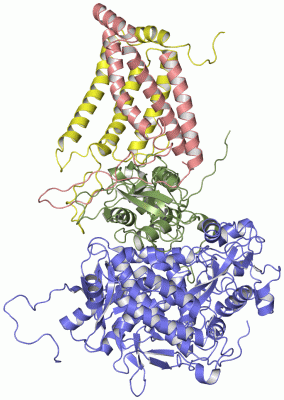
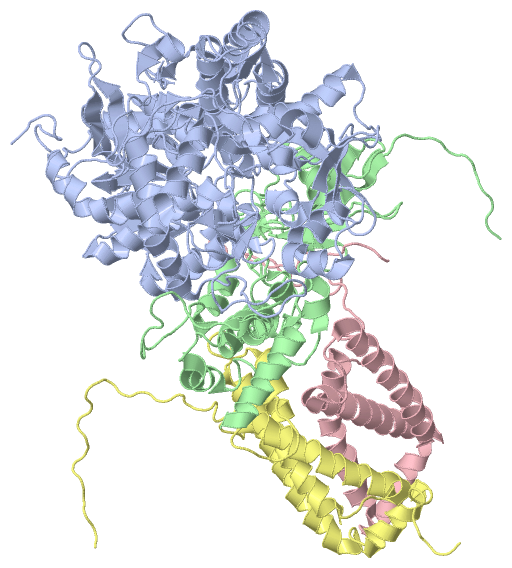
Theoretical Model(hide GO term definitions)
Chain A ( SDHA_YEAST | Q00711)
| molecular function |
|---|
| | GO:0050660 | | flavin adenine dinucleotide binding | | Interacting selectively and non-covalently with FAD, flavin-adenine dinucleotide, the coenzyme or the prosthetic group of various flavoprotein oxidoreductase enzymes, in either the oxidized form, FAD, or the reduced form, FADH2. |
| | GO:0016491 | | oxidoreductase activity | | Catalysis of an oxidation-reduction (redox) reaction, a reversible chemical reaction in which the oxidation state of an atom or atoms within a molecule is altered. One substrate acts as a hydrogen or electron donor and becomes oxidized, while the other acts as hydrogen or electron acceptor and becomes reduced. |
| | GO:0016627 | | oxidoreductase activity, acting on the CH-CH group of donors | | Catalysis of an oxidation-reduction (redox) reaction in which a CH-CH group acts as a hydrogen or electron donor and reduces a hydrogen or electron acceptor. |
| | GO:0005515 | | protein binding | | Interacting selectively and non-covalently with any protein or protein complex (a complex of two or more proteins that may include other nonprotein molecules). |
| | GO:0008177 | | succinate dehydrogenase (ubiquinone) activity | | Catalysis of the reaction: succinate + ubiquinone = fumarate + ubiquinol. |
| biological process |
|---|
| | GO:0045333 | | cellular respiration | | The enzymatic release of energy from inorganic and organic compounds (especially carbohydrates and fats) which either requires oxygen (aerobic respiration) or does not (anaerobic respiration). |
| | GO:0022900 | | electron transport chain | | A process in which a series of electron carriers operate together to transfer electrons from donors to any of several different terminal electron acceptors to generate a transmembrane electrochemical gradient. |
| | GO:0006121 | | mitochondrial electron transport, succinate to ubiquinone | | The transfer of electrons from succinate to ubiquinone that occurs during oxidative phosphorylation, mediated by the multisubunit enzyme known as complex II. |
| | GO:0055114 | | oxidation-reduction process | | A metabolic process that results in the removal or addition of one or more electrons to or from a substance, with or without the concomitant removal or addition of a proton or protons. |
| | GO:0006099 | | tricarboxylic acid cycle | | A nearly universal metabolic pathway in which the acetyl group of acetyl coenzyme A is effectively oxidized to two CO2 and four pairs of electrons are transferred to coenzymes. The acetyl group combines with oxaloacetate to form citrate, which undergoes successive transformations to isocitrate, 2-oxoglutarate, succinyl-CoA, succinate, fumarate, malate, and oxaloacetate again, thus completing the cycle. In eukaryotes the tricarboxylic acid is confined to the mitochondria. See also glyoxylate cycle. |
| cellular component |
|---|
| | GO:0016020 | | membrane | | A lipid bilayer along with all the proteins and protein complexes embedded in it an attached to it. |
| | GO:0005743 | | mitochondrial inner membrane | | The inner, i.e. lumen-facing, lipid bilayer of the mitochondrial envelope. It is highly folded to form cristae. |
| | GO:0031966 | | mitochondrial membrane | | Either of the lipid bilayers that surround the mitochondrion and form the mitochondrial envelope. |
| | GO:0005749 | | mitochondrial respiratory chain complex II, succinate dehydrogenase complex (ubiquinone) | | A protein complex located in the mitochondrial inner membrane that forms part of the mitochondrial respiratory chain. Contains the four polypeptide subunits of succinate dehydrogenase, flavin-adenine dinucleotide and iron-sulfur. Catalyzes the oxidation of succinate by ubiquinone. Connects the TCA cycle with the respiratory chain. |
| | GO:0005739 | | mitochondrion | | A semiautonomous, self replicating organelle that occurs in varying numbers, shapes, and sizes in the cytoplasm of virtually all eukaryotic cells. It is notably the site of tissue respiration. |
Chain B ( SDHB_YEAST | P21801)
| molecular function |
|---|
| | GO:0051537 | | 2 iron, 2 sulfur cluster binding | | Interacting selectively and non-covalently with a 2 iron, 2 sulfur (2Fe-2S) cluster; this cluster consists of two iron atoms, with two inorganic sulfur atoms found between the irons and acting as bridging ligands. |
| | GO:0051538 | | 3 iron, 4 sulfur cluster binding | | Interacting selectively and non-covalently with a 3 iron, 4 sulfur (3Fe-4S) cluster; this cluster consists of three iron atoms, with the inorganic sulfur atoms found between the irons and acting as bridging ligands. It is essentially a 4Fe-4S cluster with one iron missing. |
| | GO:0051539 | | 4 iron, 4 sulfur cluster binding | | Interacting selectively and non-covalently with a 4 iron, 4 sulfur (4Fe-4S) cluster; this cluster consists of four iron atoms, with the inorganic sulfur atoms found between the irons and acting as bridging ligands. |
| | GO:0009055 | | electron carrier activity | | Any molecular entity that serves as an electron acceptor and electron donor in an electron transport chain. An electron transport chain is a process in which a series of electron carriers operate together to transfer electrons from donors to any of several different terminal electron acceptors to generate a transmembrane electrochemical gradient. |
| | GO:0051536 | | iron-sulfur cluster binding | | Interacting selectively and non-covalently with an iron-sulfur cluster, a combination of iron and sulfur atoms. |
| | GO:0046872 | | metal ion binding | | Interacting selectively and non-covalently with any metal ion. |
| | GO:0016491 | | oxidoreductase activity | | Catalysis of an oxidation-reduction (redox) reaction, a reversible chemical reaction in which the oxidation state of an atom or atoms within a molecule is altered. One substrate acts as a hydrogen or electron donor and becomes oxidized, while the other acts as hydrogen or electron acceptor and becomes reduced. |
| | GO:0008177 | | succinate dehydrogenase (ubiquinone) activity | | Catalysis of the reaction: succinate + ubiquinone = fumarate + ubiquinol. |
| biological process |
|---|
| | GO:0045333 | | cellular respiration | | The enzymatic release of energy from inorganic and organic compounds (especially carbohydrates and fats) which either requires oxygen (aerobic respiration) or does not (anaerobic respiration). |
| | GO:0055114 | | oxidation-reduction process | | A metabolic process that results in the removal or addition of one or more electrons to or from a substance, with or without the concomitant removal or addition of a proton or protons. |
| | GO:0006099 | | tricarboxylic acid cycle | | A nearly universal metabolic pathway in which the acetyl group of acetyl coenzyme A is effectively oxidized to two CO2 and four pairs of electrons are transferred to coenzymes. The acetyl group combines with oxaloacetate to form citrate, which undergoes successive transformations to isocitrate, 2-oxoglutarate, succinyl-CoA, succinate, fumarate, malate, and oxaloacetate again, thus completing the cycle. In eukaryotes the tricarboxylic acid is confined to the mitochondria. See also glyoxylate cycle. |
| cellular component |
|---|
| | GO:0000329 | | fungal-type vacuole membrane | | The lipid bilayer surrounding a vacuole, the shape of which correlates with cell cycle phase. The membrane separates its contents from the cytoplasm of the cell. An example of this structure is found in Saccharomyces cerevisiae. |
| | GO:0016020 | | membrane | | A lipid bilayer along with all the proteins and protein complexes embedded in it an attached to it. |
| | GO:0005743 | | mitochondrial inner membrane | | The inner, i.e. lumen-facing, lipid bilayer of the mitochondrial envelope. It is highly folded to form cristae. |
| | GO:0031966 | | mitochondrial membrane | | Either of the lipid bilayers that surround the mitochondrion and form the mitochondrial envelope. |
| | GO:0005749 | | mitochondrial respiratory chain complex II, succinate dehydrogenase complex (ubiquinone) | | A protein complex located in the mitochondrial inner membrane that forms part of the mitochondrial respiratory chain. Contains the four polypeptide subunits of succinate dehydrogenase, flavin-adenine dinucleotide and iron-sulfur. Catalyzes the oxidation of succinate by ubiquinone. Connects the TCA cycle with the respiratory chain. |
| | GO:0005739 | | mitochondrion | | A semiautonomous, self replicating organelle that occurs in varying numbers, shapes, and sizes in the cytoplasm of virtually all eukaryotic cells. It is notably the site of tissue respiration. |
Chain C ( SDH3_YEAST | P33421)
| molecular function |
|---|
| | GO:0009055 | | electron carrier activity | | Any molecular entity that serves as an electron acceptor and electron donor in an electron transport chain. An electron transport chain is a process in which a series of electron carriers operate together to transfer electrons from donors to any of several different terminal electron acceptors to generate a transmembrane electrochemical gradient. |
| | GO:0046872 | | metal ion binding | | Interacting selectively and non-covalently with any metal ion. |
| | GO:0016627 | | oxidoreductase activity, acting on the CH-CH group of donors | | Catalysis of an oxidation-reduction (redox) reaction in which a CH-CH group acts as a hydrogen or electron donor and reduces a hydrogen or electron acceptor. |
| | GO:0048038 | | quinone binding | | Interacting selectively and non-covalently with a quinone, any member of a class of diketones derivable from aromatic compounds by conversion of two CH groups into CO groups with any necessary rearrangement of double bonds. |
| | GO:0008177 | | succinate dehydrogenase (ubiquinone) activity | | Catalysis of the reaction: succinate + ubiquinone = fumarate + ubiquinol. |
| | GO:0000104 | | succinate dehydrogenase activity | | Catalysis of the reaction: succinate + acceptor = fumarate + reduced acceptor. |
| biological process |
|---|
| | GO:0045333 | | cellular respiration | | The enzymatic release of energy from inorganic and organic compounds (especially carbohydrates and fats) which either requires oxygen (aerobic respiration) or does not (anaerobic respiration). |
| | GO:0006121 | | mitochondrial electron transport, succinate to ubiquinone | | The transfer of electrons from succinate to ubiquinone that occurs during oxidative phosphorylation, mediated by the multisubunit enzyme known as complex II. |
| | GO:0055114 | | oxidation-reduction process | | A metabolic process that results in the removal or addition of one or more electrons to or from a substance, with or without the concomitant removal or addition of a proton or protons. |
| | GO:0045039 | | protein import into mitochondrial inner membrane | | The process comprising the import of proteins into the mitochondrion from outside the organelle and their insertion into the mitochondrial inner membrane. The translocase of the outer membrane complex mediates the passage of these proteins across the outer membrane, after which they are guided by either of two inner membrane translocase complexes into their final destination in the inner membrane. |
| | GO:0006099 | | tricarboxylic acid cycle | | A nearly universal metabolic pathway in which the acetyl group of acetyl coenzyme A is effectively oxidized to two CO2 and four pairs of electrons are transferred to coenzymes. The acetyl group combines with oxaloacetate to form citrate, which undergoes successive transformations to isocitrate, 2-oxoglutarate, succinyl-CoA, succinate, fumarate, malate, and oxaloacetate again, thus completing the cycle. In eukaryotes the tricarboxylic acid is confined to the mitochondria. See also glyoxylate cycle. |
| cellular component |
|---|
| | GO:0016021 | | integral component of membrane | | The component of a membrane consisting of the gene products and protein complexes having at least some part of their peptide sequence embedded in the hydrophobic region of the membrane. |
| | GO:0016020 | | membrane | | A lipid bilayer along with all the proteins and protein complexes embedded in it an attached to it. |
| | GO:0005743 | | mitochondrial inner membrane | | The inner, i.e. lumen-facing, lipid bilayer of the mitochondrial envelope. It is highly folded to form cristae. |
| | GO:0042721 | | mitochondrial inner membrane protein insertion complex | | A multi-subunit complex embedded in the mitochondrial inner membrane that mediates insertion of carrier proteins into the inner membrane. |
| | GO:0005749 | | mitochondrial respiratory chain complex II, succinate dehydrogenase complex (ubiquinone) | | A protein complex located in the mitochondrial inner membrane that forms part of the mitochondrial respiratory chain. Contains the four polypeptide subunits of succinate dehydrogenase, flavin-adenine dinucleotide and iron-sulfur. Catalyzes the oxidation of succinate by ubiquinone. Connects the TCA cycle with the respiratory chain. |
| | GO:0005739 | | mitochondrion | | A semiautonomous, self replicating organelle that occurs in varying numbers, shapes, and sizes in the cytoplasm of virtually all eukaryotic cells. It is notably the site of tissue respiration. |
Chain D ( DHSD_YEAST | P37298)
| molecular function |
|---|
| | GO:0020037 | | heme binding | | Interacting selectively and non-covalently with heme, any compound of iron complexed in a porphyrin (tetrapyrrole) ring. |
| | GO:0046872 | | metal ion binding | | Interacting selectively and non-covalently with any metal ion. |
| | GO:0048038 | | quinone binding | | Interacting selectively and non-covalently with a quinone, any member of a class of diketones derivable from aromatic compounds by conversion of two CH groups into CO groups with any necessary rearrangement of double bonds. |
| | GO:0008177 | | succinate dehydrogenase (ubiquinone) activity | | Catalysis of the reaction: succinate + ubiquinone = fumarate + ubiquinol. |
| | GO:0048039 | | ubiquinone binding | | Interacting selectively and non-covalently with ubiquinone, a quinone derivative with a tail of isoprene units. |
| biological process |
|---|
| | GO:0045333 | | cellular respiration | | The enzymatic release of energy from inorganic and organic compounds (especially carbohydrates and fats) which either requires oxygen (aerobic respiration) or does not (anaerobic respiration). |
| | GO:0006121 | | mitochondrial electron transport, succinate to ubiquinone | | The transfer of electrons from succinate to ubiquinone that occurs during oxidative phosphorylation, mediated by the multisubunit enzyme known as complex II. |
| | GO:0055114 | | oxidation-reduction process | | A metabolic process that results in the removal or addition of one or more electrons to or from a substance, with or without the concomitant removal or addition of a proton or protons. |
| | GO:0006099 | | tricarboxylic acid cycle | | A nearly universal metabolic pathway in which the acetyl group of acetyl coenzyme A is effectively oxidized to two CO2 and four pairs of electrons are transferred to coenzymes. The acetyl group combines with oxaloacetate to form citrate, which undergoes successive transformations to isocitrate, 2-oxoglutarate, succinyl-CoA, succinate, fumarate, malate, and oxaloacetate again, thus completing the cycle. In eukaryotes the tricarboxylic acid is confined to the mitochondria. See also glyoxylate cycle. |
| cellular component |
|---|
| | GO:0016021 | | integral component of membrane | | The component of a membrane consisting of the gene products and protein complexes having at least some part of their peptide sequence embedded in the hydrophobic region of the membrane. |
| | GO:0016020 | | membrane | | A lipid bilayer along with all the proteins and protein complexes embedded in it an attached to it. |
| | GO:0005740 | | mitochondrial envelope | | The double lipid bilayer enclosing the mitochondrion and separating its contents from the cell cytoplasm; includes the intermembrane space. |
| | GO:0005743 | | mitochondrial inner membrane | | The inner, i.e. lumen-facing, lipid bilayer of the mitochondrial envelope. It is highly folded to form cristae. |
| | GO:0005749 | | mitochondrial respiratory chain complex II, succinate dehydrogenase complex (ubiquinone) | | A protein complex located in the mitochondrial inner membrane that forms part of the mitochondrial respiratory chain. Contains the four polypeptide subunits of succinate dehydrogenase, flavin-adenine dinucleotide and iron-sulfur. Catalyzes the oxidation of succinate by ubiquinone. Connects the TCA cycle with the respiratory chain. |
| | GO:0005739 | | mitochondrion | | A semiautonomous, self replicating organelle that occurs in varying numbers, shapes, and sizes in the cytoplasm of virtually all eukaryotic cells. It is notably the site of tissue respiration. |
|

 Description