Show PDB file:   
         Plain Text   HTML   (compressed file size)
QuickSearch:   
by PDB,NDB,UniProt,PROSITE Code or Search Term(s)  
(-)Asym./Biol. Unit - manually
(-)Asym./Biol. Unit
(-)Asym./Biol. Unit - sites
collapse expand < >
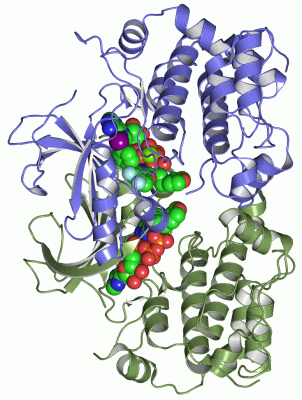
Image Asym./Biol. Unit - manually
Asym./Biol. Unit - manually  (Jmol Viewer)
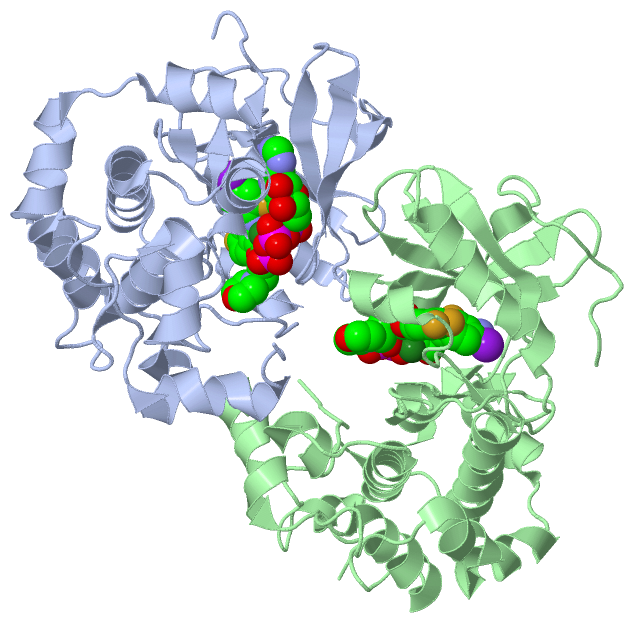
Image Asym./Biol. Unit
Asym./Biol. Unit  (Jmol Viewer)
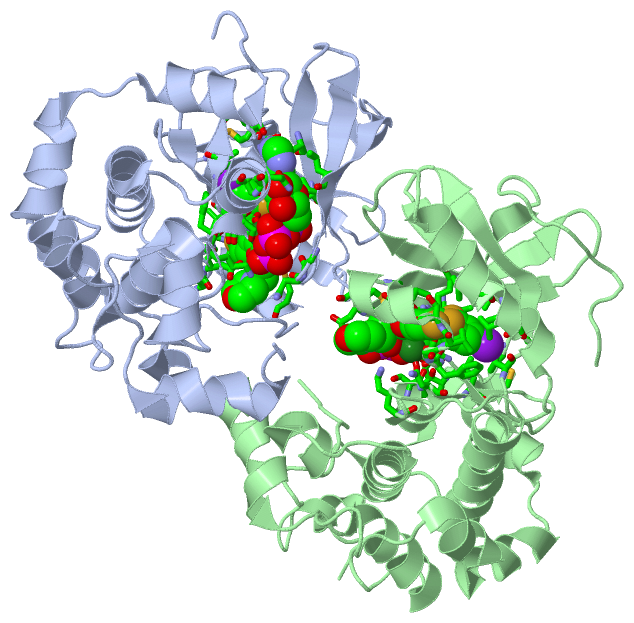
Image Asym./Biol. Unit - sites
Asym./Biol. Unit - sites  (Jmol Viewer)

(-) Description

Title :  X-RAY STRUCTURE OF THE HUMAN MITOGEN-ACTIVATED PROTEIN KINASE KINASE 2 (MEK2)IN A COMPLEX WITH LIGAND AND MGATP
 
Authors :  J. F. Ohren, H. Chen, A. Pavlovsky, C. Whitehead, C. Yan, P. Mcconnell, A. Delaney, D. T. Dudley, J. Sebolt-Leopold, C. A. Hasemann
Date :  04 Feb 04  (Deposition) - 23 Nov 04  (Release) - 24 Feb 09  (Revision)
Method :  X-RAY DIFFRACTION
Resolution :  3.20
Chains :  Asym./Biol. Unit :  A,B
Keywords :  Protein Kinase-Ligand-Mgatp Complex, Protein-Protein Interactions, Transferase (Keyword Search: [Gene Ontology, PubMed, Web (Google))
 
Reference :  J. F. Ohren, H. Chen, A. Pavlovsky, C. Whitehead, E. Zhang, P. Kuffa, C. Yan, P. Mcconnell, C. Spessard, C. Banotai, W. T. Mueller, A. Delaney, C. Omer, J. Sebolt-Leopold, D. T. Dudley, I. K. Leung, C. Flamme, J. Warmus, M. Kaufman, S. Barrett, H. Tecle, C. A. Hasemann
Structures Of Human Map Kinase Kinase 1 (Mek1) And Mek2 Describe Novel Noncompetitive Kinase Inhibition.
Nat. Struct. Mol. Biol. V. 11 1192 2004
PubMed-ID: 15543157  |  Reference-DOI: 10.1038/NSMB859
(for further references see the PDB file header)

(-) Compounds

Molecule 1 - DUAL SPECIFICITY MITOGEN-ACTIVATED PROTEIN KINASE KINASE 2
    ChainsA, B
    EC Number2.7.1.37
    EngineeredYES
    Expression SystemESCHERICHIA COLI BL21(DE3)
    Expression System PlasmidPET24B
    Expression System StrainBL21(DE3)
    Expression System Taxid469008
    Expression System VectorPLASMID
    GeneMAP2K2, PRKMK2, MEK2, MKK2
    Organism CommonHUMAN
    Organism ScientificHOMO SAPIENS
    Organism Taxid9606
    SynonymMAP KINASE KINASE 2, MAPKK 2, ERK ACTIVATOR KINASE 2, MAPK/ERK KINASE 2, MEK2

 Structural Features

(-) Chains, Units

  12
Asymmetric/Biological Unit AB

Summary Information (see also Sequences/Alignments below)

(-) Ligands, Modified Residues, Ions  (3, 6)

Asymmetric/Biological Unit (3, 6)
No.NameCountTypeFull Name
15EA2Ligand/Ion5-{3,4-DIFLUORO-2-[(2-FLUORO-4-IODOPHENYL)AMINO]PHENYL}-N-(2-MORPHOLIN-4-YLETHYL)-1,3,4-OXADIAZOL-2-AMINE
2ATP2Ligand/IonADENOSINE-5'-TRIPHOSPHATE
3MG2Ligand/IonMAGNESIUM ION

(-) Sites  (6, 6)

Asymmetric Unit (6, 6)
No.NameEvidenceResiduesDescription
1AC1SOFTWAREASN A:199 , ASP A:212 , ATP A:535BINDING SITE FOR RESIDUE MG A 536
2AC2SOFTWAREASN B:199 , ASP B:212 , ATP B:537BINDING SITE FOR RESIDUE MG B 538
3AC3SOFTWARELEU A:78 , GLY A:81 , ASN A:82 , VAL A:86 , ALA A:99 , LYS A:101 , MET A:147 , GLU A:148 , MET A:150 , SER A:154 , GLN A:157 , ASP A:194 , LYS A:196 , SER A:198 , LEU A:201 , ASP A:212 , MG A:536 , 5EA A:1001BINDING SITE FOR RESIDUE ATP A 535
4AC4SOFTWARELEU B:78 , GLY B:79 , GLY B:81 , ASN B:82 , GLY B:84 , ALA B:99 , LYS B:101 , MET B:147 , GLU B:148 , MET B:150 , SER B:154 , GLN B:157 , LYS B:196 , SER B:198 , ASN B:199 , LEU B:201 , ASP B:212 , MG B:538 , 5EA B:1002BINDING SITE FOR RESIDUE ATP B 537
5AC5SOFTWAREASN A:82 , LYS A:101 , LEU A:119 , LEU A:122 , VAL A:131 , MET A:147 , ARG A:193 , ASP A:194 , ASP A:212 , PHE A:213 , GLY A:214 , VAL A:215 , SER A:216 , MET A:223 , ATP A:535BINDING SITE FOR RESIDUE 5EA A 1001
6AC6SOFTWARELYS B:101 , LEU B:119 , LEU B:122 , VAL B:131 , ASP B:212 , PHE B:213 , GLY B:214 , VAL B:215 , SER B:216 , LEU B:219 , MET B:223 , ATP B:537BINDING SITE FOR RESIDUE 5EA B 1002

(-) SS Bonds  (0, 0)

(no "SS Bond" information available for 1S9I)

(-) Cis Peptide Bonds  (2, 2)

Asymmetric/Biological Unit
No.Residues
1Val A:64 -Gly A:65
2Gly A:280 -Arg A:281

 Sequence-Structure Mapping

(-) SAPs(SNPs)/Variants  (2, 4)

Asymmetric/Biological Unit (2, 4)
  dbSNPPDB
No.SourceVariant IDVariantUniProt IDStatusIDChainVariant
1UniProtVAR_069782P128QMP2K2_HUMANDisease (CFC4)267607230A/BP128Q
2UniProtVAR_069783Y134HMP2K2_HUMANDisease (CFC4)121434499A/BY134H

  SNP/SAP Summary Statistics (UniProtKB/Swiss-Prot)

(-) PROSITE Motifs  (2, 4)

Asymmetric/Biological Unit (2, 4)
 PROSITEUniProtKBPDB
No.IDACDescriptionIDLocationCountLocation
1PROTEIN_KINASE_ATPPS00107 Protein kinases ATP-binding region signature.MP2K2_HUMAN78-101
 
  2A:78-101
B:78-101
2PROTEIN_KINASE_STPS00108 Serine/Threonine protein kinases active-site signature.MP2K2_HUMAN190-202
 
  2A:190-202
B:190-202

(-) Exons   (10, 20)

Asymmetric/Biological Unit (10, 20)
 ENSEMBLUniProtKBPDB
No.Transcript IDExonExon IDGenome LocationLengthIDLocationLengthCountLocationLength
1.1aENST000002629481aENSE00001147081chr19:4124126-4123781346MP2K2_HUMAN1-31310--
1.2ENST000002629482ENSE00001681490chr19:4117627-4117417211MP2K2_HUMAN31-101712A:60-101
B:59-101
42
43
1.3ENST000002629483ENSE00001603898chr19:4110653-4110507147MP2K2_HUMAN102-150492A:102-150
B:102-150
49
49
1.4dENST000002629484dENSE00001718004chr19:4102451-410237478MP2K2_HUMAN151-176262A:151-176
B:151-176
26
26
1.5ENST000002629485ENSE00001762857chr19:4101278-410122752MP2K2_HUMAN177-194182A:177-194
B:177-194
18
18
1.6aENST000002629486aENSE00000951535chr19:4101141-4101017125MP2K2_HUMAN194-235422A:194-235 (gaps)
B:194-235 (gaps)
42
42
1.7dENST000002629487dENSE00000951536chr19:4099412-4099199214MP2K2_HUMAN236-307722A:236-285
B:236-281
50
46
1.8ENST000002629488ENSE00000951537chr19:4097341-409727765MP2K2_HUMAN307-328222A:313-328
B:316-328
16
13
1.9aENST000002629489aENSE00000951538chr19:4095447-409538662MP2K2_HUMAN329-349212A:329-349
B:329-349
21
21
1.9cENST000002629489cENSE00000663997chr19:4094496-409445146MP2K2_HUMAN349-364162A:349-364
B:349-364
16
16
1.10cENST0000026294810cENSE00001519838chr19:4090706-4090319388MP2K2_HUMAN365-400362A:365-393
B:365-389
29
25

(-) Sequences/Alignments

Asymmetric/Biological Unit
   Reformat: Number of residues per line =  ('0' or empty: single-line sequence representation)
  Number of residues per labelling interval =   
  UniProt sequence: complete  aligned part    
   Show mapping: SCOP domains CATH domains Pfam domains Secondary structure (by author)
SAPs(SNPs) PROSITE motifs Exons
(details for a mapped element are shown in a popup box when the mouse pointer rests over it)
Chain A from PDB  Type:PROTEIN  Length:303
 aligned with MP2K2_HUMAN | P36507 from UniProtKB/Swiss-Prot  Length:400

    Alignment length:334
                                    69        79        89        99       109       119       129       139       149       159       169       179       189       199       209       219       229       239       249       259       269       279       289       299       309       319       329       339       349       359       369       379       389    
          MP2K2_HUMAN    60 QKAKVGELKDDDFERISELGAGNGGVVTKVQHRPSGLIMARKLIHLEIKPAIRNQIIRELQVLHECNSPYIVGFYGAFYSDGEISICMEHMDGGSLDQVLKEAKRIPEEILGKVSIAVLRGLAYLREKHQIMHRDVKPSNILVNSRGEIKLCDFGVSGQLIDSMANSFVGTRSYMAPERLQGTHYSVQSDIWSMGLSLVELAVGRYPIPPPDAKELEAIFGRPVVDGEEGEPHSISPRPRPPGRPVSGHGMDSRPAMAIFELLDYIVNEPPPKLPNGVFTPDFQEFVNKCLIKNPAERADLKMLTNHTFIKRSEVEEVDFAGWLCKTLRLNQPG 393
               SCOP domains d1s9ia_ A: Dual specificity mitogen-activated protein kinase kinase 2, Mek2                                                                                                                                                                                                                                                                    SCOP domains
               CATH domains 1s9iA01 A:60-151 Phosphorylase Kinase; domain 1                                             1s9iA02 A:152-393 Transferase(Phosphotransferase) domain 1                                                                                                                                                                                         CATH domains
               Pfam domains ---------------------------------------------------------------------------------------------------------------------------------------------------------------------------------------------------------------------------------------------------------------------------------------------------------------------------------------------- Pfam domains
         Sec.struct. author ........hhh.eeeeeeeee....eeeeeee.....eeeeeee.....hhhhhhhhhhhhhhh.........eeeeee....eeeeee....eehhhhhhhh...hhhhhhhhhhhhhhhhhhhhhh........hhh.eee.....eee.....hhhhhhhh----.......hhhhhh....hhhhhhhhhhhhhhhhhhh.......hhhhhhhhhh.....---------------------------....hhhhhhhhhhhh..........hhhhhhhhhhhh........hhhhhhhhhhhhhhhhh..hhhhhhhhhh...... Sec.struct. author
                 SAPs(SNPs) --------------------------------------------------------------------Q-----H------------------------------------------------------------------------------------------------------------------------------------------------------------------------------------------------------------------------------------------------------------------- SAPs(SNPs)
                    PROSITE ------------------PROTEIN_KINASE_ATP      ----------------------------------------------------------------------------------------PROTEIN_KINAS----------------------------------------------------------------------------------------------------------------------------------------------------------------------------------------------- PROSITE
           Transcript 1 (1) Exon 1.2  PDB: A:60-101 UniProt: 31-101   Exon 1.3  PDB: A:102-150 UniProt: 102-150        Exon 1.4d  PDB: A:151-176 Exon 1.5          -----------------------------------------Exon 1.7d  PDB: A:236-285 UniProt: 236-307 [INCOMPLETE]                 ---------------------Exon 1.9a            ---------------Exon 1.10c  PDB: A:365-393    Transcript 1 (1)
           Transcript 1 (2) --------------------------------------------------------------------------------------------------------------------------------------Exon 1.6a  PDB: A:194-235 (gaps)          -----------------------------------------------------------------------Exon 1.8 [INCOMPLETE] --------------------Exon 1.9c       ----------------------------- Transcript 1 (2)
                 1s9i A  60 QKAKVGELKDDDFERISELGAGNGGVVTKVQHRPSGLIMARKLIHLEIKPAIRNQIIRELQVLHECNSPYIVGFYGAFYSDGEISICMEHMDGGSLDQVLKEAKRIPEEILGKVSIAVLRGLAYLREKHQIMHRDVKPSNILVNSRGEIKLCDFGVSGQLIDSM----VGTRSYMAPERLQGTHYSVQSDIWSMGLSLVELAVGRYPIPPPDAKELEAIFGRPVVD---------------------------RPAMAIFELLDYIVNEPPPKLPNGVFTPDFQEFVNKCLIKNPAERADLKMLTNHTFIKRSEVEEVDFAGWLCKTLRLNQPG 393
                                    69        79        89        99       109       119       129       139       149       159       169       179       189       199       209       219   |   229       239       249       259       269       279     |   -         -         -   |   319       329       339       349       359       369       379       389    
                                                                                                                                                                                             223  228                                                      285                         313                                                                                

Chain B from PDB  Type:PROTEIN  Length:291
 aligned with MP2K2_HUMAN | P36507 from UniProtKB/Swiss-Prot  Length:400

    Alignment length:331
                                    68        78        88        98       108       118       128       138       148       158       168       178       188       198       208       218       228       238       248       258       268       278       288       298       308       318       328       338       348       358       368       378       388 
          MP2K2_HUMAN    59 TQKAKVGELKDDDFERISELGAGNGGVVTKVQHRPSGLIMARKLIHLEIKPAIRNQIIRELQVLHECNSPYIVGFYGAFYSDGEISICMEHMDGGSLDQVLKEAKRIPEEILGKVSIAVLRGLAYLREKHQIMHRDVKPSNILVNSRGEIKLCDFGVSGQLIDSMANSFVGTRSYMAPERLQGTHYSVQSDIWSMGLSLVELAVGRYPIPPPDAKELEAIFGRPVVDGEEGEPHSISPRPRPPGRPVSGHGMDSRPAMAIFELLDYIVNEPPPKLPNGVFTPDFQEFVNKCLIKNPAERADLKMLTNHTFIKRSEVEEVDFAGWLCKTLRL 389
               SCOP domains d1s9ib_ B: Dual specificity mitogen-activated protein kinase kinase 2, Mek2                                                                                                                                                                                                                                                                 SCOP domains
               CATH domains 1s9iB01 B:59-151 Phosphorylase Kinase; domain 1                                              1s9iB02 B:152-389 Transferase(Phosphotransferase) domain 1                                                                                                                                                                                     CATH domains
           Pfam domains (1) -------------Pkinase-1s9iB01 B:72-369                                                                                                                                                                                                                                                                                  -------------------- Pfam domains (1)
           Pfam domains (2) -------------Pkinase-1s9iB02 B:72-369                                                                                                                                                                                                                                                                                  -------------------- Pfam domains (2)
         Sec.struct. author .............eeeeeeeeee..eeeeeeee.....eeeeeeee......hhhhhhhhhhhhhhh.......eeeeeee..eeeeeee....eehhhhhhhh...hhhhhhhhhhhhhhhhhhhhhh........hhh.eee.....eee.....hhhhhhh.------.....hhhhhhh....hhhhhhhhhhhhhhhhhh..........hhhhh...----------------------------------.hhhhhhhhhhhh..........hhhhhhhhhhhh........hhhhhhhhhhhhhhhh...hhhhhhhhhhh. Sec.struct. author
                 SAPs(SNPs) ---------------------------------------------------------------------Q-----H--------------------------------------------------------------------------------------------------------------------------------------------------------------------------------------------------------------------------------------------------------------- SAPs(SNPs)
                    PROSITE -------------------PROTEIN_KINASE_ATP      ----------------------------------------------------------------------------------------PROTEIN_KINAS------------------------------------------------------------------------------------------------------------------------------------------------------------------------------------------- PROSITE
           Transcript 1 (1) Exon 1.2  PDB: B:59-101 UniProt: 31-101    Exon 1.3  PDB: B:102-150 UniProt: 102-150        Exon 1.4d  PDB: B:151-176 Exon 1.5          -----------------------------------------Exon 1.7d  PDB: B:236-281 UniProt: 236-307 [INCOMPLETE]                 ---------------------Exon 1.9a            ---------------Exon 1.10c  PDB: B:365-38 Transcript 1 (1)
           Transcript 1 (2) ---------------------------------------------------------------------------------------------------------------------------------------Exon 1.6a  PDB: B:194-235 (gaps)          -----------------------------------------------------------------------Exon 1.8 [INCOMPLETE] --------------------Exon 1.9c       ------------------------- Transcript 1 (2)
                 1s9i B  59 TQKAKVGELKDDDFERISELGAGNGGVVTKVQHRPSGLIMARKLIHLEIKPAIRNQIIRELQVLHECNSPYIVGFYGAFYSDGEISICMEHMDGGSLDQVLKEAKRIPEEILGKVSIAVLRGLAYLREKHQIMHRDVKPSNILVNSRGEIKLCDFGVSGQLIDSM------TRSYMAPERLQGTHYSVQSDIWSMGLSLVELAVGRYPIPPPDAKELEAIFGR----------------------------------MAIFELLDYIVNEPPPKLPNGVFTPDFQEFVNKCLIKNPAERADLKMLTNHTFIKRSEVEEVDFAGWLCKTLRL 389
                                    68        78        88        98       108       118       128       138       148       158       168       178       188       198       208       218    |    - |     238       248       258       268       278  |      -         -         -       318       328       338       348       358       368       378       388 
                                                                                                                                                                                              223    230                                                281                                316                                                                         

   Legend:   → Mismatch (orange background)
  - → Gap (green background, '-', border residues have a numbering label)
    → Modified Residue (blue background, lower-case, 'x' indicates undefined single-letter code, labelled with number + name)
  x → Chemical Group (purple background, 'x', labelled with number + name, e.g. ACE or NH2)
  extra numbering lines below/above indicate numbering irregularities and modified residue names etc., number ends below/above '|'

 Classification and Annotation

(-) SCOP Domains  (1, 2)

Asymmetric/Biological Unit

(-) CATH Domains  (2, 4)

Asymmetric/Biological Unit
(-)
Class: Alpha Beta (26913)

(-) Pfam Domains  (1, 2)

Asymmetric/Biological Unit
(-)
Clan: PKinase (934)

(-) Gene Ontology  (60, 60)

Asymmetric/Biological Unit(hide GO term definitions)
Chain A,B   (MP2K2_HUMAN | P36507)
molecular function
    GO:0005524    ATP binding    Interacting selectively and non-covalently with ATP, adenosine 5'-triphosphate, a universally important coenzyme and enzyme regulator.
    GO:0004708    MAP kinase kinase activity    Catalysis of the concomitant phosphorylation of threonine (T) and tyrosine (Y) residues in a Thr-Glu-Tyr (TEY) thiolester sequence in a MAP kinase (MAPK) substrate.
    GO:0030165    PDZ domain binding    Interacting selectively and non-covalently with a PDZ domain of a protein, a domain found in diverse signaling proteins.
    GO:0016301    kinase activity    Catalysis of the transfer of a phosphate group, usually from ATP, to a substrate molecule.
    GO:0046872    metal ion binding    Interacting selectively and non-covalently with any metal ion.
    GO:0000166    nucleotide binding    Interacting selectively and non-covalently with a nucleotide, any compound consisting of a nucleoside that is esterified with (ortho)phosphate or an oligophosphate at any hydroxyl group on the ribose or deoxyribose.
    GO:0005515    protein binding    Interacting selectively and non-covalently with any protein or protein complex (a complex of two or more proteins that may include other nonprotein molecules).
    GO:0032947    protein complex scaffold activity    A structural molecule activity that provides a physical support for the assembly of a multiprotein complex. The scaffold may or may not be part of the final complex.
    GO:0004672    protein kinase activity    Catalysis of the phosphorylation of an amino acid residue in a protein, usually according to the reaction: a protein + ATP = a phosphoprotein + ADP.
    GO:0043539    protein serine/threonine kinase activator activity    Binds to and increases the activity of a protein serine/threonine kinase.
    GO:0004674    protein serine/threonine kinase activity    Catalysis of the reactions: ATP + protein serine = ADP + protein serine phosphate, and ATP + protein threonine = ADP + protein threonine phosphate.
    GO:0004712    protein serine/threonine/tyrosine kinase activity    Catalysis of the reactions: ATP + a protein serine = ADP + protein serine phosphate; ATP + a protein threonine = ADP + protein threonine phosphate; and ATP + a protein tyrosine = ADP + protein tyrosine phosphate.
    GO:0004713    protein tyrosine kinase activity    Catalysis of the reaction: ATP + a protein tyrosine = ADP + protein tyrosine phosphate.
    GO:0097110    scaffold protein binding    Interacting selectively and non-covalently with a scaffold protein. Scaffold proteins are crucial regulators of many key signaling pathways. Although not strictly defined in function, they are known to interact and/or bind with multiple members of a signaling pathway, tethering them into complexes.
    GO:0004702    signal transducer, downstream of receptor, with serine/threonine kinase activity    Conveys a signal from an upstream receptor or intracellular signal transducer by catalysis of the reaction: ATP protein serine = ADP + protein serine phosphate, and ATP + protein threonine = ADP + protein threonine phosphate.
    GO:0016740    transferase activity    Catalysis of the transfer of a group, e.g. a methyl group, glycosyl group, acyl group, phosphorus-containing, or other groups, from one compound (generally regarded as the donor) to another compound (generally regarded as the acceptor). Transferase is the systematic name for any enzyme of EC class 2.
biological process
    GO:0070371    ERK1 and ERK2 cascade    An intracellular protein kinase cascade containing at least ERK1 or ERK2 (MAPKs), a MEK (a MAPKK) and a MAP3K. The cascade can also contain two additional tiers: the upstream MAP4K and the downstream MAP Kinase-activated kinase (MAPKAPK). The kinases in each tier phosphorylate and activate the kinases in the downstream tier to transmit a signal within a cell.
    GO:0000165    MAPK cascade    An intracellular protein kinase cascade containing at least a MAPK, a MAPKK and a MAP3K. The cascade can also contain two additional tiers: the upstream MAP4K and the downstream MAP Kinase-activated kinase (MAPKAPK). The kinases in each tier phosphorylate and activate the kinases in the downstream tier to transmit a signal within a cell.
    GO:0000187    activation of MAPK activity    The initiation of the activity of the inactive enzyme MAP kinase (MAPK).
    GO:0060502    epithelial cell proliferation involved in lung morphogenesis    The multiplication or reproduction of epithelial cells, resulting in the expansion of a cell population that contributes to the shaping of the lung.
    GO:0060324    face development    The biological process whose specific outcome is the progression of a face from an initial condition to its mature state. The face is the ventral division of the head.
    GO:0007507    heart development    The process whose specific outcome is the progression of the heart over time, from its formation to the mature structure. The heart is a hollow, muscular organ, which, by contracting rhythmically, keeps up the circulation of the blood.
    GO:0060425    lung morphogenesis    The process in which the anatomical structures of the lung are generated and organized.
    GO:0010629    negative regulation of gene expression    Any process that decreases the frequency, rate or extent of gene expression. Gene expression is the process in which a gene's coding sequence is converted into a mature gene product or products (proteins or RNA). This includes the production of an RNA transcript as well as any processing to produce a mature RNA product or an mRNA or circRNA (for protein-coding genes) and the translation of that mRNA or circRNA into protein. Protein maturation is included when required to form an active form of a product from an inactive precursor form.
    GO:0036289    peptidyl-serine autophosphorylation    The phosphorylation by a protein of one or more of its own serine amino acid residues, or a serine residue on an identical protein.
    GO:0018108    peptidyl-tyrosine phosphorylation    The phosphorylation of peptidyl-tyrosine to form peptidyl-O4'-phospho-L-tyrosine.
    GO:0016310    phosphorylation    The process of introducing a phosphate group into a molecule, usually with the formation of a phosphoric ester, a phosphoric anhydride or a phosphoric amide.
    GO:0070374    positive regulation of ERK1 and ERK2 cascade    Any process that activates or increases the frequency, rate or extent of signal transduction mediated by the ERK1 and ERK2 cascade.
    GO:0050772    positive regulation of axonogenesis    Any process that activates or increases the frequency, rate or extent of axonogenesis.
    GO:2000147    positive regulation of cell motility    Any process that activates or increases the frequency, rate or extent of cell motility.
    GO:1903800    positive regulation of production of miRNAs involved in gene silencing by miRNA    Any process that activates or increases the frequency, rate or extent of production of miRNAs involved in gene silencing by miRNA.
    GO:0071902    positive regulation of protein serine/threonine kinase activity    Any process that increases the rate, frequency, or extent of protein serine/threonine kinase activity.
    GO:0045893    positive regulation of transcription, DNA-templated    Any process that activates or increases the frequency, rate or extent of cellular DNA-templated transcription.
    GO:0006468    protein phosphorylation    The process of introducing a phosphate group on to a protein.
    GO:0035897    proteolysis in other organism    The chemical reactions and pathways performed by an organism resulting in the hydrolysis of proteins in another organism by cleavage of their peptide bonds.
    GO:0090170    regulation of Golgi inheritance    Any process that modulates the rate, frequency or extent of Golgi inheritance. Golgi inheritance is the partitioning of Golgi apparatus between daughter cells at cell division.
    GO:0048679    regulation of axon regeneration    Any process that modulates the frequency, rate or extent of axon regeneration.
    GO:2000641    regulation of early endosome to late endosome transport    Any process that modulates the frequency, rate or extent of early endosome to late endosome transport.
    GO:0001932    regulation of protein phosphorylation    Any process that modulates the frequency, rate or extent of addition of phosphate groups into an amino acid in a protein.
    GO:0032872    regulation of stress-activated MAPK cascade    Any process that modulates the frequency, rate or extent of signal transduction mediated by the stress-activated MAPK cascade.
    GO:0048538    thymus development    The process whose specific outcome is the progression of the thymus over time, from its formation to the mature structure. The thymus is a symmetric bi-lobed organ involved primarily in the differentiation of immature to mature T cells, with unique vascular, nervous, epithelial, and lymphoid cell components.
    GO:0030878    thyroid gland development    The process whose specific outcome is the progression of the thyroid gland over time, from its formation to the mature structure. The thyroid gland is an endoderm-derived gland that produces thyroid hormone.
    GO:0060440    trachea formation    The process pertaining to the initial formation of a trachea from unspecified parts. The process begins with the specific processes that contribute to the appearance of the discrete structure and ends when the trachea is recognizable. The trachea is the portion of the airway that attaches to the bronchi as it branches.
cellular component
    GO:0005794    Golgi apparatus    A compound membranous cytoplasmic organelle of eukaryotic cells, consisting of flattened, ribosome-free vesicles arranged in a more or less regular stack. The Golgi apparatus differs from the endoplasmic reticulum in often having slightly thicker membranes, appearing in sections as a characteristic shallow semicircle so that the convex side (cis or entry face) abuts the endoplasmic reticulum, secretory vesicles emerging from the concave side (trans or exit face). In vertebrate cells there is usually one such organelle, while in invertebrates and plants, where they are known usually as dictyosomes, there may be several scattered in the cytoplasm. The Golgi apparatus processes proteins produced on the ribosomes of the rough endoplasmic reticulum; such processing includes modification of the core oligosaccharides of glycoproteins, and the sorting and packaging of proteins for transport to a variety of cellular locations. Three different regions of the Golgi are now recognized both in terms of structure and function: cis, in the vicinity of the cis face, trans, in the vicinity of the trans face, and medial, lying between the cis and trans regions.
    GO:0005938    cell cortex    The region of a cell that lies just beneath the plasma membrane and often, but not always, contains a network of actin filaments and associated proteins.
    GO:0005911    cell-cell junction    A cell junction that forms a connection between two or more cells in a multicellular organism; excludes direct cytoplasmic junctions such as ring canals.
    GO:0005737    cytoplasm    All of the contents of a cell excluding the plasma membrane and nucleus, but including other subcellular structures.
    GO:0009898    cytoplasmic side of plasma membrane    The leaflet the plasma membrane that faces the cytoplasm and any proteins embedded or anchored in it or attached to its surface.
    GO:0005829    cytosol    The part of the cytoplasm that does not contain organelles but which does contain other particulate matter, such as protein complexes.
    GO:0005769    early endosome    A membrane-bounded organelle that receives incoming material from primary endocytic vesicles that have been generated by clathrin-dependent and clathrin-independent endocytosis; vesicles fuse with the early endosome to deliver cargo for sorting into recycling or degradation pathways.
    GO:0005783    endoplasmic reticulum    The irregular network of unit membranes, visible only by electron microscopy, that occurs in the cytoplasm of many eukaryotic cells. The membranes form a complex meshwork of tubular channels, which are often expanded into slitlike cavities called cisternae. The ER takes two forms, rough (or granular), with ribosomes adhering to the outer surface, and smooth (with no ribosomes attached).
    GO:0005576    extracellular region    The space external to the outermost structure of a cell. For cells without external protective or external encapsulating structures this refers to space outside of the plasma membrane. This term covers the host cell environment outside an intracellular parasite.
    GO:0005925    focal adhesion    Small region on the surface of a cell that anchors the cell to the extracellular matrix and that forms a point of termination of actin filaments.
    GO:0005770    late endosome    A prelysosomal endocytic organelle differentiated from early endosomes by lower lumenal pH and different protein composition. Late endosomes are more spherical than early endosomes and are mostly juxtanuclear, being concentrated near the microtubule organizing center.
    GO:0016020    membrane    A lipid bilayer along with all the proteins and protein complexes embedded in it an attached to it.
    GO:0005874    microtubule    Any of the long, generally straight, hollow tubes of internal diameter 12-15 nm and external diameter 24 nm found in a wide variety of eukaryotic cells; each consists (usually) of 13 protofilaments of polymeric tubulin, staggered in such a manner that the tubulin monomers are arranged in a helical pattern on the microtubular surface, and with the alpha/beta axes of the tubulin subunits parallel to the long axis of the tubule; exist in equilibrium with pool of tubulin monomers and can be rapidly assembled or disassembled in response to physiological stimuli; concerned with force generation, e.g. in the spindle.
    GO:0005739    mitochondrion    A semiautonomous, self replicating organelle that occurs in varying numbers, shapes, and sizes in the cytoplasm of virtually all eukaryotic cells. It is notably the site of tissue respiration.
    GO:0005634    nucleus    A membrane-bounded organelle of eukaryotic cells in which chromosomes are housed and replicated. In most cells, the nucleus contains all of the cell's chromosomes except the organellar chromosomes, and is the site of RNA synthesis and processing. In some species, or in specialized cell types, RNA metabolism or DNA replication may be absent.
    GO:0048471    perinuclear region of cytoplasm    Cytoplasm situated near, or occurring around, the nucleus.
    GO:0005778    peroxisomal membrane    The lipid bilayer surrounding a peroxisome.

 Visualization

(-) Interactive Views

Asymmetric/Biological Unit
  Complete Structure
    Jena3D(integrated viewing of ligand, site, SAP, PROSITE, SCOP information)
    WebMol | AstexViewer[tm]@PDBe
(Java Applets, require no local installation except for Java; loading may be slow)
    STRAP
(Java WebStart application, automatic local installation, requires Java; full application with system access!)
    RasMol
(require local installation)
    Molscript (VRML)
(requires installation of a VRML viewer; select preferred view via VRML and generate a mono or stereo PDF format file)
 
  Ligands, Modified Residues, Ions
    5EA  [ RasMol | Jena3D ]  +environment [ RasMol | Jena3D ]
    ATP  [ RasMol | Jena3D ]  +environment [ RasMol | Jena3D ]
    MG  [ RasMol | Jena3D ]  +environment [ RasMol | Jena3D ]
 
  Sites
    AC1  [ RasMol ]  +environment [ RasMol ]
    AC2  [ RasMol ]  +environment [ RasMol ]
    AC3  [ RasMol ]  +environment [ RasMol ]
    AC4  [ RasMol ]  +environment [ RasMol ]
    AC5  [ RasMol ]  +environment [ RasMol ]
    AC6  [ RasMol ]  +environment [ RasMol ]
 
  Cis Peptide Bonds
    Gly A:280 - Arg A:281   [ RasMol ]  
    Val A:64 - Gly A:65   [ RasMol ]  
 

(-) Still Images

Jmol
  protein: cartoon or spacefill or dots and stick; nucleic acid: cartoon and stick; ligands: spacefill; active site: stick
Molscript
  protein, nucleic acid: cartoon; ligands: spacefill; active site: ball and stick

 Databases and Analysis Tools

(-) Databases

Access by PDB/NDB ID
  1s9i
    Family and Domain InformationProDom | SYSTERS
    General Structural InformationGlycoscienceDB | MMDB | NDB | OCA | PDB | PDBe | PDBj | PDBsum | PDBWiki | PQS | PROTEOPEDIA
    Orientation in MembranesOPM
    Protein SurfaceSURFACE
    Secondary StructureDSSP (structure derived) | HSSP (homology derived)
    Structural GenomicsGeneCensus
    Structural NeighboursCE | VAST
    Structure ClassificationCATH | Dali | SCOP
    Validation and Original DataBMRB Data View | BMRB Restraints Grid | EDS | PROCHECK | RECOORD | WHAT_CHECK
 
Access by UniProt ID/Accession number
  MP2K2_HUMAN | P36507
    Comparative Protein Structure ModelsModBase
    Genomic InformationEnsembl
    Protein-protein InteractionDIP
    Sequence, Family and Domain InformationInterPro | Pfam | SMART | UniProtKB/SwissProt
 
Access by Enzyme Classificator   (EC Number)
  2.7.1.37
    General Enzyme InformationBRENDA | EC-PDB | Enzyme | IntEnz
    PathwayKEGG | MetaCyc
 
Access by Disease Identifier   (MIM ID)
  615280
    Disease InformationOMIM
 
Access by GenAge ID
  (no 'GenAge ID' available)
    Age Related InformationGenAge

(-) Analysis Tools

Access by PDB/NDB ID
    Domain InformationXDom
    Interatomic Contacts of Structural UnitsCSU
    Ligand-protein ContactsLPC
    Protein CavitiescastP
    Sequence and Secondary StructurePDBCartoon
    Structure AlignmentSTRAP(Java WebStart application, automatic local installation, requires Java; full application with system access!)
    Structure and Sequence BrowserSTING
 
Access by UniProt ID/Accession number
  MP2K2_HUMAN | P36507
    Protein Disorder PredictionDisEMBL | FoldIndex | GLOBPLOT (for more information see DisProt)

 Related Entries

(-) Entries Sharing at Least One Protein Chain (UniProt ID)

UniProtKB/Swiss-Prot
        MP2K2_HUMAN | P365074h3q

(-) Related Entries Specified in the PDB File

1s9j