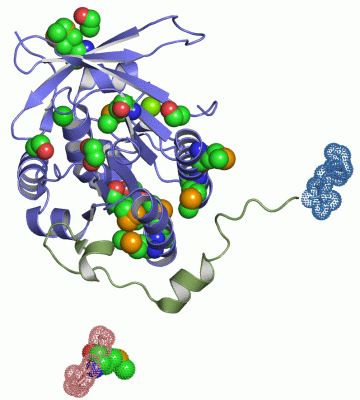
Asymmetric/Biological Unit(hide GO term definitions)
Chain A ( RAD51_HUMAN | Q06609)
| molecular function |
|---|
| | GO:0005524 | | ATP binding | | Interacting selectively and non-covalently with ATP, adenosine 5'-triphosphate, a universally important coenzyme and enzyme regulator. |
| | GO:0003677 | | DNA binding | | Any molecular function by which a gene product interacts selectively and non-covalently with DNA (deoxyribonucleic acid). |
| | GO:0070182 | | DNA polymerase binding | | Interacting selectively and non-covalently with a DNA polymerase. |
| | GO:0008094 | | DNA-dependent ATPase activity | | Catalysis of the reaction: ATP + H2O = ADP + phosphate; this reaction requires the presence of single- or double-stranded DNA, and it drives another reaction. |
| | GO:0003682 | | chromatin binding | | Interacting selectively and non-covalently with chromatin, the network of fibers of DNA, protein, and sometimes RNA, that make up the chromosomes of the eukaryotic nucleus during interphase. |
| | GO:0003690 | | double-stranded DNA binding | | Interacting selectively and non-covalently with double-stranded DNA. |
| | GO:0004520 | | endodeoxyribonuclease activity | | Catalysis of the hydrolysis of ester linkages within deoxyribonucleic acid by creating internal breaks. |
| | GO:0000400 | | four-way junction DNA binding | | Interacting selectively and non-covalently with DNA containing four-way junctions, also known as Holliday junctions, a structure where two DNA double strands are held together by reciprocal exchange of two of the four strands, one strand each from the two original helices. |
| | GO:0042802 | | identical protein binding | | Interacting selectively and non-covalently with an identical protein or proteins. |
| | GO:0000166 | | nucleotide binding | | Interacting selectively and non-covalently with a nucleotide, any compound consisting of a nucleoside that is esterified with (ortho)phosphate or an oligophosphate at any hydroxyl group on the ribose or deoxyribose. |
| | GO:0008022 | | protein C-terminus binding | | Interacting selectively and non-covalently with a protein C-terminus, the end of any peptide chain at which the 1-carboxy function of a constituent amino acid is not attached in peptide linkage to another amino-acid residue. |
| | GO:0005515 | | protein binding | | Interacting selectively and non-covalently with any protein or protein complex (a complex of two or more proteins that may include other nonprotein molecules). |
| | GO:0000150 | | recombinase activity | | Catalysis of the identification and base-pairing of homologous sequences between single-stranded DNA and double-stranded DNA. |
| | GO:0003697 | | single-stranded DNA binding | | Interacting selectively and non-covalently with single-stranded DNA. |
| | GO:0043142 | | single-stranded DNA-dependent ATPase activity | | Catalysis of the reaction: ATP + H2O = ADP + phosphate; this reaction requires the presence of single-stranded DNA, and it drives another reaction. |
| biological process |
|---|
| | GO:0006259 | | DNA metabolic process | | Any cellular metabolic process involving deoxyribonucleic acid. This is one of the two main types of nucleic acid, consisting of a long, unbranched macromolecule formed from one, or more commonly, two, strands of linked deoxyribonucleotides. |
| | GO:0000730 | | DNA recombinase assembly | | The aggregation, arrangement and bonding together of strand exchange proteins (recombinases) into higher order oligomers on single-stranded DNA. |
| | GO:0006310 | | DNA recombination | | Any process in which a new genotype is formed by reassortment of genes resulting in gene combinations different from those that were present in the parents. In eukaryotes genetic recombination can occur by chromosome assortment, intrachromosomal recombination, or nonreciprocal interchromosomal recombination. Intrachromosomal recombination occurs by crossing over. In bacteria it may occur by genetic transformation, conjugation, transduction, or F-duction. |
| | GO:0006281 | | DNA repair | | The process of restoring DNA after damage. Genomes are subject to damage by chemical and physical agents in the environment (e.g. UV and ionizing radiations, chemical mutagens, fungal and bacterial toxins, etc.) and by free radicals or alkylating agents endogenously generated in metabolism. DNA is also damaged because of errors during its replication. A variety of different DNA repair pathways have been reported that include direct reversal, base excision repair, nucleotide excision repair, photoreactivation, bypass, double-strand break repair pathway, and mismatch repair pathway. |
| | GO:0000731 | | DNA synthesis involved in DNA repair | | Synthesis of DNA that proceeds from the broken 3' single-strand DNA end and uses the homologous intact duplex as the template. |
| | GO:0006268 | | DNA unwinding involved in DNA replication | | The process in which interchain hydrogen bonds between two strands of DNA are broken or 'melted', generating unpaired template strands for DNA replication. |
| | GO:0006974 | | cellular response to DNA damage stimulus | | Any process that results in a change in state or activity of a cell (in terms of movement, secretion, enzyme production, gene expression, etc.) as a result of a stimulus indicating damage to its DNA from environmental insults or errors during metabolism. |
| | GO:0071312 | | cellular response to alkaloid | | Any process that results in a change in state or activity of a cell (in terms of movement, secretion, enzyme production, gene expression, etc.) as a result of an alkaloid stimulus. Alkaloids are a large group of nitrogenous substances found in naturally in plants, many of which have extracts that are pharmacologically active. |
| | GO:0072757 | | cellular response to camptothecin | | Any process that results in a change in state or activity of a cell (in terms of movement, secretion, enzyme production, gene expression, etc.) as a result of a camptothecin stimulus. |
| | GO:0072719 | | cellular response to cisplatin | | Any process that results in a change in state or activity of a cell (in terms of movement, secretion, enzyme production, gene expression, etc.) as a result of a cisplatin stimulus. |
| | GO:0071480 | | cellular response to gamma radiation | | Any process that results in a change in state or activity of a cell (in terms of movement, secretion, enzyme production, gene expression, etc.) as a result of a gamma radiation stimulus. Gamma radiation is a form of electromagnetic radiation (EMR) or light emission of a specific frequency produced from sub-atomic particle interaction, such as electron-positron annihilation and radioactive decay. Gamma rays are generally characterized as EMR having the highest frequency and energy, and also the shortest wavelength, within the electromagnetic radiation spectrum. |
| | GO:0072711 | | cellular response to hydroxyurea | | Any process that results in a change in state or activity of a cell (in terms of movement, secretion, enzyme production, gene expression, etc.) as a result of a hydroxyurea stimulus. |
| | GO:0071479 | | cellular response to ionizing radiation | | Any process that results in a change in state or activity of a cell (in terms of movement, secretion, enzyme production, gene expression, etc.) as a result of a ionizing radiation stimulus. Ionizing radiation is radiation with sufficient energy to remove electrons from atoms and may arise from spontaneous decay of unstable isotopes, resulting in alpha and beta particles and gamma rays. Ionizing radiation also includes X-rays. |
| | GO:0070192 | | chromosome organization involved in meiotic cell cycle | | A process of chromosome organization that is involved in a meiotic cell cycle. |
| | GO:0000724 | | double-strand break repair via homologous recombination | | The error-free repair of a double-strand break in DNA in which the broken DNA molecule is repaired using homologous sequences. A strand in the broken DNA searches for a homologous region in an intact chromosome to serve as the template for DNA synthesis. The restoration of two intact DNA molecules results in the exchange, reciprocal or nonreciprocal, of genetic material between the intact DNA molecule and the broken DNA molecule. |
| | GO:0007127 | | meiosis I | | The first meiotic nuclear division in which homologous chromosomes are paired and segregated from each other, producing two haploid daughter nuclei. |
| | GO:0006312 | | mitotic recombination | | The exchange, reciprocal or nonreciprocal, of genetic material between one DNA molecule and a homologous region of DNA that occurs during mitotic cell cycles. |
| | GO:1990426 | | mitotic recombination-dependent replication fork processing | | Replication fork processing that includes recombination between DNA near the arrested fork and homologous sequences. Proteins involved in homologous recombination are required for replication restart. |
| | GO:0051106 | | positive regulation of DNA ligation | | Any process that activates or increases the frequency, rate or extent of DNA ligation, the re-formation of a broken phosphodiester bond in the DNA backbone, carried out by DNA ligase. |
| | GO:0051260 | | protein homooligomerization | | The process of creating protein oligomers, compounds composed of a small number, usually between three and ten, of identical component monomers. Oligomers may be formed by the polymerization of a number of monomers or the depolymerization of a large protein polymer. |
| | GO:0007131 | | reciprocal meiotic recombination | | The cell cycle process in which double strand breaks are formed and repaired through a double Holliday junction intermediate. This results in the equal exchange of genetic material between non-sister chromatids in a pair of homologous chromosomes. These reciprocal recombinant products ensure the proper segregation of homologous chromosomes during meiosis I and create genetic diversity. |
| | GO:0010569 | | regulation of double-strand break repair via homologous recombination | | Any process that modulates the frequency, rate or extent of the error-free repair of a double-strand break in DNA in which the broken DNA molecule is repaired using homologous sequences. |
| | GO:0001932 | | regulation of protein phosphorylation | | Any process that modulates the frequency, rate or extent of addition of phosphate groups into an amino acid in a protein. |
| | GO:0031297 | | replication fork processing | | The process in which a DNA replication fork that has stalled is restored to a functional state and replication is restarted. The stalling may be due to DNA damage, DNA secondary structure, bound proteins, dNTP shortage, or other causes. |
| | GO:1990414 | | replication-born double-strand break repair via sister chromatid exchange | | The repair of a replication-born double-strand DNA break in which the DNA molecule is repaired using the homologous sequence of the sister chromatid which serves as a template to repair the breaks. |
| | GO:0010165 | | response to X-ray | | Any process that results in a change in state or activity of a cell or an organism (in terms of movement, secretion, enzyme production, gene expression, etc.) as a result of X-ray radiation. An X-ray is a form of electromagnetic radiation with a wavelength in the range of 10 nanometers to 100 picometers (corresponding to frequencies in the range 30 PHz to 3 EHz). |
| | GO:0042493 | | response to drug | | Any process that results in a change in state or activity of a cell or an organism (in terms of movement, secretion, enzyme production, gene expression, etc.) as a result of a drug stimulus. A drug is a substance used in the diagnosis, treatment or prevention of a disease. |
| | GO:1902521 | | response to etoposide | | Any process that results in a change in state or activity of a cell or an organism (in terms of movement, secretion, enzyme production, gene expression, etc.) as a result of an etoposide stimulus. |
| | GO:0014070 | | response to organic cyclic compound | | Any process that results in a change in state or activity of a cell or an organism (in terms of movement, secretion, enzyme production, gene expression, etc.) as a result of an organic cyclic compound stimulus. |
| | GO:0009636 | | response to toxic substance | | Any process that results in a change in state or activity of a cell or an organism (in terms of movement, secretion, enzyme production, gene expression, etc.) as a result of a toxic stimulus. |
| | GO:0000732 | | strand displacement | | The rejection of the broken 3' single-strand DNA molecule that formed heteroduplex DNA with its complement in an intact duplex DNA. The Watson-Crick base pairing in the original duplex is restored. The rejected 3' single-strand DNA molecule reanneals with its original complement to reform two intact duplex molecules. |
| | GO:0042148 | | strand invasion | | The process in which the nucleoprotein complex (composed of the broken single-strand DNA and the recombinase) searches and identifies a region of homology in intact duplex DNA. The broken single-strand DNA displaces the like strand and forms Watson-Crick base pairs with its complement, forming a duplex in which each strand is from one of the two recombining DNA molecules. |
| | GO:0000722 | | telomere maintenance via recombination | | Any recombinational process that contributes to the maintenance of proper telomeric length. |
| | GO:0010833 | | telomere maintenance via telomere lengthening | | Any process that contributes to the maintenance of proper telomeric length and structure by affecting and monitoring the activity of telomeric proteins and lengthening the telomeric DNA. |
| | GO:0032200 | | telomere organization | | A process that is carried out at the cellular level which results in the assembly, arrangement of constituent parts, or disassembly of telomeres, terminal regions of a linear chromosome that include the telomeric DNA repeats and associated proteins. |
| cellular component |
|---|
| | GO:0016605 | | PML body | | A class of nuclear body; they react against SP100 auto-antibodies (PML, promyelocytic leukemia); cells typically contain 10-30 PML bodies per nucleus; alterations in the localization of PML bodies occurs after viral infection. |
| | GO:0000785 | | chromatin | | The ordered and organized complex of DNA, protein, and sometimes RNA, that forms the chromosome. |
| | GO:0000793 | | condensed chromosome | | A highly compacted molecule of DNA and associated proteins resulting in a cytologically distinct structure. |
| | GO:0000794 | | condensed nuclear chromosome | | A highly compacted molecule of DNA and associated proteins resulting in a cytologically distinct nuclear chromosome. |
| | GO:0005737 | | cytoplasm | | All of the contents of a cell excluding the plasma membrane and nucleus, but including other subcellular structures. |
| | GO:0005856 | | cytoskeleton | | Any of the various filamentous elements that form the internal framework of cells, and typically remain after treatment of the cells with mild detergent to remove membrane constituents and soluble components of the cytoplasm. The term embraces intermediate filaments, microfilaments, microtubules, the microtrabecular lattice, and other structures characterized by a polymeric filamentous nature and long-range order within the cell. The various elements of the cytoskeleton not only serve in the maintenance of cellular shape but also have roles in other cellular functions, including cellular movement, cell division, endocytosis, and movement of organelles. |
| | GO:0000800 | | lateral element | | A proteinaceous core found between sister chromatids during meiotic prophase. |
| | GO:0005815 | | microtubule organizing center | | An intracellular structure that can catalyze gamma-tubulin-dependent microtubule nucleation and that can anchor microtubules by interacting with their minus ends, plus ends or sides. |
| | GO:0005759 | | mitochondrial matrix | | The gel-like material, with considerable fine structure, that lies in the matrix space, or lumen, of a mitochondrion. It contains the enzymes of the tricarboxylic acid cycle and, in some organisms, the enzymes concerned with fatty acid oxidation. |
| | GO:0005739 | | mitochondrion | | A semiautonomous, self replicating organelle that occurs in varying numbers, shapes, and sizes in the cytoplasm of virtually all eukaryotic cells. It is notably the site of tissue respiration. |
| | GO:0000228 | | nuclear chromosome | | A chromosome that encodes the nuclear genome and is found in the nucleus of a eukaryotic cell during the cell cycle phases when the nucleus is intact. |
| | GO:0000784 | | nuclear chromosome, telomeric region | | The terminal region of a linear nuclear chromosome that includes the telomeric DNA repeats and associated proteins. |
| | GO:0005730 | | nucleolus | | A small, dense body one or more of which are present in the nucleus of eukaryotic cells. It is rich in RNA and protein, is not bounded by a limiting membrane, and is not seen during mitosis. Its prime function is the transcription of the nucleolar DNA into 45S ribosomal-precursor RNA, the processing of this RNA into 5.8S, 18S, and 28S components of ribosomal RNA, and the association of these components with 5S RNA and proteins synthesized outside the nucleolus. This association results in the formation of ribonucleoprotein precursors; these pass into the cytoplasm and mature into the 40S and 60S subunits of the ribosome. |
| | GO:0005654 | | nucleoplasm | | That part of the nuclear content other than the chromosomes or the nucleolus. |
| | GO:0005634 | | nucleus | | A membrane-bounded organelle of eukaryotic cells in which chromosomes are housed and replicated. In most cells, the nucleus contains all of the cell's chromosomes except the organellar chromosomes, and is the site of RNA synthesis and processing. In some species, or in specialized cell types, RNA metabolism or DNA replication may be absent. |
| | GO:0048471 | | perinuclear region of cytoplasm | | Cytoplasm situated near, or occurring around, the nucleus. |
| | GO:0035861 | | site of double-strand break | | A region of a chromosome at which a DNA double-strand break has occurred. DNA damage signaling and repair proteins accumulate at the lesion to respond to the damage and repair the DNA to form a continuous DNA helix. |
Chain B ( BRCA2_HUMAN | P51587)
| molecular function |
|---|
| | GO:0003677 | | DNA binding | | Any molecular function by which a gene product interacts selectively and non-covalently with DNA (deoxyribonucleic acid). |
| | GO:0010484 | | H3 histone acetyltransferase activity | | Catalysis of the reaction: acetyl-CoA + histone H3 = CoA + acetyl-histone H3. |
| | GO:0010485 | | H4 histone acetyltransferase activity | | Catalysis of the reaction: acetyl-CoA + histone H4 = CoA + acetyl-histone H4. |
| | GO:0043015 | | gamma-tubulin binding | | Interacting selectively and non-covalently with the microtubule constituent protein gamma-tubulin. |
| | GO:0004402 | | histone acetyltransferase activity | | Catalysis of the reaction: acetyl-CoA + histone = CoA + acetyl-histone. |
| | GO:0002020 | | protease binding | | Interacting selectively and non-covalently with any protease or peptidase. |
| | GO:0005515 | | protein binding | | Interacting selectively and non-covalently with any protein or protein complex (a complex of two or more proteins that may include other nonprotein molecules). |
| | GO:0003697 | | single-stranded DNA binding | | Interacting selectively and non-covalently with single-stranded DNA. |
| biological process |
|---|
| | GO:0006978 | | DNA damage response, signal transduction by p53 class mediator resulting in transcription of p21 class mediator | | A cascade of processes induced by the cell cycle regulator phosphoprotein p53, or an equivalent protein, resulting in the induction of the transcription of p21 (also known as WAF1, CIP1 and SDI1) or any equivalent protein, in response to the detection of DNA damage. |
| | GO:0006310 | | DNA recombination | | Any process in which a new genotype is formed by reassortment of genes resulting in gene combinations different from those that were present in the parents. In eukaryotes genetic recombination can occur by chromosome assortment, intrachromosomal recombination, or nonreciprocal interchromosomal recombination. Intrachromosomal recombination occurs by crossing over. In bacteria it may occur by genetic transformation, conjugation, transduction, or F-duction. |
| | GO:0006281 | | DNA repair | | The process of restoring DNA after damage. Genomes are subject to damage by chemical and physical agents in the environment (e.g. UV and ionizing radiations, chemical mutagens, fungal and bacterial toxins, etc.) and by free radicals or alkylating agents endogenously generated in metabolism. DNA is also damaged because of errors during its replication. A variety of different DNA repair pathways have been reported that include direct reversal, base excision repair, nucleotide excision repair, photoreactivation, bypass, double-strand break repair pathway, and mismatch repair pathway. |
| | GO:0000731 | | DNA synthesis involved in DNA repair | | Synthesis of DNA that proceeds from the broken 3' single-strand DNA end and uses the homologous intact duplex as the template. |
| | GO:0007420 | | brain development | | The process whose specific outcome is the progression of the brain over time, from its formation to the mature structure. Brain development begins with patterning events in the neural tube and ends with the mature structure that is the center of thought and emotion. The brain is responsible for the coordination and control of bodily activities and the interpretation of information from the senses (sight, hearing, smell, etc.). |
| | GO:0007569 | | cell aging | | An aging process that has as participant a cell after a cell has stopped dividing. Cell aging may occur when a cell has temporarily stopped dividing through cell cycle arrest (GO:0007050) or when a cell has permanently stopped dividing, in which case it is undergoing cellular senescence (GO:0090398). May precede cell death (GO:0008219) and succeed cell maturation (GO:0048469). |
| | GO:0007049 | | cell cycle | | The progression of biochemical and morphological phases and events that occur in a cell during successive cell replication or nuclear replication events. Canonically, the cell cycle comprises the replication and segregation of genetic material followed by the division of the cell, but in endocycles or syncytial cells nuclear replication or nuclear division may not be followed by cell division. |
| | GO:0008283 | | cell proliferation | | The multiplication or reproduction of cells, resulting in the expansion of a cell population. |
| | GO:0006974 | | cellular response to DNA damage stimulus | | Any process that results in a change in state or activity of a cell (in terms of movement, secretion, enzyme production, gene expression, etc.) as a result of a stimulus indicating damage to its DNA from environmental insults or errors during metabolism. |
| | GO:0051298 | | centrosome duplication | | The replication of a centrosome, a structure comprised of a pair of centrioles and peri-centriolar material from which a microtubule spindle apparatus is organized. |
| | GO:0043009 | | chordate embryonic development | | The process whose specific outcome is the progression of the embryo over time, from zygote formation through a stage including a notochord and neural tube until birth or egg hatching. |
| | GO:0031052 | | chromosome breakage | | Regulated cleavage of the developing macronuclear genome at a limited number of chromosome breakage sites (CBS). The macronuclear destined segment (MDS) sequence adjacent to the CBS (or separated from it by a BES) receives a macronuclear telomere following chromosome breakage. |
| | GO:0051276 | | chromosome organization | | A process that is carried out at the cellular level that results in the assembly, arrangement of constituent parts, or disassembly of chromosomes, structures composed of a very long molecule of DNA and associated proteins that carries hereditary information. This term covers covalent modifications at the molecular level as well as spatial relationships among the major components of a chromosome. |
| | GO:0000910 | | cytokinesis | | The division of the cytoplasm and the plasma membrane of a cell and its partitioning into two daughter cells. |
| | GO:0006302 | | double-strand break repair | | The repair of double-strand breaks in DNA via homologous and nonhomologous mechanisms to reform a continuous DNA helix. |
| | GO:0000724 | | double-strand break repair via homologous recombination | | The error-free repair of a double-strand break in DNA in which the broken DNA molecule is repaired using homologous sequences. A strand in the broken DNA searches for a homologous region in an intact chromosome to serve as the template for DNA synthesis. The restoration of two intact DNA molecules results in the exchange, reciprocal or nonreciprocal, of genetic material between the intact DNA molecule and the broken DNA molecule. |
| | GO:0070200 | | establishment of protein localization to telomere | | The directed movement of a protein to a specific location in the telomeric region of a chromosome. |
| | GO:0008585 | | female gonad development | | The process whose specific outcome is the progression of the female gonad over time, from its formation to the mature structure. |
| | GO:0030097 | | hemopoiesis | | The process whose specific outcome is the progression of the myeloid and lymphoid derived organ/tissue systems of the blood and other parts of the body over time, from formation to the mature structure. The site of hemopoiesis is variable during development, but occurs primarily in bone marrow or kidney in many adult vertebrates. |
| | GO:0043966 | | histone H3 acetylation | | The modification of histone H3 by the addition of an acetyl group. |
| | GO:0043967 | | histone H4 acetylation | | The modification of histone H4 by the addition of an acetyl group. |
| | GO:0031619 | | homologous chromosome orientation involved in meiotic metaphase I plate congression | | The cell cycle process in which the sister centromeres of one chromosome attach to microtubules that emanate from the same spindle pole, which ensures that homologous maternal and paternal chromosomes are pulled in opposite directions at anaphase of meiosis I. |
| | GO:0001833 | | inner cell mass cell proliferation | | The proliferation of cells in the inner cell mass. |
| | GO:0008630 | | intrinsic apoptotic signaling pathway in response to DNA damage | | A series of molecular signals in which an intracellular signal is conveyed to trigger the apoptotic death of a cell. The pathway is induced by the detection of DNA damage, and ends when the execution phase of apoptosis is triggered. |
| | GO:0042771 | | intrinsic apoptotic signaling pathway in response to DNA damage by p53 class mediator | | A series of molecular signals in which an intracellular signal is conveyed to trigger the apoptotic death of a cell. The pathway is induced by the cell cycle regulator phosphoprotein p53, or an equivalent protein, in response to the detection of DNA damage, and ends when the execution phase of apoptosis is triggered. |
| | GO:0007141 | | male meiosis I | | A cell cycle process comprising the steps by which a cell progresses through male meiosis I, the first meiotic division in the male germline. |
| | GO:0030879 | | mammary gland development | | The process whose specific outcome is the progression of the mammary gland over time, from its formation to the mature structure. The mammary gland is a large compound sebaceous gland that in female mammals is modified to secrete milk. Its development starts with the formation of the mammary line and ends as the mature gland cycles between nursing and weaning stages. |
| | GO:1990426 | | mitotic recombination-dependent replication fork processing | | Replication fork processing that includes recombination between DNA near the arrested fork and homologous sequences. Proteins involved in homologous recombination are required for replication restart. |
| | GO:0035264 | | multicellular organism growth | | The increase in size or mass of an entire multicellular organism, as opposed to cell growth. |
| | GO:0033600 | | negative regulation of mammary gland epithelial cell proliferation | | Any process that stops, prevents or reduces the rate or extent of mammary gland epithelial cell proliferation. |
| | GO:0006289 | | nucleotide-excision repair | | A DNA repair process in which a small region of the strand surrounding the damage is removed from the DNA helix as an oligonucleotide. The small gap left in the DNA helix is filled in by the sequential action of DNA polymerase and DNA ligase. Nucleotide excision repair recognizes a wide range of substrates, including damage caused by UV irradiation (pyrimidine dimers and 6-4 photoproducts) and chemicals (intrastrand cross-links and bulky adducts). |
| | GO:0001556 | | oocyte maturation | | A developmental process, independent of morphogenetic (shape) change, that is required for an oocyte to attain its fully functional state. Oocyte maturation commences after reinitiation of meiosis commonly starting with germinal vesicle breakdown, and continues up to the second meiotic arrest prior to fertilization. |
| | GO:0045931 | | positive regulation of mitotic cell cycle | | Any process that activates or increases the rate or extent of progression through the mitotic cell cycle. |
| | GO:0045893 | | positive regulation of transcription, DNA-templated | | Any process that activates or increases the frequency, rate or extent of cellular DNA-templated transcription. |
| | GO:0032465 | | regulation of cytokinesis | | Any process that modulates the frequency, rate or extent of the division of the cytoplasm of a cell and its separation into two daughter cells. |
| | GO:0048478 | | replication fork protection | | Any process that prevents the collapse of stalled replication forks. |
| | GO:0010225 | | response to UV-C | | Any process that results in a change in state or activity of a cell or an organism (in terms of movement, secretion, enzyme production, gene expression, etc.) as a result of a UV-C radiation stimulus. UV-C radiation (UV-C light) spans the wavelengths 100 to 280 nm. |
| | GO:0010165 | | response to X-ray | | Any process that results in a change in state or activity of a cell or an organism (in terms of movement, secretion, enzyme production, gene expression, etc.) as a result of X-ray radiation. An X-ray is a form of electromagnetic radiation with a wavelength in the range of 10 nanometers to 100 picometers (corresponding to frequencies in the range 30 PHz to 3 EHz). |
| | GO:0032355 | | response to estradiol | | Any process that results in a change in state or activity of a cell or an organism (in terms of movement, secretion, enzyme production, gene expression, etc.) as a result of stimulus by estradiol, a C18 steroid hormone hydroxylated at C3 and C17 that acts as a potent estrogen. |
| | GO:0010332 | | response to gamma radiation | | Any process that results in a change in state or activity of a cell or an organism (in terms of movement, secretion, enzyme production, gene expression, etc.) as a result of a gamma radiation stimulus. Gamma radiation is a form of electromagnetic radiation (EMR) or light emission of a specific frequency produced from sub-atomic particle interaction, such as electron-positron annihilation and radioactive decay. Gamma rays are generally characterized as EMR having the highest frequency and energy, and also the shortest wavelength, within the electromagnetic radiation spectrum. |
| | GO:0007584 | | response to nutrient | | Any process that results in a change in state or activity of a cell or an organism (in terms of movement, secretion, enzyme production, gene expression, etc.) as a result of a nutrient stimulus. |
| | GO:0007283 | | spermatogenesis | | The process of formation of spermatozoa, including spermatocytogenesis and spermiogenesis. |
| | GO:0000732 | | strand displacement | | The rejection of the broken 3' single-strand DNA molecule that formed heteroduplex DNA with its complement in an intact duplex DNA. The Watson-Crick base pairing in the original duplex is restored. The rejected 3' single-strand DNA molecule reanneals with its original complement to reform two intact duplex molecules. |
| | GO:0000722 | | telomere maintenance via recombination | | Any recombinational process that contributes to the maintenance of proper telomeric length. |
| cellular component |
|---|
| | GO:0033593 | | BRCA2-MAGE-D1 complex | | A heterodimeric protein complex formed of BRCA2 and MAGE-D1; may mediate the synergistic activities of the two proteins in regulating cell growth. |
| | GO:0005813 | | centrosome | | A structure comprised of a core structure (in most organisms, a pair of centrioles) and peripheral material from which a microtubule-based structure, such as a spindle apparatus, is organized. Centrosomes occur close to the nucleus during interphase in many eukaryotic cells, though in animal cells it changes continually during the cell-division cycle. |
| | GO:0005737 | | cytoplasm | | All of the contents of a cell excluding the plasma membrane and nucleus, but including other subcellular structures. |
| | GO:0005856 | | cytoskeleton | | Any of the various filamentous elements that form the internal framework of cells, and typically remain after treatment of the cells with mild detergent to remove membrane constituents and soluble components of the cytoplasm. The term embraces intermediate filaments, microfilaments, microtubules, the microtrabecular lattice, and other structures characterized by a polymeric filamentous nature and long-range order within the cell. The various elements of the cytoskeleton not only serve in the maintenance of cellular shape but also have roles in other cellular functions, including cellular movement, cell division, endocytosis, and movement of organelles. |
| | GO:0005815 | | microtubule organizing center | | An intracellular structure that can catalyze gamma-tubulin-dependent microtubule nucleation and that can anchor microtubules by interacting with their minus ends, plus ends or sides. |
| | GO:0000784 | | nuclear chromosome, telomeric region | | The terminal region of a linear nuclear chromosome that includes the telomeric DNA repeats and associated proteins. |
| | GO:0005654 | | nucleoplasm | | That part of the nuclear content other than the chromosomes or the nucleolus. |
| | GO:0005634 | | nucleus | | A membrane-bounded organelle of eukaryotic cells in which chromosomes are housed and replicated. In most cells, the nucleus contains all of the cell's chromosomes except the organellar chromosomes, and is the site of RNA synthesis and processing. In some species, or in specialized cell types, RNA metabolism or DNA replication may be absent. |
| | GO:0043234 | | protein complex | | A stable macromolecular complex composed (only) of two or more polypeptide subunits along with any covalently attached molecules (such as lipid anchors or oligosaccharide) or non-protein prosthetic groups (such as nucleotides or metal ions). Prosthetic group in this context refers to a tightly bound cofactor. The component polypeptide subunits may be identical. |
| | GO:0030141 | | secretory granule | | A small subcellular vesicle, surrounded by a membrane, that is formed from the Golgi apparatus and contains a highly concentrated protein destined for secretion. Secretory granules move towards the periphery of the cell and upon stimulation, their membranes fuse with the cell membrane, and their protein load is exteriorized. Processing of the contained protein may take place in secretory granules. |
|

 Description