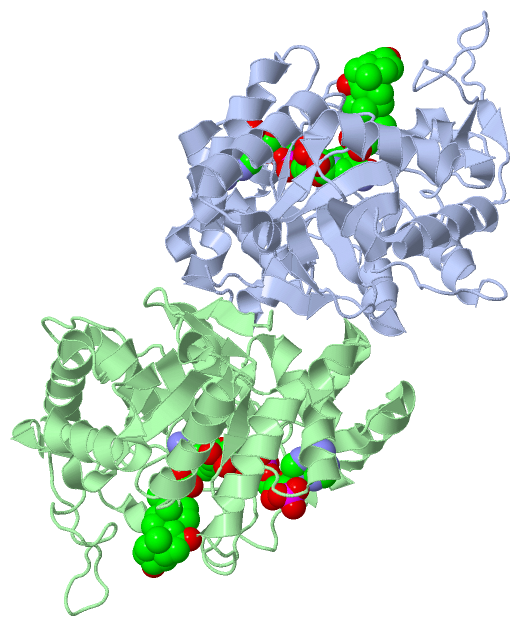
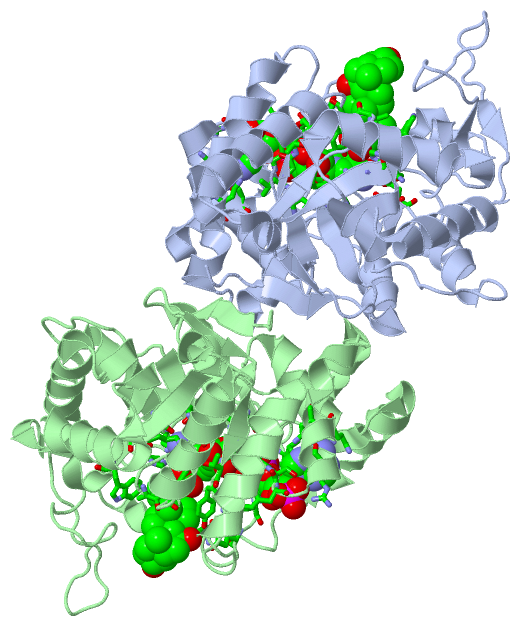
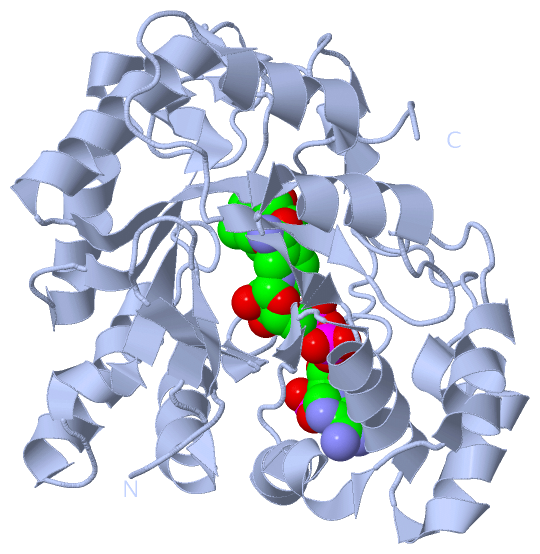
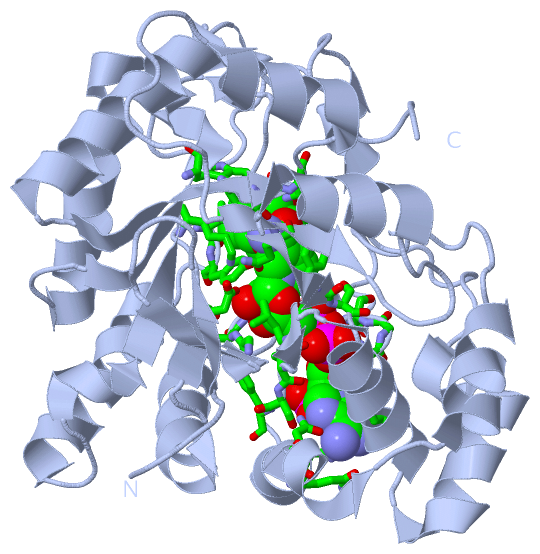
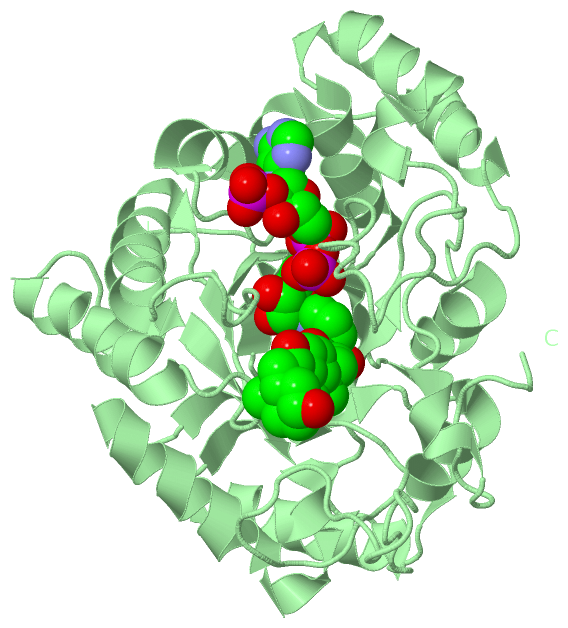
| molecular function |
|---|
| | GO:0004032 | | alditol:NADP+ 1-oxidoreductase activity | | Catalysis of the reaction: an alditol + NADP+ = an aldose + NADPH + H+. |
| | GO:0032052 | | bile acid binding | | Interacting selectively and non-covalently with bile acids, any of a group of steroid carboxylic acids occurring in bile. |
| | GO:0031406 | | carboxylic acid binding | | Interacting selectively and non-covalently with a carboxylic acid, any organic acid containing one or more carboxyl (COOH) groups or anions (COO-). |
| | GO:0047086 | | ketosteroid monooxygenase activity | | Catalysis of the reaction: O2 + NADPH + progesterone = H2O + NADP+ + testosterone acetate. |
| | GO:0016491 | | oxidoreductase activity | | Catalysis of an oxidation-reduction (redox) reaction, a reversible chemical reaction in which the oxidation state of an atom or atoms within a molecule is altered. One substrate acts as a hydrogen or electron donor and becomes oxidized, while the other acts as hydrogen or electron acceptor and becomes reduced. |
| | GO:0016655 | | oxidoreductase activity, acting on NAD(P)H, quinone or similar compound as acceptor | | Catalysis of an oxidation-reduction (redox) reaction in which NADH or NADPH acts as a hydrogen or electron donor and reduces a quinone or a similar acceptor molecule. |
| | GO:0018636 | | phenanthrene 9,10-monooxygenase activity | | Catalysis of the reaction: phenanthrene + O2 + NADH + H+ = H2O + NAD+ + phenanthrene-9,10-oxide. |
| | GO:0047115 | | trans-1,2-dihydrobenzene-1,2-diol dehydrogenase activity | | Catalysis of the reaction: NADP+ + trans-1,2-dihydrobenzene-1,2-diol = NADPH + catechol. |
| biological process |
|---|
| | GO:0007186 | | G-protein coupled receptor signaling pathway | | A series of molecular signals that proceeds with an activated receptor promoting the exchange of GDP for GTP on the alpha-subunit of an associated heterotrimeric G-protein complex. The GTP-bound activated alpha-G-protein then dissociates from the beta- and gamma-subunits to further transmit the signal within the cell. The pathway begins with receptor-ligand interaction, or for basal GPCR signaling the pathway begins with the receptor activating its G protein in the absence of an agonist, and ends with regulation of a downstream cellular process, e.g. transcription. The pathway can start from the plasma membrane, Golgi or nuclear membrane (PMID:24568158 and PMID:16902576). |
| | GO:0071395 | | cellular response to jasmonic acid stimulus | | Any process that results in a change in state or activity of a cell (in terms of movement, secretion, enzyme production, gene expression, etc.) as a result of a jasmonic acid stimulus. |
| | GO:0071799 | | cellular response to prostaglandin D stimulus | | Any process that results in a change in state or activity of a cell (in terms of movement, secretion, enzyme production, gene expression, etc.) as a result of a prostagladin D stimulus. |
| | GO:0044597 | | daunorubicin metabolic process | | The chemical reactions and pathways involving daunorubicin, a chemotherapeutic of the anthracycline family that is given as a treatment for some types of cancer. |
| | GO:0007586 | | digestion | | The whole of the physical, chemical, and biochemical processes carried out by multicellular organisms to break down ingested nutrients into components that may be easily absorbed and directed into metabolism. |
| | GO:0044598 | | doxorubicin metabolic process | | The chemical reactions and pathways involving doxorubicin, an anthracycline antibiotic, used in cancer chemotherapy. |
| | GO:0030855 | | epithelial cell differentiation | | The process in which a relatively unspecialized cell acquires specialized features of an epithelial cell, any of the cells making up an epithelium. |
| | GO:0006629 | | lipid metabolic process | | The chemical reactions and pathways involving lipids, compounds soluble in an organic solvent but not, or sparingly, in an aqueous solvent. Includes fatty acids; neutral fats, other fatty-acid esters, and soaps; long-chain (fatty) alcohols and waxes; sphingoids and other long-chain bases; glycolipids, phospholipids and sphingolipids; and carotenes, polyprenols, sterols, terpenes and other isoprenoids. |
| | GO:0055114 | | oxidation-reduction process | | A metabolic process that results in the removal or addition of one or more electrons to or from a substance, with or without the concomitant removal or addition of a proton or protons. |
| | GO:0008284 | | positive regulation of cell proliferation | | Any process that activates or increases the rate or extent of cell proliferation. |
| | GO:0051897 | | positive regulation of protein kinase B signaling | | Any process that activates or increases the frequency, rate or extent of protein kinase B signaling, a series of reactions mediated by the intracellular serine/threonine kinase protein kinase B. |
| | GO:0042448 | | progesterone metabolic process | | The chemical reactions and pathways involving progesterone, a steroid hormone produced in the ovary which prepares and maintains the uterus for pregnancy. Also found in plants. |
| | GO:0006693 | | prostaglandin metabolic process | | The chemical reactions and pathways involving prostaglandins, any of a group of biologically active metabolites which contain a cyclopentane ring due to the formation of a bond between two carbons of a fatty acid. They have a wide range of biological activities. |
| | GO:0008202 | | steroid metabolic process | | The chemical reactions and pathways involving steroids, compounds with a 1,2,cyclopentanoperhydrophenanthrene nucleus. |
| cellular component |
|---|
| | GO:0005737 | | cytoplasm | | All of the contents of a cell excluding the plasma membrane and nucleus, but including other subcellular structures. |

 Description