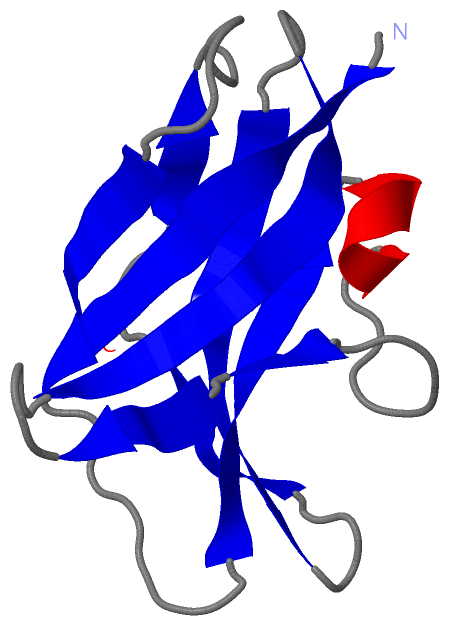
Asymmetric/Biological Unit(hide GO term definitions)
Chain A ( AMYB_BACCE | P36924)
| molecular function |
|---|
| | GO:0016161 | | beta-amylase activity | | Catalysis of the reaction: (1,4-alpha-D-glucosyl)(n+1) + H2O = (1,4-alpha-D-glucosyl)(n-1) + alpha-maltose. This reaction is the hydrolysis of 1,4-alpha-glucosidic linkages in polysaccharides so as to remove successive maltose units from the non-reducing ends of the chains. |
| | GO:0016787 | | hydrolase activity | | Catalysis of the hydrolysis of various bonds, e.g. C-O, C-N, C-C, phosphoric anhydride bonds, etc. Hydrolase is the systematic name for any enzyme of EC class 3. |
| | GO:0016798 | | hydrolase activity, acting on glycosyl bonds | | Catalysis of the hydrolysis of any glycosyl bond. |
| | GO:0046872 | | metal ion binding | | Interacting selectively and non-covalently with any metal ion. |
| | GO:2001070 | | starch binding | | Interacting selectively and non-covalently with starch. |
| biological process |
|---|
| | GO:0005975 | | carbohydrate metabolic process | | The chemical reactions and pathways involving carbohydrates, any of a group of organic compounds based of the general formula Cx(H2O)y. Includes the formation of carbohydrate derivatives by the addition of a carbohydrate residue to another molecule. |
| | GO:0008152 | | metabolic process | | The chemical reactions and pathways, including anabolism and catabolism, by which living organisms transform chemical substances. Metabolic processes typically transform small molecules, but also include macromolecular processes such as DNA repair and replication, and protein synthesis and degradation. |
| | GO:0000272 | | polysaccharide catabolic process | | The chemical reactions and pathways resulting in the breakdown of a polysaccharide, a polymer of many (typically more than 10) monosaccharide residues linked glycosidically. |
| | GO:0005976 | | polysaccharide metabolic process | | The chemical reactions and pathways involving a polysaccharide, a polymer of many (typically more than 10) monosaccharide residues linked glycosidically. |
Chain A ( Q9Z4N9_BACCE | Q9Z4N9)
| molecular function |
|---|
| | GO:0016161 | | beta-amylase activity | | Catalysis of the reaction: (1,4-alpha-D-glucosyl)(n+1) + H2O = (1,4-alpha-D-glucosyl)(n-1) + alpha-maltose. This reaction is the hydrolysis of 1,4-alpha-glucosidic linkages in polysaccharides so as to remove successive maltose units from the non-reducing ends of the chains. |
| | GO:0016787 | | hydrolase activity | | Catalysis of the hydrolysis of various bonds, e.g. C-O, C-N, C-C, phosphoric anhydride bonds, etc. Hydrolase is the systematic name for any enzyme of EC class 3. |
| | GO:0016798 | | hydrolase activity, acting on glycosyl bonds | | Catalysis of the hydrolysis of any glycosyl bond. |
| | GO:2001070 | | starch binding | | Interacting selectively and non-covalently with starch. |
| biological process |
|---|
| | GO:0005975 | | carbohydrate metabolic process | | The chemical reactions and pathways involving carbohydrates, any of a group of organic compounds based of the general formula Cx(H2O)y. Includes the formation of carbohydrate derivatives by the addition of a carbohydrate residue to another molecule. |
| | GO:0008152 | | metabolic process | | The chemical reactions and pathways, including anabolism and catabolism, by which living organisms transform chemical substances. Metabolic processes typically transform small molecules, but also include macromolecular processes such as DNA repair and replication, and protein synthesis and degradation. |
| | GO:0000272 | | polysaccharide catabolic process | | The chemical reactions and pathways resulting in the breakdown of a polysaccharide, a polymer of many (typically more than 10) monosaccharide residues linked glycosidically. |
| | GO:0005976 | | polysaccharide metabolic process | | The chemical reactions and pathways involving a polysaccharide, a polymer of many (typically more than 10) monosaccharide residues linked glycosidically. |
|

 Description