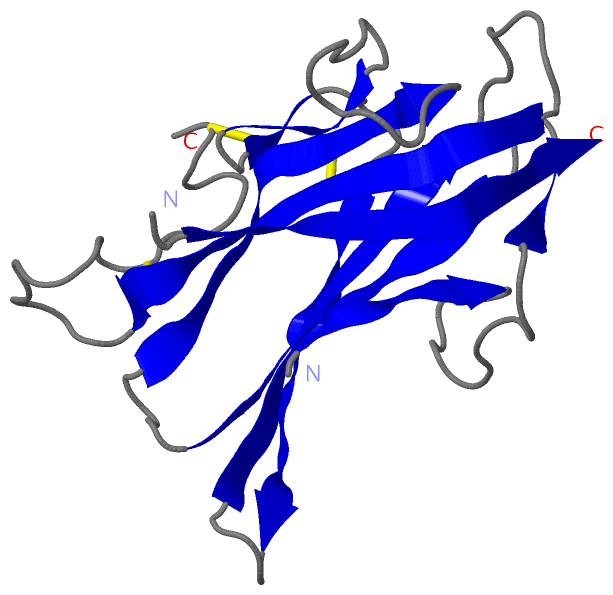
| molecular function |
|---|
| | GO:0030165 | | PDZ domain binding | | Interacting selectively and non-covalently with a PDZ domain of a protein, a domain found in diverse signaling proteins. |
| | GO:0046332 | | SMAD binding | | Interacting selectively and non-covalently with a SMAD signaling protein. |
| | GO:0015026 | | coreceptor activity | | Combining with an extracellular or intracellular messenger, and in cooperation with a nearby primary receptor, initiating a change in cell activity. |
| | GO:0005539 | | glycosaminoglycan binding | | Interacting selectively and non-covalently with any glycan (polysaccharide) containing a substantial proportion of aminomonosaccharide residues. |
| | GO:0005515 | | protein binding | | Interacting selectively and non-covalently with any protein or protein complex (a complex of two or more proteins that may include other nonprotein molecules). |
| | GO:0050431 | | transforming growth factor beta binding | | Interacting selectively and non-covalently with TGF-beta, transforming growth factor beta, a multifunctional peptide that controls proliferation, differentiation and other functions in many cell types. |
| | GO:0070123 | | transforming growth factor beta receptor activity, type III | | Combining with transforming growth factor beta to initiate a change in cell activity; facilitates ligand binding to type I and type II TGF-beta receptors. |
| | GO:0005024 | | transforming growth factor beta-activated receptor activity | | Combining with a transforming growth factor beta (TGFbeta) and transmitting the signal from one side of the membrane to the other to initiate a change in cell activity by catalysis of the reaction: ATP protein serine = ADP + protein serine phosphate, and ATP + protein threonine = ADP + protein threonine phosphate. |
| | GO:0005114 | | type II transforming growth factor beta receptor binding | | Interacting selectively and non-covalently with a type II transforming growth factor beta receptor. |
| biological process |
|---|
| | GO:0030509 | | BMP signaling pathway | | A series of molecular signals initiated by the binding of a member of the BMP (bone morphogenetic protein) family to a receptor on the surface of a target cell, and ending with regulation of a downstream cellular process, e.g. transcription. |
| | GO:0001824 | | blastocyst development | | The process whose specific outcome is the progression of the blastocyst over time, from its formation to the mature structure. The mammalian blastocyst is a hollow ball of cells containing two cell types, the inner cell mass and the trophectoderm. |
| | GO:0001568 | | blood vessel development | | The process whose specific outcome is the progression of a blood vessel over time, from its formation to the mature structure. The blood vessel is the vasculature carrying blood. |
| | GO:0001974 | | blood vessel remodeling | | The reorganization or renovation of existing blood vessels. |
| | GO:0060317 | | cardiac epithelial to mesenchymal transition | | A transition where a cardiac epithelial cell loses apical/basolateral polarity, severs intercellular adhesive junctions, degrades basement membrane components and becomes a migratory mesenchymal cell. |
| | GO:0060038 | | cardiac muscle cell proliferation | | The expansion of a cardiac muscle cell population by cell division. |
| | GO:0032963 | | collagen metabolic process | | The chemical reactions and pathways involving collagen, any of a group of fibrous proteins of very high tensile strength that form the main component of connective tissue in animals. Collagen is highly enriched in glycine (some regions are 33% glycine) and proline, occurring predominantly as 3-hydroxyproline (about 20%). |
| | GO:0060976 | | coronary vasculature development | | The process whose specific outcome is the progression of the blood vessels of the heart over time, from its formation to the mature structure. |
| | GO:0060977 | | coronary vasculature morphogenesis | | The process in which the anatomical structures of blood vessels of the heart are generated and organized. The blood vessel is the vasculature carrying blood. |
| | GO:0060318 | | definitive erythrocyte differentiation | | Erythrocyte differentiation which occurs as part of the process of definitive hemopoiesis. |
| | GO:0060216 | | definitive hemopoiesis | | A second wave of blood cell production that, in vertebrates, generates long-term hemopoietic stem cells that continously provide erythroid, myeloid and lymphoid lineages throughout adulthood. |
| | GO:0009790 | | embryo development | | The process whose specific outcome is the progression of an embryo from its formation until the end of its embryonic life stage. The end of the embryonic stage is organism-specific. For example, for mammals, the process would begin with zygote formation and end with birth. For insects, the process would begin at zygote formation and end with larval hatching. For plant zygotic embryos, this would be from zygote formation to the end of seed dormancy. For plant vegetative embryos, this would be from the initial determination of the cell or group of cells to form an embryo until the point when the embryo becomes independent of the parent plant. |
| | GO:0003347 | | epicardial cell to mesenchymal cell transition | | A transition where an epicardial cell loses apical/basolateral polarity, severs intercellular adhesive junctions, degrades basement membrane components and becomes a migratory mesenchymal cell. The epicardium is a part of the pericardium. |
| | GO:0001837 | | epithelial to mesenchymal transition | | A transition where an epithelial cell loses apical/basolateral polarity, severs intercellular adhesive junctions, degrades basement membrane components and becomes a migratory mesenchymal cell. |
| | GO:0060347 | | heart trabecula formation | | The process of creating a trabecula in the heart. A trabecula is a tissue element in the form of a small beam, strut or rod. |
| | GO:0006955 | | immune response | | Any immune system process that functions in the calibrated response of an organism to a potential internal or invasive threat. |
| | GO:0001701 | | in utero embryonic development | | The process whose specific outcome is the progression of the embryo in the uterus over time, from formation of the zygote in the oviduct, to birth. An example of this process is found in Mus musculus. |
| | GO:0035556 | | intracellular signal transduction | | The process in which a signal is passed on to downstream components within the cell, which become activated themselves to further propagate the signal and finally trigger a change in the function or state of the cell. |
| | GO:0001889 | | liver development | | The process whose specific outcome is the progression of the liver over time, from its formation to the mature structure. The liver is an exocrine gland which secretes bile and functions in metabolism of protein and carbohydrate and fat, synthesizes substances involved in the clotting of the blood, synthesizes vitamin A, detoxifies poisonous substances, stores glycogen, and breaks down worn-out erythrocytes. |
| | GO:1902338 | | negative regulation of apoptotic process involved in morphogenesis | | Any process that stops, prevents or reduces the frequency, rate or extent of apoptotic process involved in morphogenesis. |
| | GO:0051271 | | negative regulation of cellular component movement | | Any process that stops, prevents, or reduces the frequency, rate or extent of the movement of a cellular component. |
| | GO:0010633 | | negative regulation of epithelial cell migration | | Any process that stops, prevents, or reduces the frequency, rate or extent of epithelial cell migration. |
| | GO:0050680 | | negative regulation of epithelial cell proliferation | | Any process that stops, prevents or reduces the rate or extent of epithelial cell proliferation. |
| | GO:0010719 | | negative regulation of epithelial to mesenchymal transition | | Any process that decreases the rate, frequency, or extent of epithelial to mesenchymal transition. Epithelial to mesenchymal transition where an epithelial cell loses apical/basolateral polarity, severs intercellular adhesive junctions, degrades basement membrane components and becomes a migratory mesenchymal cell. |
| | GO:0010629 | | negative regulation of gene expression | | Any process that decreases the frequency, rate or extent of gene expression. Gene expression is the process in which a gene's coding sequence is converted into a mature gene product or products (proteins or RNA). This includes the production of an RNA transcript as well as any processing to produce a mature RNA product or an mRNA or circRNA (for protein-coding genes) and the translation of that mRNA or circRNA into protein. Protein maturation is included when required to form an active form of a product from an inactive precursor form. |
| | GO:0001649 | | osteoblast differentiation | | The process whereby a relatively unspecialized cell acquires the specialized features of an osteoblast, a mesodermal or neural crest cell that gives rise to bone. |
| | GO:0060021 | | palate development | | The biological process whose specific outcome is the progression of the palate from an initial condition to its mature state. This process begins with the formation of the structure and ends with the mature structure. The palate is the partition that separates the nasal and oral cavities. |
| | GO:0060389 | | pathway-restricted SMAD protein phosphorylation | | The process of introducing a phosphate group on to a pathway restricted SMAD protein. A pathway restricted SMAD protein is an effector protein that acts directly downstream of the transforming growth factor family receptor. |
| | GO:0030513 | | positive regulation of BMP signaling pathway | | Any process that activates or increases the frequency, rate or extent of BMP signaling pathway activity. |
| | GO:0051092 | | positive regulation of NF-kappaB transcription factor activity | | Any process that activates or increases the frequency, rate or extent of activity of the transcription factor NF-kappaB. |
| | GO:0008284 | | positive regulation of cell proliferation | | Any process that activates or increases the rate or extent of cell proliferation. |
| | GO:0030511 | | positive regulation of transforming growth factor beta receptor signaling pathway | | Any process that activates or increases the frequency, rate or extent of TGF-beta receptor signaling pathway activity. |
| | GO:0050880 | | regulation of blood vessel size | | Any process that modulates the size of blood vessels. |
| | GO:0032354 | | response to follicle-stimulating hormone | | Any process that results in a change in state or activity of a cell or an organism (in terms of movement, secretion, enzyme production, gene expression, etc.) as a result of a follicle-stimulating hormone stimulus. |
| | GO:0034699 | | response to luteinizing hormone | | Any process that results in a change in state or activity of a cell or an organism (in terms of movement, secretion, enzyme production, gene expression, etc.) as a result of a luteinizing hormone stimulus. |
| | GO:0034695 | | response to prostaglandin E | | Any process that results in a change in state or activity of a cell or an organism (in terms of movement, secretion, enzyme production, gene expression, etc.) as a result of a prostagladin E stimulus. |
| | GO:0007179 | | transforming growth factor beta receptor signaling pathway | | A series of molecular signals initiated by the binding of an extracellular ligand to a transforming growth factor beta receptor on the surface of a target cell, and ending with regulation of a downstream cellular process, e.g. transcription. |
| | GO:0001570 | | vasculogenesis | | The differentiation of endothelial cells from progenitor cells during blood vessel development, and the de novo formation of blood vessels and tubes. |
| | GO:0060979 | | vasculogenesis involved in coronary vascular morphogenesis | | The differentiation of endothelial cells from progenitor cells that contributes to blood vessel development in the heart, and the de novo formation of blood vessels and tubes. |
| | GO:0055010 | | ventricular cardiac muscle tissue morphogenesis | | The process in which the anatomical structures of cardiac ventricle muscle is generated and organized. |
| | GO:0061032 | | visceral serous pericardium development | | The progression of the visceral serous pericardium from its formation to the mature structure. The visceral serous pericardium is the inner layer of the pericardium. |
| cellular component |
|---|
| | GO:0009986 | | cell surface | | The external part of the cell wall and/or plasma membrane. |
| | GO:0005737 | | cytoplasm | | All of the contents of a cell excluding the plasma membrane and nucleus, but including other subcellular structures. |
| | GO:0005783 | | endoplasmic reticulum | | The irregular network of unit membranes, visible only by electron microscopy, that occurs in the cytoplasm of many eukaryotic cells. The membranes form a complex meshwork of tubular channels, which are often expanded into slitlike cavities called cisternae. The ER takes two forms, rough (or granular), with ribosomes adhering to the outer surface, and smooth (with no ribosomes attached). |
| | GO:0009897 | | external side of plasma membrane | | The leaflet of the plasma membrane that faces away from the cytoplasm and any proteins embedded or anchored in it or attached to its surface. |
| | GO:0070062 | | extracellular exosome | | A vesicle that is released into the extracellular region by fusion of the limiting endosomal membrane of a multivesicular body with the plasma membrane. Extracellular exosomes, also simply called exosomes, have a diameter of about 40-100 nm. |
| | GO:0005576 | | extracellular region | | The space external to the outermost structure of a cell. For cells without external protective or external encapsulating structures this refers to space outside of the plasma membrane. This term covers the host cell environment outside an intracellular parasite. |
| | GO:0005615 | | extracellular space | | That part of a multicellular organism outside the cells proper, usually taken to be outside the plasma membranes, and occupied by fluid. |
| | GO:0034673 | | inhibin-betaglycan-ActRII complex | | A protein complex that consists of inhibin, type III transforming growth factor beta receptor (also known as betaglycan), and the type II activin receptor ActRII. The complex is thought to negatively regulate the activity of activin B. |
| | GO:0016021 | | integral component of membrane | | The component of a membrane consisting of the gene products and protein complexes having at least some part of their peptide sequence embedded in the hydrophobic region of the membrane. |
| | GO:0005887 | | integral component of plasma membrane | | The component of the plasma membrane consisting of the gene products and protein complexes having at least some part of their peptide sequence embedded in the hydrophobic region of the membrane. |
| | GO:0016020 | | membrane | | A lipid bilayer along with all the proteins and protein complexes embedded in it an attached to it. |
| | GO:0005886 | | plasma membrane | | The membrane surrounding a cell that separates the cell from its external environment. It consists of a phospholipid bilayer and associated proteins. |
| | GO:0005578 | | proteinaceous extracellular matrix | | A layer consisting mainly of proteins (especially collagen) and glycosaminoglycans (mostly as proteoglycans) that forms a sheet underlying or overlying cells such as endothelial and epithelial cells. The proteins are secreted by cells in the vicinity. An example of this component is found in Mus musculus. |
| | GO:0043235 | | receptor complex | | Any protein complex that undergoes combination with a hormone, neurotransmitter, drug or intracellular messenger to initiate a change in cell function. |

 Description