Show PDB file:   
         Plain Text   HTML   (compressed file size)
QuickSearch:   
by PDB,NDB,UniProt,PROSITE Code or Search Term(s)  
(-)NMR Structure - model 1
(-)NMR Structure - all models
collapse expand < >
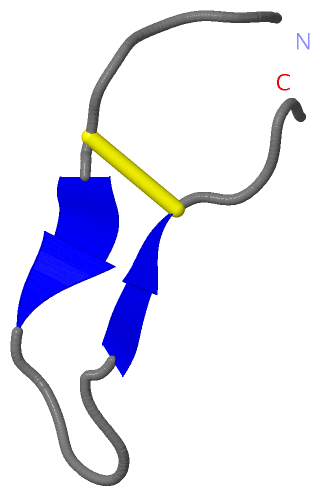
Image NMR Structure - model 1
NMR Structure - model 1  (Jmol Viewer)
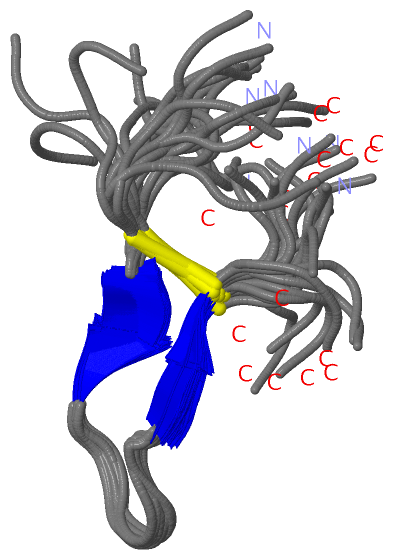
Image NMR Structure - all models
NMR Structure - all models  (Jmol Viewer)

(-) Description

Title :  PEPTIDE LEUCINE ARGININE
 
Authors :  T. Polte
Date :  23 Jan 13  (Deposition) - 11 Sep 13  (Release) - 25 Sep 13  (Revision)
Method :  SOLUTION NMR
Resolution :  NOT APPLICABLE
Chains :  NMR Structure  :  A  (20x)
NMR Structure *:  A  (1x)
Keywords :  Bowman Birk Inhibitor, Hydrolase Inhibitor (Keyword Search: [Gene Ontology, PubMed, Web (Google))
 
Reference :  S. Rothemund, F. D. Sonnichsen, T. Polte
Therapeutic Potential Of The Peptide Leucine Arginine As A New Nonplant Bowman-Birk-Like Serine Protease Inhibitor.
J. Med. Chem. V. 56 6732 2013
PubMed-ID: 23988198  |  Reference-DOI: 10.1021/JM4005362

(-) Compounds

Molecule 1 - PEPTIDE LEUCINE ARGININE
    ChainsA
    EngineeredYES
    Organism CommonNORTHERN LEOPARD FROG
    Organism ScientificRANA PIPIENS
    Organism Taxid8404
    SynonymPLR
    SyntheticYES

 Structural Features

(-) Chains, Units

  1
NMR Structure (20x)A
NMR Structure * (1x)A

Summary Information (see also Sequences/Alignments below)

(-) Ligands, Modified Residues, Ions  (0, 0)

(no "Ligand,Modified Residues,Ions" information available for 2M3N)

(-) Sites  (0, 0)

(no "Site" information available for 2M3N)

(-) SS Bonds  (1, 1)

NMR Structure
No.Residues
1A:5 -A:15

(-) Cis Peptide Bonds  (1, 20)

NMR Structure
No.ModelResidues
11, 2, 3, 4, 5, 6, 7, 8, 9, 10, 11, 12, 13, 14, 15, 16, 17, 18, 19, 20Tyr A:10 -Pro A:11

 Sequence-Structure Mapping

(-) SAPs(SNPs)/Variants  (0, 0)

(no "SAP(SNP)/Variant" information available for 2M3N)

(-) PROSITE Motifs  (0, 0)

(no "PROSITE Motif" information available for 2M3N)

(-) Exons   (0, 0)

(no "Exon" information available for 2M3N)

(-) Sequences/Alignments

NMR Structure
   Reformat: Number of residues per line =  ('0' or empty: single-line sequence representation)
  Number of residues per labelling interval =   
  UniProt sequence: complete  aligned part    
   Show mapping: SCOP domains CATH domains Pfam domains Secondary structure (by author)
SAPs(SNPs) PROSITE motifs Exons
(details for a mapped element are shown in a popup box when the mouse pointer rests over it)
Chain A from PDB  Type:PROTEIN  Length:18
 aligned with PLR_LITPI | Q90WP7 from UniProtKB/Swiss-Prot  Length:62

    Alignment length:18
                                    53        
             PLR_LITPI   44 LVRGCWTKSYPPKPCFVR 61
               SCOP domains ------------------ SCOP domains
               CATH domains ------------------ CATH domains
               Pfam domains ------------------ Pfam domains
         Sec.struct. author .....ee.....ee.... Sec.struct. author
                 SAPs(SNPs) ------------------ SAPs(SNPs)
                    PROSITE ------------------ PROSITE
                 Transcript ------------------ Transcript
                  2m3n A  1 LVRGCWTKSYPPKPCFVR 18
                                    10        

   Legend:   → Mismatch (orange background)
  - → Gap (green background, '-', border residues have a numbering label)
    → Modified Residue (blue background, lower-case, 'x' indicates undefined single-letter code, labelled with number + name)
  x → Chemical Group (purple background, 'x', labelled with number + name, e.g. ACE or NH2)
  extra numbering lines below/above indicate numbering irregularities and modified residue names etc., number ends below/above '|'

 Classification and Annotation

(-) SCOP Domains  (0, 0)

(no "SCOP Domain" information available for 2M3N)

(-) CATH Domains  (0, 0)

(no "CATH Domain" information available for 2M3N)

(-) Pfam Domains  (0, 0)

(no "Pfam Domain" information available for 2M3N)

(-) Gene Ontology  (12, 12)

NMR Structure(hide GO term definitions)
Chain A   (PLR_LITPI | Q90WP7)
molecular function
    GO:0003674    molecular_function    Elemental activities, such as catalysis or binding, describing the actions of a gene product at the molecular level. A given gene product may exhibit one or more molecular functions.
biological process
    GO:0019835    cytolysis    The rupture of cell membranes and the loss of cytoplasm.
    GO:0006952    defense response    Reactions, triggered in response to the presence of a foreign body or the occurrence of an injury, which result in restriction of damage to the organism attacked or prevention/recovery from the infection caused by the attack.
    GO:0050830    defense response to Gram-positive bacterium    Reactions triggered in response to the presence of a Gram-positive bacterium that act to protect the cell or organism.
    GO:0042742    defense response to bacterium    Reactions triggered in response to the presence of a bacterium that act to protect the cell or organism.
    GO:0050832    defense response to fungus    Reactions triggered in response to the presence of a fungus that act to protect the cell or organism.
    GO:0044179    hemolysis in other organism    The cytolytic destruction of red blood cells, with the release of intracellular hemoglobin, in one organism by another.
    GO:0006954    inflammatory response    The immediate defensive reaction (by vertebrate tissue) to infection or injury caused by chemical or physical agents. The process is characterized by local vasodilation, extravasation of plasma into intercellular spaces and accumulation of white blood cells and macrophages.
    GO:0031640    killing of cells of other organism    Any process in an organism that results in the killing of cells of another organism, including in some cases the death of the other organism. Killing here refers to the induction of death in one cell by another cell, not cell-autonomous death due to internal or other environmental conditions.
    GO:0043303    mast cell degranulation    The regulated exocytosis of secretory granules containing preformed mediators such as histamine, serotonin, and neutral proteases by a mast cell.
cellular component
    GO:0005576    extracellular region    The space external to the outermost structure of a cell. For cells without external protective or external encapsulating structures this refers to space outside of the plasma membrane. This term covers the host cell environment outside an intracellular parasite.
    GO:0042629    mast cell granule    Coarse, bluish-black staining cytoplasmic granules, bounded by a plasma membrane and found in mast cells and basophils. Contents include histamine, heparin, chondroitin sulfates, chymase and tryptase.

 Visualization

(-) Interactive Views

NMR Structure
  Complete Structure
    Jena3D(integrated viewing of ligand, site, SAP, PROSITE, SCOP information)
    WebMol | AstexViewer[tm]@PDBe
(Java Applets, require no local installation except for Java; loading may be slow)
    STRAP
(Java WebStart application, automatic local installation, requires Java; full application with system access!)
    RasMol
(require local installation)
    Molscript (VRML)
(requires installation of a VRML viewer; select preferred view via VRML and generate a mono or stereo PDF format file)
 
  Ligands, Modified Residues, Ions
(no "Ligands, Modified Residues, Ions" information available for 2m3n)
 
  Sites
(no "Sites" information available for 2m3n)
 
  Cis Peptide Bonds
    Tyr A:10 - Pro A:11   [ RasMol ]  
 

(-) Still Images

Jmol
  protein: cartoon or spacefill or dots and stick; nucleic acid: cartoon and stick; ligands: spacefill; active site: stick
Molscript
  protein, nucleic acid: cartoon; ligands: spacefill; active site: ball and stick

 Databases and Analysis Tools

(-) Databases

Access by PDB/NDB ID
  2m3n
    Family and Domain InformationProDom | SYSTERS
    General Structural InformationGlycoscienceDB | MMDB | NDB | OCA | PDB | PDBe | PDBj | PDBsum | PDBWiki | PQS | PROTEOPEDIA
    Orientation in MembranesOPM
    Protein SurfaceSURFACE
    Secondary StructureDSSP (structure derived) | HSSP (homology derived)
    Structural GenomicsGeneCensus
    Structural NeighboursCE | VAST
    Structure ClassificationCATH | Dali | SCOP
    Validation and Original DataBMRB Data View | BMRB Restraints Grid | EDS | PROCHECK | RECOORD | WHAT_CHECK
 
Access by UniProt ID/Accession number
  PLR_LITPI | Q90WP7
    Comparative Protein Structure ModelsModBase
    Genomic InformationEnsembl
    Protein-protein InteractionDIP
    Sequence, Family and Domain InformationInterPro | Pfam | SMART | UniProtKB/SwissProt
 
Access by Enzyme Classificator   (EC Number)
  (no 'Enzyme Classificator' available)
    General Enzyme InformationBRENDA | EC-PDB | Enzyme | IntEnz
    PathwayKEGG | MetaCyc
 
Access by Disease Identifier   (MIM ID)
  (no 'MIM ID' available)
    Disease InformationOMIM
 
Access by GenAge ID
  (no 'GenAge ID' available)
    Age Related InformationGenAge

(-) Analysis Tools

Access by PDB/NDB ID
    Domain InformationXDom
    Interatomic Contacts of Structural UnitsCSU
    Ligand-protein ContactsLPC
    Protein CavitiescastP
    Sequence and Secondary StructurePDBCartoon
    Structure AlignmentSTRAP(Java WebStart application, automatic local installation, requires Java; full application with system access!)
    Structure and Sequence BrowserSTING
 
Access by UniProt ID/Accession number
  PLR_LITPI | Q90WP7
    Protein Disorder PredictionDisEMBL | FoldIndex | GLOBPLOT (for more information see DisProt)

 Related Entries

(-) Entries Sharing at Least One Protein Chain (UniProt ID)

(no "Entries Sharing at Least One Protein Chain" available for 2M3N)

(-) Related Entries Specified in the PDB File

1gm2 RELATED ID: 18970 RELATED DB: BMRB
1jbl