Show PDB file:   
         Plain Text   HTML   (compressed file size)
QuickSearch:   
by PDB,NDB,UniProt,PROSITE Code or Search Term(s)  
(-)NMR Structure - model 1
(-)NMR Structure - all models
collapse expand < >
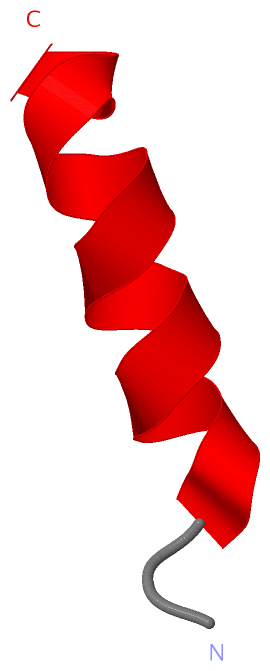
Image NMR Structure - model 1
NMR Structure - model 1  (Jmol Viewer)
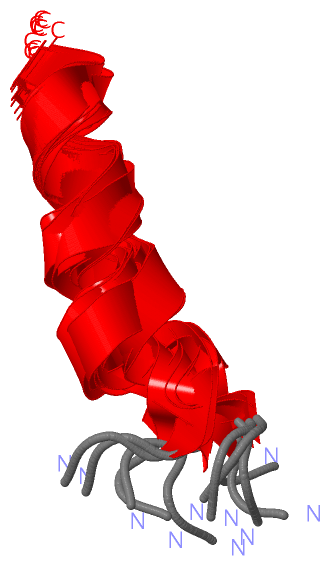
Image NMR Structure - all models
NMR Structure - all models  (Jmol Viewer)

(-) Description

Title :  NMR SOLUTION STRUCTURE OF PEPTIDE A2N(1-17) FROM MUS MUSCULUS V-ATPASE
 
Authors :  P. Dip, G. Gruber, V. Marshansky
Date :  14 Aug 12  (Deposition) - 09 Jan 13  (Release) - 13 Mar 13  (Revision)
Method :  SOLUTION NMR
Resolution :  NOT APPLICABLE
Chains :  NMR Structure  :  A  (10x)
NMR Structure *:  A  (1x)
Keywords :  V-Atpase, Subunit A, Alpha Helix, Ph Sensor, Sec7 Binding Motif, Proton Transport (Keyword Search: [Gene Ontology, PubMed, Web (Google))
 
Reference :  H. Hosokawa, P. V. Dip, M. Merkulova, A. Bakulina, Z. Zhuang, A. Khatri X. Jian, S. M. Keating, S. A. Bueler, J. L. Rubinstein, P. A. Randazzo, D. A. Ausiello, G. Gruber, V. Marshansky
The N Termini Of A-Subunit Isoforms Are Involved In Signaling Between Vacuolar H+-Atpase (V-Atpase) And Cytohesin-2.
J. Biol. Chem. V. 288 5896 2013
PubMed-ID: 23288846  |  Reference-DOI: 10.1074/JBC.M112.409169

(-) Compounds

Molecule 1 - V-TYPE PROTON ATPASE 116 KDA SUBUNIT A ISOFORM 2
    ChainsA
    EngineeredYES
    FragmentN-TERMINUS (RESIDUES 1-17)
    Organism CommonMOUSE
    Organism ScientificMUS MUSCULUS
    Organism Taxid10090
    SyntheticYES

 Structural Features

(-) Chains, Units

  1
NMR Structure (10x)A
NMR Structure * (1x)A

Summary Information (see also Sequences/Alignments below)

(-) Ligands, Modified Residues, Ions  (0, 0)

(no "Ligand,Modified Residues,Ions" information available for 2LX4)

(-) Sites  (0, 0)

(no "Site" information available for 2LX4)

(-) SS Bonds  (0, 0)

(no "SS Bond" information available for 2LX4)

(-) Cis Peptide Bonds  (0, 0)

(no "Cis Peptide Bond" information available for 2LX4)

 Sequence-Structure Mapping

(-) SAPs(SNPs)/Variants  (0, 0)

(no "SAP(SNP)/Variant" information available for 2LX4)

(-) PROSITE Motifs  (0, 0)

(no "PROSITE Motif" information available for 2LX4)

(-) Exons   (0, 0)

(no "Exon" information available for 2LX4)

(-) Sequences/Alignments

NMR Structure
   Reformat: Number of residues per line =  ('0' or empty: single-line sequence representation)
  Number of residues per labelling interval =   
  UniProt sequence: complete  aligned part    
   Show mapping: SCOP domains CATH domains Pfam domains Secondary structure (by author)
SAPs(SNPs) PROSITE motifs Exons
(details for a mapped element are shown in a popup box when the mouse pointer rests over it)
Chain A from PDB  Type:PROTEIN  Length:17
 aligned with VPP2_MOUSE | P15920 from UniProtKB/Swiss-Prot  Length:856

    Alignment length:17
                                    10       
            VPP2_MOUSE    1 MGSLFRSESMCLAQLFL 17
               SCOP domains ----------------- SCOP domains
               CATH domains ----------------- CATH domains
               Pfam domains ----------------- Pfam domains
         Sec.struct. author ..hhhhhhhhhhhhhhh Sec.struct. author
                 SAPs(SNPs) ----------------- SAPs(SNPs)
                    PROSITE ----------------- PROSITE
                 Transcript ----------------- Transcript
                  2lx4 A  1 MGSLFRSESMCLAQLFL 17
                                    10       

   Legend:   → Mismatch (orange background)
  - → Gap (green background, '-', border residues have a numbering label)
    → Modified Residue (blue background, lower-case, 'x' indicates undefined single-letter code, labelled with number + name)
  x → Chemical Group (purple background, 'x', labelled with number + name, e.g. ACE or NH2)
  extra numbering lines below/above indicate numbering irregularities and modified residue names etc., number ends below/above '|'

 Classification and Annotation

(-) SCOP Domains  (0, 0)

(no "SCOP Domain" information available for 2LX4)

(-) CATH Domains  (0, 0)

(no "CATH Domain" information available for 2LX4)

(-) Pfam Domains  (0, 0)

(no "Pfam Domain" information available for 2LX4)

(-) Gene Ontology  (23, 23)

NMR Structure(hide GO term definitions)
Chain A   (VPP2_MOUSE | P15920)
molecular function
    GO:0051117    ATPase binding    Interacting selectively and non-covalently with an ATPase, any enzyme that catalyzes the hydrolysis of ATP.
    GO:0015078    hydrogen ion transmembrane transporter activity    Enables the transfer of hydrogen ions from one side of a membrane to the other.
    GO:0005515    protein binding    Interacting selectively and non-covalently with any protein or protein complex (a complex of two or more proteins that may include other nonprotein molecules).
    GO:0046961    proton-transporting ATPase activity, rotational mechanism    Catalysis of the transfer of protons from one side of a membrane to the other according to the reaction: ATP + H2O + H+(in) = ADP + phosphate + H+(out), by a rotational mechanism.
biological process
    GO:0015991    ATP hydrolysis coupled proton transport    The transport of protons against an electrochemical gradient, using energy from ATP hydrolysis.
    GO:0015986    ATP synthesis coupled proton transport    The transport of protons across a membrane to generate an electrochemical gradient (proton-motive force) that powers ATP synthesis.
    GO:0006811    ion transport    The directed movement of charged atoms or small charged molecules into, out of or within a cell, or between cells, by means of some agent such as a transporter or pore.
    GO:0015992    proton transport    The directed movement of protons (hydrogen ions) into, out of or within a cell, or between cells, by means of some agent such as a transporter or pore.
    GO:0006810    transport    The directed movement of substances (such as macromolecules, small molecules, ions) or cellular components (such as complexes and organelles) into, out of or within a cell, or between cells, or within a multicellular organism by means of some agent such as a transporter, pore or motor protein.
    GO:0007035    vacuolar acidification    Any process that reduces the pH of the vacuole, measured by the concentration of the hydrogen ion.
    GO:0070072    vacuolar proton-transporting V-type ATPase complex assembly    The aggregation, arrangement and bonding together of a vacuolar proton-transporting V-type ATPase complex, proton-transporting two-sector ATPase complex that couples ATP hydrolysis to the transport of protons across the vacuolar membrane.
cellular component
    GO:0001669    acrosomal vesicle    A structure in the head of a spermatozoon that contains acid hydrolases, and is concerned with the breakdown of the outer membrane of the ovum during fertilization. It lies just beneath the plasma membrane and is derived from the lysosome.
    GO:0005737    cytoplasm    All of the contents of a cell excluding the plasma membrane and nucleus, but including other subcellular structures.
    GO:0005768    endosome    A vacuole to which materials ingested by endocytosis are delivered.
    GO:0010008    endosome membrane    The lipid bilayer surrounding an endosome.
    GO:0005925    focal adhesion    Small region on the surface of a cell that anchors the cell to the extracellular matrix and that forms a point of termination of actin filaments.
    GO:0016021    integral component of membrane    The component of a membrane consisting of the gene products and protein complexes having at least some part of their peptide sequence embedded in the hydrophobic region of the membrane.
    GO:0005765    lysosomal membrane    The lipid bilayer surrounding the lysosome and separating its contents from the cell cytoplasm.
    GO:0016020    membrane    A lipid bilayer along with all the proteins and protein complexes embedded in it an attached to it.
    GO:0005886    plasma membrane    The membrane surrounding a cell that separates the cell from its external environment. It consists of a phospholipid bilayer and associated proteins.
    GO:0033179    proton-transporting V-type ATPase, V0 domain    A protein complex that forms part of a proton-transporting V-type ATPase and mediates proton transport across a membrane. The V0 complex consists of at least four different subunits (a,c,d and e); six or more c subunits form a proton-binding rotor ring.
    GO:0016471    vacuolar proton-transporting V-type ATPase complex    A proton-transporting two-sector ATPase complex found in the vacuolar membrane, where it acts as a proton pump to mediate acidification of the vacuolar lumen.
    GO:0000220    vacuolar proton-transporting V-type ATPase, V0 domain    The V0 domain of a proton-transporting V-type ATPase found in the vacuolar membrane.

 Visualization

(-) Interactive Views

NMR Structure
  Complete Structure
    Jena3D(integrated viewing of ligand, site, SAP, PROSITE, SCOP information)
    WebMol | AstexViewer[tm]@PDBe
(Java Applets, require no local installation except for Java; loading may be slow)
    STRAP
(Java WebStart application, automatic local installation, requires Java; full application with system access!)
    RasMol
(require local installation)
    Molscript (VRML)
(requires installation of a VRML viewer; select preferred view via VRML and generate a mono or stereo PDF format file)
 
  Ligands, Modified Residues, Ions
(no "Ligands, Modified Residues, Ions" information available for 2lx4)
 
  Sites
(no "Sites" information available for 2lx4)
 
  Cis Peptide Bonds
(no "Cis Peptide Bonds" information available for 2lx4)
 

(-) Still Images

Jmol
  protein: cartoon or spacefill or dots and stick; nucleic acid: cartoon and stick; ligands: spacefill; active site: stick
Molscript
  protein, nucleic acid: cartoon; ligands: spacefill; active site: ball and stick

 Databases and Analysis Tools

(-) Databases

Access by PDB/NDB ID
  2lx4
    Family and Domain InformationProDom | SYSTERS
    General Structural InformationGlycoscienceDB | MMDB | NDB | OCA | PDB | PDBe | PDBj | PDBsum | PDBWiki | PQS | PROTEOPEDIA
    Orientation in MembranesOPM
    Protein SurfaceSURFACE
    Secondary StructureDSSP (structure derived) | HSSP (homology derived)
    Structural GenomicsGeneCensus
    Structural NeighboursCE | VAST
    Structure ClassificationCATH | Dali | SCOP
    Validation and Original DataBMRB Data View | BMRB Restraints Grid | EDS | PROCHECK | RECOORD | WHAT_CHECK
 
Access by UniProt ID/Accession number
  VPP2_MOUSE | P15920
    Comparative Protein Structure ModelsModBase
    Genomic InformationEnsembl
    Protein-protein InteractionDIP
    Sequence, Family and Domain InformationInterPro | Pfam | SMART | UniProtKB/SwissProt
 
Access by Enzyme Classificator   (EC Number)
  (no 'Enzyme Classificator' available)
    General Enzyme InformationBRENDA | EC-PDB | Enzyme | IntEnz
    PathwayKEGG | MetaCyc
 
Access by Disease Identifier   (MIM ID)
  (no 'MIM ID' available)
    Disease InformationOMIM
 
Access by GenAge ID
  (no 'GenAge ID' available)
    Age Related InformationGenAge

(-) Analysis Tools

Access by PDB/NDB ID
    Domain InformationXDom
    Interatomic Contacts of Structural UnitsCSU
    Ligand-protein ContactsLPC
    Protein CavitiescastP
    Sequence and Secondary StructurePDBCartoon
    Structure AlignmentSTRAP(Java WebStart application, automatic local installation, requires Java; full application with system access!)
    Structure and Sequence BrowserSTING
 
Access by UniProt ID/Accession number
  VPP2_MOUSE | P15920
    Protein Disorder PredictionDisEMBL | FoldIndex | GLOBPLOT (for more information see DisProt)

 Related Entries

(-) Entries Sharing at Least One Protein Chain (UniProt ID)

(no "Entries Sharing at Least One Protein Chain" available for 2LX4)

(-) Related Entries Specified in the PDB File

(no "Related Entries Specified in the PDB File" available for 2LX4)