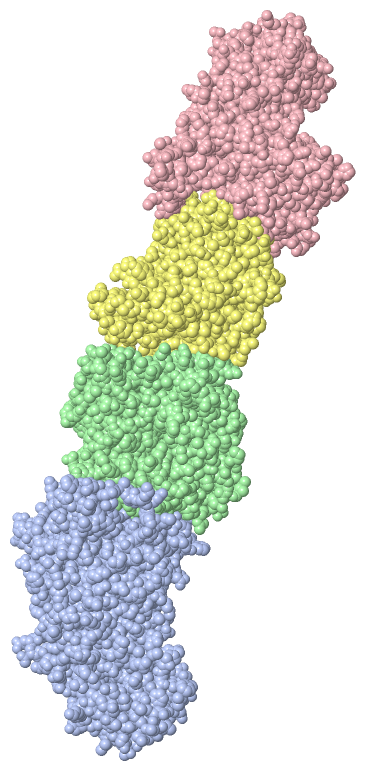
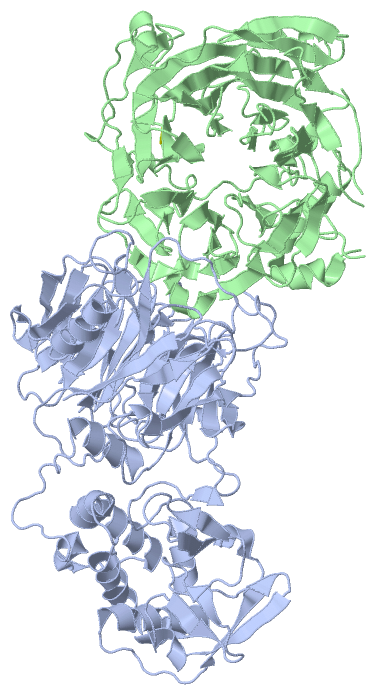
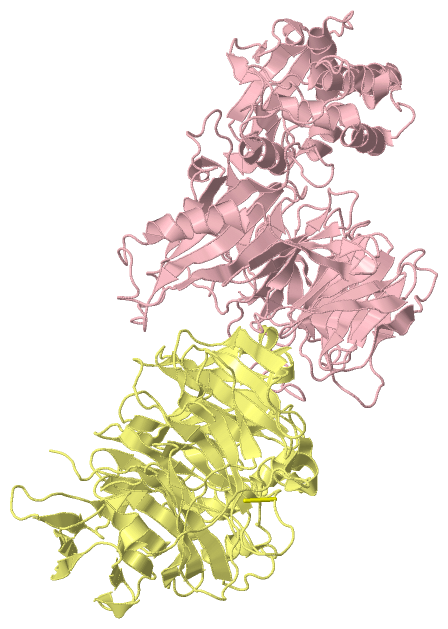
Asymmetric Unit(hide GO term definitions)
Chain A,C ( TFC8_YEAST | Q12308)
| molecular function |
|---|
| | GO:0003677 | | DNA binding | | Any molecular function by which a gene product interacts selectively and non-covalently with DNA (deoxyribonucleic acid). |
| | GO:0008301 | | DNA binding, bending | | The activity of binding selectively and non-covalently to and distorting the original structure of DNA, typically a straight helix, into a bend, or increasing the bend if the original structure was intrinsically bent due to its sequence. |
| | GO:0001002 | | RNA polymerase III type 1 promoter sequence-specific DNA binding | | Interacting selectively and non-covalently with a sequence of DNA that is a part of a type 1 promoter that controls transcription by RNA polymerase III. Type 1 promoters are found in 5S rRNA genes, downstream of the transcription start site within the sequence of the mature RNA, and require TFIIIA for recognition. |
| | GO:0001003 | | RNA polymerase III type 2 promoter sequence-specific DNA binding | | Interacting selectively and non-covalently with a sequence of DNA that is a part of a type 2 promoter that controls transcription by RNA polymerase III. Type 2 promoters consist of an A box and a B box downstream of the transcription start site within the sequence within the sequence of the mature RNA. Type 2 promoters are found in many tRNA genes as well as in other small RNAs. |
| | GO:0001005 | | transcription factor activity, RNA polymerase III type 1 promoter sequence-specific binding, TFIIIB recruiting | | The function of binding to a specific DNA sequence motif in a type 1 RNA polymerase III (Pol III) promoter in order to recruit the Pol III recruiting factor TFIIIB to the promoter. For type 1 Pol III promoters, this requires both TFIIIA and TFIIIC. |
| | GO:0001008 | | transcription factor activity, RNA polymerase III type 2 promoter sequence-specific binding, TFIIIB recruiting | | Interacting selectively and non-covalently with a specific DNA sequence motif in a type 2 RNA polymerase III (Pol III) promoter in order to recruit TFIIIB to the promoter. For type 2 Pol III promoters, this requires TFIIIC activity. |
| biological process |
|---|
| | GO:0042791 | | 5S class rRNA transcription from RNA polymerase III type 1 promoter | | The synthesis of 5S ribosomal RNA (rRNA), or an equivalent rRNA, from a DNA template by RNA polymerase III (Pol III), originating at a type 1 RNA polymerase III promoter. |
| | GO:0000999 | | RNA polymerase III type 1 promoter transcriptional preinitiation complex assembly | | The aggregation, arrangement and bonding together of proteins on a type 1 RNA polymerase III (Pol III) promoter DNA to form the transcriptional preinitiation complex (PIC), the formation of which is the first step of transcription. Type 1 promoters require TFIIIA for promoter recognition, which then recruits TFIIIC. TFIIIC in turn recruits TFIIIB, which recruits Pol III to the promoter. |
| | GO:0001021 | | RNA polymerase III type 2 promoter transcriptional preinitiation complex assembly | | The aggregation, arrangement and bonding together of proteins on a type 2 RNA polymerase III (Pol III) promoter DNA to form the transcriptional preinitiation complex (PIC), the formation of which is the first step of transcription. Type 2 promoters require TFIIIC for promoter recognition, which then recruits TFIIIB, which in turn which recruits Pol III to the promoter. |
| | GO:0006355 | | regulation of transcription, DNA-templated | | Any process that modulates the frequency, rate or extent of cellular DNA-templated transcription. |
| | GO:0006383 | | transcription from RNA polymerase III promoter | | The synthesis of RNA from a DNA template by RNA polymerase III, originating at an RNAP III promoter. |
| | GO:0001009 | | transcription from RNA polymerase III type 2 promoter | | The synthesis of RNA from a DNA template by RNA polymerase III (RNAP III), originating at a type 2 RNAP III promoter. Type 2 RNAP III promoters consist of an A box and a B box downstream of the transcription start site within the sequence of the mature RNA and the process of initiation is different than from other promoter types. Type 2 promoters are found in many tRNA genes as well as in other small RNAs. |
| | GO:0001041 | | transcription from a RNA polymerase III hybrid type promoter | | The synthesis of RNA from a DNA template by RNA polymerase III, originating at a hybrid type RNA polymerase III (RNAP III) promoter. A hybrid RNAP III promoter contains both regulatory elements both upstream and downstream of the transcription initiation site. An example gene with such a promoter is the S. cerevisiae U6 gene. |
| | GO:0006351 | | transcription, DNA-templated | | The cellular synthesis of RNA on a template of DNA. |
| cellular component |
|---|
| | GO:0005634 | | nucleus | | A membrane-bounded organelle of eukaryotic cells in which chromosomes are housed and replicated. In most cells, the nucleus contains all of the cell's chromosomes except the organellar chromosomes, and is the site of RNA synthesis and processing. In some species, or in specialized cell types, RNA metabolism or DNA replication may be absent. |
| | GO:0000127 | | transcription factor TFIIIC complex | | A heterotrimeric transcription factor complex that is involved in regulating transcription from RNA polymerase III (Pol III) promoters. TFIIIC contains three conserved subunits that associate with the proximal Pol III promoter element, and additional subunits that associate with sequence elements downstream of the promoter and are more diverged among species. It also functions as a boundary element to partition genome content into distinct domains outside Pol III promoter regions. |
Chain B,D ( TFC6_YEAST | Q06339)
| molecular function |
|---|
| | GO:0003677 | | DNA binding | | Any molecular function by which a gene product interacts selectively and non-covalently with DNA (deoxyribonucleic acid). |
| | GO:0001002 | | RNA polymerase III type 1 promoter sequence-specific DNA binding | | Interacting selectively and non-covalently with a sequence of DNA that is a part of a type 1 promoter that controls transcription by RNA polymerase III. Type 1 promoters are found in 5S rRNA genes, downstream of the transcription start site within the sequence of the mature RNA, and require TFIIIA for recognition. |
| | GO:0001003 | | RNA polymerase III type 2 promoter sequence-specific DNA binding | | Interacting selectively and non-covalently with a sequence of DNA that is a part of a type 2 promoter that controls transcription by RNA polymerase III. Type 2 promoters consist of an A box and a B box downstream of the transcription start site within the sequence within the sequence of the mature RNA. Type 2 promoters are found in many tRNA genes as well as in other small RNAs. |
| | GO:0001005 | | transcription factor activity, RNA polymerase III type 1 promoter sequence-specific binding, TFIIIB recruiting | | The function of binding to a specific DNA sequence motif in a type 1 RNA polymerase III (Pol III) promoter in order to recruit the Pol III recruiting factor TFIIIB to the promoter. For type 1 Pol III promoters, this requires both TFIIIA and TFIIIC. |
| | GO:0001008 | | transcription factor activity, RNA polymerase III type 2 promoter sequence-specific binding, TFIIIB recruiting | | Interacting selectively and non-covalently with a specific DNA sequence motif in a type 2 RNA polymerase III (Pol III) promoter in order to recruit TFIIIB to the promoter. For type 2 Pol III promoters, this requires TFIIIC activity. |
| biological process |
|---|
| | GO:0042791 | | 5S class rRNA transcription from RNA polymerase III type 1 promoter | | The synthesis of 5S ribosomal RNA (rRNA), or an equivalent rRNA, from a DNA template by RNA polymerase III (Pol III), originating at a type 1 RNA polymerase III promoter. |
| | GO:0000999 | | RNA polymerase III type 1 promoter transcriptional preinitiation complex assembly | | The aggregation, arrangement and bonding together of proteins on a type 1 RNA polymerase III (Pol III) promoter DNA to form the transcriptional preinitiation complex (PIC), the formation of which is the first step of transcription. Type 1 promoters require TFIIIA for promoter recognition, which then recruits TFIIIC. TFIIIC in turn recruits TFIIIB, which recruits Pol III to the promoter. |
| | GO:0001021 | | RNA polymerase III type 2 promoter transcriptional preinitiation complex assembly | | The aggregation, arrangement and bonding together of proteins on a type 2 RNA polymerase III (Pol III) promoter DNA to form the transcriptional preinitiation complex (PIC), the formation of which is the first step of transcription. Type 2 promoters require TFIIIC for promoter recognition, which then recruits TFIIIB, which in turn which recruits Pol III to the promoter. |
| | GO:0006355 | | regulation of transcription, DNA-templated | | Any process that modulates the frequency, rate or extent of cellular DNA-templated transcription. |
| | GO:0001009 | | transcription from RNA polymerase III type 2 promoter | | The synthesis of RNA from a DNA template by RNA polymerase III (RNAP III), originating at a type 2 RNAP III promoter. Type 2 RNAP III promoters consist of an A box and a B box downstream of the transcription start site within the sequence of the mature RNA and the process of initiation is different than from other promoter types. Type 2 promoters are found in many tRNA genes as well as in other small RNAs. |
| | GO:0001041 | | transcription from a RNA polymerase III hybrid type promoter | | The synthesis of RNA from a DNA template by RNA polymerase III, originating at a hybrid type RNA polymerase III (RNAP III) promoter. A hybrid RNAP III promoter contains both regulatory elements both upstream and downstream of the transcription initiation site. An example gene with such a promoter is the S. cerevisiae U6 gene. |
| | GO:0006351 | | transcription, DNA-templated | | The cellular synthesis of RNA on a template of DNA. |
| cellular component |
|---|
| | GO:0005634 | | nucleus | | A membrane-bounded organelle of eukaryotic cells in which chromosomes are housed and replicated. In most cells, the nucleus contains all of the cell's chromosomes except the organellar chromosomes, and is the site of RNA synthesis and processing. In some species, or in specialized cell types, RNA metabolism or DNA replication may be absent. |
| | GO:0000127 | | transcription factor TFIIIC complex | | A heterotrimeric transcription factor complex that is involved in regulating transcription from RNA polymerase III (Pol III) promoters. TFIIIC contains three conserved subunits that associate with the proximal Pol III promoter element, and additional subunits that associate with sequence elements downstream of the promoter and are more diverged among species. It also functions as a boundary element to partition genome content into distinct domains outside Pol III promoter regions. |
|

 Description