Show PDB file:   
         Plain Text   HTML   (compressed file size)
QuickSearch:   
by PDB,NDB,UniProt,PROSITE Code or Search Term(s)  
(-)Theor.Model - manually
(-)Theoretical Model
collapse expand < >
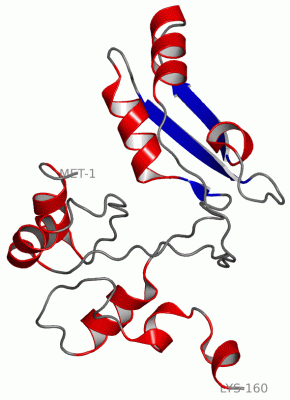
Image Theor.Model - manually
Theor.Model - manually  (Jmol Viewer)
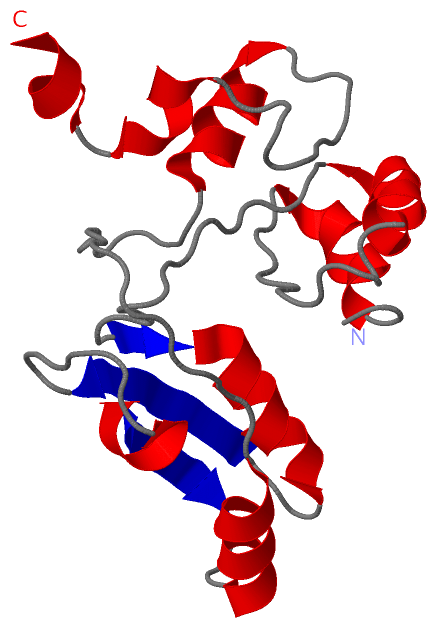
Image Theoretical Model
Theoretical Model  (Jmol Viewer)

(-) Description

Title :  BIK
 
Authors :  Bhargavi Kondagari, Kalyan Chaitanya Pulipaka, Ramakrishna Annabhimoju, Uma Vuruputuri, K. Murthy Dwarkanath
Date :  12 Oct 06  (Deposition) - 24 Oct 06  (Release) - 24 Oct 06  (Revision)
Method :  THEORETICAL MODEL
Resolution :  NOT APPLICABLE
Chains :  Theor. Model :  _
Keywords :  Bcl-2L13, Bcl Interacting Killer, Pro-Apoptotic Protein, Transmembrane Protein, Apoptosis (Keyword Search: [Gene Ontology, PubMed, Web (Google))
 
Reference :  

PubMed: search
(for further references see the PDB file header)

(-) Compounds

Molecule 1 - PROTEIN BCL-2L13 PRO-APOPTOTIC PROTEIN TRANSMEMBRANE PROTEIN
    Chains_
    Organism CommonHUMAN
    Organism ScientificHOMO SAPIENS
    Other DetailsB-CELL, LYMPH

 Structural Features

(-) Chains, Units

  
Theoretical Model 

Summary Information (see also Sequences/Alignments below)

(-) Ligands, Modified Residues, Ions  (0, 0)

(no "Ligand,Modified Residues,Ions" information available for 2IPE)

(-) Sites  (0, 0)

(no "Site" information available for 2IPE)

(-) SS Bonds  (0, 0)

(no "SS Bond" information available for 2IPE)

(-) Cis Peptide Bonds  (1, 1)

Theoretical Model
No.Residues
1Phe  :45 -Asp  :46

 Sequence-Structure Mapping

(-) SAPs(SNPs)/Variants  (3, 3)

Theoretical Model (3, 3)
  dbSNPPDB
No.SourceVariant IDVariantUniProt IDStatusIDChainVariant
1UniProtVAR_029179E19KBIK_HUMANPolymorphism4988415_E19K
2UniProtVAR_048420T26IBIK_HUMANPolymorphism11090143_T26I
3UniProtVAR_029180L148PBIK_HUMANPolymorphism11574527_L148P

  SNP/SAP Summary Statistics (UniProtKB/Swiss-Prot)

(-) PROSITE Motifs  (1, 1)

Theoretical Model (1, 1)
 PROSITEUniProtKBPDB
No.IDACDescriptionIDLocationCountLocation
1BH3PS01259 Apoptosis regulator, Bcl-2 family BH3 motif signature.BIK_HUMAN57-71  1_:57-71

(-) Exons   (4, 4)

Theoretical Model (4, 4)
 ENSEMBLUniProtKBPDB
No.Transcript IDExonExon IDGenome LocationLengthIDLocationLengthCountLocationLength
1.1ENST000002161151ENSE00001044574chr22:43506754-4350680956BIK_HUMAN-00--
1.2ENST000002161152ENSE00000880611chr22:43520022-43520189168BIK_HUMAN1-54541_:1-5454
1.3ENST000002161153ENSE00000656749chr22:43523703-4352380199BIK_HUMAN54-87341_:54-8734
1.4ENST000002161154ENSE00000656750chr22:43524502-43524631130BIK_HUMAN87-130441_:87-13044
1.5ENST000002161155ENSE00000880612chr22:43525219-43525718500BIK_HUMAN131-160301_:131-16030

(-) Sequences/Alignments

Theoretical Model
   Reformat: Number of residues per line =  ('0' or empty: single-line sequence representation)
  Number of residues per labelling interval =   
  UniProt sequence: complete  aligned part    
   Show mapping: SCOP domains CATH domains Pfam domains Secondary structure (by author)
SAPs(SNPs) PROSITE motifs Exons
(details for a mapped element are shown in a popup box when the mouse pointer rests over it)
Chain _ from PDB  Type:PROTEIN  Length:160
 aligned with BIK_HUMAN | Q13323 from UniProtKB/Swiss-Prot  Length:160

    Alignment length:160
                                    10        20        30        40        50        60        70        80        90       100       110       120       130       140       150       160
            BIK_HUMAN     1 MSEVRPLSRDILMETLLYEQLLEPPTMEVLGMTDSEEDLDPMEDFDSLECMEGSDALALRLACIGDEMDVSLRAPRLAQLSEVAMHSLGLAFIYDQTEDIRDVLRSFMDGFTTLKENIMRFWRSPNPGSWVSCEQVLLALLLLLALLLPLLSGGLHLLLK 160
               SCOP domains ---------------------------------------------------------------------------------------------------------------------------------------------------------------- SCOP domains
               CATH domains ---------------------------------------------------------------------------------------------------------------------------------------------------------------- CATH domains
               Pfam domains ---------------------------------------------------------------------------------------------------------------------------------------------------------------- Pfam domains
         Sec.struct. author ...hhhhhhhhh............hhhhhhhhhh..............eehhhhhhhhhhh....eeeeeeee.......hhhhheeeeeeee...hhhhhhhhhhh..................hhhhhhhhhh...........hhhhhh.hhhhhh. Sec.struct. author
                 SAPs(SNPs) ------------------K------I-------------------------------------------------------------------------------------------------------------------------P------------ SAPs(SNPs)
                    PROSITE --------------------------------------------------------BH3  PDB: -    ----------------------------------------------------------------------------------------- PROSITE
           Transcript 1 (1) Exon 1.2  PDB: - UniProt: 1-54                        --------------------------------Exon 1.4  PDB: - UniProt: 87-130            Exon 1.5  PDB: -               Transcript 1 (1)
           Transcript 1 (2) -----------------------------------------------------Exon 1.3  PDB: - UniProt: 54-87   ------------------------------------------------------------------------- Transcript 1 (2)
                 2ipe _   1 MSEVRPLSRDILMETLLYEQLLEPPTMEVLGMTDSEEDLDPMEDFDSLECMEGSDALALRLACIGDEMDVSLRAPRLAQLSEVAMHSLGLAFIYDQTEDIRDVLRSFMDGFTTLKENIMRFWRSPNPGSWVSCEQVLLALLLLLALLLPLLSGGLHLLLK 160
                                    10        20        30        40        50        60        70        80        90       100       110       120       130       140       150       160

   Legend:   → Mismatch (orange background)
  - → Gap (green background, '-', border residues have a numbering label)
    → Modified Residue (blue background, lower-case, 'x' indicates undefined single-letter code, labelled with number + name)
  x → Chemical Group (purple background, 'x', labelled with number + name, e.g. ACE or NH2)
  extra numbering lines below/above indicate numbering irregularities and modified residue names etc., number ends below/above '|'

 Classification and Annotation

(-) SCOP Domains  (0, 0)

(no "SCOP Domain" information available for 2IPE)

(-) CATH Domains  (0, 0)

(no "CATH Domain" information available for 2IPE)

(-) Pfam Domains  (0, 0)

(no "Pfam Domain" information available for 2IPE)

(-) Gene Ontology  (16, 16)

Theoretical Model(hide GO term definitions)
Chain   (BIK_HUMAN | Q13323)
molecular function
    GO:0051400    BH domain binding    Interacting selectively and non-covalently with the Bcl-2 homology (BH) domain of a protein. Bcl-2-related proteins share homology in one to four conserved regions designated the Bcl-2 homology (BH) domains BH1, BH2, BH3 and BH4. These domains contribute at multiple levels to the function of these proteins in cell death and survival. Anti-apoptotic members of the Bcl-2 family have four BH domains (BH1-BH4). Pro-apoptotic members have fewer BH domains.
    GO:0005515    protein binding    Interacting selectively and non-covalently with any protein or protein complex (a complex of two or more proteins that may include other nonprotein molecules).
    GO:0046982    protein heterodimerization activity    Interacting selectively and non-covalently with a nonidentical protein to form a heterodimer.
biological process
    GO:0008637    apoptotic mitochondrial changes    The morphological and physiological alterations undergone by mitochondria during apoptosis.
    GO:0006915    apoptotic process    A programmed cell death process which begins when a cell receives an internal (e.g. DNA damage) or external signal (e.g. an extracellular death ligand), and proceeds through a series of biochemical events (signaling pathway phase) which trigger an execution phase. The execution phase is the last step of an apoptotic process, and is typically characterized by rounding-up of the cell, retraction of pseudopodes, reduction of cellular volume (pyknosis), chromatin condensation, nuclear fragmentation (karyorrhexis), plasma membrane blebbing and fragmentation of the cell into apoptotic bodies. When the execution phase is completed, the cell has died.
    GO:0008584    male gonad development    The process whose specific outcome is the progression of the male gonad over time, from its formation to the mature structure.
    GO:0032464    positive regulation of protein homooligomerization    Any process that activates or increases the frequency, rate or extent of protein homooligomerization.
    GO:0090200    positive regulation of release of cytochrome c from mitochondria    Any process that increases the rate, frequency or extent of release of cytochrome c from mitochondria, the process in which cytochrome c is enabled to move from the mitochondrial intermembrane space into the cytosol, which is an early step in apoptosis and leads to caspase activation.
    GO:0042981    regulation of apoptotic process    Any process that modulates the occurrence or rate of cell death by apoptotic process.
    GO:0007283    spermatogenesis    The process of formation of spermatozoa, including spermatocytogenesis and spermiogenesis.
cellular component
    GO:0012505    endomembrane system    A collection of membranous structures involved in transport within the cell. The main components of the endomembrane system are endoplasmic reticulum, Golgi bodies, vesicles, cell membrane and nuclear envelope. Members of the endomembrane system pass materials through each other or though the use of vesicles.
    GO:0016021    integral component of membrane    The component of a membrane consisting of the gene products and protein complexes having at least some part of their peptide sequence embedded in the hydrophobic region of the membrane.
    GO:0016020    membrane    A lipid bilayer along with all the proteins and protein complexes embedded in it an attached to it.
    GO:0005740    mitochondrial envelope    The double lipid bilayer enclosing the mitochondrion and separating its contents from the cell cytoplasm; includes the intermembrane space.
    GO:0031966    mitochondrial membrane    Either of the lipid bilayers that surround the mitochondrion and form the mitochondrial envelope.
    GO:0005739    mitochondrion    A semiautonomous, self replicating organelle that occurs in varying numbers, shapes, and sizes in the cytoplasm of virtually all eukaryotic cells. It is notably the site of tissue respiration.

 Visualization

(-) Interactive Views

Theoretical Model
  Complete Structure
    Jena3D(integrated viewing of ligand, site, SAP, PROSITE, SCOP information)
    WebMol | AstexViewer[tm]@PDBe
(Java Applets, require no local installation except for Java; loading may be slow)
    STRAP
(Java WebStart application, automatic local installation, requires Java; full application with system access!)
    RasMol
(require local installation)
    Molscript (VRML)
(requires installation of a VRML viewer; select preferred view via VRML and generate a mono or stereo PDF format file)
 
  Ligands, Modified Residues, Ions
(no "Ligands, Modified Residues, Ions" information available for 2ipe)
 
  Sites
(no "Sites" information available for 2ipe)
 
  Cis Peptide Bonds
    Phe  :45 - Asp  :46   [ RasMol ]  
 

(-) Still Images

Jmol
  protein: cartoon or spacefill or dots and stick; nucleic acid: cartoon and stick; ligands: spacefill; active site: stick
Molscript
  protein, nucleic acid: cartoon; ligands: spacefill; active site: ball and stick

 Databases and Analysis Tools

(-) Databases

Access by PDB/NDB ID
  2ipe
    Family and Domain InformationProDom | SYSTERS
    General Structural InformationGlycoscienceDB | MMDB | NDB | OCA | PDB | PDBe | PDBj | PDBsum | PDBWiki | PQS | PROTEOPEDIA
    Orientation in MembranesOPM
    Protein SurfaceSURFACE
    Secondary StructureDSSP (structure derived) | HSSP (homology derived)
    Structural GenomicsGeneCensus
    Structural NeighboursCE | VAST
    Structure ClassificationCATH | Dali | SCOP
    Validation and Original DataBMRB Data View | BMRB Restraints Grid | EDS | PROCHECK | RECOORD | WHAT_CHECK
 
Access by UniProt ID/Accession number
  BIK_HUMAN | Q13323
    Comparative Protein Structure ModelsModBase
    Genomic InformationEnsembl
    Protein-protein InteractionDIP
    Sequence, Family and Domain InformationInterPro | Pfam | SMART | UniProtKB/SwissProt
 
Access by Enzyme Classificator   (EC Number)
  (no 'Enzyme Classificator' available)
    General Enzyme InformationBRENDA | EC-PDB | Enzyme | IntEnz
    PathwayKEGG | MetaCyc
 
Access by Disease Identifier   (MIM ID)
  (no 'MIM ID' available)
    Disease InformationOMIM
 
Access by GenAge ID
  (no 'GenAge ID' available)
    Age Related InformationGenAge

(-) Analysis Tools

Access by PDB/NDB ID
    Domain InformationXDom
    Interatomic Contacts of Structural UnitsCSU
    Ligand-protein ContactsLPC
    Protein CavitiescastP
    Sequence and Secondary StructurePDBCartoon
    Structure AlignmentSTRAP(Java WebStart application, automatic local installation, requires Java; full application with system access!)
    Structure and Sequence BrowserSTING
 
Access by UniProt ID/Accession number
  BIK_HUMAN | Q13323
    Protein Disorder PredictionDisEMBL | FoldIndex | GLOBPLOT (for more information see DisProt)

 Related Entries

(-) Entries Sharing at Least One Protein Chain (UniProt ID)

(no "Entries Sharing at Least One Protein Chain" available for 2IPE)

(-) Related Entries Specified in the PDB File

(no "Related Entries Specified in the PDB File" available for 2IPE)