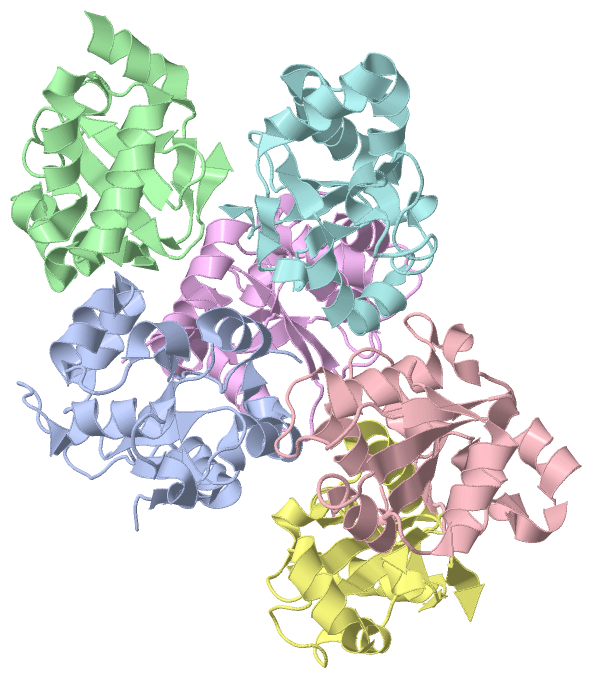
Asymmetric Unit(hide GO term definitions)
Chain A,C,E ( UBP8_HUMAN | P40818)
| molecular function |
|---|
| | GO:0017124 | | SH3 domain binding | | Interacting selectively and non-covalently with a SH3 domain (Src homology 3) of a protein, small protein modules containing approximately 50 amino acid residues found in a great variety of intracellular or membrane-associated proteins. |
| | GO:0004197 | | cysteine-type endopeptidase activity | | Catalysis of the hydrolysis of internal, alpha-peptide bonds in a polypeptide chain by a mechanism in which the sulfhydryl group of a cysteine residue at the active center acts as a nucleophile. |
| | GO:0008234 | | cysteine-type peptidase activity | | Catalysis of the hydrolysis of peptide bonds in a polypeptide chain by a mechanism in which the sulfhydryl group of a cysteine residue at the active center acts as a nucleophile. |
| | GO:0016787 | | hydrolase activity | | Catalysis of the hydrolysis of various bonds, e.g. C-O, C-N, C-C, phosphoric anhydride bonds, etc. Hydrolase is the systematic name for any enzyme of EC class 3. |
| | GO:0008233 | | peptidase activity | | Catalysis of the hydrolysis of a peptide bond. A peptide bond is a covalent bond formed when the carbon atom from the carboxyl group of one amino acid shares electrons with the nitrogen atom from the amino group of a second amino acid. |
| | GO:0005515 | | protein binding | | Interacting selectively and non-covalently with any protein or protein complex (a complex of two or more proteins that may include other nonprotein molecules). |
| | GO:0004843 | | thiol-dependent ubiquitin-specific protease activity | | Catalysis of the thiol-dependent hydrolysis of a peptide bond formed by the C-terminal glycine of ubiquitin and another protein. |
| | GO:0036459 | | thiol-dependent ubiquitinyl hydrolase activity | | Catalysis of the thiol-dependent hydrolysis of an ester, thioester, amide, peptide or isopeptide bond formed by the C-terminal glycine of ubiquitin. |
| biological process |
|---|
| | GO:0038128 | | ERBB2 signaling pathway | | A series of molecular signals initiated by binding of a ligand to a member of the ERBB family of receptors on the surface of a cell, where the signal is transmitted by ERBB2. The pathway ends with regulation of a downstream cellular process, e.g. transcription. ERBB2 receptors are themselves unable to bind to ligands, but act as a signal-amplifying tyrosine kinase within a heterodimeric pair. |
| | GO:0007049 | | cell cycle | | The progression of biochemical and morphological phases and events that occur in a cell during successive cell replication or nuclear replication events. Canonically, the cell cycle comprises the replication and segregation of genetic material followed by the division of the cell, but in endocycles or syncytial cells nuclear replication or nuclear division may not be followed by cell division. |
| | GO:0008283 | | cell proliferation | | The multiplication or reproduction of cells, resulting in the expansion of a cell population. |
| | GO:0007032 | | endosome organization | | A process that is carried out at the cellular level which results in the assembly, arrangement of constituent parts, or disassembly of endosomes. |
| | GO:0000281 | | mitotic cytokinesis | | A cell cycle process that results in the division of the cytoplasm of a cell after mitosis, resulting in the separation of the original cell into two daughter cells. |
| | GO:0071108 | | protein K48-linked deubiquitination | | A protein deubiquitination process in which a K48-linked ubiquitin chain, i.e. a polymer of ubiquitin formed by linkages between lysine residues at position 48 of the ubiquitin monomers, is removed from a protein. |
| | GO:0070536 | | protein K63-linked deubiquitination | | A protein deubiquitination process in which a K63-linked ubiquitin chain, i.e. a polymer of ubiquitin formed by linkages between lysine residues at position 63 of the ubiquitin monomers, is removed from a protein. |
| | GO:0016579 | | protein deubiquitination | | The removal of one or more ubiquitin groups from a protein. |
| | GO:0006508 | | proteolysis | | The hydrolysis of proteins into smaller polypeptides and/or amino acids by cleavage of their peptide bonds. |
| | GO:0006511 | | ubiquitin-dependent protein catabolic process | | The chemical reactions and pathways resulting in the breakdown of a protein or peptide by hydrolysis of its peptide bonds, initiated by the covalent attachment of a ubiquitin group, or multiple ubiquitin groups, to the protein. |
| cellular component |
|---|
| | GO:0005794 | | Golgi apparatus | | A compound membranous cytoplasmic organelle of eukaryotic cells, consisting of flattened, ribosome-free vesicles arranged in a more or less regular stack. The Golgi apparatus differs from the endoplasmic reticulum in often having slightly thicker membranes, appearing in sections as a characteristic shallow semicircle so that the convex side (cis or entry face) abuts the endoplasmic reticulum, secretory vesicles emerging from the concave side (trans or exit face). In vertebrate cells there is usually one such organelle, while in invertebrates and plants, where they are known usually as dictyosomes, there may be several scattered in the cytoplasm. The Golgi apparatus processes proteins produced on the ribosomes of the rough endoplasmic reticulum; such processing includes modification of the core oligosaccharides of glycoproteins, and the sorting and packaging of proteins for transport to a variety of cellular locations. Three different regions of the Golgi are now recognized both in terms of structure and function: cis, in the vicinity of the cis face, trans, in the vicinity of the trans face, and medial, lying between the cis and trans regions. |
| | GO:0005737 | | cytoplasm | | All of the contents of a cell excluding the plasma membrane and nucleus, but including other subcellular structures. |
| | GO:0005829 | | cytosol | | The part of the cytoplasm that does not contain organelles but which does contain other particulate matter, such as protein complexes. |
| | GO:0005769 | | early endosome | | A membrane-bounded organelle that receives incoming material from primary endocytic vesicles that have been generated by clathrin-dependent and clathrin-independent endocytosis; vesicles fuse with the early endosome to deliver cargo for sorting into recycling or degradation pathways. |
| | GO:0005768 | | endosome | | A vacuole to which materials ingested by endocytosis are delivered. |
| | GO:0010008 | | endosome membrane | | The lipid bilayer surrounding an endosome. |
| | GO:0031313 | | extrinsic component of endosome membrane | | The component of an endosome membrane consisting of gene products and protein complexes that are loosely bound to one of its surfaces, but not integrated into the hydrophobic region. |
| | GO:0019897 | | extrinsic component of plasma membrane | | The component of a plasma membrane consisting of gene products and protein complexes that are loosely bound to one of its surfaces, but not integrated into the hydrophobic region. |
| | GO:0016020 | | membrane | | A lipid bilayer along with all the proteins and protein complexes embedded in it an attached to it. |
| | GO:0030496 | | midbody | | A thin cytoplasmic bridge formed between daughter cells at the end of cytokinesis. The midbody forms where the contractile ring constricts, and may persist for some time before finally breaking to complete cytokinesis. |
| | GO:0005654 | | nucleoplasm | | That part of the nuclear content other than the chromosomes or the nucleolus. |
| | GO:0005634 | | nucleus | | A membrane-bounded organelle of eukaryotic cells in which chromosomes are housed and replicated. In most cells, the nucleus contains all of the cell's chromosomes except the organellar chromosomes, and is the site of RNA synthesis and processing. In some species, or in specialized cell types, RNA metabolism or DNA replication may be absent. |
| | GO:0005886 | | plasma membrane | | The membrane surrounding a cell that separates the cell from its external environment. It consists of a phospholipid bilayer and associated proteins. |
Chain B,D,F ( RNF41_HUMAN | Q9H4P4)
| molecular function |
|---|
| | GO:0017160 | | Ral GTPase binding | | Interacting selectively and non-covalently with Ral protein, any member of the Ral subfamily of the Ras superfamily of monomeric GTPases. |
| | GO:0016881 | | acid-amino acid ligase activity | | Catalysis of the ligation of an acid to an amino acid via a carbon-nitrogen bond, with the concomitant hydrolysis of the diphosphate bond in ATP or a similar triphosphate. |
| | GO:0005128 | | erythropoietin receptor binding | | Interacting selectively and non-covalently with the erythropoietin receptor. |
| | GO:0005135 | | interleukin-3 receptor binding | | Interacting selectively and non-covalently with the interleukin-3 receptor. |
| | GO:0016874 | | ligase activity | | Catalysis of the joining of two substances, or two groups within a single molecule, with the concomitant hydrolysis of the diphosphate bond in ATP or a similar triphosphate. |
| | GO:0046872 | | metal ion binding | | Interacting selectively and non-covalently with any metal ion. |
| | GO:0005515 | | protein binding | | Interacting selectively and non-covalently with any protein or protein complex (a complex of two or more proteins that may include other nonprotein molecules). |
| | GO:0031386 | | protein tag | | A molecular function exhibited by a protein that is covalently attached (AKA tagged or conjugated) to another protein where it acts as a marker, recognized by the cellular apparatus to target the tagged protein for some cellular process such as modification, sequestration, transport or degradation. |
| | GO:0061630 | | ubiquitin protein ligase activity | | Catalysis of the transfer of ubiquitin to a substrate protein via the reaction X-ubiquitin + S -> X + S-ubiquitin, where X is either an E2 or E3 enzyme, the X-ubiquitin linkage is a thioester bond, and the S-ubiquitin linkage is an amide bond: an isopeptide bond between the C-terminal glycine of ubiquitin and the epsilon-amino group of lysine residues in the substrate or, in the linear extension of ubiquitin chains, a peptide bond the between the C-terminal glycine and N-terminal methionine of ubiquitin residues. |
| | GO:0004842 | | ubiquitin-protein transferase activity | | Catalysis of the transfer of ubiquitin from one protein to another via the reaction X-Ub + Y --> Y-Ub + X, where both X-Ub and Y-Ub are covalent linkages. |
| | GO:0008270 | | zinc ion binding | | Interacting selectively and non-covalently with zinc (Zn) ions. |
| biological process |
|---|
| | GO:0038128 | | ERBB2 signaling pathway | | A series of molecular signals initiated by binding of a ligand to a member of the ERBB family of receptors on the surface of a cell, where the signal is transmitted by ERBB2. The pathway ends with regulation of a downstream cellular process, e.g. transcription. ERBB2 receptors are themselves unable to bind to ligands, but act as a signal-amplifying tyrosine kinase within a heterodimeric pair. |
| | GO:0006915 | | apoptotic process | | A programmed cell death process which begins when a cell receives an internal (e.g. DNA damage) or external signal (e.g. an extracellular death ligand), and proceeds through a series of biochemical events (signaling pathway phase) which trigger an execution phase. The execution phase is the last step of an apoptotic process, and is typically characterized by rounding-up of the cell, retraction of pseudopodes, reduction of cellular volume (pyknosis), chromatin condensation, nuclear fragmentation (karyorrhexis), plasma membrane blebbing and fragmentation of the cell into apoptotic bodies. When the execution phase is completed, the cell has died. |
| | GO:0006914 | | autophagy | | The process in which cells digest parts of their own cytoplasm; allows for both recycling of macromolecular constituents under conditions of cellular stress and remodeling the intracellular structure for cell differentiation. |
| | GO:0097191 | | extrinsic apoptotic signaling pathway | | A series of molecular signals in which a signal is conveyed from the cell surface to trigger the apoptotic death of a cell. The pathway starts with either a ligand binding to a cell surface receptor, or a ligand being withdrawn from a cell surface receptor (e.g. in the case of signaling by dependence receptors), and ends when the execution phase of apoptosis is triggered. |
| | GO:0030336 | | negative regulation of cell migration | | Any process that stops, prevents, or reduces the frequency, rate or extent of cell migration. |
| | GO:0008285 | | negative regulation of cell proliferation | | Any process that stops, prevents or reduces the rate or extent of cell proliferation. |
| | GO:2000379 | | positive regulation of reactive oxygen species metabolic process | | Any process that activates or increases the frequency, rate or extent of reactive oxygen species metabolic process. |
| | GO:0051091 | | positive regulation of sequence-specific DNA binding transcription factor activity | | Any process that activates or increases the frequency, rate or extent of activity of a transcription factor, any factor involved in the initiation or regulation of transcription. |
| | GO:0010498 | | proteasomal protein catabolic process | | The chemical reactions and pathways resulting in the breakdown of a protein or peptide by hydrolysis of its peptide bonds that is mediated by the proteasome. |
| | GO:0051865 | | protein autoubiquitination | | The ubiquitination by a protein of one or more of its own amino acid residues, or residues on an identical protein. Ubiquitination occurs on the lysine residue by formation of an isopeptide crosslink. |
| | GO:0000209 | | protein polyubiquitination | | Addition of multiple ubiquitin groups to a protein, forming a ubiquitin chain. |
| | GO:0016567 | | protein ubiquitination | | The process in which one or more ubiquitin groups are added to a protein. |
| | GO:0043408 | | regulation of MAPK cascade | | Any process that modulates the frequency, rate or extent of signal transduction mediated by the MAP kinase (MAPK) cascade. |
| | GO:2000114 | | regulation of establishment of cell polarity | | Any process that modulates the frequency, rate or extent of establishment of cell polarity. |
| | GO:0010468 | | regulation of gene expression | | Any process that modulates the frequency, rate or extent of gene expression. Gene expression is the process in which a gene's coding sequence is converted into a mature gene product or products (proteins or RNA). This includes the production of an RNA transcript as well as any processing to produce a mature RNA product or an mRNA or circRNA (for protein-coding genes) and the translation of that mRNA or circRNA into protein. Protein maturation is included when required to form an active form of a product from an inactive precursor form. |
| | GO:0045619 | | regulation of lymphocyte differentiation | | Any process that modulates the frequency, rate or extent of lymphocyte differentiation. |
| | GO:0045637 | | regulation of myeloid cell differentiation | | Any process that modulates the frequency, rate or extent of myeloid cell differentiation. |
| | GO:0051896 | | regulation of protein kinase B signaling | | Any process that modulates the frequency, rate or extent of protein kinase B signaling, a series of reactions mediated by the intracellular serine/threonine kinase protein kinase B. |
| | GO:2000377 | | regulation of reactive oxygen species metabolic process | | Any process that modulates the frequency, rate or extent of reactive oxygen species metabolic process. |
| cellular component |
|---|
| | GO:0005829 | | cytosol | | The part of the cytoplasm that does not contain organelles but which does contain other particulate matter, such as protein complexes. |
|

 Description