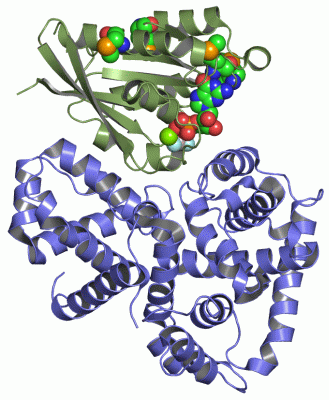
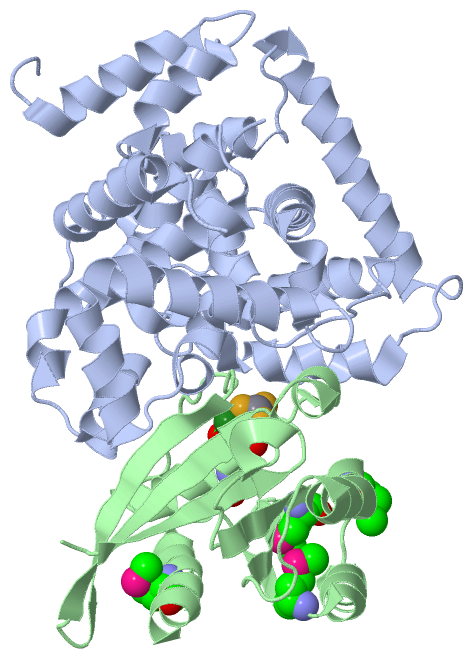
Asymmetric/Biological Unit(hide GO term definitions)
Chain A ( GYP1_YEAST | Q08484)
| molecular function |
|---|
| | GO:0005096 | | GTPase activator activity | | Binds to and increases the activity of a GTPase, an enzyme that catalyzes the hydrolysis of GTP. |
| | GO:0017137 | | Rab GTPase binding | | Interacting selectively and non-covalently with Rab protein, any member of the Rab subfamily of the Ras superfamily of monomeric GTPases. |
| biological process |
|---|
| | GO:0090630 | | activation of GTPase activity | | Any process that initiates the activity of an inactive GTPase through the replacement of GDP by GTP. |
| | GO:0006886 | | intracellular protein transport | | The directed movement of proteins in a cell, including the movement of proteins between specific compartments or structures within a cell, such as organelles of a eukaryotic cell. |
| | GO:0031338 | | regulation of vesicle fusion | | Any process that modulates the frequency, rate or extent of vesicle fusion. |
| | GO:0016192 | | vesicle-mediated transport | | A cellular transport process in which transported substances are moved in membrane-bounded vesicles; transported substances are enclosed in the vesicle lumen or located in the vesicle membrane. The process begins with a step that directs a substance to the forming vesicle, and includes vesicle budding and coating. Vesicles are then targeted to, and fuse with, an acceptor membrane. |
| cellular component |
|---|
| | GO:0005794 | | Golgi apparatus | | A compound membranous cytoplasmic organelle of eukaryotic cells, consisting of flattened, ribosome-free vesicles arranged in a more or less regular stack. The Golgi apparatus differs from the endoplasmic reticulum in often having slightly thicker membranes, appearing in sections as a characteristic shallow semicircle so that the convex side (cis or entry face) abuts the endoplasmic reticulum, secretory vesicles emerging from the concave side (trans or exit face). In vertebrate cells there is usually one such organelle, while in invertebrates and plants, where they are known usually as dictyosomes, there may be several scattered in the cytoplasm. The Golgi apparatus processes proteins produced on the ribosomes of the rough endoplasmic reticulum; such processing includes modification of the core oligosaccharides of glycoproteins, and the sorting and packaging of proteins for transport to a variety of cellular locations. Three different regions of the Golgi are now recognized both in terms of structure and function: cis, in the vicinity of the cis face, trans, in the vicinity of the trans face, and medial, lying between the cis and trans regions. |
| | GO:0005795 | | Golgi stack | | The set of thin, flattened membrane-bounded compartments, called cisternae, that form the central portion of the Golgi complex. The stack usually comprises cis, medial, and trans cisternae; the cis- and trans-Golgi networks are not considered part of the stack. |
Chain B ( RB33B_MOUSE | O35963)
| molecular function |
|---|
| | GO:0005525 | | GTP binding | | Interacting selectively and non-covalently with GTP, guanosine triphosphate. |
| | GO:0003924 | | GTPase activity | | Catalysis of the reaction: GTP + H2O = GDP + phosphate. |
| | GO:0000166 | | nucleotide binding | | Interacting selectively and non-covalently with a nucleotide, any compound consisting of a nucleoside that is esterified with (ortho)phosphate or an oligophosphate at any hydroxyl group on the ribose or deoxyribose. |
| | GO:0005515 | | protein binding | | Interacting selectively and non-covalently with any protein or protein complex (a complex of two or more proteins that may include other nonprotein molecules). |
| biological process |
|---|
| | GO:0006914 | | autophagy | | The process in which cells digest parts of their own cytoplasm; allows for both recycling of macromolecular constituents under conditions of cellular stress and remodeling the intracellular structure for cell differentiation. |
| | GO:0006891 | | intra-Golgi vesicle-mediated transport | | The directed movement of substances within the Golgi, mediated by small transport vesicles. These either fuse with the cis-Golgi or with each other to form the membrane stacks known as the cis-Golgi reticulum (network). |
| | GO:1903434 | | negative regulation of constitutive secretory pathway | | Any process that stops, prevents or reduces the frequency, rate or extent of constitutive secretory pathway. |
| | GO:0000042 | | protein targeting to Golgi | | The process of directing proteins towards the Golgi; usually uses signals contained within the protein. |
| | GO:0015031 | | protein transport | | The directed movement of proteins into, out of or within a cell, or between cells, by means of some agent such as a transporter or pore. |
| | GO:1903358 | | regulation of Golgi organization | | Any process that modulates the frequency, rate or extent of Golgi organization. |
| | GO:2000785 | | regulation of autophagosome assembly | | Any process that modulates the frequency, rate or extent of autophagosome assembly. |
| | GO:2000156 | | regulation of retrograde vesicle-mediated transport, Golgi to ER | | Any process that modulates the frequency, rate or extent of retrograde vesicle-mediated transport, Golgi to ER. |
| | GO:0048705 | | skeletal system morphogenesis | | The process in which the anatomical structures of the skeleton are generated and organized. |
| | GO:0007264 | | small GTPase mediated signal transduction | | Any series of molecular signals in which a small monomeric GTPase relays one or more of the signals. |
| | GO:0006810 | | transport | | The directed movement of substances (such as macromolecules, small molecules, ions) or cellular components (such as complexes and organelles) into, out of or within a cell, or between cells, or within a multicellular organism by means of some agent such as a transporter, pore or motor protein. |
| cellular component |
|---|
| | GO:0005794 | | Golgi apparatus | | A compound membranous cytoplasmic organelle of eukaryotic cells, consisting of flattened, ribosome-free vesicles arranged in a more or less regular stack. The Golgi apparatus differs from the endoplasmic reticulum in often having slightly thicker membranes, appearing in sections as a characteristic shallow semicircle so that the convex side (cis or entry face) abuts the endoplasmic reticulum, secretory vesicles emerging from the concave side (trans or exit face). In vertebrate cells there is usually one such organelle, while in invertebrates and plants, where they are known usually as dictyosomes, there may be several scattered in the cytoplasm. The Golgi apparatus processes proteins produced on the ribosomes of the rough endoplasmic reticulum; such processing includes modification of the core oligosaccharides of glycoproteins, and the sorting and packaging of proteins for transport to a variety of cellular locations. Three different regions of the Golgi are now recognized both in terms of structure and function: cis, in the vicinity of the cis face, trans, in the vicinity of the trans face, and medial, lying between the cis and trans regions. |
| | GO:0005796 | | Golgi lumen | | The volume enclosed by the membranes of any cisterna or subcompartment of the Golgi apparatus, including the cis- and trans-Golgi networks. |
| | GO:0000139 | | Golgi membrane | | The lipid bilayer surrounding any of the compartments of the Golgi apparatus. |
| | GO:0070062 | | extracellular exosome | | A vesicle that is released into the extracellular region by fusion of the limiting endosomal membrane of a multivesicular body with the plasma membrane. Extracellular exosomes, also simply called exosomes, have a diameter of about 40-100 nm. |
| | GO:0016020 | | membrane | | A lipid bilayer along with all the proteins and protein complexes embedded in it an attached to it. |
|

 Description