Show PDB file:   
         Plain Text   HTML   (compressed file size)
QuickSearch:   
by PDB,NDB,UniProt,PROSITE Code or Search Term(s)  
(-)Theor.Model - manually
(-)Theoretical Model
collapse expand < >
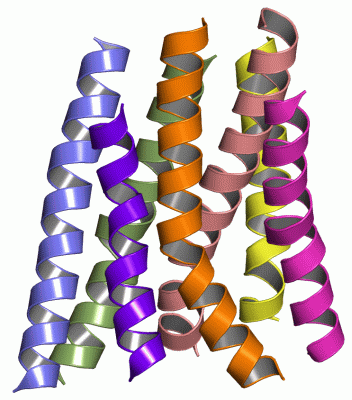
Image Theor.Model - manually
Theor.Model - manually  (Jmol Viewer)
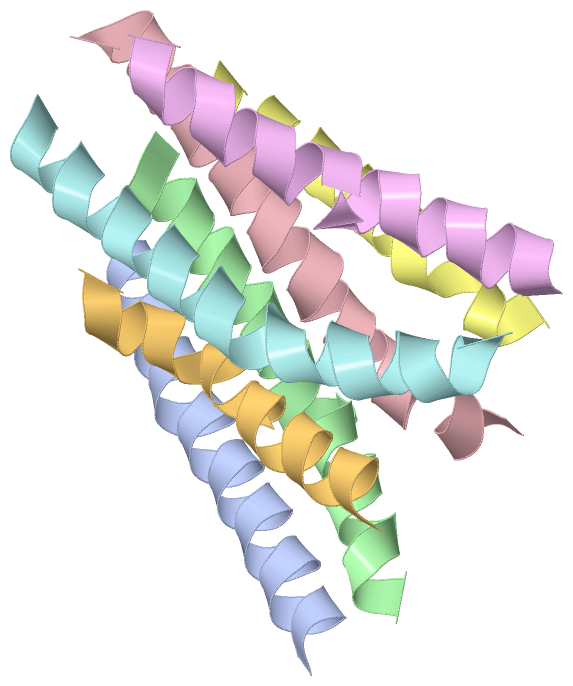
Image Theoretical Model
Theoretical Model  (Jmol Viewer)

(-) Description

Title :  A HOMOLOGY-BASED 3D MODEL OF THE HUMAN NEUROPEPTIDE Y RECEPTOR Y1
 
Authors :  P. Sjodin, H. Akerberg, D. Larhammar
Date :  15 Nov 05  (Deposition) - 04 Jul 06  (Release) - 04 Jul 06  (Revision)
Method :  THEORETICAL MODEL
Resolution :  NOT APPLICABLE
Chains :  Theor. Model :  A,B,C,D,E,F,G
Keywords :  Transmembrane, Alpha-Helix, Gpcr, (Keyword Search: [Gene Ontology, PubMed, Web (Google))
 
Reference :  P. Sjodin, S. K. S. Holmberg, H. Akerberg, M. M. Berglund, N. Mohell, D. Larhammar
Re-Evaluation Of Receptor-Ligand Interactions Of The Human Neuropeptide Y Receptor Y1: A Site-Directed Mutagenesis Study
Biochem. J. V. 393 161 2006
PubMed: search
(for further references see the PDB file header)

(-) Compounds

Molecule 1 - NEUROPEPTIDE Y RECEPTOR TYPE 1
    ChainsA
    Organism CommonHUMAN
    Organism ScientificHOMO SAPIENS
    SynonymNPY1-R
 
Molecule 2 - NEUROPEPTIDE Y RECEPTOR TYPE 1
    ChainsB
    Organism CommonHUMAN
    Organism ScientificHOMO SAPIENS
    SynonymNPY1-R
 
Molecule 3 - NEUROPEPTIDE Y RECEPTOR TYPE 1
    ChainsC
    Organism CommonHUMAN
    Organism ScientificHOMO SAPIENS
    SynonymNPY1-R
 
Molecule 4 - NEUROPEPTIDE Y RECEPTOR TYPE 1
    ChainsD
    Organism CommonHUMAN
    Organism ScientificHOMO SAPIENS
    SynonymNPY1-R
 
Molecule 5 - NEUROPEPTIDE Y RECEPTOR TYPE 1
    ChainsE
    Organism CommonHUMAN
    Organism ScientificHOMO SAPIENS
    SynonymNPY1-R
 
Molecule 6 - NEUROPEPTIDE Y RECEPTOR TYPE 1
    ChainsF
    Organism CommonHUMAN
    Organism ScientificHOMO SAPIENS
    SynonymNPY1-R
 
Molecule 7 - NEUROPEPTIDE Y RECEPTOR TYPE 1
    ChainsG
    Organism CommonHUMAN
    Organism ScientificHOMO SAPIENS
    SynonymNPY1-R

 Structural Features

(-) Chains, Units

  
Theoretical Model 

Summary Information (see also Sequences/Alignments below)

(-) Ligands, Modified Residues, Ions  (0, 0)

(no "Ligand,Modified Residues,Ions" information available for 2F1U)

(-) Sites  (0, 0)

(no "Site" information available for 2F1U)

(-) SS Bonds  (0, 0)

(no "SS Bond" information available for 2F1U)

(-) Cis Peptide Bonds  (0, 0)

(no "Cis Peptide Bond" information available for 2F1U)

 Sequence-Structure Mapping

(-) SAPs(SNPs)/Variants  (0, 0)

(no "SAP(SNP)/Variant" information available for 2F1U)

(-) PROSITE Motifs  (1, 1)

Theoretical Model (1, 1)
 PROSITEUniProtKBPDB
No.IDACDescriptionIDLocationCountLocation
1G_PROTEIN_RECEP_F1_1PS00237 G-protein coupled receptors family 1 signature.NPY1R_HUMAN126-142  1C:123-139

(-) Exons   (2, 7)

Theoretical Model (2, 7)
 ENSEMBLUniProtKBPDB
No.Transcript IDExonExon IDGenome LocationLengthIDLocationLengthCountLocationLength
1.2bENST000002965332bENSE00002047720chr4:164254014-164253634381NPY1R_HUMAN-00--
1.4eENST000002965334eENSE00001081706chr4:164247857-164247008850NPY1R_HUMAN1-2332335A:35-64
B:71-100
C:107-139
D:151-173
E:200-225
-
-
30
30
33
23
26
-
-
1.5dENST000002965335dENSE00001081704chr4:164246910-1642451131798NPY1R_HUMAN234-3841512-
-
-
-
-
F:247-277
G:286-306
-
-
-
-
-
31
21

(-) Sequences/Alignments

Theoretical Model
   Reformat: Number of residues per line =  ('0' or empty: single-line sequence representation)
  Number of residues per labelling interval =   
  UniProt sequence: complete  aligned part    
   Show mapping: SCOP domains CATH domains Pfam domains Secondary structure (by author)
SAPs(SNPs) PROSITE motifs Exons
(details for a mapped element are shown in a popup box when the mouse pointer rests over it)
Chain A from PDB  Type:PROTEIN  Length:30
 aligned with NPY1R_HUMAN | P25929 from UniProtKB/Swiss-Prot  Length:384

    Alignment length:30
                                    47        57        67
          NPY1R_HUMAN    38 AMIFTLALAYGAVIILGVSGNLALIIIILK  67
               SCOP domains ------------------------------ SCOP domains
               CATH domains ------------------------------ CATH domains
               Pfam domains ------------------------------ Pfam domains
         Sec.struct. author hhhhhhhhhhhhhhhhhhhhhhhhhhhhhh Sec.struct. author
                 SAPs(SNPs) ------------------------------ SAPs(SNPs)
                    PROSITE ------------------------------ PROSITE
               Transcript 1 Exon 1.4e  PDB: A:35-64        Transcript 1
                 2f1u A  35 AMIFTLALAYGAVIILGVSGNLALIIIILK  64
                                    44        54        64

Chain B from PDB  Type:PROTEIN  Length:30
 aligned with NPY1R_HUMAN | P25929 from UniProtKB/Swiss-Prot  Length:384

    Alignment length:30
                                    83        93       103
          NPY1R_HUMAN    74 VTNILIVNLSFSDLLVAIMCLPFTFVYTLM 103
               SCOP domains ------------------------------ SCOP domains
               CATH domains ------------------------------ CATH domains
               Pfam domains ------------------------------ Pfam domains
         Sec.struct. author hhhhhhhhhhhhhhhhhhhhhhhhhhhhhh Sec.struct. author
                 SAPs(SNPs) ------------------------------ SAPs(SNPs)
                    PROSITE ------------------------------ PROSITE
               Transcript 1 Exon 1.4e  PDB: B:71-100       Transcript 1
                 2f1u B  71 VTNILIVNLSFSDLLVAIMCLPFTFVYTLM 100
                                    80        90       100

Chain C from PDB  Type:PROTEIN  Length:33
 aligned with NPY1R_HUMAN | P25929 from UniProtKB/Swiss-Prot  Length:384

    Alignment length:33
                                   119       129       139   
          NPY1R_HUMAN   110 EAMCKLNPFVQCVSITVSIFSLVLIAVERHQLI 142
               SCOP domains --------------------------------- SCOP domains
               CATH domains --------------------------------- CATH domains
               Pfam domains --------------------------------- Pfam domains
         Sec.struct. author hhhhhhhhhhhhhhhhhhhhhhhhhhhhhhhhh Sec.struct. author
                 SAPs(SNPs) --------------------------------- SAPs(SNPs)
                    PROSITE ----------------G_PROTEIN_RECEP_F PROSITE
               Transcript 1 Exon 1.4e  PDB: C:107-139         Transcript 1
                 2f1u C 107 EAMCKLNPFVQCVSITVSIFSLVLIAVERHQLI 139
                                   116       126       136   

Chain D from PDB  Type:PROTEIN  Length:23
 aligned with NPY1R_HUMAN | P25929 from UniProtKB/Swiss-Prot  Length:384

    Alignment length:23
                                   162       172   
          NPY1R_HUMAN   153 RHAYVGIAVIWVLAVASSLPFLI 175
               SCOP domains ----------------------- SCOP domains
               CATH domains ----------------------- CATH domains
               Pfam domains ----------------------- Pfam domains
         Sec.struct. author hhhhhhhhhhhhhhhhhhhhhhh Sec.struct. author
                 SAPs(SNPs) ----------------------- SAPs(SNPs)
                    PROSITE ----------------------- PROSITE
               Transcript 1 Exon 1.4e [INCOMPLETE]  Transcript 1
                 2f1u D 151 RHAYVGIAVIWVLAVASSLPFLI 173
                                   160       170   

Chain E from PDB  Type:PROTEIN  Length:26
 aligned with NPY1R_HUMAN | P25929 from UniProtKB/Swiss-Prot  Length:384

    Alignment length:26
                                   217       227      
          NPY1R_HUMAN   208 RLSYTTLLLVLQYFGPLCFIFICYFK 233
               SCOP domains -------------------------- SCOP domains
               CATH domains -------------------------- CATH domains
               Pfam domains -------------------------- Pfam domains
         Sec.struct. author hhhhhhhhhhhhhhhhhhhhhhhhhh Sec.struct. author
                 SAPs(SNPs) -------------------------- SAPs(SNPs)
                    PROSITE -------------------------- PROSITE
               Transcript 1 Exon 1.4e  PDB: E:200-225  Transcript 1
                 2f1u E 200 RLSYTTLLLVLQYFGPLCFIFICYFK 225
                                   209       219      

Chain F from PDB  Type:PROTEIN  Length:31
 aligned with NPY1R_HUMAN | P25929 from UniProtKB/Swiss-Prot  Length:384

    Alignment length:31
                                   267       277       287 
          NPY1R_HUMAN   258 TKRINIMLLSIVVAFAVCWLPLTIFNTVFDW 288
               SCOP domains ------------------------------- SCOP domains
               CATH domains ------------------------------- CATH domains
               Pfam domains ------------------------------- Pfam domains
         Sec.struct. author hhhhhhhhhhhhhhhhhhhhhhhhhhhhhhh Sec.struct. author
                 SAPs(SNPs) ------------------------------- SAPs(SNPs)
                    PROSITE ------------------------------- PROSITE
               Transcript 1 Exon 1.5d  PDB: F:247-277       Transcript 1
                 2f1u F 247 TKRINIMLLSIVVAFAVCWLPLTIFNTVFDW 277
                                   256       266       276 

Chain G from PDB  Type:PROTEIN  Length:21
 aligned with NPY1R_HUMAN | P25929 from UniProtKB/Swiss-Prot  Length:384

    Alignment length:21
                                   309       319 
          NPY1R_HUMAN   300 LLFLLCHLTAMISTCVNPIFY 320
               SCOP domains --------------------- SCOP domains
               CATH domains --------------------- CATH domains
               Pfam domains --------------------- Pfam domains
         Sec.struct. author hhhhhhhhhhhhhhhhhhhhh Sec.struct. author
                 SAPs(SNPs) --------------------- SAPs(SNPs)
                    PROSITE --------------------- PROSITE
               Transcript 1 Exon 1.5d             Transcript 1
                 2f1u G 286 LLFLLCHLTAMISTCVNPIFY 306
                                   295       305 

   Legend:   → Mismatch (orange background)
  - → Gap (green background, '-', border residues have a numbering label)
    → Modified Residue (blue background, lower-case, 'x' indicates undefined single-letter code, labelled with number + name)
  x → Chemical Group (purple background, 'x', labelled with number + name, e.g. ACE or NH2)
  extra numbering lines below/above indicate numbering irregularities and modified residue names etc., number ends below/above '|'

 Classification and Annotation

(-) SCOP Domains  (0, 0)

(no "SCOP Domain" information available for 2F1U)

(-) CATH Domains  (0, 0)

(no "CATH Domain" information available for 2F1U)

(-) Pfam Domains  (0, 0)

(no "Pfam Domain" information available for 2F1U)

(-) Gene Ontology  (32, 32)

Theoretical Model(hide GO term definitions)
Chain A,B,C,D,E,F,G   (NPY1R_HUMAN | P25929)
molecular function
    GO:0004930    G-protein coupled receptor activity    Combining with an extracellular signal and transmitting the signal across the membrane by activating an associated G-protein; promotes the exchange of GDP for GTP on the alpha subunit of a heterotrimeric G-protein complex.
    GO:0004983    neuropeptide Y receptor activity    Combining with neuropeptide Y to initiate a change in cell activity.
    GO:0001602    pancreatic polypeptide receptor activity    Combining with pancreatic polypeptide PP to initiate a change in cell activity.
    GO:0001601    peptide YY receptor activity    Combining with gut peptide YY to initiate a change in cell activity.
    GO:0005515    protein binding    Interacting selectively and non-covalently with any protein or protein complex (a complex of two or more proteins that may include other nonprotein molecules).
    GO:0004871    signal transducer activity    Conveys a signal across a cell to trigger a change in cell function or state. A signal is a physical entity or change in state that is used to transfer information in order to trigger a response.
biological process
    GO:0007186    G-protein coupled receptor signaling pathway    A series of molecular signals that proceeds with an activated receptor promoting the exchange of GDP for GTP on the alpha-subunit of an associated heterotrimeric G-protein complex. The GTP-bound activated alpha-G-protein then dissociates from the beta- and gamma-subunits to further transmit the signal within the cell. The pathway begins with receptor-ligand interaction, or for basal GPCR signaling the pathway begins with the receptor activating its G protein in the absence of an agonist, and ends with regulation of a downstream cellular process, e.g. transcription. The pathway can start from the plasma membrane, Golgi or nuclear membrane (PMID:24568158 and PMID:16902576).
    GO:0007187    G-protein coupled receptor signaling pathway, coupled to cyclic nucleotide second messenger    The series of molecular signals generated as a consequence of a G-protein coupled receptor binding to its physiological ligand, where the pathway proceeds with activation or inhibition of a nucleotide cyclase activity and a subsequent change in the concentration of a cyclic nucleotide.
    GO:0007193    adenylate cyclase-inhibiting G-protein coupled receptor signaling pathway    The series of molecular signals generated as a consequence of a G-protein coupled receptor binding to its physiological ligand, where the pathway proceeds through inhibition of adenylyl cyclase activity and a subsequent decrease in the concentration of cyclic AMP (cAMP).
    GO:0008015    blood circulation    The flow of blood through the body of an animal, enabling the transport of nutrients to the tissues and the removal of waste products.
    GO:0007166    cell surface receptor signaling pathway    A series of molecular signals initiated by activation of a receptor on the surface of a cell. The pathway begins with binding of an extracellular ligand to a cell surface receptor, or for receptors that signal in the absence of a ligand, by ligand-withdrawal or the activity of a constitutively active receptor. The pathway ends with regulation of a downstream cellular process, e.g. transcription.
    GO:0007631    feeding behavior    Behavior associated with the intake of food.
    GO:0006006    glucose metabolic process    The chemical reactions and pathways involving glucose, the aldohexose gluco-hexose. D-glucose is dextrorotatory and is sometimes known as dextrose; it is an important source of energy for living organisms and is found free as well as combined in homo- and hetero-oligosaccharides and polysaccharides.
    GO:0007626    locomotory behavior    The specific movement from place to place of an organism in response to external or internal stimuli. Locomotion of a whole organism in a manner dependent upon some combination of that organism's internal state and external conditions.
    GO:0051481    negative regulation of cytosolic calcium ion concentration    Any process that decreases the concentration of calcium ions in the cytosol.
    GO:0046888    negative regulation of hormone secretion    Any process that stops, prevents, or reduces the frequency, rate or extent of the regulated release of a hormone from a cell.
    GO:0007218    neuropeptide signaling pathway    The series of molecular signals generated as a consequence of a peptide neurotransmitter binding to a cell surface receptor.
    GO:0003151    outflow tract morphogenesis    The process in which the anatomical structures of the outflow tract are generated and organized. The outflow tract is the portion of the heart through which blood flows into the arteries.
    GO:0030432    peristalsis    A wavelike sequence of involuntary muscular contraction and relaxation that passes along a tubelike structure, such as the intestine, impelling the contents onwards.
    GO:0045907    positive regulation of vasoconstriction    Any process that activates or increases the frequency, rate or extent of vasoconstriction.
    GO:0008217    regulation of blood pressure    Any process that modulates the force with which blood travels through the circulatory system. The process is controlled by a balance of processes that increase pressure and decrease pressure.
    GO:0040014    regulation of multicellular organism growth    Any process that modulates the frequency, rate or extent of growth of the body of an organism so that it reaches its usual body size.
    GO:0032355    response to estradiol    Any process that results in a change in state or activity of a cell or an organism (in terms of movement, secretion, enzyme production, gene expression, etc.) as a result of stimulus by estradiol, a C18 steroid hormone hydroxylated at C3 and C17 that acts as a potent estrogen.
    GO:0019233    sensory perception of pain    The series of events required for an organism to receive a painful stimulus, convert it to a molecular signal, and recognize and characterize the signal. Pain is medically defined as the physical sensation of discomfort or distress caused by injury or illness, so can hence be described as a harmful stimulus which signals current (or impending) tissue damage. Pain may come from extremes of temperature, mechanical damage, electricity or from noxious chemical substances. This is a neurological process.
    GO:0007165    signal transduction    The cellular process in which a signal is conveyed to trigger a change in the activity or state of a cell. Signal transduction begins with reception of a signal (e.g. a ligand binding to a receptor or receptor activation by a stimulus such as light), or for signal transduction in the absence of ligand, signal-withdrawal or the activity of a constitutively active receptor. Signal transduction ends with regulation of a downstream cellular process, e.g. regulation of transcription or regulation of a metabolic process. Signal transduction covers signaling from receptors located on the surface of the cell and signaling via molecules located within the cell. For signaling between cells, signal transduction is restricted to events at and within the receiving cell.
cellular component
    GO:0030424    axon    The long process of a neuron that conducts nerve impulses, usually away from the cell body to the terminals and varicosities, which are sites of storage and release of neurotransmitter.
    GO:0005829    cytosol    The part of the cytoplasm that does not contain organelles but which does contain other particulate matter, such as protein complexes.
    GO:0016021    integral component of membrane    The component of a membrane consisting of the gene products and protein complexes having at least some part of their peptide sequence embedded in the hydrophobic region of the membrane.
    GO:0005887    integral component of plasma membrane    The component of the plasma membrane consisting of the gene products and protein complexes having at least some part of their peptide sequence embedded in the hydrophobic region of the membrane.
    GO:0016020    membrane    A lipid bilayer along with all the proteins and protein complexes embedded in it an attached to it.
    GO:0005886    plasma membrane    The membrane surrounding a cell that separates the cell from its external environment. It consists of a phospholipid bilayer and associated proteins.
    GO:0008021    synaptic vesicle    A secretory organelle, typically 50 nm in diameter, of presynaptic nerve terminals; accumulates in high concentrations of neurotransmitters and secretes these into the synaptic cleft by fusion with the 'active zone' of the presynaptic plasma membrane.

 Visualization

(-) Interactive Views

Theoretical Model
  Complete Structure
    Jena3D(integrated viewing of ligand, site, SAP, PROSITE, SCOP information)
    WebMol | AstexViewer[tm]@PDBe
(Java Applets, require no local installation except for Java; loading may be slow)
    STRAP
(Java WebStart application, automatic local installation, requires Java; full application with system access!)
    RasMol
(require local installation)
    Molscript (VRML)
(requires installation of a VRML viewer; select preferred view via VRML and generate a mono or stereo PDF format file)
 
  Ligands, Modified Residues, Ions
(no "Ligands, Modified Residues, Ions" information available for 2f1u)
 
  Sites
(no "Sites" information available for 2f1u)
 
  Cis Peptide Bonds
(no "Cis Peptide Bonds" information available for 2f1u)
 

(-) Still Images

Jmol
  protein: cartoon or spacefill or dots and stick; nucleic acid: cartoon and stick; ligands: spacefill; active site: stick
Molscript
  protein, nucleic acid: cartoon; ligands: spacefill; active site: ball and stick

 Databases and Analysis Tools

(-) Databases

Access by PDB/NDB ID
  2f1u
    Family and Domain InformationProDom | SYSTERS
    General Structural InformationGlycoscienceDB | MMDB | NDB | OCA | PDB | PDBe | PDBj | PDBsum | PDBWiki | PQS | PROTEOPEDIA
    Orientation in MembranesOPM
    Protein SurfaceSURFACE
    Secondary StructureDSSP (structure derived) | HSSP (homology derived)
    Structural GenomicsGeneCensus
    Structural NeighboursCE | VAST
    Structure ClassificationCATH | Dali | SCOP
    Validation and Original DataBMRB Data View | BMRB Restraints Grid | EDS | PROCHECK | RECOORD | WHAT_CHECK
 
Access by UniProt ID/Accession number
  NPY1R_HUMAN | P25929
    Comparative Protein Structure ModelsModBase
    Genomic InformationEnsembl
    Protein-protein InteractionDIP
    Sequence, Family and Domain InformationInterPro | Pfam | SMART | UniProtKB/SwissProt
 
Access by Enzyme Classificator   (EC Number)
  (no 'Enzyme Classificator' available)
    General Enzyme InformationBRENDA | EC-PDB | Enzyme | IntEnz
    PathwayKEGG | MetaCyc
 
Access by Disease Identifier   (MIM ID)
  (no 'MIM ID' available)
    Disease InformationOMIM
 
Access by GenAge ID
  (no 'GenAge ID' available)
    Age Related InformationGenAge

(-) Analysis Tools

Access by PDB/NDB ID
    Domain InformationXDom
    Interatomic Contacts of Structural UnitsCSU
    Ligand-protein ContactsLPC
    Protein CavitiescastP
    Sequence and Secondary StructurePDBCartoon
    Structure AlignmentSTRAP(Java WebStart application, automatic local installation, requires Java; full application with system access!)
    Structure and Sequence BrowserSTING
 
Access by UniProt ID/Accession number
  NPY1R_HUMAN | P25929
    Protein Disorder PredictionDisEMBL | FoldIndex | GLOBPLOT (for more information see DisProt)

 Related Entries

(-) Entries Sharing at Least One Protein Chain (UniProt ID)

UniProtKB/Swiss-Prot
        NPY1R_HUMAN | P259292iil

(-) Related Entries Specified in the PDB File

(no "Related Entries Specified in the PDB File" available for 2F1U)