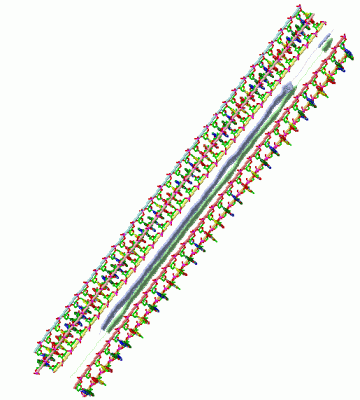
Theoretical Model(hide GO term definitions)
Chain A ( HSP1_HUMAN | P04553)
| molecular function |
|---|
| | GO:0003677 | | DNA binding | | Any molecular function by which a gene product interacts selectively and non-covalently with DNA (deoxyribonucleic acid). |
| biological process |
|---|
| | GO:0006323 | | DNA packaging | | Any process in which DNA and associated proteins are formed into a compact, orderly structure. |
| | GO:0030154 | | cell differentiation | | The process in which relatively unspecialized cells, e.g. embryonic or regenerative cells, acquire specialized structural and/or functional features that characterize the cells, tissues, or organs of the mature organism or some other relatively stable phase of the organism's life history. Differentiation includes the processes involved in commitment of a cell to a specific fate and its subsequent development to the mature state. |
| | GO:0030261 | | chromosome condensation | | The progressive compaction of dispersed interphase chromatin into threadlike chromosomes prior to mitotic or meiotic nuclear division, or during apoptosis, in eukaryotic cells. |
| | GO:0007275 | | multicellular organism development | | The biological process whose specific outcome is the progression of a multicellular organism over time from an initial condition (e.g. a zygote or a young adult) to a later condition (e.g. a multicellular animal or an aged adult). |
| | GO:0006997 | | nucleus organization | | A process that is carried out at the cellular level which results in the assembly, arrangement of constituent parts, or disassembly of the nucleus. |
| | GO:0007286 | | spermatid development | | The process whose specific outcome is the progression of a spermatid over time, from its formation to the mature structure. |
| | GO:0007283 | | spermatogenesis | | The process of formation of spermatozoa, including spermatocytogenesis and spermiogenesis. |
| cellular component |
|---|
| | GO:0005694 | | chromosome | | A structure composed of a very long molecule of DNA and associated proteins (e.g. histones) that carries hereditary information. |
| | GO:0005654 | | nucleoplasm | | That part of the nuclear content other than the chromosomes or the nucleolus. |
| | GO:0000786 | | nucleosome | | A complex comprised of DNA wound around a multisubunit core and associated proteins, which forms the primary packing unit of DNA into higher order structures. |
| | GO:0005634 | | nucleus | | A membrane-bounded organelle of eukaryotic cells in which chromosomes are housed and replicated. In most cells, the nucleus contains all of the cell's chromosomes except the organellar chromosomes, and is the site of RNA synthesis and processing. In some species, or in specialized cell types, RNA metabolism or DNA replication may be absent. |
Chain B ( PRM2_HUMAN | P04554)
| molecular function |
|---|
| | GO:0003677 | | DNA binding | | Any molecular function by which a gene product interacts selectively and non-covalently with DNA (deoxyribonucleic acid). |
| biological process |
|---|
| | GO:0006323 | | DNA packaging | | Any process in which DNA and associated proteins are formed into a compact, orderly structure. |
| | GO:0030154 | | cell differentiation | | The process in which relatively unspecialized cells, e.g. embryonic or regenerative cells, acquire specialized structural and/or functional features that characterize the cells, tissues, or organs of the mature organism or some other relatively stable phase of the organism's life history. Differentiation includes the processes involved in commitment of a cell to a specific fate and its subsequent development to the mature state. |
| | GO:0030261 | | chromosome condensation | | The progressive compaction of dispersed interphase chromatin into threadlike chromosomes prior to mitotic or meiotic nuclear division, or during apoptosis, in eukaryotic cells. |
| | GO:0007275 | | multicellular organism development | | The biological process whose specific outcome is the progression of a multicellular organism over time from an initial condition (e.g. a zygote or a young adult) to a later condition (e.g. a multicellular animal or an aged adult). |
| | GO:0006997 | | nucleus organization | | A process that is carried out at the cellular level which results in the assembly, arrangement of constituent parts, or disassembly of the nucleus. |
| | GO:0007286 | | spermatid development | | The process whose specific outcome is the progression of a spermatid over time, from its formation to the mature structure. |
| | GO:0007283 | | spermatogenesis | | The process of formation of spermatozoa, including spermatocytogenesis and spermiogenesis. |
| cellular component |
|---|
| | GO:0005694 | | chromosome | | A structure composed of a very long molecule of DNA and associated proteins (e.g. histones) that carries hereditary information. |
| | GO:0005654 | | nucleoplasm | | That part of the nuclear content other than the chromosomes or the nucleolus. |
| | GO:0000786 | | nucleosome | | A complex comprised of DNA wound around a multisubunit core and associated proteins, which forms the primary packing unit of DNA into higher order structures. |
| | GO:0005634 | | nucleus | | A membrane-bounded organelle of eukaryotic cells in which chromosomes are housed and replicated. In most cells, the nucleus contains all of the cell's chromosomes except the organellar chromosomes, and is the site of RNA synthesis and processing. In some species, or in specialized cell types, RNA metabolism or DNA replication may be absent. |
|

 Description