Asymmetric Unit(hide GO term definitions)
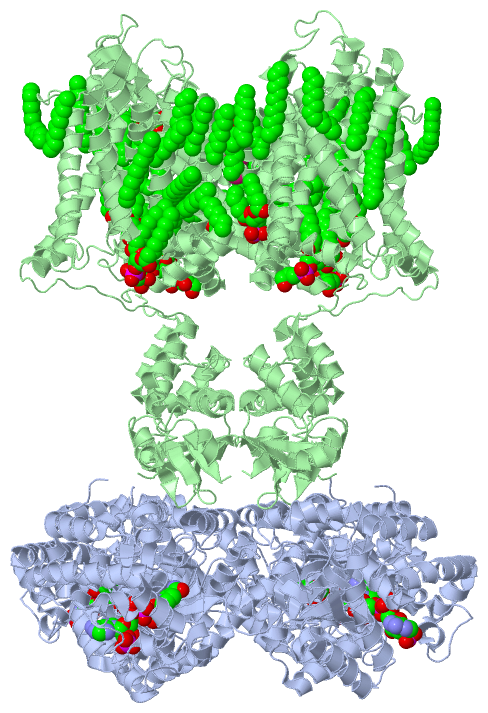
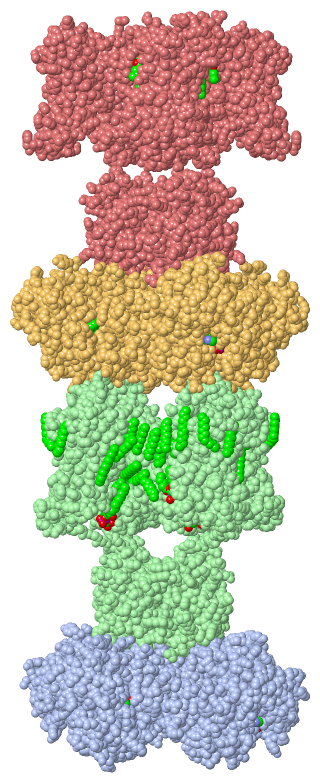
Chain A,G ( KCAB2_RAT | P62483)
| molecular function |
|---|
| | GO:0004033 | | aldo-keto reductase (NADP) activity | | Catalysis of the reaction: an alcohol + NADP+ = an aldehyde or a ketone + NADPH + H+. |
| | GO:0044325 | | ion channel binding | | Interacting selectively and non-covalently with one or more specific sites on an ion channel, a protein complex that spans a membrane and forms a water-filled channel across the phospholipid bilayer allowing selective ion transport down its electrochemical gradient. |
| | GO:0016491 | | oxidoreductase activity | | Catalysis of an oxidation-reduction (redox) reaction, a reversible chemical reaction in which the oxidation state of an atom or atoms within a molecule is altered. One substrate acts as a hydrogen or electron donor and becomes oxidized, while the other acts as hydrogen or electron acceptor and becomes reduced. |
| | GO:0015459 | | potassium channel regulator activity | | Modulates potassium channel activity via direct interaction interaction with a potassium channel (binding or modification). |
| | GO:0005515 | | protein binding | | Interacting selectively and non-covalently with any protein or protein complex (a complex of two or more proteins that may include other nonprotein molecules). |
| | GO:0005244 | | voltage-gated ion channel activity | | Enables the transmembrane transfer of an ion by a voltage-gated channel. An ion is an atom or group of atoms carrying an electric charge by virtue of having gained or lost one or more electrons. A voltage-gated channel is a channel whose open state is dependent on the voltage across the membrane in which it is embedded. |
| | GO:0005249 | | voltage-gated potassium channel activity | | Enables the transmembrane transfer of a potassium ion by a voltage-gated channel. A voltage-gated channel is a channel whose open state is dependent on the voltage across the membrane in which it is embedded. |
| biological process |
|---|
| | GO:0070995 | | NADPH oxidation | | A metabolic process that results in the oxidation of reduced nicotinamide adenine dinucleotide, NADPH, to the oxidized form, NADP. |
| | GO:0006811 | | ion transport | | The directed movement of charged atoms or small charged molecules into, out of or within a cell, or between cells, by means of some agent such as a transporter or pore. |
| | GO:0045445 | | myoblast differentiation | | The process in which a relatively unspecialized cell acquires specialized features of a myoblast. A myoblast is a mononucleate cell type that, by fusion with other myoblasts, gives rise to the myotubes that eventually develop into striated muscle fibers. |
| | GO:0055114 | | oxidation-reduction process | | A metabolic process that results in the removal or addition of one or more electrons to or from a substance, with or without the concomitant removal or addition of a proton or protons. |
| | GO:0071805 | | potassium ion transmembrane transport | | A process in which a potassium ion is transported from one side of a membrane to the other. |
| | GO:0006813 | | potassium ion transport | | The directed movement of potassium ions (K+) into, out of or within a cell, or between cells, by means of some agent such as a transporter or pore. |
| | GO:0051291 | | protein heterooligomerization | | The process of creating protein oligomers, compounds composed of a small number, usually between three and ten, of component monomers that are not all identical. Oligomers may be formed by the polymerization of a number of monomers or the depolymerization of a large protein polymer. |
| | GO:0034765 | | regulation of ion transmembrane transport | | Any process that modulates the frequency, rate or extent of the directed movement of ions from one side of a membrane to the other. |
| | GO:1901379 | | regulation of potassium ion transmembrane transport | | Any process that modulates the frequency, rate or extent of potassium ion transmembrane transport. |
| | GO:2000008 | | regulation of protein localization to cell surface | | Any process that modulates the frequency, rate or extent of protein localization to the cell surface. |
| | GO:0006810 | | transport | | The directed movement of substances (such as macromolecules, small molecules, ions) or cellular components (such as complexes and organelles) into, out of or within a cell, or between cells, or within a multicellular organism by means of some agent such as a transporter, pore or motor protein. |
| cellular component |
|---|
| | GO:0030424 | | axon | | The long process of a neuron that conducts nerve impulses, usually away from the cell body to the terminals and varicosities, which are sites of storage and release of neurotransmitter. |
| | GO:0030054 | | cell junction | | A cellular component that forms a specialized region of connection between two or more cells or between a cell and the extracellular matrix. At a cell junction, anchoring proteins extend through the plasma membrane to link cytoskeletal proteins in one cell to cytoskeletal proteins in neighboring cells or to proteins in the extracellular matrix. |
| | GO:0042995 | | cell projection | | A prolongation or process extending from a cell, e.g. a flagellum or axon. |
| | GO:0005737 | | cytoplasm | | All of the contents of a cell excluding the plasma membrane and nucleus, but including other subcellular structures. |
| | GO:0005856 | | cytoskeleton | | Any of the various filamentous elements that form the internal framework of cells, and typically remain after treatment of the cells with mild detergent to remove membrane constituents and soluble components of the cytoplasm. The term embraces intermediate filaments, microfilaments, microtubules, the microtrabecular lattice, and other structures characterized by a polymeric filamentous nature and long-range order within the cell. The various elements of the cytoskeleton not only serve in the maintenance of cellular shape but also have roles in other cellular functions, including cellular movement, cell division, endocytosis, and movement of organelles. |
| | GO:0005829 | | cytosol | | The part of the cytoplasm that does not contain organelles but which does contain other particulate matter, such as protein complexes. |
| | GO:0031234 | | extrinsic component of cytoplasmic side of plasma membrane | | The component of a plasma membrane consisting of gene products and protein complexes that are loosely bound to its cytoplasmic surface, but not integrated into the hydrophobic region. |
| | GO:0016021 | | integral component of membrane | | The component of a membrane consisting of the gene products and protein complexes having at least some part of their peptide sequence embedded in the hydrophobic region of the membrane. |
| | GO:0044224 | | juxtaparanode region of axon | | A region of an axon near a node of Ranvier that is between the paranode and internode regions. |
| | GO:0016020 | | membrane | | A lipid bilayer along with all the proteins and protein complexes embedded in it an attached to it. |
| | GO:0005874 | | microtubule | | Any of the long, generally straight, hollow tubes of internal diameter 12-15 nm and external diameter 24 nm found in a wide variety of eukaryotic cells; each consists (usually) of 13 protofilaments of polymeric tubulin, staggered in such a manner that the tubulin monomers are arranged in a helical pattern on the microtubular surface, and with the alpha/beta axes of the tubulin subunits parallel to the long axis of the tubule; exist in equilibrium with pool of tubulin monomers and can be rapidly assembled or disassembled in response to physiological stimuli; concerned with force generation, e.g. in the spindle. |
| | GO:0043005 | | neuron projection | | A prolongation or process extending from a nerve cell, e.g. an axon or dendrite. |
| | GO:1990031 | | pinceau fiber | | Dense plexus formed by the descending collaterals of cerebellar basket cells that wrap around a Purkinje cell axonal initial segment. |
| | GO:0005886 | | plasma membrane | | The membrane surrounding a cell that separates the cell from its external environment. It consists of a phospholipid bilayer and associated proteins. |
| | GO:0034705 | | potassium channel complex | | An ion channel complex through which potassium ions pass. |
| | GO:0045202 | | synapse | | The junction between a nerve fiber of one neuron and another neuron, muscle fiber or glial cell. As the nerve fiber approaches the synapse it enlarges into a specialized structure, the presynaptic nerve ending, which contains mitochondria and synaptic vesicles. At the tip of the nerve ending is the presynaptic membrane; facing it, and separated from it by a minute cleft (the synaptic cleft) is a specialized area of membrane on the receiving cell, known as the postsynaptic membrane. In response to the arrival of nerve impulses, the presynaptic nerve ending secretes molecules of neurotransmitters into the synaptic cleft. These diffuse across the cleft and transmit the signal to the postsynaptic membrane. |
Chain B,H ( KCNB1_RAT | P15387)
| molecular function |
|---|
| | GO:0000149 | | SNARE binding | | Interacting selectively and non-covalently with a SNARE (soluble N-ethylmaleimide-sensitive factor attached protein receptor) protein. |
| | GO:0005251 | | delayed rectifier potassium channel activity | | Enables the transmembrane transfer of a potassium ion by a delayed rectifying voltage-gated channel. A delayed rectifying current-voltage relation is one where channel activation kinetics are time-dependent, and inactivation is slow. |
| | GO:0005216 | | ion channel activity | | Enables the facilitated diffusion of an ion (by an energy-independent process) by passage through a transmembrane aqueous pore or channel without evidence for a carrier-mediated mechanism. May be either selective (it enables passage of a specific ion only) or non-selective (it enables passage of two or more ions of same charge but different size). |
| | GO:0044325 | | ion channel binding | | Interacting selectively and non-covalently with one or more specific sites on an ion channel, a protein complex that spans a membrane and forms a water-filled channel across the phospholipid bilayer allowing selective ion transport down its electrochemical gradient. |
| | GO:0015271 | | outward rectifier potassium channel activity | | Enables the transmembrane transfer of a potassium ion by an outwardly-rectifying voltage-gated channel. An outwardly rectifying current-voltage relation is one where at any given driving force the outward flow of K+ ions exceeds the inward flow for the opposite driving force. |
| | GO:0005267 | | potassium channel activity | | Enables the facilitated diffusion of a potassium ion (by an energy-independent process) involving passage through a transmembrane aqueous pore or channel without evidence for a carrier-mediated mechanism. |
| | GO:0047485 | | protein N-terminus binding | | Interacting selectively and non-covalently with a protein N-terminus, the end of any peptide chain at which the 2-amino (or 2-imino) function of a constituent amino acid is not attached in peptide linkage to another amino-acid residue. |
| | GO:0005515 | | protein binding | | Interacting selectively and non-covalently with any protein or protein complex (a complex of two or more proteins that may include other nonprotein molecules). |
| | GO:0046982 | | protein heterodimerization activity | | Interacting selectively and non-covalently with a nonidentical protein to form a heterodimer. |
| | GO:0005244 | | voltage-gated ion channel activity | | Enables the transmembrane transfer of an ion by a voltage-gated channel. An ion is an atom or group of atoms carrying an electric charge by virtue of having gained or lost one or more electrons. A voltage-gated channel is a channel whose open state is dependent on the voltage across the membrane in which it is embedded. |
| | GO:0005249 | | voltage-gated potassium channel activity | | Enables the transmembrane transfer of a potassium ion by a voltage-gated channel. A voltage-gated channel is a channel whose open state is dependent on the voltage across the membrane in which it is embedded. |
| biological process |
|---|
| | GO:0001508 | | action potential | | A process in which membrane potential cycles through a depolarizing spike, triggered in response to depolarization above some threshold, followed by repolarization. This cycle is driven by the flow of ions through various voltage gated channels with different thresholds and ion specificities. |
| | GO:0071333 | | cellular response to glucose stimulus | | Any process that results in a change in state or activity of a cell (in terms of movement, secretion, enzyme production, gene expression, etc.) as a result of a glucose stimulus. |
| | GO:0031669 | | cellular response to nutrient levels | | Any process that results in a change in state or activity of a cell (in terms of movement, secretion, enzyme production, gene expression, etc.) as a result of a stimulus reflecting the presence, absence, or concentration of nutrients. |
| | GO:0006887 | | exocytosis | | A process of secretion by a cell that results in the release of intracellular molecules (e.g. hormones, matrix proteins) contained within a membrane-bounded vesicle. Exocytosis can occur either by full fusion, when the vesicle collapses into the plasma membrane, or by a kiss-and-run mechanism that involves the formation of a transient contact, a pore, between a granule (for exemple of chromaffin cells) and the plasma membrane. The latter process most of the time leads to only partial secretion of the granule content. Exocytosis begins with steps that prepare vesicles for fusion with the membrane (tethering and docking) and ends when molecules are secreted from the cell. |
| | GO:0042593 | | glucose homeostasis | | Any process involved in the maintenance of an internal steady state of glucose within an organism or cell. |
| | GO:0007215 | | glutamate receptor signaling pathway | | A series of molecular signals initiated by the binding of glutamate to a glutamate receptor on the surface of a target cell, and ending with regulation of a downstream cellular process, e.g. transcription. |
| | GO:0006811 | | ion transport | | The directed movement of charged atoms or small charged molecules into, out of or within a cell, or between cells, by means of some agent such as a transporter or pore. |
| | GO:0046676 | | negative regulation of insulin secretion | | Any process that stops, prevents, or reduces the frequency, rate or extent of the regulated release of insulin. |
| | GO:0045956 | | positive regulation of calcium ion-dependent exocytosis | | Any process that activates or increases the frequency, rate or extent of calcium ion-dependent exocytosis. |
| | GO:0033605 | | positive regulation of catecholamine secretion | | Any process that activates or increases the frequency, rate or extent of the regulated release of a catecholamine. |
| | GO:1900454 | | positive regulation of long term synaptic depression | | Any process that activates or increases the frequency, rate or extent of long term synaptic depression. |
| | GO:0010701 | | positive regulation of norepinephrine secretion | | Any process that increases the frequency, rate or extent of the regulated release of norepinephrine. |
| | GO:0090314 | | positive regulation of protein targeting to membrane | | Any process that increases the frequency, rate or extent of the process of directing proteins towards a membrane, usually using signals contained within the protein. |
| | GO:0071805 | | potassium ion transmembrane transport | | A process in which a potassium ion is transported from one side of a membrane to the other. |
| | GO:0006813 | | potassium ion transport | | The directed movement of potassium ions (K+) into, out of or within a cell, or between cells, by means of some agent such as a transporter or pore. |
| | GO:0051260 | | protein homooligomerization | | The process of creating protein oligomers, compounds composed of a small number, usually between three and ten, of identical component monomers. Oligomers may be formed by the polymerization of a number of monomers or the depolymerization of a large protein polymer. |
| | GO:0051259 | | protein oligomerization | | The process of creating protein oligomers, compounds composed of a small number, usually between three and ten, of component monomers; protein oligomers may be composed of different or identical monomers. Oligomers may be formed by the polymerization of a number of monomers or the depolymerization of a large protein polymer. |
| | GO:0072661 | | protein targeting to plasma membrane | | The process of directing proteins towards the plasma membrane; usually uses signals contained within the protein. |
| | GO:0098900 | | regulation of action potential | | Any process that modulates the frequency, rate or extent of action potential creation, propagation or termination. This typically occurs via modulation of the activity or expression of voltage-gated ion channels. |
| | GO:0034765 | | regulation of ion transmembrane transport | | Any process that modulates the frequency, rate or extent of the directed movement of ions from one side of a membrane to the other. |
| | GO:2000671 | | regulation of motor neuron apoptotic process | | Any process that modulates the frequency, rate or extent of motor neuron apoptotic process. |
| | GO:0055085 | | transmembrane transport | | The process in which a solute is transported across a lipid bilayer, from one side of a membrane to the other |
| | GO:0006810 | | transport | | The directed movement of substances (such as macromolecules, small molecules, ions) or cellular components (such as complexes and organelles) into, out of or within a cell, or between cells, or within a multicellular organism by means of some agent such as a transporter, pore or motor protein. |
| | GO:0006904 | | vesicle docking involved in exocytosis | | The initial attachment of a vesicle membrane to a target membrane, mediated by proteins protruding from the membrane of the vesicle and the target membrane, that contributes to exocytosis. |
| cellular component |
|---|
| | GO:0030424 | | axon | | The long process of a neuron that conducts nerve impulses, usually away from the cell body to the terminals and varicosities, which are sites of storage and release of neurotransmitter. |
| | GO:0030054 | | cell junction | | A cellular component that forms a specialized region of connection between two or more cells or between a cell and the extracellular matrix. At a cell junction, anchoring proteins extend through the plasma membrane to link cytoskeletal proteins in one cell to cytoskeletal proteins in neighboring cells or to proteins in the extracellular matrix. |
| | GO:0042995 | | cell projection | | A prolongation or process extending from a cell, e.g. a flagellum or axon. |
| | GO:0030425 | | dendrite | | A neuron projection that has a short, tapering, often branched, morphology, receives and integrates signals from other neurons or from sensory stimuli, and conducts a nerve impulse towards the axon or the cell body. In most neurons, the impulse is conveyed from dendrites to axon via the cell body, but in some types of unipolar neuron, the impulse does not travel via the cell body. |
| | GO:0032590 | | dendrite membrane | | The portion of the plasma membrane surrounding a dendrite. |
| | GO:0016021 | | integral component of membrane | | The component of a membrane consisting of the gene products and protein complexes having at least some part of their peptide sequence embedded in the hydrophobic region of the membrane. |
| | GO:0005622 | | intracellular | | The living contents of a cell; the matter contained within (but not including) the plasma membrane, usually taken to exclude large vacuoles and masses of secretory or ingested material. In eukaryotes it includes the nucleus and cytoplasm. |
| | GO:0016328 | | lateral plasma membrane | | The portion of the plasma membrane at the lateral side of the cell. In epithelial cells, lateral plasma membranes are on the sides of cells which lie at the interface of adjacent cells. |
| | GO:0016020 | | membrane | | A lipid bilayer along with all the proteins and protein complexes embedded in it an attached to it. |
| | GO:0043005 | | neuron projection | | A prolongation or process extending from a nerve cell, e.g. an axon or dendrite. |
| | GO:0043025 | | neuronal cell body | | The portion of a neuron that includes the nucleus, but excludes cell projections such as axons and dendrites. |
| | GO:0032809 | | neuronal cell body membrane | | The plasma membrane of a neuron cell body - excludes the plasma membrane of cell projections such as axons and dendrites. |
| | GO:0043204 | | perikaryon | | The portion of the cell soma (neuronal cell body) that excludes the nucleus. |
| | GO:0005886 | | plasma membrane | | The membrane surrounding a cell that separates the cell from its external environment. It consists of a phospholipid bilayer and associated proteins. |
| | GO:0045211 | | postsynaptic membrane | | A specialized area of membrane facing the presynaptic membrane on the tip of the nerve ending and separated from it by a minute cleft (the synaptic cleft). Neurotransmitters cross the synaptic cleft and transmit the signal to the postsynaptic membrane. |
| | GO:0042383 | | sarcolemma | | The outer membrane of a muscle cell, consisting of the plasma membrane, a covering basement membrane (about 100 nm thick and sometimes common to more than one fiber), and the associated loose network of collagen fibers. |
| | GO:0045202 | | synapse | | The junction between a nerve fiber of one neuron and another neuron, muscle fiber or glial cell. As the nerve fiber approaches the synapse it enlarges into a specialized structure, the presynaptic nerve ending, which contains mitochondria and synaptic vesicles. At the tip of the nerve ending is the presynaptic membrane; facing it, and separated from it by a minute cleft (the synaptic cleft) is a specialized area of membrane on the receiving cell, known as the postsynaptic membrane. In response to the arrival of nerve impulses, the presynaptic nerve ending secretes molecules of neurotransmitters into the synaptic cleft. These diffuse across the cleft and transmit the signal to the postsynaptic membrane. |
| | GO:0008076 | | voltage-gated potassium channel complex | | A protein complex that forms a transmembrane channel through which potassium ions may cross a cell membrane in response to changes in membrane potential. |
Chain B,H ( KCNA2_RAT | P63142)
| molecular function |
|---|
| | GO:0005251 | | delayed rectifier potassium channel activity | | Enables the transmembrane transfer of a potassium ion by a delayed rectifying voltage-gated channel. A delayed rectifying current-voltage relation is one where channel activation kinetics are time-dependent, and inactivation is slow. |
| | GO:0005216 | | ion channel activity | | Enables the facilitated diffusion of an ion (by an energy-independent process) by passage through a transmembrane aqueous pore or channel without evidence for a carrier-mediated mechanism. May be either selective (it enables passage of a specific ion only) or non-selective (it enables passage of two or more ions of same charge but different size). |
| | GO:0019894 | | kinesin binding | | Interacting selectively and non-covalently and stoichiometrically with kinesin, a member of a superfamily of microtubule-based motor proteins that perform force-generating tasks such as organelle transport and chromosome segregation. |
| | GO:0015271 | | outward rectifier potassium channel activity | | Enables the transmembrane transfer of a potassium ion by an outwardly-rectifying voltage-gated channel. An outwardly rectifying current-voltage relation is one where at any given driving force the outward flow of K+ ions exceeds the inward flow for the opposite driving force. |
| | GO:0005267 | | potassium channel activity | | Enables the facilitated diffusion of a potassium ion (by an energy-independent process) involving passage through a transmembrane aqueous pore or channel without evidence for a carrier-mediated mechanism. |
| | GO:0005515 | | protein binding | | Interacting selectively and non-covalently with any protein or protein complex (a complex of two or more proteins that may include other nonprotein molecules). |
| | GO:0005244 | | voltage-gated ion channel activity | | Enables the transmembrane transfer of an ion by a voltage-gated channel. An ion is an atom or group of atoms carrying an electric charge by virtue of having gained or lost one or more electrons. A voltage-gated channel is a channel whose open state is dependent on the voltage across the membrane in which it is embedded. |
| | GO:0005249 | | voltage-gated potassium channel activity | | Enables the transmembrane transfer of a potassium ion by a voltage-gated channel. A voltage-gated channel is a channel whose open state is dependent on the voltage across the membrane in which it is embedded. |
| biological process |
|---|
| | GO:0006811 | | ion transport | | The directed movement of charged atoms or small charged molecules into, out of or within a cell, or between cells, by means of some agent such as a transporter or pore. |
| | GO:0019228 | | neuronal action potential | | An action potential that occurs in a neuron. |
| | GO:0071805 | | potassium ion transmembrane transport | | A process in which a potassium ion is transported from one side of a membrane to the other. |
| | GO:0006813 | | potassium ion transport | | The directed movement of potassium ions (K+) into, out of or within a cell, or between cells, by means of some agent such as a transporter or pore. |
| | GO:0051260 | | protein homooligomerization | | The process of creating protein oligomers, compounds composed of a small number, usually between three and ten, of identical component monomers. Oligomers may be formed by the polymerization of a number of monomers or the depolymerization of a large protein polymer. |
| | GO:0051259 | | protein oligomerization | | The process of creating protein oligomers, compounds composed of a small number, usually between three and ten, of component monomers; protein oligomers may be composed of different or identical monomers. Oligomers may be formed by the polymerization of a number of monomers or the depolymerization of a large protein polymer. |
| | GO:0014059 | | regulation of dopamine secretion | | Any process that modulates the frequency, rate or extent of the regulated release of dopamine. |
| | GO:0034765 | | regulation of ion transmembrane transport | | Any process that modulates the frequency, rate or extent of the directed movement of ions from one side of a membrane to the other. |
| | GO:0019233 | | sensory perception of pain | | The series of events required for an organism to receive a painful stimulus, convert it to a molecular signal, and recognize and characterize the signal. Pain is medically defined as the physical sensation of discomfort or distress caused by injury or illness, so can hence be described as a harmful stimulus which signals current (or impending) tissue damage. Pain may come from extremes of temperature, mechanical damage, electricity or from noxious chemical substances. This is a neurological process. |
| | GO:0055085 | | transmembrane transport | | The process in which a solute is transported across a lipid bilayer, from one side of a membrane to the other |
| | GO:0006810 | | transport | | The directed movement of substances (such as macromolecules, small molecules, ions) or cellular components (such as complexes and organelles) into, out of or within a cell, or between cells, or within a multicellular organism by means of some agent such as a transporter, pore or motor protein. |
| cellular component |
|---|
| | GO:0030424 | | axon | | The long process of a neuron that conducts nerve impulses, usually away from the cell body to the terminals and varicosities, which are sites of storage and release of neurotransmitter. |
| | GO:0043679 | | axon terminus | | Terminal inflated portion of the axon, containing the specialized apparatus necessary to release neurotransmitters. The axon terminus is considered to be the whole region of thickening and the terminal button is a specialized region of it. |
| | GO:0030054 | | cell junction | | A cellular component that forms a specialized region of connection between two or more cells or between a cell and the extracellular matrix. At a cell junction, anchoring proteins extend through the plasma membrane to link cytoskeletal proteins in one cell to cytoskeletal proteins in neighboring cells or to proteins in the extracellular matrix. |
| | GO:0042995 | | cell projection | | A prolongation or process extending from a cell, e.g. a flagellum or axon. |
| | GO:0030425 | | dendrite | | A neuron projection that has a short, tapering, often branched, morphology, receives and integrates signals from other neurons or from sensory stimuli, and conducts a nerve impulse towards the axon or the cell body. In most neurons, the impulse is conveyed from dendrites to axon via the cell body, but in some types of unipolar neuron, the impulse does not travel via the cell body. |
| | GO:0005783 | | endoplasmic reticulum | | The irregular network of unit membranes, visible only by electron microscopy, that occurs in the cytoplasm of many eukaryotic cells. The membranes form a complex meshwork of tubular channels, which are often expanded into slitlike cavities called cisternae. The ER takes two forms, rough (or granular), with ribosomes adhering to the outer surface, and smooth (with no ribosomes attached). |
| | GO:0005789 | | endoplasmic reticulum membrane | | The lipid bilayer surrounding the endoplasmic reticulum. |
| | GO:0005768 | | endosome | | A vacuole to which materials ingested by endocytosis are delivered. |
| | GO:0016021 | | integral component of membrane | | The component of a membrane consisting of the gene products and protein complexes having at least some part of their peptide sequence embedded in the hydrophobic region of the membrane. |
| | GO:0005887 | | integral component of plasma membrane | | The component of the plasma membrane consisting of the gene products and protein complexes having at least some part of their peptide sequence embedded in the hydrophobic region of the membrane. |
| | GO:0044224 | | juxtaparanode region of axon | | A region of an axon near a node of Ranvier that is between the paranode and internode regions. |
| | GO:0030027 | | lamellipodium | | A thin sheetlike process extended by the leading edge of a migrating cell or extending cell process; contains a dense meshwork of actin filaments. |
| | GO:0031258 | | lamellipodium membrane | | The portion of the plasma membrane surrounding a lamellipodium. |
| | GO:0016020 | | membrane | | A lipid bilayer along with all the proteins and protein complexes embedded in it an attached to it. |
| | GO:0043005 | | neuron projection | | A prolongation or process extending from a nerve cell, e.g. an axon or dendrite. |
| | GO:0032809 | | neuronal cell body membrane | | The plasma membrane of a neuron cell body - excludes the plasma membrane of cell projections such as axons and dendrites. |
| | GO:0043204 | | perikaryon | | The portion of the cell soma (neuronal cell body) that excludes the nucleus. |
| | GO:0005886 | | plasma membrane | | The membrane surrounding a cell that separates the cell from its external environment. It consists of a phospholipid bilayer and associated proteins. |
| | GO:0034705 | | potassium channel complex | | An ion channel complex through which potassium ions pass. |
| | GO:0042734 | | presynaptic membrane | | A specialized area of membrane of the axon terminal that faces the plasma membrane of the neuron or muscle fiber with which the axon terminal establishes a synaptic junction; many synaptic junctions exhibit structural presynaptic characteristics, such as conical, electron-dense internal protrusions, that distinguish it from the remainder of the axon plasma membrane. |
| | GO:0045202 | | synapse | | The junction between a nerve fiber of one neuron and another neuron, muscle fiber or glial cell. As the nerve fiber approaches the synapse it enlarges into a specialized structure, the presynaptic nerve ending, which contains mitochondria and synaptic vesicles. At the tip of the nerve ending is the presynaptic membrane; facing it, and separated from it by a minute cleft (the synaptic cleft) is a specialized area of membrane on the receiving cell, known as the postsynaptic membrane. In response to the arrival of nerve impulses, the presynaptic nerve ending secretes molecules of neurotransmitters into the synaptic cleft. These diffuse across the cleft and transmit the signal to the postsynaptic membrane. |
| | GO:0008076 | | voltage-gated potassium channel complex | | A protein complex that forms a transmembrane channel through which potassium ions may cross a cell membrane in response to changes in membrane potential. |
|

 Description