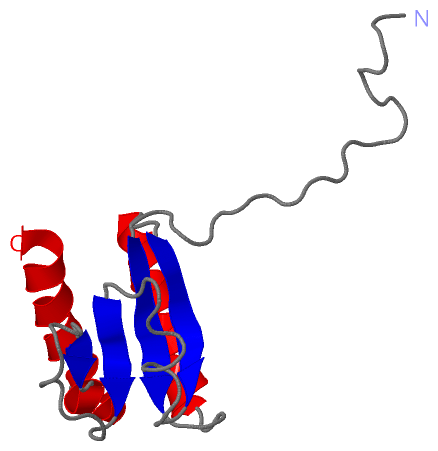
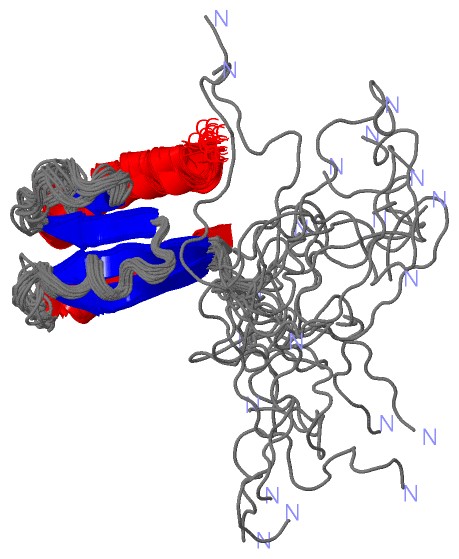
NMR Structure(hide GO term definitions)
Chain A ( PTKB_ECO57 | P0A436)
| molecular function |
|---|
| | GO:0008982 | | protein-N(PI)-phosphohistidine-sugar phosphotransferase activity | | Catalysis of the PEP-dependent, phosphoryl transfer-driven transport of substances across a membrane. The transport happens by catalysis of the reaction: protein N-phosphohistidine + sugar(out) = protein histidine + sugar phosphate(in). This differs from primary and secondary active transport in that the solute is modified during transport. |
| | GO:0016740 | | transferase activity | | Catalysis of the transfer of a group, e.g. a methyl group, glycosyl group, acyl group, phosphorus-containing, or other groups, from one compound (generally regarded as the donor) to another compound (generally regarded as the acceptor). Transferase is the systematic name for any enzyme of EC class 2. |
| biological process |
|---|
| | GO:0034219 | | carbohydrate transmembrane transport | | The process in which a carbohydrate is transported from one side of a membrane to the other by means of some agent such as a transporter or pore. |
| | GO:0008643 | | carbohydrate transport | | The directed movement of carbohydrate into, out of or within a cell, or between cells, by means of some agent such as a transporter or pore. Carbohydrates are any of a group of organic compounds based of the general formula Cx(H2O)y. |
| | GO:0019402 | | galactitol metabolic process | | The chemical reactions and pathways involving galactitol, the hexitol derived by the reduction of the aldehyde group of either D- or L-galactose. |
| | GO:0009401 | | phosphoenolpyruvate-dependent sugar phosphotransferase system | | The uptake and phosphorylation of specific carbohydrates from the extracellular environment; uptake and phosphorylation are coupled, making the PTS a link between the uptake and metabolism of sugars; phosphoenolpyruvate is the original phosphate donor; phosphoenolpyruvate passes the phosphate via a signal transduction pathway, to enzyme 1 (E1), which in turn passes it on to the histidine protein, HPr; the next step in the system involves sugar-specific membrane-bound complex, enzyme 2 (EII), which transports the sugar into the cell; it includes the sugar permease, which catalyzes the transport reactions; EII is usually divided into three different domains, EIIA, EIIB, and EIIC. |
| | GO:0006810 | | transport | | The directed movement of substances (such as macromolecules, small molecules, ions) or cellular components (such as complexes and organelles) into, out of or within a cell, or between cells, or within a multicellular organism by means of some agent such as a transporter, pore or motor protein. |
| cellular component |
|---|
| | GO:0005737 | | cytoplasm | | All of the contents of a cell excluding the plasma membrane and nucleus, but including other subcellular structures. |
Chain A ( PTKB_SHIFL | P0A437)
| molecular function |
|---|
| | GO:0008982 | | protein-N(PI)-phosphohistidine-sugar phosphotransferase activity | | Catalysis of the PEP-dependent, phosphoryl transfer-driven transport of substances across a membrane. The transport happens by catalysis of the reaction: protein N-phosphohistidine + sugar(out) = protein histidine + sugar phosphate(in). This differs from primary and secondary active transport in that the solute is modified during transport. |
| | GO:0016740 | | transferase activity | | Catalysis of the transfer of a group, e.g. a methyl group, glycosyl group, acyl group, phosphorus-containing, or other groups, from one compound (generally regarded as the donor) to another compound (generally regarded as the acceptor). Transferase is the systematic name for any enzyme of EC class 2. |
| biological process |
|---|
| | GO:0034219 | | carbohydrate transmembrane transport | | The process in which a carbohydrate is transported from one side of a membrane to the other by means of some agent such as a transporter or pore. |
| | GO:0008643 | | carbohydrate transport | | The directed movement of carbohydrate into, out of or within a cell, or between cells, by means of some agent such as a transporter or pore. Carbohydrates are any of a group of organic compounds based of the general formula Cx(H2O)y. |
| | GO:0019402 | | galactitol metabolic process | | The chemical reactions and pathways involving galactitol, the hexitol derived by the reduction of the aldehyde group of either D- or L-galactose. |
| | GO:0009401 | | phosphoenolpyruvate-dependent sugar phosphotransferase system | | The uptake and phosphorylation of specific carbohydrates from the extracellular environment; uptake and phosphorylation are coupled, making the PTS a link between the uptake and metabolism of sugars; phosphoenolpyruvate is the original phosphate donor; phosphoenolpyruvate passes the phosphate via a signal transduction pathway, to enzyme 1 (E1), which in turn passes it on to the histidine protein, HPr; the next step in the system involves sugar-specific membrane-bound complex, enzyme 2 (EII), which transports the sugar into the cell; it includes the sugar permease, which catalyzes the transport reactions; EII is usually divided into three different domains, EIIA, EIIB, and EIIC. |
| | GO:0006810 | | transport | | The directed movement of substances (such as macromolecules, small molecules, ions) or cellular components (such as complexes and organelles) into, out of or within a cell, or between cells, or within a multicellular organism by means of some agent such as a transporter, pore or motor protein. |
| cellular component |
|---|
| | GO:0005737 | | cytoplasm | | All of the contents of a cell excluding the plasma membrane and nucleus, but including other subcellular structures. |
Chain A ( PTKB_ECOL6 | P0A435)
| molecular function |
|---|
| | GO:0008982 | | protein-N(PI)-phosphohistidine-sugar phosphotransferase activity | | Catalysis of the PEP-dependent, phosphoryl transfer-driven transport of substances across a membrane. The transport happens by catalysis of the reaction: protein N-phosphohistidine + sugar(out) = protein histidine + sugar phosphate(in). This differs from primary and secondary active transport in that the solute is modified during transport. |
| | GO:0016740 | | transferase activity | | Catalysis of the transfer of a group, e.g. a methyl group, glycosyl group, acyl group, phosphorus-containing, or other groups, from one compound (generally regarded as the donor) to another compound (generally regarded as the acceptor). Transferase is the systematic name for any enzyme of EC class 2. |
| biological process |
|---|
| | GO:0034219 | | carbohydrate transmembrane transport | | The process in which a carbohydrate is transported from one side of a membrane to the other by means of some agent such as a transporter or pore. |
| | GO:0008643 | | carbohydrate transport | | The directed movement of carbohydrate into, out of or within a cell, or between cells, by means of some agent such as a transporter or pore. Carbohydrates are any of a group of organic compounds based of the general formula Cx(H2O)y. |
| | GO:0019402 | | galactitol metabolic process | | The chemical reactions and pathways involving galactitol, the hexitol derived by the reduction of the aldehyde group of either D- or L-galactose. |
| | GO:0009401 | | phosphoenolpyruvate-dependent sugar phosphotransferase system | | The uptake and phosphorylation of specific carbohydrates from the extracellular environment; uptake and phosphorylation are coupled, making the PTS a link between the uptake and metabolism of sugars; phosphoenolpyruvate is the original phosphate donor; phosphoenolpyruvate passes the phosphate via a signal transduction pathway, to enzyme 1 (E1), which in turn passes it on to the histidine protein, HPr; the next step in the system involves sugar-specific membrane-bound complex, enzyme 2 (EII), which transports the sugar into the cell; it includes the sugar permease, which catalyzes the transport reactions; EII is usually divided into three different domains, EIIA, EIIB, and EIIC. |
| | GO:0006810 | | transport | | The directed movement of substances (such as macromolecules, small molecules, ions) or cellular components (such as complexes and organelles) into, out of or within a cell, or between cells, or within a multicellular organism by means of some agent such as a transporter, pore or motor protein. |
| cellular component |
|---|
| | GO:0005737 | | cytoplasm | | All of the contents of a cell excluding the plasma membrane and nucleus, but including other subcellular structures. |
|

 Description