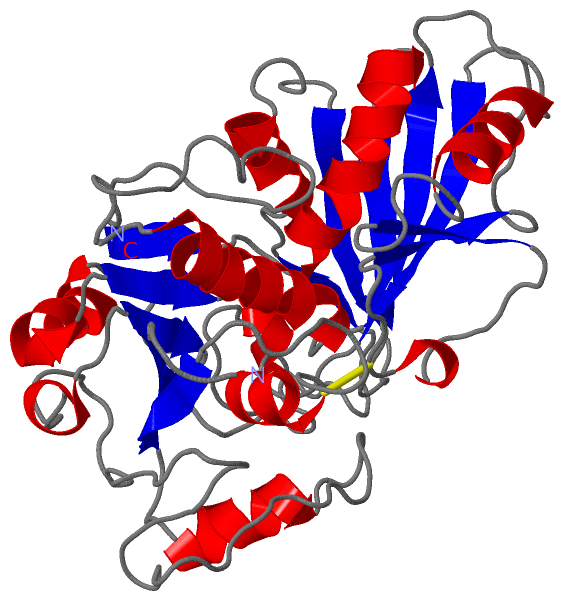
| molecular function |
|---|
| | GO:0051287 | | NAD binding | | Interacting selectively and non-covalently with nicotinamide adenine dinucleotide, a coenzyme involved in many redox and biosynthetic reactions; binding may be to either the oxidized form, NAD+, or the reduced form, NADH. |
| | GO:0050661 | | NADP binding | | Interacting selectively and non-covalently with nicotinamide-adenine dinucleotide phosphate, a coenzyme involved in many redox and biosynthetic reactions; binding may be to either the oxidized form, NADP+, or the reduced form, NADPH. |
| | GO:0047100 | | glyceraldehyde-3-phosphate dehydrogenase (NADP+) (phosphorylating) activity | | Catalysis of the reaction: phosphate + NADP+ + glyceraldehyde-3-phosphate = NADPH + 3-phospho-D-glyceroyl-phosphate. |
| | GO:0016491 | | oxidoreductase activity | | Catalysis of an oxidation-reduction (redox) reaction, a reversible chemical reaction in which the oxidation state of an atom or atoms within a molecule is altered. One substrate acts as a hydrogen or electron donor and becomes oxidized, while the other acts as hydrogen or electron acceptor and becomes reduced. |
| | GO:0016620 | | oxidoreductase activity, acting on the aldehyde or oxo group of donors, NAD or NADP as acceptor | | Catalysis of an oxidation-reduction (redox) reaction in which an aldehyde or ketone (oxo) group acts as a hydrogen or electron donor and reduces NAD or NADP. |
| | GO:0005515 | | protein binding | | Interacting selectively and non-covalently with any protein or protein complex (a complex of two or more proteins that may include other nonprotein molecules). |
| biological process |
|---|
| | GO:0006006 | | glucose metabolic process | | The chemical reactions and pathways involving glucose, the aldohexose gluco-hexose. D-glucose is dextrorotatory and is sometimes known as dextrose; it is an important source of energy for living organisms and is found free as well as combined in homo- and hetero-oligosaccharides and polysaccharides. |
| | GO:0055114 | | oxidation-reduction process | | A metabolic process that results in the removal or addition of one or more electrons to or from a substance, with or without the concomitant removal or addition of a proton or protons. |
| | GO:0019253 | | reductive pentose-phosphate cycle | | The fixation of carbon dioxide (CO2) as glucose in the chloroplasts of C3 plants; uses ATP and NADPH formed in the light reactions of photosynthesis; carbon dioxide reacts with ribulose 1,5-bisphosphate (catalyzed by the function of ribulose-bisphosphate carboxylase) to yield two molecules of 3-phosphoglycerate; these are then phosphorylated by ATP to 1,3-bisphosphateglyceraldehyde which, in turn, is then reduced by NADPH to glyceraldehyde 3-phosphate. The glyceraldehyde 3-phosphate is converted to fructose 5-phosphate and ribulose 5-phosphate by aldolase and other enzymes; the ribulose 5-phosphate is phosphorylated by ATP to ribulose 1,5-bisphosphate. |
| cellular component |
|---|
| | GO:0009507 | | chloroplast | | A chlorophyll-containing plastid with thylakoids organized into grana and frets, or stroma thylakoids, and embedded in a stroma. |
| | GO:0009536 | | plastid | | Any member of a family of organelles found in the cytoplasm of plants and some protists, which are membrane-bounded and contain DNA. Plant plastids develop from a common type, the proplastid. |

 Description