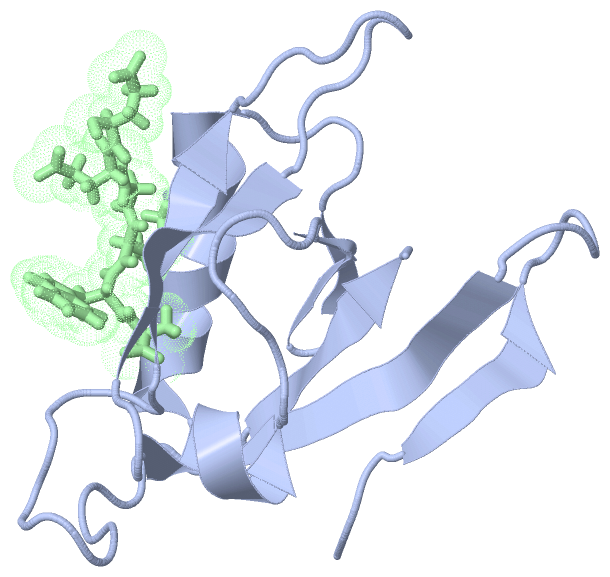
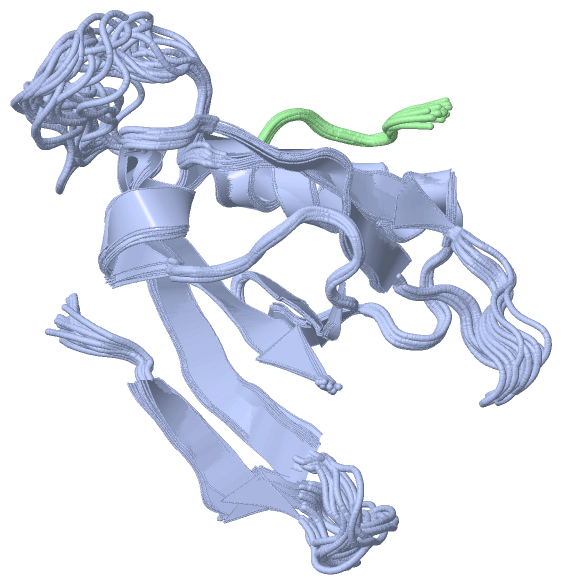
NMR Structure(hide GO term definitions)
Chain A ( RIMS1_RAT | Q9JIR4)
| molecular function |
|---|
| | GO:0017137 | | Rab GTPase binding | | Interacting selectively and non-covalently with Rab protein, any member of the Rab subfamily of the Ras superfamily of monomeric GTPases. |
| | GO:0017124 | | SH3 domain binding | | Interacting selectively and non-covalently with a SH3 domain (Src homology 3) of a protein, small protein modules containing approximately 50 amino acid residues found in a great variety of intracellular or membrane-associated proteins. |
| | GO:0046872 | | metal ion binding | | Interacting selectively and non-covalently with any metal ion. |
| | GO:0005515 | | protein binding | | Interacting selectively and non-covalently with any protein or protein complex (a complex of two or more proteins that may include other nonprotein molecules). |
| | GO:0019901 | | protein kinase binding | | Interacting selectively and non-covalently with a protein kinase, any enzyme that catalyzes the transfer of a phosphate group, usually from ATP, to a protein substrate. |
| biological process |
|---|
| | GO:0030154 | | cell differentiation | | The process in which relatively unspecialized cells, e.g. embryonic or regenerative cells, acquire specialized structural and/or functional features that characterize the cells, tissues, or organs of the mature organism or some other relatively stable phase of the organism's life history. Differentiation includes the processes involved in commitment of a cell to a specific fate and its subsequent development to the mature state. |
| | GO:0006887 | | exocytosis | | A process of secretion by a cell that results in the release of intracellular molecules (e.g. hormones, matrix proteins) contained within a membrane-bounded vesicle. Exocytosis can occur either by full fusion, when the vesicle collapses into the plasma membrane, or by a kiss-and-run mechanism that involves the formation of a transient contact, a pore, between a granule (for exemple of chromaffin cells) and the plasma membrane. The latter process most of the time leads to only partial secretion of the granule content. Exocytosis begins with steps that prepare vesicles for fusion with the membrane (tethering and docking) and ends when molecules are secreted from the cell. |
| | GO:0006886 | | intracellular protein transport | | The directed movement of proteins in a cell, including the movement of proteins between specific compartments or structures within a cell, such as organelles of a eukaryotic cell. |
| | GO:0060291 | | long-term synaptic potentiation | | A process that modulates synaptic plasticity such that synapses are changed resulting in the increase in the rate, or frequency of synaptic transmission at the synapse. |
| | GO:0006836 | | neurotransmitter transport | | The directed movement of a neurotransmitter into, out of or within a cell, or between cells, by means of some agent such as a transporter or pore. Neurotransmitters are any chemical substance that is capable of transmitting (or inhibiting the transmission of) a nerve impulse from a neuron to another cell. |
| | GO:2000463 | | positive regulation of excitatory postsynaptic potential | | Any process that enhances the establishment or increases the extent of the excitatory postsynaptic potential (EPSP) which is a temporary increase in postsynaptic potential due to the flow of positively charged ions into the postsynaptic cell. The flow of ions that causes an EPSP is an excitatory postsynaptic current (EPSC) and makes it easier for the neuron to fire an action potential. |
| | GO:0010628 | | positive regulation of gene expression | | Any process that increases the frequency, rate or extent of gene expression. Gene expression is the process in which a gene's coding sequence is converted into a mature gene product or products (proteins or RNA). This includes the production of an RNA transcript as well as any processing to produce a mature RNA product or an mRNA or circRNA (for protein-coding genes) and the translation of that mRNA or circRNA into protein. Protein maturation is included when required to form an active form of a product from an inactive precursor form. |
| | GO:0097151 | | positive regulation of inhibitory postsynaptic potential | | Any process that activates or increases the frequency, rate or extent of inhibitory postsynaptic potential (IPSP). IPSP is a temporary decrease in postsynaptic membrane potential due to the flow of negatively charged ions into the postsynaptic cell. The flow of ions that causes an IPSP is an inhibitory postsynaptic current (IPSC) and makes it more difficult for the neuron to fire an action potential. |
| | GO:0031632 | | positive regulation of synaptic vesicle fusion to presynaptic active zone membrane | | Any process that activates or increases the frequency, rate or extent of synaptic vesicle fusion to the presynaptic membrane. |
| | GO:0010808 | | positive regulation of synaptic vesicle priming | | Any process that increases the frequency, rate or extent of synaptic vesicle priming. Synaptic vesicle priming is the formation of SNARE-containing complexes, bringing synaptic vesicle membrane and plasma membranes into close proximity and thereby facilitating membrane fusion. |
| | GO:0006810 | | transport | | The directed movement of substances (such as macromolecules, small molecules, ions) or cellular components (such as complexes and organelles) into, out of or within a cell, or between cells, or within a multicellular organism by means of some agent such as a transporter, pore or motor protein. |
| cellular component |
|---|
| | GO:0030054 | | cell junction | | A cellular component that forms a specialized region of connection between two or more cells or between a cell and the extracellular matrix. At a cell junction, anchoring proteins extend through the plasma membrane to link cytoskeletal proteins in one cell to cytoskeletal proteins in neighboring cells or to proteins in the extracellular matrix. |
| | GO:0005622 | | intracellular | | The living contents of a cell; the matter contained within (but not including) the plasma membrane, usually taken to exclude large vacuoles and masses of secretory or ingested material. In eukaryotes it includes the nucleus and cytoplasm. |
| | GO:0016020 | | membrane | | A lipid bilayer along with all the proteins and protein complexes embedded in it an attached to it. |
| | GO:0005886 | | plasma membrane | | The membrane surrounding a cell that separates the cell from its external environment. It consists of a phospholipid bilayer and associated proteins. |
| | GO:0048786 | | presynaptic active zone | | A specialized region of the plasma membrane and cell cortex of a presynaptic neuron; encompasses a region of the plasma membrane where synaptic vesicles dock and fuse, and a specialized cortical cytoskeletal matrix. |
| | GO:0042734 | | presynaptic membrane | | A specialized area of membrane of the axon terminal that faces the plasma membrane of the neuron or muscle fiber with which the axon terminal establishes a synaptic junction; many synaptic junctions exhibit structural presynaptic characteristics, such as conical, electron-dense internal protrusions, that distinguish it from the remainder of the axon plasma membrane. |
| | GO:0045202 | | synapse | | The junction between a nerve fiber of one neuron and another neuron, muscle fiber or glial cell. As the nerve fiber approaches the synapse it enlarges into a specialized structure, the presynaptic nerve ending, which contains mitochondria and synaptic vesicles. At the tip of the nerve ending is the presynaptic membrane; facing it, and separated from it by a minute cleft (the synaptic cleft) is a specialized area of membrane on the receiving cell, known as the postsynaptic membrane. In response to the arrival of nerve impulses, the presynaptic nerve ending secretes molecules of neurotransmitters into the synaptic cleft. These diffuse across the cleft and transmit the signal to the postsynaptic membrane. |
Chain B ( RB6I2_RAT | Q811U3)
| molecular function |
|---|
| | GO:0030165 | | PDZ domain binding | | Interacting selectively and non-covalently with a PDZ domain of a protein, a domain found in diverse signaling proteins. |
| | GO:0017137 | | Rab GTPase binding | | Interacting selectively and non-covalently with Rab protein, any member of the Rab subfamily of the Ras superfamily of monomeric GTPases. |
| | GO:0005515 | | protein binding | | Interacting selectively and non-covalently with any protein or protein complex (a complex of two or more proteins that may include other nonprotein molecules). |
| biological process |
|---|
| | GO:0015031 | | protein transport | | The directed movement of proteins into, out of or within a cell, or between cells, by means of some agent such as a transporter or pore. |
| | GO:0042147 | | retrograde transport, endosome to Golgi | | The directed movement of membrane-bounded vesicles from endosomes back to the trans-Golgi network where they are recycled for further rounds of transport. |
| | GO:0006810 | | transport | | The directed movement of substances (such as macromolecules, small molecules, ions) or cellular components (such as complexes and organelles) into, out of or within a cell, or between cells, or within a multicellular organism by means of some agent such as a transporter, pore or motor protein. |
| cellular component |
|---|
| | GO:0005794 | | Golgi apparatus | | A compound membranous cytoplasmic organelle of eukaryotic cells, consisting of flattened, ribosome-free vesicles arranged in a more or less regular stack. The Golgi apparatus differs from the endoplasmic reticulum in often having slightly thicker membranes, appearing in sections as a characteristic shallow semicircle so that the convex side (cis or entry face) abuts the endoplasmic reticulum, secretory vesicles emerging from the concave side (trans or exit face). In vertebrate cells there is usually one such organelle, while in invertebrates and plants, where they are known usually as dictyosomes, there may be several scattered in the cytoplasm. The Golgi apparatus processes proteins produced on the ribosomes of the rough endoplasmic reticulum; such processing includes modification of the core oligosaccharides of glycoproteins, and the sorting and packaging of proteins for transport to a variety of cellular locations. Three different regions of the Golgi are now recognized both in terms of structure and function: cis, in the vicinity of the cis face, trans, in the vicinity of the trans face, and medial, lying between the cis and trans regions. |
| | GO:0000139 | | Golgi membrane | | The lipid bilayer surrounding any of the compartments of the Golgi apparatus. |
| | GO:0005737 | | cytoplasm | | All of the contents of a cell excluding the plasma membrane and nucleus, but including other subcellular structures. |
| | GO:0005829 | | cytosol | | The part of the cytoplasm that does not contain organelles but which does contain other particulate matter, such as protein complexes. |
| | GO:0016020 | | membrane | | A lipid bilayer along with all the proteins and protein complexes embedded in it an attached to it. |
| | GO:0048786 | | presynaptic active zone | | A specialized region of the plasma membrane and cell cortex of a presynaptic neuron; encompasses a region of the plasma membrane where synaptic vesicles dock and fuse, and a specialized cortical cytoskeletal matrix. |
| | GO:0045202 | | synapse | | The junction between a nerve fiber of one neuron and another neuron, muscle fiber or glial cell. As the nerve fiber approaches the synapse it enlarges into a specialized structure, the presynaptic nerve ending, which contains mitochondria and synaptic vesicles. At the tip of the nerve ending is the presynaptic membrane; facing it, and separated from it by a minute cleft (the synaptic cleft) is a specialized area of membrane on the receiving cell, known as the postsynaptic membrane. In response to the arrival of nerve impulses, the presynaptic nerve ending secretes molecules of neurotransmitters into the synaptic cleft. These diffuse across the cleft and transmit the signal to the postsynaptic membrane. |
|

 Description