Show PDB file:   
         Plain Text   HTML   (compressed file size)
QuickSearch:   
by PDB,NDB,UniProt,PROSITE Code or Search Term(s)  
(-)Asymmetric Unit
(-)Biological Unit 1
(-)Biological Unit 2
(-)Biological Unit 3
collapse expand < >
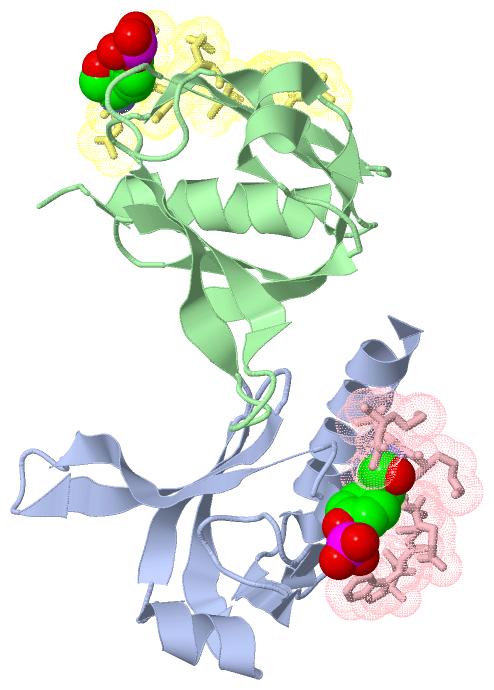
Image Asymmetric Unit
Asymmetric Unit  (Jmol Viewer)
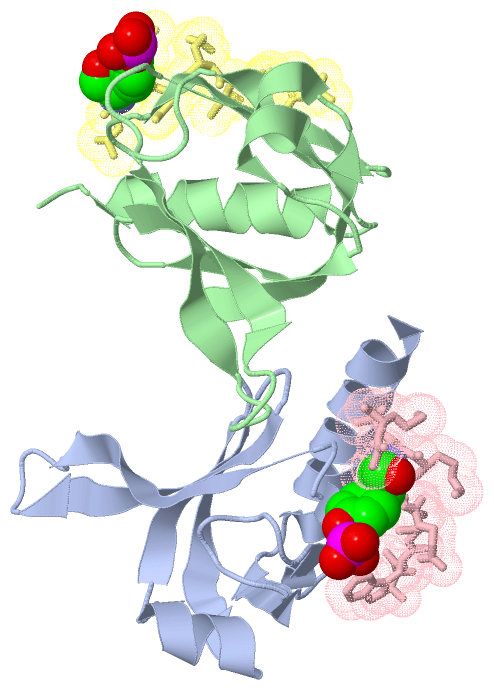
Image Biological Unit 1
Biological Unit 1  (Jmol Viewer)
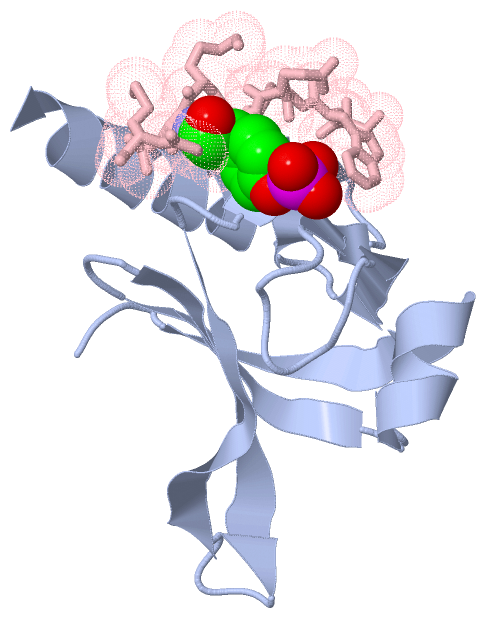
Image Biological Unit 2
Biological Unit 2  (Jmol Viewer)
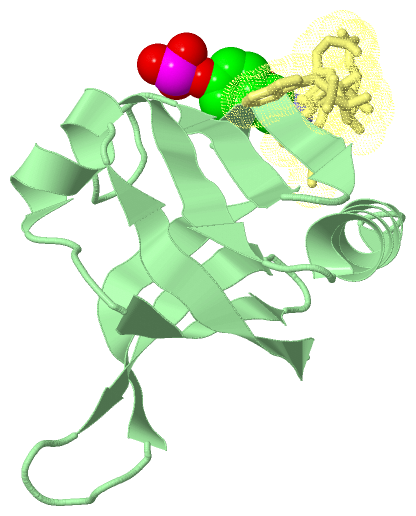
Image Biological Unit 3
Biological Unit 3  (Jmol Viewer)

(-) Description

Title :  CRYSTAL STRUCTURE OF DOK1 PTB DOMAIN COMPLEX
 
Authors :  N. Shi, S. Ye, Y. Liu, W. Zhou, Y. Ding, Z. Lou, B. Qiang, J. Yan, Z. Rao
Date :  14 May 03  (Deposition) - 25 May 04  (Release) - 15 Sep 09  (Revision)
Method :  X-RAY DIFFRACTION
Resolution :  2.50
Chains :  Asym. Unit :  A,B,C,D
Biol. Unit 1:  A,B,C,D  (1x)
Biol. Unit 2:  A,C  (1x)
Biol. Unit 3:  B,D  (1x)
Keywords :  Protein Binding, Transferase, Phosphotyrosine Binding Domain, Protein Binding/Transferase Complex (Keyword Search: [Gene Ontology, PubMed, Web (Google))
 
Reference :  N. Shi, S. Ye, M. Bartlam, M. Yang, J. Wu, Y. Liu, F. Sun, X. Han, X. Peng, B. Qiang, J. Yuan, Z. Rao
Structural Basis For The Specific Recognition Of Ret By The Dok1 Phosphotyrosine Binding Domain
J. Biol. Chem. V. 279 4962 2004
PubMed-ID: 14607833  |  Reference-DOI: 10.1074/JBC.M311030200
(for further references see the PDB file header)

(-) Compounds

Molecule 1 - DOCKING PROTEIN 1
    ChainsA, B
    EngineeredYES
    Expression SystemESCHERICHIA COLI BL21
    Expression System PlasmidPET28A
    Expression System StrainBL21
    Expression System Taxid511693
    Expression System Vector TypePLASMID
    FragmentDOK1 PTB DOMAIN
    Organism CommonHOUSE MOUSE
    Organism ScientificMUS MUSCULUS
    Organism Taxid10090
 
Molecule 2 - 13-MER PEPTIDE FROM PROTO-ONCOGENE TYROSINE- PROTEIN KINASE RECEPTOR RET
    ChainsC, D
    EC Number2.7.1.112
    EngineeredYES
    Other DetailsTHIS POLYPEPTIDE SUBSTRATE, IS SYNTHESIZED ARTIFICIALLY.
    SynonymPOLYPEPTIDE CONTAINING A PHOSPHORYLATED TYROSINE
    SyntheticYES

 Structural Features

(-) Chains, Units

  1234
Asymmetric Unit ABCD
Biological Unit 1 (1x)ABCD
Biological Unit 2 (1x)A C 
Biological Unit 3 (1x) B D

Summary Information (see also Sequences/Alignments below)

(-) Ligands, Modified Residues, Ions  (1, 2)

Asymmetric Unit (1, 2)
No.NameCountTypeFull Name
1PTR2Mod. Amino AcidO-PHOSPHOTYROSINE
Biological Unit 1 (1, 2)
No.NameCountTypeFull Name
1PTR2Mod. Amino AcidO-PHOSPHOTYROSINE
Biological Unit 2 (1, 1)
No.NameCountTypeFull Name
1PTR1Mod. Amino AcidO-PHOSPHOTYROSINE
Biological Unit 3 (1, 1)
No.NameCountTypeFull Name
1PTR1Mod. Amino AcidO-PHOSPHOTYROSINE

(-) Sites  (0, 0)

(no "Site" information available for 1UEF)

(-) SS Bonds  (0, 0)

(no "SS Bond" information available for 1UEF)

(-) Cis Peptide Bonds  (0, 0)

(no "Cis Peptide Bond" information available for 1UEF)

 Sequence-Structure Mapping

(-) SAPs(SNPs)/Variants  (0, 0)

(no "SAP(SNP)/Variant" information available for 1UEF)

(-) PROSITE Motifs  (1, 1)

Asymmetric Unit (1, 1)
 PROSITEUniProtKBPDB
No.IDACDescriptionIDLocationCountLocation
1IRS_PTBPS51064 IRS-type PTB domain profile.DOK1_MOUSE151-259  1A:5-108
Biological Unit 1 (1, 1)
 PROSITEUniProtKBPDB
No.IDACDescriptionIDLocationCountLocation
1IRS_PTBPS51064 IRS-type PTB domain profile.DOK1_MOUSE151-259  1A:5-108
Biological Unit 2 (1, 1)
 PROSITEUniProtKBPDB
No.IDACDescriptionIDLocationCountLocation
1IRS_PTBPS51064 IRS-type PTB domain profile.DOK1_MOUSE151-259  1A:5-108
Biological Unit 3 (, 0)
 PROSITEUniProtKBPDB
No.IDACDescriptionIDLocationCountLocation
1IRS_PTBPS51064 IRS-type PTB domain profile.DOK1_MOUSE151-259  0-

(-) Exons   (0, 0)

(no "Exon" information available for 1UEF)

(-) Sequences/Alignments

Asymmetric Unit
   Reformat: Number of residues per line =  ('0' or empty: single-line sequence representation)
  Number of residues per labelling interval =   
  UniProt sequence: complete  aligned part    
   Show mapping: SCOP domains CATH domains Pfam domains Secondary structure (by author)
SAPs(SNPs) PROSITE motifs Exons
(details for a mapped element are shown in a popup box when the mouse pointer rests over it)
Chain A from PDB  Type:PROTEIN  Length:105
 aligned with DOK1_MOUSE | P97465 from UniProtKB/Swiss-Prot  Length:482

    Alignment length:105
                                   160       170       180       190       200       210       220       230       240       250     
          DOK1_MOUSE    151 EGSQFWVTSQKTEASERCGLQGSYILRVEAEKLTLLTLGAQSQILEPLLFWPYTLLRRYGRDKVMFSFEAGRRCPSGPGTFTFQTSQGNDIFQAVEAAIQQQKAQ  255
               SCOP domains d1uefa_ A: Docking protein 1, Dok1                                                                        SCOP domains
               CATH domains 1uefA00 A:4-108 Pleckstrin-homology domain (PH domain)/Phosphotyrosine-binding domain (PTB)               CATH domains
               Pfam domains --------------------------------------------------------------------------------------------------------- Pfam domains
         Sec.struct. author ...eeeeeee.hhhhhhh....eeeeee...eeeeeeee....eeeeeeeee...eeeeee...eeeeee........eeeeee..hhhhhhhhhhhhhhhhhh. Sec.struct. author
                 SAPs(SNPs) --------------------------------------------------------------------------------------------------------- SAPs(SNPs)
                    PROSITE IRS_PTB  PDB: A:5-108 UniProt: 151-259                                                                    PROSITE
                 Transcript --------------------------------------------------------------------------------------------------------- Transcript
                1uef A    4 MGSQFWVTSQKTEASERCGLQGSYILRVEAEKLTLLTLGAQSQILEPLLFWPYTLLRRYGRDKVMFSFEAGRRCPSGPGTFTFQTSQGNDIFQAVEAAIQQQKAQ  108
                                    13        23        33        43        53        63        73        83        93       103     

Chain B from PDB  Type:PROTEIN  Length:103
 aligned with DOK1_MOUSE | P97465 from UniProtKB/Swiss-Prot  Length:482

    Alignment length:103
                                   161       171       181       191       201       211       221       231       241       251   
          DOK1_MOUSE    152 GSQFWVTSQKTEASERCGLQGSYILRVEAEKLTLLTLGAQSQILEPLLFWPYTLLRRYGRDKVMFSFEAGRRCPSGPGTFTFQTSQGNDIFQAVEAAIQQQKA  254
               SCOP domains d1uefb_ B: Docking protein 1, Dok1                                                                      SCOP domains
               CATH domains 1uefB00 B:5-107 Pleckstrin-homology domain (PH domain)/Phosphotyrosine-binding domain (PTB)             CATH domains
           Pfam domains (1) IRS-1uefB01 B:5-107                                                                                     Pfam domains (1)
           Pfam domains (2) IRS-1uefB02 B:5-107                                                                                     Pfam domains (2)
         Sec.struct. author .eeeeeeee.hhhhhhh....eeeeee...eeeeeee......eeeeeeee...eeeeeee..eeeeee........eeeeee..hhhhhhhhhhhhhhh... Sec.struct. author
                 SAPs(SNPs) ------------------------------------------------------------------------------------------------------- SAPs(SNPs)
                    PROSITE IRS_PTB  PDB: - UniProt: 151-259                                                                        PROSITE
                 Transcript ------------------------------------------------------------------------------------------------------- Transcript
                1uef B    5 GSQFWVTSQKTEASERCGLQGSYILRVEAEKLTLLTLGAQSQILEPLLFWPYTLLRRYGRDKVMFSFEAGRRCPSGPGTFTFQTSQGNDIFQAVEAAIQQQKA  107
                                    14        24        34        44        54        64        74        84        94       104   

Chain C from PDB  Type:PROTEIN  Length:10
 aligned with RET_MOUSE | P35546 from UniProtKB/Swiss-Prot  Length:1115

    Alignment length:10
                                  1065
           RET_MOUSE   1056 TWIENKLYGM 1065
               SCOP domains ---------- SCOP domains
               CATH domains ---------- CATH domains
               Pfam domains ---------- Pfam domains
         Sec.struct. author .eee...... Sec.struct. author
                 SAPs(SNPs) ---------- SAPs(SNPs)
                    PROSITE ---------- PROSITE
                 Transcript ---------- Transcript
                1uef C    2 TWIENKLyGM   11
                                   |11
                                   9-PTR

Chain D from PDB  Type:PROTEIN  Length:8
 aligned with RET_MOUSE | P35546 from UniProtKB/Swiss-Prot  Length:1115

    Alignment length:8
           RET_MOUSE   1056 TWIENKLY 1063
               SCOP domains -------- SCOP domains
               CATH domains -------- CATH domains
               Pfam domains -------- Pfam domains
         Sec.struct. author .eee.... Sec.struct. author
                 SAPs(SNPs) -------- SAPs(SNPs)
                    PROSITE -------- PROSITE
                 Transcript -------- Transcript
                1uef D    2 TWIENKLy    9
                                   |
                                   9-PTR

   Legend:   → Mismatch (orange background)
  - → Gap (green background, '-', border residues have a numbering label)
    → Modified Residue (blue background, lower-case, 'x' indicates undefined single-letter code, labelled with number + name)
  x → Chemical Group (purple background, 'x', labelled with number + name, e.g. ACE or NH2)
  extra numbering lines below/above indicate numbering irregularities and modified residue names etc., number ends below/above '|'

 Classification and Annotation

(-) SCOP Domains  (1, 2)

Asymmetric Unit

(-) CATH Domains  (1, 2)

Asymmetric Unit
(-)
Class: Mainly Beta (13760)

(-) Pfam Domains  (1, 2)

Asymmetric Unit
(-)
Family: IRS (14)

(-) Gene Ontology  (64, 68)

Asymmetric Unit(hide GO term definitions)
Chain A,B   (DOK1_MOUSE | P97465)
molecular function
    GO:0005158    insulin receptor binding    Interacting selectively and non-covalently with the insulin receptor.
    GO:0005515    protein binding    Interacting selectively and non-covalently with any protein or protein complex (a complex of two or more proteins that may include other nonprotein molecules).
    GO:0005057    signal transducer activity, downstream of receptor    Conveys a signal from an upstream receptor or intracellular signal transducer, converting the signal into a form where it can ultimately trigger a change in the state or activity of a cell.
biological process
    GO:0000165    MAPK cascade    An intracellular protein kinase cascade containing at least a MAPK, a MAPKK and a MAP3K. The cascade can also contain two additional tiers: the upstream MAP4K and the downstream MAP Kinase-activated kinase (MAPKAPK). The kinases in each tier phosphorylate and activate the kinases in the downstream tier to transmit a signal within a cell.
    GO:0007265    Ras protein signal transduction    A series of molecular signals within the cell that are mediated by a member of the Ras superfamily of proteins switching to a GTP-bound active state.
    GO:0035556    intracellular signal transduction    The process in which a signal is passed on to downstream components within the cell, which become activated themselves to further propagate the signal and finally trigger a change in the function or state of the cell.
    GO:0007169    transmembrane receptor protein tyrosine kinase signaling pathway    A series of molecular signals initiated by the binding of an extracellular ligand to a receptor on the surface of the target cell where the receptor possesses tyrosine kinase activity, and ending with regulation of a downstream cellular process, e.g. transcription.
cellular component
    GO:0005737    cytoplasm    All of the contents of a cell excluding the plasma membrane and nucleus, but including other subcellular structures.
    GO:0005634    nucleus    A membrane-bounded organelle of eukaryotic cells in which chromosomes are housed and replicated. In most cells, the nucleus contains all of the cell's chromosomes except the organellar chromosomes, and is the site of RNA synthesis and processing. In some species, or in specialized cell types, RNA metabolism or DNA replication may be absent.

Chain C,D   (RET_MOUSE | P35546)
molecular function
    GO:0005524    ATP binding    Interacting selectively and non-covalently with ATP, adenosine 5'-triphosphate, a universally important coenzyme and enzyme regulator.
    GO:0005509    calcium ion binding    Interacting selectively and non-covalently with calcium ions (Ca2+).
    GO:0016301    kinase activity    Catalysis of the transfer of a phosphate group, usually from ATP, to a substrate molecule.
    GO:0000166    nucleotide binding    Interacting selectively and non-covalently with a nucleotide, any compound consisting of a nucleoside that is esterified with (ortho)phosphate or an oligophosphate at any hydroxyl group on the ribose or deoxyribose.
    GO:0005515    protein binding    Interacting selectively and non-covalently with any protein or protein complex (a complex of two or more proteins that may include other nonprotein molecules).
    GO:0004672    protein kinase activity    Catalysis of the phosphorylation of an amino acid residue in a protein, usually according to the reaction: a protein + ATP = a phosphoprotein + ADP.
    GO:0004713    protein tyrosine kinase activity    Catalysis of the reaction: ATP + a protein tyrosine = ADP + protein tyrosine phosphate.
    GO:0016740    transferase activity    Catalysis of the transfer of a group, e.g. a methyl group, glycosyl group, acyl group, phosphorus-containing, or other groups, from one compound (generally regarded as the donor) to another compound (generally regarded as the acceptor). Transferase is the systematic name for any enzyme of EC class 2.
    GO:0004714    transmembrane receptor protein tyrosine kinase activity    Combining with a signal and transmitting the signal from one side of the membrane to the other to initiate a change in cell activity by catalysis of the reaction: ATP + a protein-L-tyrosine = ADP + a protein-L-tyrosine phosphate.
biological process
    GO:0000165    MAPK cascade    An intracellular protein kinase cascade containing at least a MAPK, a MAPKK and a MAP3K. The cascade can also contain two additional tiers: the upstream MAP4K and the downstream MAP Kinase-activated kinase (MAPKAPK). The kinases in each tier phosphorylate and activate the kinases in the downstream tier to transmit a signal within a cell.
    GO:0061146    Peyer's patch morphogenesis    The process in which a Peyer's patch is generated and organized. Peyer's patches are typically found as nodules associated with gut epithelium with distinct internal structures including B- and T-zones for the activation of lymphocytes.
    GO:0006919    activation of cysteine-type endopeptidase activity involved in apoptotic process    Any process that initiates the activity of the inactive enzyme cysteine-type endopeptidase in the context of an apoptotic process.
    GO:0009653    anatomical structure morphogenesis    The process in which anatomical structures are generated and organized. Morphogenesis pertains to the creation of form.
    GO:0007155    cell adhesion    The attachment of a cell, either to another cell or to an underlying substrate such as the extracellular matrix, via cell adhesion molecules.
    GO:0071300    cellular response to retinoic acid    Any process that results in a change in state or activity of a cell (in terms of movement, secretion, enzyme production, gene expression, etc.) as a result of a retinoic acid stimulus.
    GO:0001838    embryonic epithelial tube formation    The morphogenesis of an embryonic epithelium into a tube-shaped structure.
    GO:0048484    enteric nervous system development    The process whose specific outcome is the progression of the enteric nervous system over time, from its formation to the mature structure. The enteric nervous system is composed of two ganglionated neural plexuses in the gut wall which form one of the three major divisions of the autonomic nervous system. The enteric nervous system innervates the gastrointestinal tract, the pancreas, and the gall bladder. It contains sensory neurons, interneurons, and motor neurons. Thus the circuitry can autonomously sense the tension and the chemical environment in the gut and regulate blood vessel tone, motility, secretions, and fluid transport. The system is itself governed by the central nervous system and receives both parasympathetic and sympathetic innervation.
    GO:0007156    homophilic cell adhesion via plasma membrane adhesion molecules    The attachment of a plasma membrane adhesion molecule in one cell to an identical molecule in an adjacent cell.
    GO:0060384    innervation    The process in which a nerve invades a tissue and makes functional synaptic connection within the tissue.
    GO:0033619    membrane protein proteolysis    The proteolytic cleavage of a transmembrane protein leading to the release of its intracellular or ecto-domains.
    GO:0007399    nervous system development    The process whose specific outcome is the progression of nervous tissue over time, from its formation to its mature state.
    GO:0001755    neural crest cell migration    The characteristic movement of cells from the dorsal ridge of the neural tube to a variety of locations in a vertebrate embryo.
    GO:0007158    neuron cell-cell adhesion    The attachment of a neuron to another cell via adhesion molecules.
    GO:0030182    neuron differentiation    The process in which a relatively unspecialized cell acquires specialized features of a neuron.
    GO:0042551    neuron maturation    A developmental process, independent of morphogenetic (shape) change, that is required for a neuron to attain its fully functional state.
    GO:0018108    peptidyl-tyrosine phosphorylation    The phosphorylation of peptidyl-tyrosine to form peptidyl-O4'-phospho-L-tyrosine.
    GO:0016310    phosphorylation    The process of introducing a phosphate group into a molecule, usually with the formation of a phosphoric ester, a phosphoric anhydride or a phosphoric amide.
    GO:0033630    positive regulation of cell adhesion mediated by integrin    Any process that activates or increases the frequency, rate, or extent of cell adhesion mediated by integrin.
    GO:0030335    positive regulation of cell migration    Any process that activates or increases the frequency, rate or extent of cell migration.
    GO:0045793    positive regulation of cell size    Any process that increases cell size.
    GO:2001241    positive regulation of extrinsic apoptotic signaling pathway in absence of ligand    Any process that activates or increases the frequency, rate or extent of extrinsic apoptotic signaling pathway in absence of ligand.
    GO:0010628    positive regulation of gene expression    Any process that increases the frequency, rate or extent of gene expression. Gene expression is the process in which a gene's coding sequence is converted into a mature gene product or products (proteins or RNA). This includes the production of an RNA transcript as well as any processing to produce a mature RNA product or an mRNA or circRNA (for protein-coding genes) and the translation of that mRNA or circRNA into protein. Protein maturation is included when required to form an active form of a product from an inactive precursor form.
    GO:0072300    positive regulation of metanephric glomerulus development    Any process that increases the rate, frequency or extent of metanephric glomerulus development, the progression of the metanephric glomerulus over time from its initial formation until its mature state. The metanephric glomerulus is a capillary tuft surrounded by Bowman's capsule in nephrons of the vertebrate kidney, or metanephros.
    GO:0014042    positive regulation of neuron maturation    Any process that activates or increases the frequency, rate or extent of neuron maturation.
    GO:0010976    positive regulation of neuron projection development    Any process that increases the rate, frequency or extent of neuron projection development. Neuron projection development is the process whose specific outcome is the progression of a neuron projection over time, from its formation to the mature structure. A neuron projection is any process extending from a neural cell, such as axons or dendrites (collectively called neurites).
    GO:0045893    positive regulation of transcription, DNA-templated    Any process that activates or increases the frequency, rate or extent of cellular DNA-templated transcription.
    GO:0006468    protein phosphorylation    The process of introducing a phosphate group on to a protein.
    GO:0050770    regulation of axonogenesis    Any process that modulates the frequency, rate or extent of axonogenesis, the generation of an axon, the long process of a neuron.
    GO:0030155    regulation of cell adhesion    Any process that modulates the frequency, rate or extent of attachment of a cell to another cell or to the extracellular matrix.
    GO:0042493    response to drug    Any process that results in a change in state or activity of a cell or an organism (in terms of movement, secretion, enzyme production, gene expression, etc.) as a result of a drug stimulus. A drug is a substance used in the diagnosis, treatment or prevention of a disease.
    GO:0048265    response to pain    Any process that results in a change in state or activity of a cell or an organism (in terms of movement, secretion, enzyme production, gene expression, etc.) as a result of a pain stimulus. Pain stimuli cause activation of nociceptors, peripheral receptors for pain, include receptors which are sensitive to painful mechanical stimuli, extreme heat or cold, and chemical stimuli.
    GO:0060041    retina development in camera-type eye    The process whose specific outcome is the progression of the retina over time, from its formation to the mature structure. The retina is the innermost layer or coating at the back of the eyeball, which is sensitive to light and in which the optic nerve terminates.
    GO:0007169    transmembrane receptor protein tyrosine kinase signaling pathway    A series of molecular signals initiated by the binding of an extracellular ligand to a receptor on the surface of the target cell where the receptor possesses tyrosine kinase activity, and ending with regulation of a downstream cellular process, e.g. transcription.
    GO:0035799    ureter maturation    A developmental process, independent of morphogenetic (shape) change, that is required for the ureter to attain its fully functional state. The ureter is a muscular tube that transports urine from the kidney to the urinary bladder or from the Malpighian tubule to the hindgut.
    GO:0001657    ureteric bud development    The process whose specific outcome is the progression of the ureteric bud over time, from its formation to the mature structure.
cellular component
    GO:0030424    axon    The long process of a neuron that conducts nerve impulses, usually away from the cell body to the terminals and varicosities, which are sites of storage and release of neurotransmitter.
    GO:0005737    cytoplasm    All of the contents of a cell excluding the plasma membrane and nucleus, but including other subcellular structures.
    GO:0030425    dendrite    A neuron projection that has a short, tapering, often branched, morphology, receives and integrates signals from other neurons or from sensory stimuli, and conducts a nerve impulse towards the axon or the cell body. In most neurons, the impulse is conveyed from dendrites to axon via the cell body, but in some types of unipolar neuron, the impulse does not travel via the cell body.
    GO:0005769    early endosome    A membrane-bounded organelle that receives incoming material from primary endocytic vesicles that have been generated by clathrin-dependent and clathrin-independent endocytosis; vesicles fuse with the early endosome to deliver cargo for sorting into recycling or degradation pathways.
    GO:0005768    endosome    A vacuole to which materials ingested by endocytosis are delivered.
    GO:0010008    endosome membrane    The lipid bilayer surrounding an endosome.
    GO:0016021    integral component of membrane    The component of a membrane consisting of the gene products and protein complexes having at least some part of their peptide sequence embedded in the hydrophobic region of the membrane.
    GO:0005887    integral component of plasma membrane    The component of the plasma membrane consisting of the gene products and protein complexes having at least some part of their peptide sequence embedded in the hydrophobic region of the membrane.
    GO:0043231    intracellular membrane-bounded organelle    Organized structure of distinctive morphology and function, bounded by a single or double lipid bilayer membrane and occurring within the cell. Includes the nucleus, mitochondria, plastids, vacuoles, and vesicles. Excludes the plasma membrane.
    GO:0016020    membrane    A lipid bilayer along with all the proteins and protein complexes embedded in it an attached to it.
    GO:0045121    membrane raft    Any of the small (10-200 nm), heterogeneous, highly dynamic, sterol- and sphingolipid-enriched membrane domains that compartmentalize cellular processes. Small rafts can sometimes be stabilized to form larger platforms through protein-protein and protein-lipid interactions.
    GO:0043025    neuronal cell body    The portion of a neuron that includes the nucleus, but excludes cell projections such as axons and dendrites.
    GO:0005886    plasma membrane    The membrane surrounding a cell that separates the cell from its external environment. It consists of a phospholipid bilayer and associated proteins.
    GO:0043235    receptor complex    Any protein complex that undergoes combination with a hormone, neurotransmitter, drug or intracellular messenger to initiate a change in cell function.

 Visualization

(-) Interactive Views

Asymmetric Unit
  Complete Structure
    Jena3D(integrated viewing of ligand, site, SAP, PROSITE, SCOP information)
    WebMol | AstexViewer[tm]@PDBe
(Java Applets, require no local installation except for Java; loading may be slow)
    STRAP
(Java WebStart application, automatic local installation, requires Java; full application with system access!)
    RasMol
(require local installation)
    Molscript (VRML)
(requires installation of a VRML viewer; select preferred view via VRML and generate a mono or stereo PDF format file)
 
  Ligands, Modified Residues, Ions
    PTR  [ RasMol | Jena3D ]  +environment [ RasMol | Jena3D ]
 
  Sites
(no "Sites" information available for 1uef)
 
  Cis Peptide Bonds
(no "Cis Peptide Bonds" information available for 1uef)
 
Biological Units
  Complete Structure
    Biological Unit 1  [ Jena3D ]
    Biological Unit 2  [ Jena3D ]
    Biological Unit 3  [ Jena3D ]

(-) Still Images

Jmol
  protein: cartoon or spacefill or dots and stick; nucleic acid: cartoon and stick; ligands: spacefill; active site: stick
Molscript
  protein, nucleic acid: cartoon; ligands: spacefill; active site: ball and stick

 Databases and Analysis Tools

(-) Databases

Access by PDB/NDB ID
  1uef
    Family and Domain InformationProDom | SYSTERS
    General Structural InformationGlycoscienceDB | MMDB | NDB | OCA | PDB | PDBe | PDBj | PDBsum | PDBWiki | PQS | PROTEOPEDIA
    Orientation in MembranesOPM
    Protein SurfaceSURFACE
    Secondary StructureDSSP (structure derived) | HSSP (homology derived)
    Structural GenomicsGeneCensus
    Structural NeighboursCE | VAST
    Structure ClassificationCATH | Dali | SCOP
    Validation and Original DataBMRB Data View | BMRB Restraints Grid | EDS | PROCHECK | RECOORD | WHAT_CHECK
 
Access by UniProt ID/Accession number
  DOK1_MOUSE | P97465
    Comparative Protein Structure ModelsModBase
    Genomic InformationEnsembl
    Protein-protein InteractionDIP
    Sequence, Family and Domain InformationInterPro | Pfam | SMART | UniProtKB/SwissProt
  RET_MOUSE | P35546
    Comparative Protein Structure ModelsModBase
    Genomic InformationEnsembl
    Protein-protein InteractionDIP
    Sequence, Family and Domain InformationInterPro | Pfam | SMART | UniProtKB/SwissProt
 
Access by Enzyme Classificator   (EC Number)
  2.7.1.112
    General Enzyme InformationBRENDA | EC-PDB | Enzyme | IntEnz
    PathwayKEGG | MetaCyc
 
Access by Disease Identifier   (MIM ID)
  (no 'MIM ID' available)
    Disease InformationOMIM
 
Access by GenAge ID
  (no 'GenAge ID' available)
    Age Related InformationGenAge

(-) Analysis Tools

Access by PDB/NDB ID
    Domain InformationXDom
    Interatomic Contacts of Structural UnitsCSU
    Ligand-protein ContactsLPC
    Protein CavitiescastP
    Sequence and Secondary StructurePDBCartoon
    Structure AlignmentSTRAP(Java WebStart application, automatic local installation, requires Java; full application with system access!)
    Structure and Sequence BrowserSTING
 
Access by UniProt ID/Accession number
  DOK1_MOUSE | P97465
    Protein Disorder PredictionDisEMBL | FoldIndex | GLOBPLOT (for more information see DisProt)
  RET_MOUSE | P35546
    Protein Disorder PredictionDisEMBL | FoldIndex | GLOBPLOT (for more information see DisProt)

 Related Entries

(-) Entries Sharing at Least One Protein Chain (UniProt ID)

UniProtKB/Swiss-Prot
        DOK1_MOUSE | P974651p5t

(-) Related Entries Specified in the PDB File

(no "Related Entries Specified in the PDB File" available for 1UEF)