Show PDB file:   
         Plain Text   HTML   (compressed file size)
QuickSearch:   
by PDB,NDB,UniProt,PROSITE Code or Search Term(s)  
(-)Biol.Unit 1 - manually
(-)Asymmetric Unit
(-)Biological Unit 1
collapse expand < >
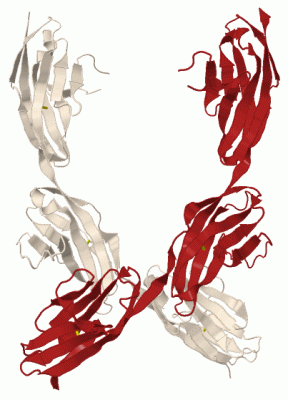
Image Biol.Unit 1 - manually
Biol.Unit 1 - manually  (Jmol Viewer)
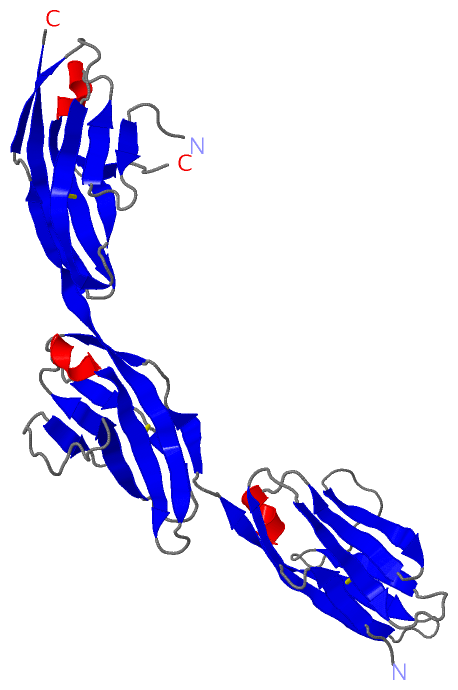
Image Asymmetric Unit
Asymmetric Unit  (Jmol Viewer)
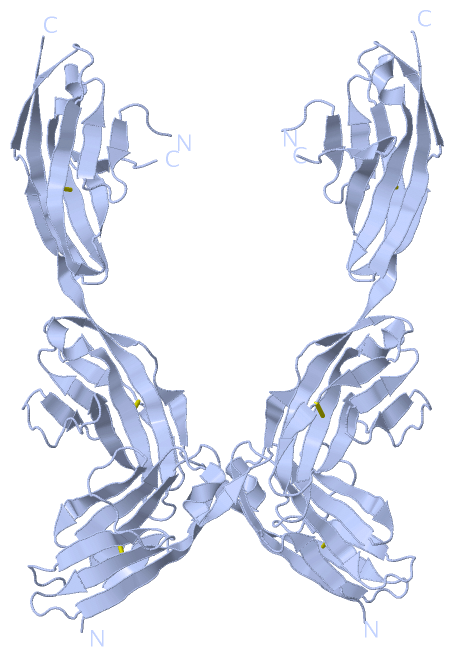
Image Biological Unit 1
Biological Unit 1  (Jmol Viewer)

(-) Description

Title :  CRYSTAL STRUCTURE OF THE IG 1-2-3 FRAGMENT OF NCAM
 
Authors :  V. Soroka, K. Kolkova, J. S. Kastrup, K. Diederichs, J. Breed, V. V. Kiselyov, F. M. Poulsen, I. K. Larsen, W. Welte, V. Berezin, E. Bock, C. Kasper
Date :  15 Sep 03  (Deposition) - 04 Nov 03  (Release) - 24 Feb 09  (Revision)
Method :  X-RAY DIFFRACTION
Resolution :  2.00
Chains :  Asym. Unit :  A
Biol. Unit 1:  A  (2x)
Keywords :  Ig Modules, Cell Adhesion, Ncam (Keyword Search: [Gene Ontology, PubMed, Web (Google))
 
Reference :  V. Soroka, K. Kolkova, J. S. Kastrup, K. Diederichs, J. Breed, V. V. Kiselyov, F. M. Poulsen, I. K. Larsen, W. Welte, V. Berezin, E. Bock, C. Kasper
Structure And Interactions Of Ncam Ig1-2-3 Suggest A Novel Zipper Mechanism For Homophilic Adhesion
Structure V. 11 1291 2003
PubMed-ID: 14527396  |  Reference-DOI: 10.1016/J.STR.2003.09.006
(for further references see the PDB file header)

(-) Compounds

Molecule 1 - NEURAL CELL ADHESION MOLECULE 1, 140 KDA ISOFORM
    ChainsA
    EngineeredYES
    Expression SystemPICHIA PASTORIS
    Expression System PlasmidPHIL-S1
    Expression System StrainGS-115
    Expression System Taxid4922
    Expression System Vector TypePLASMID
    FragmentIG MODULES 1-2-3
    GeneNCAM1
    Organism CommonNORWAY RAT
    Organism ScientificRATTUS NORVEGICUS
    Organism Taxid10116
    SynonymN-CAM 140, NCAM-140

 Structural Features

(-) Chains, Units

  1
Asymmetric Unit A
Biological Unit 1 (2x)A

Summary Information (see also Sequences/Alignments below)

(-) Ligands, Modified Residues, Ions  (0, 0)

(no "Ligand,Modified Residues,Ions" information available for 1QZ1)

(-) Sites  (0, 0)

(no "Site" information available for 1QZ1)

(-) SS Bonds  (3, 3)

Asymmetric Unit
No.Residues
1A:22 -A:77
2A:120 -A:170
3A:216 -A:269

(-) Cis Peptide Bonds  (3, 3)

Asymmetric Unit
No.Residues
1Val A:6 -Pro A:7
2Thr A:106 -Pro A:107
3Phe A:221 -Pro A:222

 Sequence-Structure Mapping

(-) SAPs(SNPs)/Variants  (0, 0)

(no "SAP(SNP)/Variant" information available for 1QZ1)

(-) PROSITE Motifs  (0, 0)

(no "PROSITE Motif" information available for 1QZ1)

(-) Exons   (0, 0)

(no "Exon" information available for 1QZ1)

(-) Sequences/Alignments

Asymmetric Unit
   Reformat: Number of residues per line =  ('0' or empty: single-line sequence representation)
  Number of residues per labelling interval =   
  UniProt sequence: complete  aligned part    
   Show mapping: SCOP domains CATH domains Pfam domains Secondary structure (by author)
SAPs(SNPs) PROSITE motifs Exons
(details for a mapped element are shown in a popup box when the mouse pointer rests over it)
Chain A from PDB  Type:PROTEIN  Length:288
 aligned with NCAM1_RAT | P13596 from UniProtKB/Swiss-Prot  Length:858

    Alignment length:290
                                    28        38        48        58        68        78        88        98       108       118       128       138       148       158       168       178       188       198       208       218       228       238       248       258       268       278       288       298       308
            NCAM1_RAT    19 SLQVDIVPSQGEISVGESKFFLCQVAGDAKDKDISWFSPNGEKLSPNQQRISVVWNDDDSSTLTIYNANIDDAGIYKCVVTAEDGTQSEATVNVKIFQKLMFKNAPTPQEFKEGEDAVIVCDVVSSLPPTIIWKHKGRDVILKKDVRFIVLSNNYLQIRGIKKTDEGTYRCEGRILARGEINFKDIQVIVNVPPTVQARQSIVNATANLGQSVTLVCDADGFPEPTMSWTKDGEPIENEEEDDEKHIFSDDSSELTIRNVDKNDEAEYVCIAENKAGEQDASIHLKVFAK 308
               SCOP domains d1qz1a1 A:-1-97 Neural cell adhesion molecule (NCAM)                                              d1qz1a2 A:98-189 Neural cell adhesion molecule (NCAM)                                       d1qz1a3 A:190-289 Neural cell adhesion molecule (  NCAM)                                             SCOP domains
               CATH domains 1qz1A01 A:-1-96 Immunoglobulins                                                                  1qz1A02 A:97-192 Immunoglobulins                                                                1qz1A03 A:193-289 Immunoglobulins                                                                 CATH domains
           Pfam domains (1) ---------------------------------------------------------------------------------------------------------------------------------------------------------------------------------------------------I-set-1qz1A01 A:195-286                                                                     --- Pfam domains (1)
           Pfam domains (2) ---------------------------------------------------------------------------------------------------------------------------------------------------------------------------------------------------I-set-1qz1A02 A:195-286                                                                     --- Pfam domains (2)
           Pfam domains (3) ---------------------------------------------------------------------------------------------------------------------------------------------------------------------------------------------------I-set-1qz1A03 A:195-286                                                                     --- Pfam domains (3)
         Sec.struct. author ...eeee...eeee....eeeeeee.......eeeee.............eeeeeee..eeeeee...hhhhheeeeeeee.....eeeeeeeeeee...eeee....eeee....eee..eee.....eeeeee............eee.....eee...hhhhheeeeeeeee....eeeeeeeeeeeeeeeeeee...eeeee......eeeeeeeeee...eeeeee..ee....--....eee.....eeee...hhhhheeeeeeeee..eeeeeeeeeeee.. Sec.struct. author
                 SAPs(SNPs) -------------------------------------------------------------------------------------------------------------------------------------------------------------------------------------------------------------------------------------------------------------------------------------------------- SAPs(SNPs)
                    PROSITE -------------------------------------------------------------------------------------------------------------------------------------------------------------------------------------------------------------------------------------------------------------------------------------------------- PROSITE
                 Transcript -------------------------------------------------------------------------------------------------------------------------------------------------------------------------------------------------------------------------------------------------------------------------------------------------- Transcript
                 1qz1 A  -1 VLQVDIVPSQGEISVGESKFFLCQVAGDAKDKDISWFSPNGEKLSPNQQRISVVWNDDDSSTLTIYNANIDDAGIYKCVVTAEDGTQSEATVNVKIFQKLMFKNAPTPQEFKEGEDAVIVCDVVSSLPPTIIWKHKGRDVILKKDVRFIVLSNNYLQIRGIKKTDEGTYRCEGRILARGEINFKDIQVIVNVPPTVQARQSIVNATANLGQSVTLVCDADGFPEPTMSWTKDGEPIENE--DDEKHIFSDDSSELTIRNVDKNDEAEYVCIAENKAGEQDASIHLKVFAK 289
                            ||       9        19        29        39        49        59        69        79        89        99       109       119       129       139       149       159       169       179       189       199       209       219       229        |- |     249       259       269       279       289
                            ||                                                                                                                                                                                                                                          238  |                                                
                           -1|                                                                                                                                                                                                                                             241                                                
                             1                                                                                                                                                                                                                                                                                                

   Legend:   → Mismatch (orange background)
  - → Gap (green background, '-', border residues have a numbering label)
    → Modified Residue (blue background, lower-case, 'x' indicates undefined single-letter code, labelled with number + name)
  x → Chemical Group (purple background, 'x', labelled with number + name, e.g. ACE or NH2)
  extra numbering lines below/above indicate numbering irregularities and modified residue names etc., number ends below/above '|'

 Classification and Annotation

(-) SCOP Domains  (1, 3)

Asymmetric Unit

(-) CATH Domains  (1, 3)

Asymmetric Unit
(-)
Class: Mainly Beta (13760)

(-) Pfam Domains  (1, 3)

Asymmetric Unit
(-)
Clan: Ig (577)
(-)
Family: I-set (67)
1aI-set-1qz1A01A:195-286
1bI-set-1qz1A02A:195-286
1cI-set-1qz1A03A:195-286

(-) Gene Ontology  (31, 31)

Asymmetric Unit(hide GO term definitions)
Chain A   (NCAM1_RAT | P13596)
molecular function
    GO:0030275    LRR domain binding    Interacting selectively and non-covalently with a LRR domain (leucine rich repeats) of a protein.
    GO:0008092    cytoskeletal protein binding    Interacting selectively and non-covalently with any protein component of any cytoskeleton (actin, microtubule, or intermediate filament cytoskeleton).
    GO:0005104    fibroblast growth factor receptor binding    Interacting selectively and non-covalently with the fibroblast growth factor receptor (FGFR).
    GO:0008201    heparin binding    Interacting selectively and non-covalently with heparin, any member of a group of glycosaminoglycans found mainly as an intracellular component of mast cells and which consist predominantly of alternating alpha-(1->4)-linked D-galactose and N-acetyl-D-glucosamine-6-sulfate residues.
    GO:0019902    phosphatase binding    Interacting selectively and non-covalently with any phosphatase.
    GO:0005515    protein binding    Interacting selectively and non-covalently with any protein or protein complex (a complex of two or more proteins that may include other nonprotein molecules).
biological process
    GO:0007568    aging    A developmental process that is a deterioration and loss of function over time. Aging includes loss of functions such as resistance to disease, homeostasis, and fertility, as well as wear and tear. Aging includes cellular senescence, but is more inclusive. May precede death and may succeed developmental maturation (GO:0021700).
    GO:0031100    animal organ regeneration    The regrowth of a lost or destroyed animal organ.
    GO:0007411    axon guidance    The chemotaxis process that directs the migration of an axon growth cone to a specific target site in response to a combination of attractive and repulsive cues.
    GO:0016338    calcium-independent cell-cell adhesion via plasma membrane cell-adhesion molecules    The attachment of one cell to another cell via adhesion molecules that do not require the presence of calcium for the interaction.
    GO:0007155    cell adhesion    The attachment of a cell, either to another cell or to an underlying substrate such as the extracellular matrix, via cell adhesion molecules.
    GO:0071241    cellular response to inorganic substance    Any process that results in a change in state or activity of a cell (in terms of movement, secretion, enzyme production, gene expression, etc.) as a result of an inorganic substance stimulus.
    GO:0071219    cellular response to molecule of bacterial origin    Any process that results in a change in state or activity of a cell (in terms of movement, secretion, enzyme production, gene expression, etc.) as a result of a stimulus by molecules of bacterial origin such as peptides derived from bacterial flagellin.
    GO:0007611    learning or memory    The acquisition and processing of information and/or the storage and retrieval of this information over time.
    GO:0033555    multicellular organismal response to stress    Any process that results in a change in state or activity of a multicellular organism (in terms of movement, secretion, enzyme production, gene expression, etc.) as a result of a stimulus indicating the organism is under stress. The stress is usually, but not necessarily, exogenous (e.g. temperature, humidity, ionizing radiation).
    GO:0060548    negative regulation of cell death    Any process that decreases the rate or frequency of cell death. Cell death is the specific activation or halting of processes within a cell so that its vital functions markedly cease, rather than simply deteriorating gradually over time, which culminates in cell death.
    GO:0048666    neuron development    The process whose specific outcome is the progression of a neuron over time, from initial commitment of the cell to a specific fate, to the fully functional differentiated cell.
    GO:0031175    neuron projection development    The process whose specific outcome is the progression of a neuron projection over time, from its formation to the mature structure. A neuron projection is any process extending from a neural cell, such as axons or dendrites (collectively called neurites).
    GO:0014012    peripheral nervous system axon regeneration    The regrowth of axons outside the central nervous system (outside the brain and spinal cord) following an axonal injury.
    GO:0060045    positive regulation of cardiac muscle cell proliferation    Any process that activates or increases the frequency, rate or extent of cardiac muscle cell proliferation.
    GO:0051930    regulation of sensory perception of pain    Any process that modulates the frequency, rate or extent of the sensory perception of pain, the series of events required for an organism to receive a painful stimulus, convert it to a molecular signal, and recognize and characterize the signal.
    GO:0048167    regulation of synaptic plasticity    A process that modulates synaptic plasticity, the ability of synapses to change as circumstances require. They may alter function, such as increasing or decreasing their sensitivity, or they may increase or decrease in actual numbers.
    GO:0042220    response to cocaine    Any process that results in a change in state or activity of a cell or an organism (in terms of movement, secretion, enzyme production, gene expression, etc.) as a result of a cocaine stimulus. Cocaine is a crystalline alkaloid obtained from the leaves of the coca plant.
    GO:0010035    response to inorganic substance    Any process that results in a change in state or activity of a cell or an organism (in terms of movement, secretion, enzyme production, gene expression, etc.) as a result of an inorganic substance stimulus.
    GO:0010288    response to lead ion    Any process that results in a change in state or activity of a cell or an organism (in terms of movement, secretion, enzyme production, gene expression, etc.) as a result of a lead ion stimulus.
    GO:0021794    thalamus development    The process in which the thalamus changes over time, from its initial formation to its mature state.
cellular component
    GO:0030426    growth cone    The migrating motile tip of a growing nerve cell axon or dendrite.
    GO:0016021    integral component of membrane    The component of a membrane consisting of the gene products and protein complexes having at least some part of their peptide sequence embedded in the hydrophobic region of the membrane.
    GO:0016020    membrane    A lipid bilayer along with all the proteins and protein complexes embedded in it an attached to it.
    GO:0043025    neuronal cell body    The portion of a neuron that includes the nucleus, but excludes cell projections such as axons and dendrites.
    GO:0005886    plasma membrane    The membrane surrounding a cell that separates the cell from its external environment. It consists of a phospholipid bilayer and associated proteins.

 Visualization

(-) Interactive Views

Asymmetric Unit
  Complete Structure
    Jena3D(integrated viewing of ligand, site, SAP, PROSITE, SCOP information)
    WebMol | AstexViewer[tm]@PDBe
(Java Applets, require no local installation except for Java; loading may be slow)
    STRAP
(Java WebStart application, automatic local installation, requires Java; full application with system access!)
    RasMol
(require local installation)
    Molscript (VRML)
(requires installation of a VRML viewer; select preferred view via VRML and generate a mono or stereo PDF format file)
 
  Ligands, Modified Residues, Ions
(no "Ligands, Modified Residues, Ions" information available for 1qz1)
 
  Sites
(no "Sites" information available for 1qz1)
 
  Cis Peptide Bonds
    Phe A:221 - Pro A:222   [ RasMol ]  
    Thr A:106 - Pro A:107   [ RasMol ]  
    Val A:6 - Pro A:7   [ RasMol ]  
 
Biological Unit
  Complete Structure
    Biological Unit 1  [ Jena3D ]

(-) Still Images

Jmol
  protein: cartoon or spacefill or dots and stick; nucleic acid: cartoon and stick; ligands: spacefill; active site: stick
Molscript
  protein, nucleic acid: cartoon; ligands: spacefill; active site: ball and stick

 Databases and Analysis Tools

(-) Databases

Access by PDB/NDB ID
  1qz1
    Family and Domain InformationProDom | SYSTERS
    General Structural InformationGlycoscienceDB | MMDB | NDB | OCA | PDB | PDBe | PDBj | PDBsum | PDBWiki | PQS | PROTEOPEDIA
    Orientation in MembranesOPM
    Protein SurfaceSURFACE
    Secondary StructureDSSP (structure derived) | HSSP (homology derived)
    Structural GenomicsGeneCensus
    Structural NeighboursCE | VAST
    Structure ClassificationCATH | Dali | SCOP
    Validation and Original DataBMRB Data View | BMRB Restraints Grid | EDS | PROCHECK | RECOORD | WHAT_CHECK
 
Access by UniProt ID/Accession number
  NCAM1_RAT | P13596
    Comparative Protein Structure ModelsModBase
    Genomic InformationEnsembl
    Protein-protein InteractionDIP
    Sequence, Family and Domain InformationInterPro | Pfam | SMART | UniProtKB/SwissProt
 
Access by Enzyme Classificator   (EC Number)
  (no 'Enzyme Classificator' available)
    General Enzyme InformationBRENDA | EC-PDB | Enzyme | IntEnz
    PathwayKEGG | MetaCyc
 
Access by Disease Identifier   (MIM ID)
  (no 'MIM ID' available)
    Disease InformationOMIM
 
Access by GenAge ID
  (no 'GenAge ID' available)
    Age Related InformationGenAge

(-) Analysis Tools

Access by PDB/NDB ID
    Domain InformationXDom
    Interatomic Contacts of Structural UnitsCSU
    Ligand-protein ContactsLPC
    Protein CavitiescastP
    Sequence and Secondary StructurePDBCartoon
    Structure AlignmentSTRAP(Java WebStart application, automatic local installation, requires Java; full application with system access!)
    Structure and Sequence BrowserSTING
 
Access by UniProt ID/Accession number
  NCAM1_RAT | P13596
    Protein Disorder PredictionDisEMBL | FoldIndex | GLOBPLOT (for more information see DisProt)

 Related Entries

(-) Entries Sharing at Least One Protein Chain (UniProt ID)

UniProtKB/Swiss-Prot
        NCAM1_RAT | P135961epf 1lwr

(-) Related Entries Specified in the PDB File

1epf CRYSTAL STRUCTURE OF THE TWO N-TERMINAL IMMUNOGLOBULIN DOMAINS OF THE NEURAL CELL ADHESION MOLECULE (NCAM)
2ncm NMR STRUCTURE OF THE FIRST IMMUNOGLOBULIN DOMAIN OF THE NEURAL CELL ADHESION MOLECULE (NCAM)
3ncm NMR STRUCTURE OF THE SECOND IMMUNOGLOBULIN DOMAIN OF THE NEURAL CELL ADHESION MOLECULE (NCAM)