Show PDB file:   
         Plain Text   HTML   (compressed file size)
QuickSearch:   
by PDB,NDB,UniProt,PROSITE Code or Search Term(s)  
(-)Biol.Unit 1 - manually
(-)Asymmetric Unit
(-)Asym. Unit - sites
(-)Biological Unit 1
(-)Biol. Unit 1 - sites
collapse expand < >
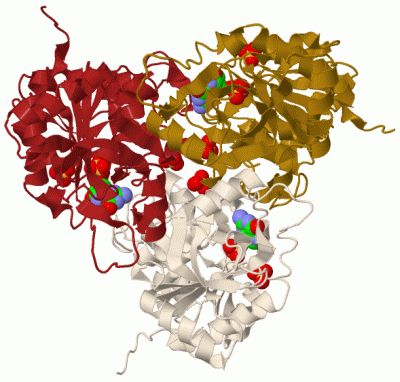
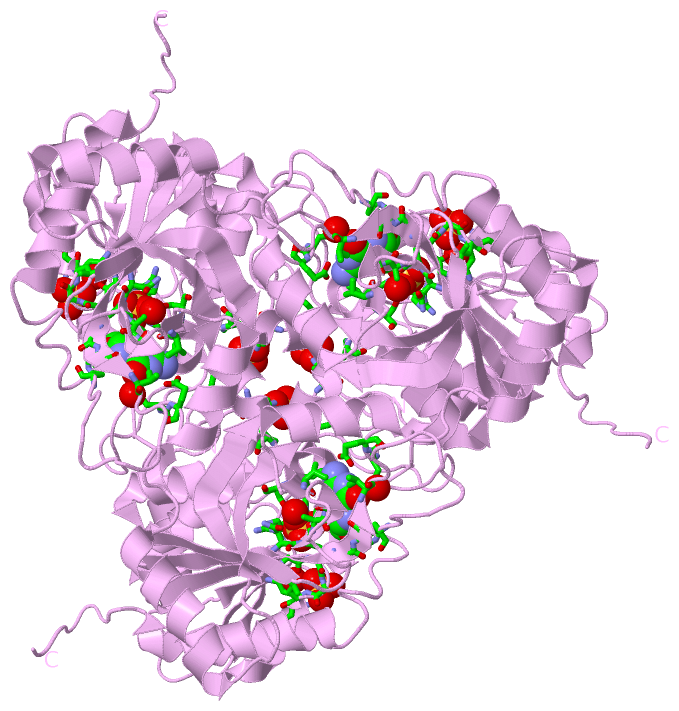
Image Biol.Unit 1 - manually
Biol.Unit 1 - manually  (Jmol Viewer)
Image Asymmetric Unit
Asymmetric Unit  (Jmol Viewer)
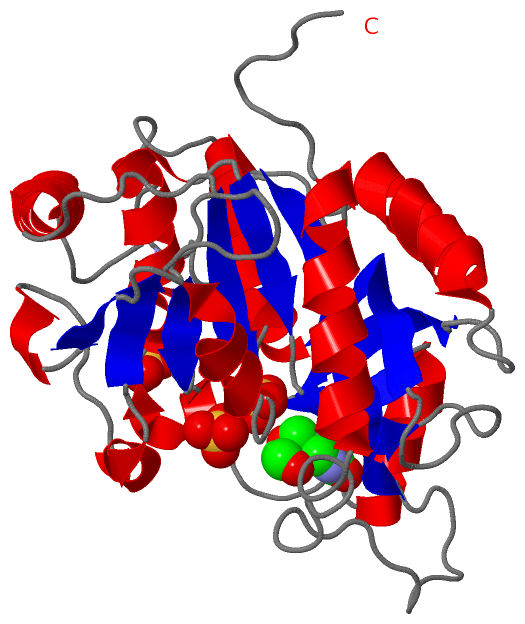
Image Asym. Unit - sites
Asym. Unit - sites  (Jmol Viewer)
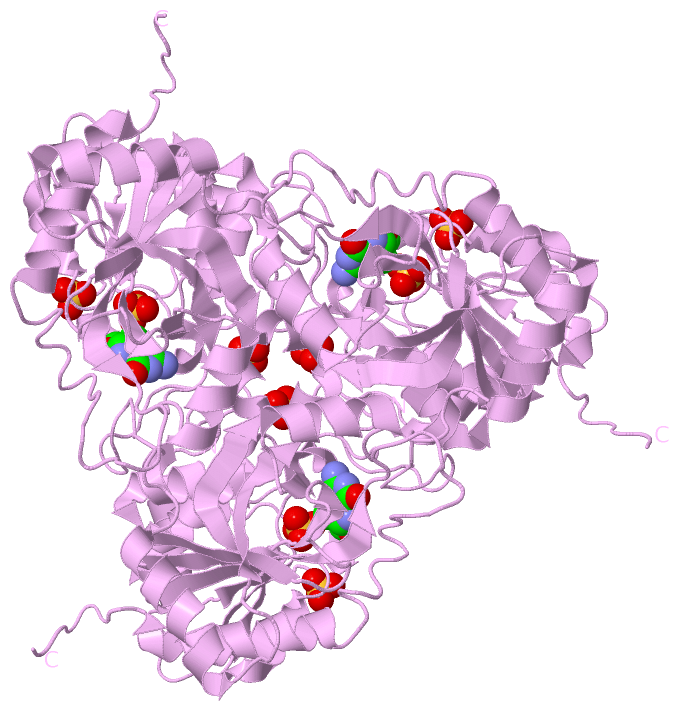
Image Biological Unit 1
Biological Unit 1  (Jmol Viewer)
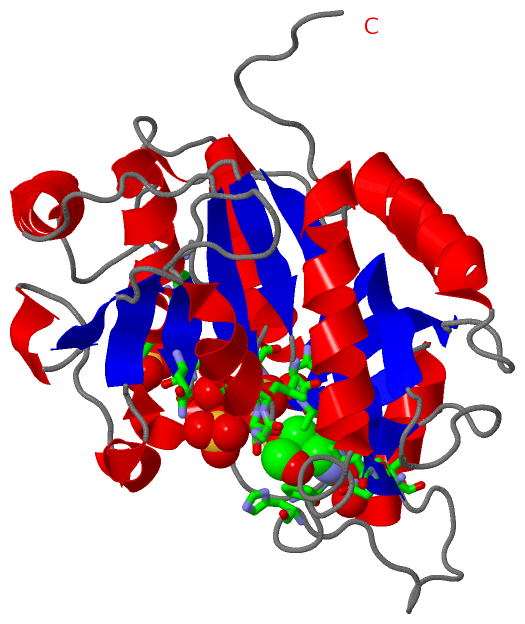
Image Biol. Unit 1 - sites
Biol. Unit 1 - sites  (Jmol Viewer)

(-) Description

Title :  CRYSTAL STRUCTURE OF HUMAN PNP COMPLEXED WITH ACYCLOVIR
 
Authors :  D. M. Dos Santos, F. Canduri, J. H. Pereira, M. Vinicius Bertacine Di R. G. Silva, M. A. Mendes, M. S. Palma, L. A. Basso, W. F. De Azevedo, D. S
Date :  02 Jul 03  (Deposition) - 23 Mar 04  (Release) - 13 Jul 11  (Revision)
Method :  X-RAY DIFFRACTION
Resolution :  2.80
Chains :  Asym. Unit :  E
Biol. Unit 1:  E  (3x)
Keywords :  Purine Nucleoside Phosphorylase, Drug Design, Synchrotron, Acyclovir, Transferase (Keyword Search: [Gene Ontology, PubMed, Web (Google))
 
Reference :  D. M. Dos Santos, F. Canduri, J. H. Pereira, M. Vinicius Bertacine Dias, R. G. Silva, M. A. Mendes, M. S. Palma, L. A. Basso, W. F. De Azevedo, D. S. Santos
Crystal Structure Of Human Purine Nucleoside Phosphorylase Complexed With Acyclovir.
Biochem. Biophys. Res. Commun. V. 308 553 2003
PubMed-ID: 12914786  |  Reference-DOI: 10.1016/S0006-291X(03)01433-5
(for further references see the PDB file header)

(-) Compounds

Molecule 1 - PURINE NUCLEOSIDE PHOSPHORYLASE
    ChainsE
    EC Number2.4.2.1
    EngineeredYES
    Expression SystemESCHERICHIA COLI
    Expression System Taxid562
    Expression System Vector TypePLASMID
    GenePNP
    Organism CommonHUMAN
    Organism ScientificHOMO SAPIENS
    Organism Taxid9606
    Other DetailsCOMPLEXED WITH ACYCLOVIR
    SynonymINOSINE PHOSPHORYLASE, PNP

 Structural Features

(-) Chains, Units

  1
Asymmetric Unit E
Biological Unit 1 (3x)E

Summary Information (see also Sequences/Alignments below)

(-) Ligands, Modified Residues, Ions  (2, 4)

Asymmetric Unit (2, 4)
No.NameCountTypeFull Name
1AC21Ligand/Ion9-HYROXYETHOXYMETHYLGUANINE
2SO43Ligand/IonSULFATE ION
Biological Unit 1 (2, 12)
No.NameCountTypeFull Name
1AC23Ligand/Ion9-HYROXYETHOXYMETHYLGUANINE
2SO49Ligand/IonSULFATE ION

(-) Sites  (4, 4)

Asymmetric Unit (4, 4)
No.NameEvidenceResiduesDescription
1AC1SOFTWAREGLY E:32 , GLY E:34 , LEU E:35 , GLY E:36 , GLN E:82 , HOH E:295BINDING SITE FOR RESIDUE SO4 E 291
2AC2SOFTWAREPRO E:92 , GLN E:144 , ARG E:148BINDING SITE FOR RESIDUE SO4 E 292
3AC3SOFTWAREGLY E:32 , SER E:33 , ARG E:84 , HIS E:86 , ASN E:115 , ALA E:116 , SER E:220 , HOH E:333BINDING SITE FOR RESIDUE SO4 E 293
4AC4SOFTWAREALA E:116 , ALA E:117 , GLY E:118 , PHE E:200 , GLU E:201 , VAL E:217 , MET E:219 , THR E:242 , ASN E:243 , VAL E:245 , HIS E:257 , HOH E:300BINDING SITE FOR RESIDUE AC2 E 290

(-) SS Bonds  (0, 0)

(no "SS Bond" information available for 1PWY)

(-) Cis Peptide Bonds  (0, 0)

(no "Cis Peptide Bond" information available for 1PWY)

 Sequence-Structure Mapping

(-) SAPs(SNPs)/Variants  (6, 6)

Asymmetric Unit (6, 6)
  dbSNPPDB
No.SourceVariant IDVariantUniProt IDStatusIDChainVariant
1UniProtVAR_002243G51SPNPH_HUMANPolymorphism1049564ES51S
2UniProtVAR_002244E89KPNPH_HUMANDisease (PNPD)104894453EE89K
3UniProtVAR_002245D128GPNPH_HUMANDisease (PNPD)104894450ED128G
4UniProtVAR_002246A174PPNPH_HUMANDisease (PNPD)104894454EA174P
5UniProtVAR_010653Y192CPNPH_HUMANDisease (PNPD)104894452EY192C
6UniProtVAR_002247R234PPNPH_HUMANDisease (PNPD)104894451ER234P

  SNP/SAP Summary Statistics (UniProtKB/Swiss-Prot)
Biological Unit 1 (6, 18)
  dbSNPPDB
No.SourceVariant IDVariantUniProt IDStatusIDChainVariant
1UniProtVAR_002243G51SPNPH_HUMANPolymorphism1049564ES51S
2UniProtVAR_002244E89KPNPH_HUMANDisease (PNPD)104894453EE89K
3UniProtVAR_002245D128GPNPH_HUMANDisease (PNPD)104894450ED128G
4UniProtVAR_002246A174PPNPH_HUMANDisease (PNPD)104894454EA174P
5UniProtVAR_010653Y192CPNPH_HUMANDisease (PNPD)104894452EY192C
6UniProtVAR_002247R234PPNPH_HUMANDisease (PNPD)104894451ER234P

  SNP/SAP Summary Statistics (UniProtKB/Swiss-Prot)

(-) PROSITE Motifs  (1, 1)

Asymmetric Unit (1, 1)
 PROSITEUniProtKBPDB
No.IDACDescriptionIDLocationCountLocation
1PNP_MTAP_2PS01240 Purine and other phosphorylases family 2 signature.PNPH_HUMAN79-120  1E:79-120
Biological Unit 1 (1, 3)
 PROSITEUniProtKBPDB
No.IDACDescriptionIDLocationCountLocation
1PNP_MTAP_2PS01240 Purine and other phosphorylases family 2 signature.PNPH_HUMAN79-120  3E:79-120

(-) Exons   (6, 6)

Asymmetric Unit (6, 6)
 ENSEMBLUniProtKBPDB
No.Transcript IDExonExon IDGenome LocationLengthIDLocationLengthCountLocationLength
1.1ENST000003615051ENSE00001020099chr14:20937538-20937694157PNPH_HUMAN1-441E:2-43
1.2ENST000003615052ENSE00000889018chr14:20940467-20940636170PNPH_HUMAN4-61581E:4-6158
1.3ENST000003615053ENSE00001096521chr14:20942631-20942734104PNPH_HUMAN61-95351E:61-9535
1.4ENST000003615054ENSE00001096522chr14:20942932-20943107176PNPH_HUMAN96-154591E:96-15459
1.5ENST000003615055ENSE00001096517chr14:20943221-20943411191PNPH_HUMAN154-218651E:154-21865
1.6ENST000003615056ENSE00001328906chr14:20944543-20945253711PNPH_HUMAN218-289721E:218-28972

(-) Sequences/Alignments

Asymmetric Unit
   Reformat: Number of residues per line =  ('0' or empty: single-line sequence representation)
  Number of residues per labelling interval =   
  UniProt sequence: complete  aligned part    
   Show mapping: SCOP domains CATH domains Pfam domains Secondary structure (by author)
SAPs(SNPs) PROSITE motifs Exons
(details for a mapped element are shown in a popup box when the mouse pointer rests over it)
Chain E from PDB  Type:PROTEIN  Length:288
 aligned with PNPH_HUMAN | P00491 from UniProtKB/Swiss-Prot  Length:289

    Alignment length:288
                                    11        21        31        41        51        61        71        81        91       101       111       121       131       141       151       161       171       181       191       201       211       221       231       241       251       261       271       281        
           PNPH_HUMAN     2 ENGYTYEDYKNTAEWLLSHTKHRPQVAIICGSGLGGLTDKLTQAQIFDYGEIPNFPRSTVPGHAGRLVFGFLNGRACVMMQGRFHMYEGYPLWKVTFPVRVFHLLGVDTLVVTNAAGGLNPKFEVGDIMLIRDHINLPGFSGQNPLRGPNDERFGDRFPAMSDAYDRTMRQRALSTWKQMGEQRELQEGTYVMVAGPSFETVAECRVLQKLGADAVGMSTVPEVIVARHCGLRVFGFSLITNKVIMDYESLEKANHEEVLAAGKQAAQKLEQFVSILMASIPLPDKAS 289
               SCOP domains d1pwye_ E: Purine nucleoside phosphorylase, PNP                                                                                                                                                                                                                                                  SCOP domains
               CATH domains 1pwyE00 E:2-289  [code=3.40.50.1580, no name defined]                                                                                                                                                                                                                                            CATH domains
               Pfam domains ------------------------PNP_UDP_1-1pwyE01 E:26-280                                                                                                                                                                                                                                     --------- Pfam domains
         Sec.struct. author ....hhhhhhhhhhhhhh.......eeeee...hhhhhhhh...eeee.hhh......hhhhh..eeee.........eee...hhhhh.hhhhhhhhhhhhhhhh..eeee..eeee.........eeeeeeeeehhhhh........................hhhhhhhhhhhhhhh......eeeeeee.......hhhhhhhhhhh...eee..hhhhhhhhhhhh.eeeeeeeeeee.....................hhhhhhhhhhhhhhhh........ Sec.struct. author
                 SAPs(SNPs) -------------------------------------------------S-------------------------------------K--------------------------------------G---------------------------------------------P-----------------C-----------------------------------------P------------------------------------------------------- SAPs(SNPs)
                    PROSITE -----------------------------------------------------------------------------PNP_MTAP_2  PDB: E:79-120 UniProt: 79-120 ------------------------------------------------------------------------------------------------------------------------------------------------------------------------- PROSITE
           Transcript 1 (1) 1.1--------------------------------------------------------Exon 1.3  PDB: E:61-95             Exon 1.4  PDB: E:96-154 UniProt: 96-154                    ---------------------------------------------------------------Exon 1.6  PDB: E:218-289 UniProt: 218-289                                Transcript 1 (1)
           Transcript 1 (2) --Exon 1.2  PDB: E:4-61 UniProt: 4-61                       --------------------------------------------------------------------------------------------Exon 1.5  PDB: E:154-218 UniProt: 154-218                        ----------------------------------------------------------------------- Transcript 1 (2)
                 1pwy E   2 ENGYTYEDYKNTAEWLLSHTKHRPQVAIICGSGLGGLTDKLTQAQIFDYSEIPNFPRSTVPGHAGRLVFGFLNGRACVMMQGRFHMYEGYPLWKVTFPVRVFHLLGVDTLVVTNAAGGLNPKFEVGDIMLIRDHINLPGFSGQNPLRGPNDERFGDRFPAMSDAYDRTMRQRALSTWKQMGEQRELQEGTYVMVAGPSFETVAECRVLQKLGADAVGMSTVPEVIVARHCGLRVFGFSLITNKVIMDYESLEKANHEEVLAAGKQAAQKLEQFVSILMASIPLPDKAS 289
                                    11        21        31        41        51        61        71        81        91       101       111       121       131       141       151       161       171       181       191       201       211       221       231       241       251       261       271       281        

   Legend:   → Mismatch (orange background)
  - → Gap (green background, '-', border residues have a numbering label)
    → Modified Residue (blue background, lower-case, 'x' indicates undefined single-letter code, labelled with number + name)
  x → Chemical Group (purple background, 'x', labelled with number + name, e.g. ACE or NH2)
  extra numbering lines below/above indicate numbering irregularities and modified residue names etc., number ends below/above '|'

 Classification and Annotation

(-) SCOP Domains  (1, 1)

Asymmetric Unit

(-) CATH Domains  (1, 1)

Asymmetric Unit
(-)
Class: Alpha Beta (26913)

(-) Pfam Domains  (1, 1)

Asymmetric Unit
(-)
Clan: PUP (121)

(-) Gene Ontology  (30, 30)

Asymmetric Unit(hide GO term definitions)
Chain E   (PNPH_HUMAN | P00491)
molecular function
    GO:0003824    catalytic activity    Catalysis of a biochemical reaction at physiological temperatures. In biologically catalyzed reactions, the reactants are known as substrates, and the catalysts are naturally occurring macromolecular substances known as enzymes. Enzymes possess specific binding sites for substrates, and are usually composed wholly or largely of protein, but RNA that has catalytic activity (ribozyme) is often also regarded as enzymatic.
    GO:0008144    drug binding    Interacting selectively and non-covalently with a drug, any naturally occurring or synthetic substance, other than a nutrient, that, when administered or applied to an organism, affects the structure or functioning of the organism; in particular, any such substance used in the diagnosis, prevention, or treatment of disease.
    GO:0001882    nucleoside binding    Interacting selectively and non-covalently with a nucleoside, a compound consisting of a purine or pyrimidine nitrogenous base linked either to ribose or deoxyribose.
    GO:0042301    phosphate ion binding    Interacting selectively and non-covalently with phosphate.
    GO:0002060    purine nucleobase binding    Interacting selectively and non-covalently with a purine nucleobase, an organic nitrogenous base with a purine skeleton.
    GO:0004731    purine-nucleoside phosphorylase activity    Catalysis of the reaction: purine nucleoside + phosphate = purine + alpha-D-ribose 1-phosphate.
    GO:0016740    transferase activity    Catalysis of the transfer of a group, e.g. a methyl group, glycosyl group, acyl group, phosphorus-containing, or other groups, from one compound (generally regarded as the donor) to another compound (generally regarded as the acceptor). Transferase is the systematic name for any enzyme of EC class 2.
    GO:0016757    transferase activity, transferring glycosyl groups    Catalysis of the transfer of a glycosyl group from one compound (donor) to another (acceptor).
    GO:0016763    transferase activity, transferring pentosyl groups    Catalysis of the transfer of a pentosyl group from one compound (donor) to another (acceptor).
biological process
    GO:0034356    NAD biosynthesis via nicotinamide riboside salvage pathway    The chemical reactions and pathways resulting in the formation of nicotinamide adenine dinucleotide (NAD) from the vitamin precursor nicotinamide riboside.
    GO:0006955    immune response    Any immune system process that functions in the calibrated response of an organism to a potential internal or invasive threat.
    GO:0006148    inosine catabolic process    The chemical reactions and pathways resulting in the breakdown of inosine, hypoxanthine riboside, a nucleoside found free but not in combination in nucleic acids except in the anticodons of some tRNAs.
    GO:0070970    interleukin-2 secretion    The regulated release of interleukin-2 from a cell.
    GO:0006738    nicotinamide riboside catabolic process    The chemical reactions and pathways resulting in the breakdown of nicotinamide riboside, the product of the formation of a glycosidic bond between ribose and nicotinamide.
    GO:0006139    nucleobase-containing compound metabolic process    Any cellular metabolic process involving nucleobases, nucleosides, nucleotides and nucleic acids.
    GO:0009116    nucleoside metabolic process    The chemical reactions and pathways involving a nucleoside, a nucleobase linked to either beta-D-ribofuranose (a ribonucleoside) or 2-deoxy-beta-D-ribofuranose, (a deoxyribonucleoside), e.g. adenosine, guanosine, inosine, cytidine, uridine and deoxyadenosine, deoxyguanosine, deoxycytidine and thymidine (= deoxythymidine).
    GO:0042102    positive regulation of T cell proliferation    Any process that activates or increases the rate or extent of T cell proliferation.
    GO:0046638    positive regulation of alpha-beta T cell differentiation    Any process that activates or increases the frequency, rate or extent of alpha-beta T cell differentiation.
    GO:0042278    purine nucleoside metabolic process    The chemical reactions and pathways involving one of a family of organic molecules consisting of a purine base covalently bonded to a sugar ribose (a ribonucleoside) or deoxyribose (a deoxyribonucleoside).
    GO:0006195    purine nucleotide catabolic process    The chemical reactions and pathways resulting in the breakdown of a purine nucleotide, a compound consisting of nucleoside (a purine base linked to a deoxyribose or ribose sugar) esterified with a phosphate group at either the 3' or 5'-hydroxyl group of the sugar.
    GO:0043101    purine-containing compound salvage    Any process that generates a purine-containing compound, any nucleobase, nucleoside, nucleotide or nucleic acid that contains a purine base, from derivatives of them without de novo synthesis.
    GO:0042493    response to drug    Any process that results in a change in state or activity of a cell or an organism (in terms of movement, secretion, enzyme production, gene expression, etc.) as a result of a drug stimulus. A drug is a substance used in the diagnosis, treatment or prevention of a disease.
    GO:0034418    urate biosynthetic process    The chemical reactions and pathways resulting in the formation of urate, the anion of uric acid, 2,6,8-trioxypurine.
cellular component
    GO:0005737    cytoplasm    All of the contents of a cell excluding the plasma membrane and nucleus, but including other subcellular structures.
    GO:0005856    cytoskeleton    Any of the various filamentous elements that form the internal framework of cells, and typically remain after treatment of the cells with mild detergent to remove membrane constituents and soluble components of the cytoplasm. The term embraces intermediate filaments, microfilaments, microtubules, the microtrabecular lattice, and other structures characterized by a polymeric filamentous nature and long-range order within the cell. The various elements of the cytoskeleton not only serve in the maintenance of cellular shape but also have roles in other cellular functions, including cellular movement, cell division, endocytosis, and movement of organelles.
    GO:0005829    cytosol    The part of the cytoplasm that does not contain organelles but which does contain other particulate matter, such as protein complexes.
    GO:0070062    extracellular exosome    A vesicle that is released into the extracellular region by fusion of the limiting endosomal membrane of a multivesicular body with the plasma membrane. Extracellular exosomes, also simply called exosomes, have a diameter of about 40-100 nm.
    GO:0005576    extracellular region    The space external to the outermost structure of a cell. For cells without external protective or external encapsulating structures this refers to space outside of the plasma membrane. This term covers the host cell environment outside an intracellular parasite.
    GO:0005622    intracellular    The living contents of a cell; the matter contained within (but not including) the plasma membrane, usually taken to exclude large vacuoles and masses of secretory or ingested material. In eukaryotes it includes the nucleus and cytoplasm.
    GO:0005634    nucleus    A membrane-bounded organelle of eukaryotic cells in which chromosomes are housed and replicated. In most cells, the nucleus contains all of the cell's chromosomes except the organellar chromosomes, and is the site of RNA synthesis and processing. In some species, or in specialized cell types, RNA metabolism or DNA replication may be absent.

 Visualization

(-) Interactive Views

Asymmetric Unit
  Complete Structure
    Jena3D(integrated viewing of ligand, site, SAP, PROSITE, SCOP information)
    WebMol | AstexViewer[tm]@PDBe
(Java Applets, require no local installation except for Java; loading may be slow)
    STRAP
(Java WebStart application, automatic local installation, requires Java; full application with system access!)
    RasMol
(require local installation)
    Molscript (VRML)
(requires installation of a VRML viewer; select preferred view via VRML and generate a mono or stereo PDF format file)
 
  Ligands, Modified Residues, Ions
    AC2  [ RasMol | Jena3D ]  +environment [ RasMol | Jena3D ]
    SO4  [ RasMol | Jena3D ]  +environment [ RasMol | Jena3D ]
 
  Sites
    AC1  [ RasMol ]  +environment [ RasMol ]
    AC2  [ RasMol ]  +environment [ RasMol ]
    AC3  [ RasMol ]  +environment [ RasMol ]
    AC4  [ RasMol ]  +environment [ RasMol ]
 
  Cis Peptide Bonds
(no "Cis Peptide Bonds" information available for 1pwy)
 
Biological Unit
  Complete Structure
    Biological Unit 1  [ Jena3D ]

(-) Still Images

Jmol
  protein: cartoon or spacefill or dots and stick; nucleic acid: cartoon and stick; ligands: spacefill; active site: stick
Molscript
  protein, nucleic acid: cartoon; ligands: spacefill; active site: ball and stick

 Databases and Analysis Tools

(-) Databases

Access by PDB/NDB ID
  1pwy
    Family and Domain InformationProDom | SYSTERS
    General Structural InformationGlycoscienceDB | MMDB | NDB | OCA | PDB | PDBe | PDBj | PDBsum | PDBWiki | PQS | PROTEOPEDIA
    Orientation in MembranesOPM
    Protein SurfaceSURFACE
    Secondary StructureDSSP (structure derived) | HSSP (homology derived)
    Structural GenomicsGeneCensus
    Structural NeighboursCE | VAST
    Structure ClassificationCATH | Dali | SCOP
    Validation and Original DataBMRB Data View | BMRB Restraints Grid | EDS | PROCHECK | RECOORD | WHAT_CHECK
 
Access by UniProt ID/Accession number
  PNPH_HUMAN | P00491
    Comparative Protein Structure ModelsModBase
    Genomic InformationEnsembl
    Protein-protein InteractionDIP
    Sequence, Family and Domain InformationInterPro | Pfam | SMART | UniProtKB/SwissProt
 
Access by Enzyme Classificator   (EC Number)
  2.4.2.1
    General Enzyme InformationBRENDA | EC-PDB | Enzyme | IntEnz
    PathwayKEGG | MetaCyc
 
Access by Disease Identifier   (MIM ID)
  613179
    Disease InformationOMIM
 
Access by GenAge ID
  (no 'GenAge ID' available)
    Age Related InformationGenAge

(-) Analysis Tools

Access by PDB/NDB ID
    Domain InformationXDom
    Interatomic Contacts of Structural UnitsCSU
    Ligand-protein ContactsLPC
    Protein CavitiescastP
    Sequence and Secondary StructurePDBCartoon
    Structure AlignmentSTRAP(Java WebStart application, automatic local installation, requires Java; full application with system access!)
    Structure and Sequence BrowserSTING
 
Access by UniProt ID/Accession number
  PNPH_HUMAN | P00491
    Protein Disorder PredictionDisEMBL | FoldIndex | GLOBPLOT (for more information see DisProt)

 Related Entries

(-) Entries Sharing at Least One Protein Chain (UniProt ID)

UniProtKB/Swiss-Prot
        PNPH_HUMAN | P004911m73 1pf7 1rct 1rfg 1rr6 1rsz 1rt9 1ula 1ulb 1v2h 1v3q 1v41 1v45 1yry 2a0w 2a0x 2a0y 2oc4 2oc9 2on6 2q7o 3bgs 3d1v 3gb9 3ggs 3iny 3k8o 3k8q 3phb 4ear 4eb8 4ece 4gka 5etj 5ugf

(-) Related Entries Specified in the PDB File

1m73 CRYSTAL STRUCTURE OF HUMAN PNP AT 2.3A RESOLUTION
1pf7 CRYSTAL STRUCTURE OF HUMAN PNP COMPLEXED WITH IMMUCILLIN H