| molecular function |
|---|
| | GO:0016491 | | oxidoreductase activity | | Catalysis of an oxidation-reduction (redox) reaction, a reversible chemical reaction in which the oxidation state of an atom or atoms within a molecule is altered. One substrate acts as a hydrogen or electron donor and becomes oxidized, while the other acts as hydrogen or electron acceptor and becomes reduced. |
| | GO:0042803 | | protein homodimerization activity | | Interacting selectively and non-covalently with an identical protein to form a homodimer. |
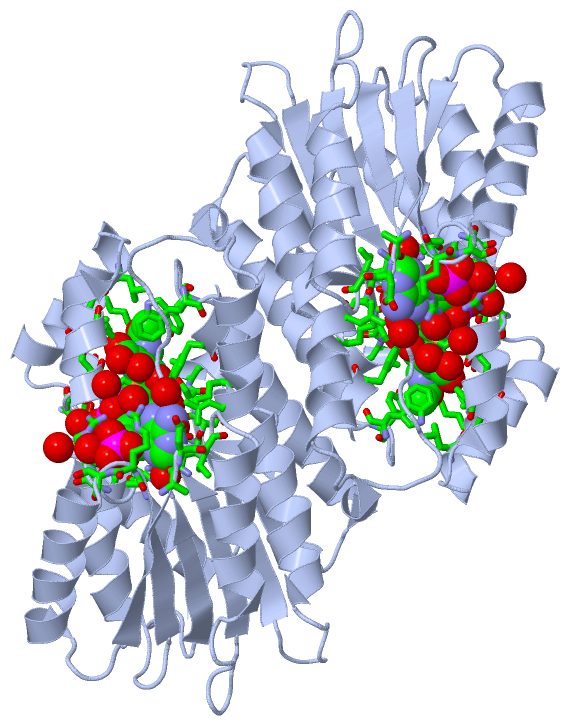
| | GO:0004757 | | sepiapterin reductase activity | | Catalysis of the reaction: 7,8-dihydrobiopterin + NADP+ = sepiapterin + NADPH + H+. |
| biological process |
|---|
| | GO:0006558 | | L-phenylalanine metabolic process | | The chemical reactions and pathways involving L-phenylalanine, the L-enantiomer of 2-amino-3-phenylpropanoic acid, i.e. (2S)-2-amino-3-phenylpropanoic acid. |
| | GO:0048667 | | cell morphogenesis involved in neuron differentiation | | The process in which the structures of a neuron are generated and organized. This process occurs while the initially relatively unspecialized cell is acquiring the specialized features of a neuron. |
| | GO:0042417 | | dopamine metabolic process | | The chemical reactions and pathways involving dopamine, a catecholamine neurotransmitter and a metabolic precursor of noradrenaline and adrenaline. |
| | GO:0006809 | | nitric oxide biosynthetic process | | The chemical reactions and pathways resulting in the formation of nitric oxide, nitrogen monoxide (NO), a colorless gas only slightly soluble in water. |
| | GO:0042415 | | norepinephrine metabolic process | | The chemical reactions and pathways involving norepinephrine, a hormone secreted by the adrenal medulla, and a neurotransmitter in the sympathetic peripheral nervous system and in some tracts in the central nervous system. It is also the demethylated biosynthetic precursor of epinephrine. |
| | GO:0055114 | | oxidation-reduction process | | A metabolic process that results in the removal or addition of one or more electrons to or from a substance, with or without the concomitant removal or addition of a proton or protons. |
| | GO:0019889 | | pteridine metabolic process | | The chemical reactions and pathways involving pteridine, pyrazino(2,3-dipyrimidine), the parent structure of pterins and the pteroyl group. |
| | GO:0040014 | | regulation of multicellular organism growth | | Any process that modulates the frequency, rate or extent of growth of the body of an organism so that it reaches its usual body size. |
| | GO:0042428 | | serotonin metabolic process | | The chemical reactions and pathways involving serotonin (5-hydroxytryptamine), a monoamine neurotransmitter occurring in the peripheral and central nervous systems, also having hormonal properties. |
| | GO:0006729 | | tetrahydrobiopterin biosynthetic process | | The chemical reactions and pathways resulting in the formation of tetrahydrobiopterin, the reduced form of biopterin (2-amino-4-hydroxy-6-(1,2-dihydroxypropyl)-pteridine). It functions as a hydroxylation coenzyme, e.g. in the conversion of phenylalanine to tyrosine. |
| | GO:0046146 | | tetrahydrobiopterin metabolic process | | The chemical reactions and pathways involving tetrahydrobiopterin, the reduced form of biopterin (2-amino-4-hydroxy-6-(1,2-dihydroxypropyl)-pteridine). It functions as a hydroxylation coenzyme, e.g. in the conversion of phenylalanine to tyrosine. |
| | GO:0050882 | | voluntary musculoskeletal movement | | The movement of an organism or part of an organism using mechanoreceptors, the nervous system, striated muscle and/or the skeletal system that can be controlled at will. |
| cellular component |
|---|
| | GO:0005737 | | cytoplasm | | All of the contents of a cell excluding the plasma membrane and nucleus, but including other subcellular structures. |
| | GO:0070062 | | extracellular exosome | | A vesicle that is released into the extracellular region by fusion of the limiting endosomal membrane of a multivesicular body with the plasma membrane. Extracellular exosomes, also simply called exosomes, have a diameter of about 40-100 nm. |
| | GO:0005739 | | mitochondrion | | A semiautonomous, self replicating organelle that occurs in varying numbers, shapes, and sizes in the cytoplasm of virtually all eukaryotic cells. It is notably the site of tissue respiration. |
| | GO:0005654 | | nucleoplasm | | That part of the nuclear content other than the chromosomes or the nucleolus. |

 Description