| molecular function |
|---|
| | GO:0042605 | | peptide antigen binding | | Interacting selectively and non-covalently with an antigen peptide. |
| | GO:1990405 | | protein antigen binding | | Interacting selectively and non-covalently with a protein antigen. |
| | GO:0005515 | | protein binding | | Interacting selectively and non-covalently with any protein or protein complex (a complex of two or more proteins that may include other nonprotein molecules). |
| | GO:0046982 | | protein heterodimerization activity | | Interacting selectively and non-covalently with a nonidentical protein to form a heterodimer. |
| | GO:0015643 | | toxic substance binding | | Interacting selectively and non-covalently with a toxic substance, a poisonous substance that causes damage to biological systems. |
| | GO:0008134 | | transcription factor binding | | Interacting selectively and non-covalently with a transcription factor, any protein required to initiate or regulate transcription. |
| | GO:0031625 | | ubiquitin protein ligase binding | | Interacting selectively and non-covalently with a ubiquitin protein ligase enzyme, any of the E3 proteins. |
| biological process |
|---|
| | GO:0002344 | | B cell affinity maturation | | The process in which B cells produce antibodies with increased antigen affinity. This is accomplished by somatic hypermutation and selection for B cells which produce higher affinity antibodies to antigen. |
| | GO:0019882 | | antigen processing and presentation | | The process in which an antigen-presenting cell expresses antigen (peptide or lipid) on its cell surface in association with an MHC protein complex. |
| | GO:0019886 | | antigen processing and presentation of exogenous peptide antigen via MHC class II | | The process in which an antigen-presenting cell expresses a peptide antigen of exogenous origin on its cell surface in association with an MHC class II protein complex. The peptide antigen is typically, but not always, processed from a whole protein. |
| | GO:0048002 | | antigen processing and presentation of peptide antigen | | The process in which an antigen-presenting cell expresses peptide antigen in association with an MHC protein complex on its cell surface, including proteolysis and transport steps for the peptide antigen both prior to and following assembly with the MHC protein complex. The peptide antigen is typically, but not always, processed from an endogenous or exogenous protein. |
| | GO:0002504 | | antigen processing and presentation of peptide or polysaccharide antigen via MHC class II | | The process in which an antigen-presenting cell expresses antigen (peptide or polysaccharide) on its cell surface in association with an MHC class II protein complex. |
| | GO:0071549 | | cellular response to dexamethasone stimulus | | Any process that results in a change in state or activity of a cell (in terms of movement, secretion, enzyme production, gene expression, etc.) as a result of a dexamethasone stimulus. |
| | GO:0071385 | | cellular response to glucocorticoid stimulus | | Any process that results in a change in state or activity of a cell (in terms of movement, secretion, enzyme production, gene expression, etc.) as a result of a glucocorticoid stimulus. Glucocorticoids are hormonal C21 corticosteroids synthesized from cholesterol with the ability to bind with the cortisol receptor and trigger similar effects. Glucocorticoids act primarily on carbohydrate and protein metabolism, and have anti-inflammatory effects. |
| | GO:0071346 | | cellular response to interferon-gamma | | Any process that results in a change in state or activity of a cell (in terms of movement, secretion, enzyme production, gene expression, etc.) as a result of an interferon-gamma stimulus. Interferon gamma is the only member of the type II interferon found so far. |
| | GO:0071315 | | cellular response to morphine | | Any process that results in a change in state or activity of a cell (in terms of movement, secretion, enzyme production, gene expression, etc.) as a result of a morphine stimulus. Morphine is an opioid alkaloid, isolated from opium, with a complex ring structure. |
| | GO:0002455 | | humoral immune response mediated by circulating immunoglobulin | | An immune response dependent upon secreted immunoglobulin. An example of this process is found in Mus musculus. |
| | GO:0006955 | | immune response | | Any immune system process that functions in the calibrated response of an organism to a potential internal or invasive threat. |
| | GO:0002376 | | immune system process | | Any process involved in the development or functioning of the immune system, an organismal system for calibrated responses to potential internal or invasive threats. |
| | GO:0002381 | | immunoglobulin production involved in immunoglobulin mediated immune response | | The appearance of immunoglobulin due to biosynthesis or secretion following a cellular stimulus during an immune response, resulting in an increase in its intracellular or extracellular levels. |
| | GO:0042130 | | negative regulation of T cell proliferation | | Any process that stops, prevents or reduces the rate or extent of T cell proliferation. |
| | GO:0002827 | | positive regulation of T-helper 1 type immune response | | Any process that activates or increases the frequency, rate, or extent of a T-helper 1 type immune response. |
| | GO:0046635 | | positive regulation of alpha-beta T cell activation | | Any process that activates or increases the frequency, rate or extent of alpha-beta T cell activation. |
| | GO:0002579 | | positive regulation of antigen processing and presentation | | Any process that activates or increases the frequency, rate, or extent of antigen processing and presentation. |
| | GO:0009623 | | response to parasitic fungus | | Any process that results in a change in state or activity of a cell or an organism (in terms of movement, secretion, enzyme production, gene expression, etc.) as a result of a stimulus from a parasitic fungus, a fungus which spends all or part of its life in or on another organism from which it obtains nourishment and/or protection. |
| cellular component |
|---|
| | GO:0005794 | | Golgi apparatus | | A compound membranous cytoplasmic organelle of eukaryotic cells, consisting of flattened, ribosome-free vesicles arranged in a more or less regular stack. The Golgi apparatus differs from the endoplasmic reticulum in often having slightly thicker membranes, appearing in sections as a characteristic shallow semicircle so that the convex side (cis or entry face) abuts the endoplasmic reticulum, secretory vesicles emerging from the concave side (trans or exit face). In vertebrate cells there is usually one such organelle, while in invertebrates and plants, where they are known usually as dictyosomes, there may be several scattered in the cytoplasm. The Golgi apparatus processes proteins produced on the ribosomes of the rough endoplasmic reticulum; such processing includes modification of the core oligosaccharides of glycoproteins, and the sorting and packaging of proteins for transport to a variety of cellular locations. Three different regions of the Golgi are now recognized both in terms of structure and function: cis, in the vicinity of the cis face, trans, in the vicinity of the trans face, and medial, lying between the cis and trans regions. |
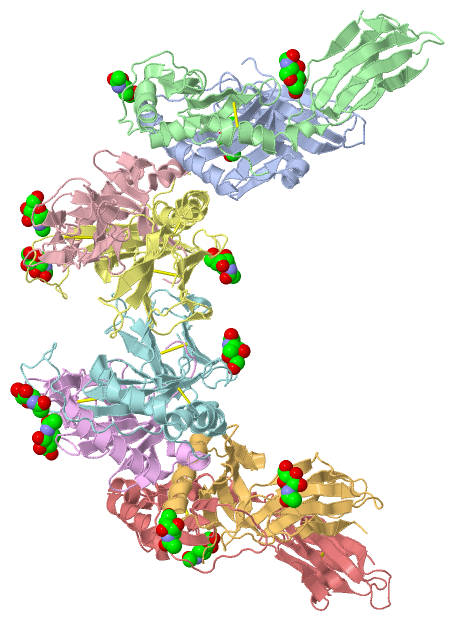
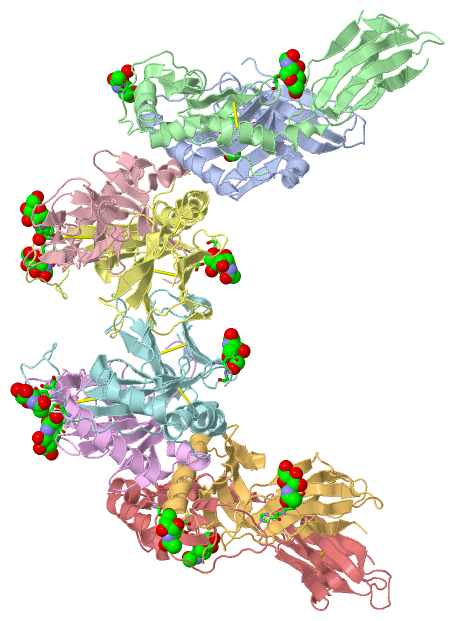
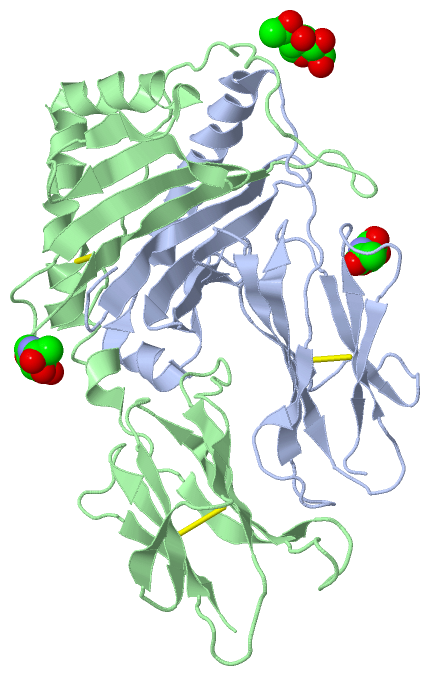
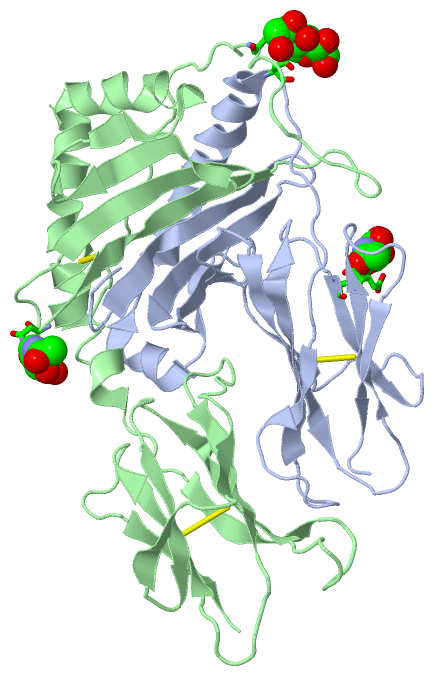
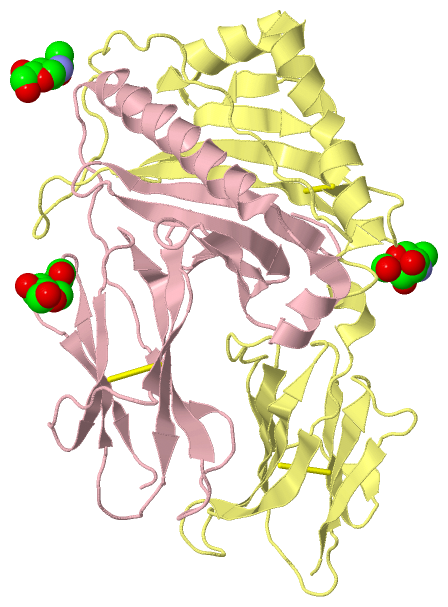
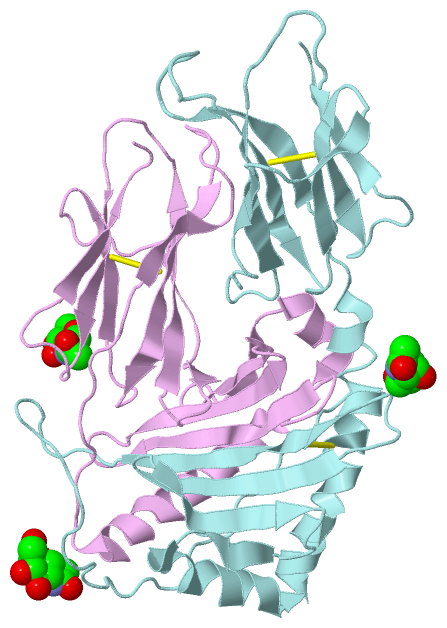
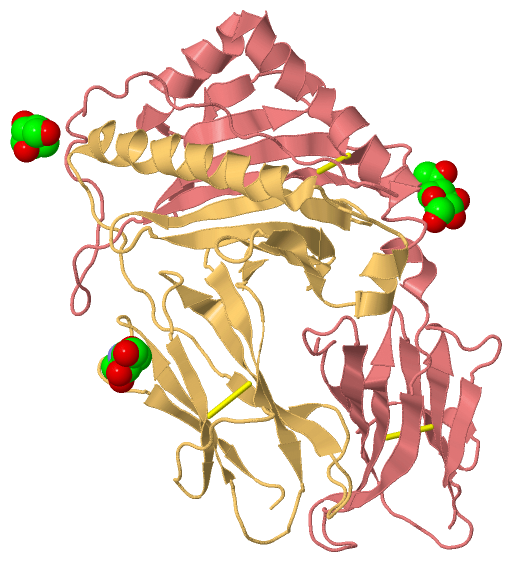
| | GO:0042613 | | MHC class II protein complex | | A transmembrane protein complex composed of an MHC class II alpha and MHC class II beta chain, and with or without a bound peptide or polysaccharide antigen. |
| | GO:0009986 | | cell surface | | The external part of the cell wall and/or plasma membrane. |
| | GO:0005769 | | early endosome | | A membrane-bounded organelle that receives incoming material from primary endocytic vesicles that have been generated by clathrin-dependent and clathrin-independent endocytosis; vesicles fuse with the early endosome to deliver cargo for sorting into recycling or degradation pathways. |
| | GO:0009897 | | external side of plasma membrane | | The leaflet of the plasma membrane that faces away from the cytoplasm and any proteins embedded or anchored in it or attached to its surface. |
| | GO:0016021 | | integral component of membrane | | The component of a membrane consisting of the gene products and protein complexes having at least some part of their peptide sequence embedded in the hydrophobic region of the membrane. |
| | GO:0005622 | | intracellular | | The living contents of a cell; the matter contained within (but not including) the plasma membrane, usually taken to exclude large vacuoles and masses of secretory or ingested material. In eukaryotes it includes the nucleus and cytoplasm. |
| | GO:0016020 | | membrane | | A lipid bilayer along with all the proteins and protein complexes embedded in it an attached to it. |
| | GO:0005771 | | multivesicular body | | A type of endosome in which regions of the limiting endosomal membrane invaginate to form internal vesicles; membrane proteins that enter the internal vesicles are sequestered from the cytoplasm. |
| | GO:0005886 | | plasma membrane | | The membrane surrounding a cell that separates the cell from its external environment. It consists of a phospholipid bilayer and associated proteins. |

 Description