Show PDB file:   
         Plain Text   HTML   (compressed file size)
QuickSearch:   
by PDB,NDB,UniProt,PROSITE Code or Search Term(s)  
(-)Asym./Biol. Unit
(-)Asym./Biol. Unit - sites
collapse expand < >
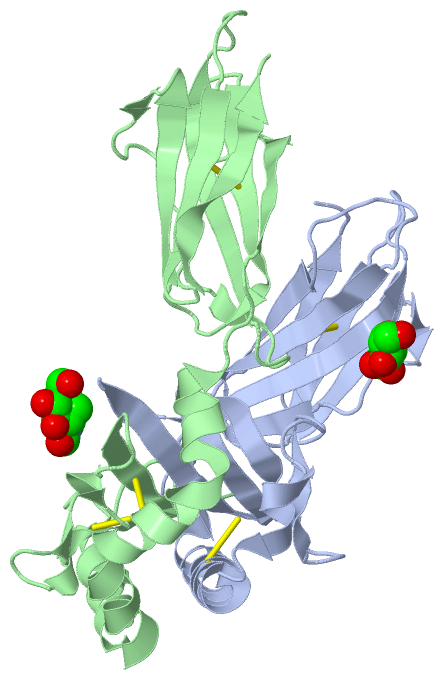
Image Asym./Biol. Unit
Asym./Biol. Unit  (Jmol Viewer)
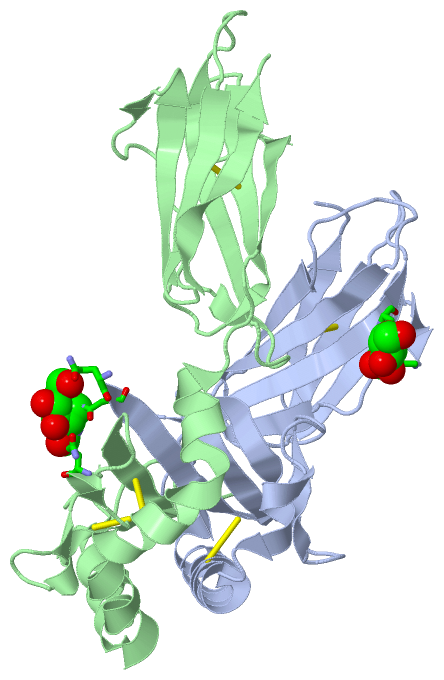
Image Asym./Biol. Unit - sites
Asym./Biol. Unit - sites  (Jmol Viewer)

(-) Description

Title :  CRYSTAL STRUCTURE OF MOUSE H2-DM
 
Authors :  D. H. Fremont, F. Crawford, P. Marrack, W. Hendrickson, J. Kappler
Date :  24 Oct 01  (Deposition) - 05 Dec 01  (Release) - 13 Jul 11  (Revision)
Method :  X-RAY DIFFRACTION
Resolution :  3.10
Chains :  Asym./Biol. Unit :  A,B
Keywords :  Mhc, Immune System (Keyword Search: [Gene Ontology, PubMed, Web (Google))
 
Reference :  D. H. Fremont, F. Crawford, P. Marrack, W. A. Hendrickson, J. Kappler
Crystal Structure Of Mouse H2-M.
Immunity V. 9 385 1998
PubMed-ID: 9768758  |  Reference-DOI: 10.1016/S1074-7613(00)80621-4

(-) Compounds

Molecule 1 - MHC CLASS II H2-M ALPHA CHAIN
    ChainsA
    EngineeredYES
    Expression SystemTRICHOPLUSIA NI
    Expression System Cell LineHIGH-FIVE
    Expression System CommonCABBAGE LOOPER
    Expression System Taxid7111
    Expression System Vector TypeBACULOVIRUS
    GeneH2-DM
    Organism CommonHOUSE MOUSE
    Organism ScientificMUS MUSCULUS
    Organism Taxid10090
 
Molecule 2 - MHC CLASS II H2-M BETA 2 CHAIN
    ChainsB
    EngineeredYES
    Expression SystemTRICHOPLUSIA NI
    Expression System Cell LineHIGH-FIVE
    Expression System CommonCABBAGE LOOPER
    Expression System Taxid7111
    Expression System Vector TypeBACULOVIRUS
    GeneH2-DM
    Organism CommonHOUSE MOUSE
    Organism ScientificMUS MUSCULUS
    Organism Taxid10090

 Structural Features

(-) Chains, Units

  12
Asymmetric/Biological Unit AB

Summary Information (see also Sequences/Alignments below)

(-) Ligands, Modified Residues, Ions  (1, 2)

Asymmetric/Biological Unit (1, 2)
No.NameCountTypeFull Name
1NAG2Ligand/IonN-ACETYL-D-GLUCOSAMINE

(-) Sites  (2, 2)

Asymmetric Unit (2, 2)
No.NameEvidenceResiduesDescription
1AC1SOFTWAREGLN A:11 , ASN A:12 , GLN B:19BINDING SITE FOR RESIDUE NAG A 192
2AC2SOFTWAREGLY A:141 , ASN A:162BINDING SITE FOR RESIDUE NAG A 193

(-) SS Bonds  (5, 5)

Asymmetric/Biological Unit
No.Residues
1A:21 -A:76
2A:118 -A:173
3B:10 -B:78
4B:24 -B:34
5B:116 -B:173

(-) Cis Peptide Bonds  (2, 2)

Asymmetric/Biological Unit
No.Residues
1Phe A:124 -Pro A:125
2Tyr B:122 -Pro B:123

 Sequence-Structure Mapping

(-) SAPs(SNPs)/Variants  (0, 0)

(no "SAP(SNP)/Variant" information available for 1K8I)

(-) PROSITE Motifs  (1, 1)

Asymmetric/Biological Unit (1, 1)
 PROSITEUniProtKBPDB
No.IDACDescriptionIDLocationCountLocation
1IG_MHCPS00290 Immunoglobulins and major histocompatibility complex proteins signature.DMA_MOUSE200-206  1A:171-177

(-) Exons   (0, 0)

(no "Exon" information available for 1K8I)

(-) Sequences/Alignments

Asymmetric/Biological Unit
   Reformat: Number of residues per line =  ('0' or empty: single-line sequence representation)
  Number of residues per labelling interval =   
  UniProt sequence: complete  aligned part    
   Show mapping: SCOP domains CATH domains Pfam domains Secondary structure (by author)
SAPs(SNPs) PROSITE motifs Exons
(details for a mapped element are shown in a popup box when the mouse pointer rests over it)
Chain A from PDB  Type:PROTEIN  Length:181
 aligned with DMA_MOUSE | P28078 from UniProtKB/Swiss-Prot  Length:261

    Alignment length:181
                                    49        59        69        79        89        99       109       119       129       139       149       159       169       179       189       199       209       219 
            DMA_MOUSE    40 QNHTFRHTLFCQDGIPNIGLSETYDEDELFSFDFSQNTRVPRLPDFAEWAQGQGDASAIAFGKSFCEMLMREVSPKLEGQIPVSRGLSVAEVFTLKPLEFGKPNTLVCFISNLFPPTLTVNWQLHSAPVEGASPTSISAVDGLTFQAFSYLNFTPEPFDLYSCTVTHEIDRYTAIAYWVPQ 220
               SCOP domains d1k8ia2 A:11-92 Class II MHC alpha chain, N-terminal domain                       d1k8ia1 A:93-191 Class II MHC alpha chain, C-terminal domain                                        SCOP domains
               CATH domains 1k8iA01 A:11-87                                                              1k8iA02 A:88-191 Immunoglobulins                                                                         CATH domains
               Pfam domains -MHC_II_alpha-1k8iA02 A:12-95                                                        --------C1-set-1k8iA01 A:104-183                                                        -------- Pfam domains
         Sec.struct. author .eeeeeeeeeee.....eeeeeee..eeeeeee....eeee.....hhhhhh..hhhhhhhhhhhhhhhhhhhhhhhh..........eeeeee.........eeeeeeeeee....eeeeeee..eee......eeeee...eeeeeeeeee.......eeeeeee.....eeeeee... Sec.struct. author
                 SAPs(SNPs) ------------------------------------------------------------------------------------------------------------------------------------------------------------------------------------- SAPs(SNPs)
                    PROSITE ----------------------------------------------------------------------------------------------------------------------------------------------------------------IG_MHC -------------- PROSITE
                 Transcript ------------------------------------------------------------------------------------------------------------------------------------------------------------------------------------- Transcript
                 1k8i A  11 QNHTFRHTLFCQDGIPNIGLSETYDEDELFSFDFSQNTRVPRLPDFAEWAQGQGDASAIAFDKSFCEMLMREVSPKLEGQIPVSRGLPVAEVFTLKPLEFGKPNTLVCFISNLFPPTLTVNWQLHSAPVEGASPTSISAVDGLTFQAFSYLNFTPEPFDLYSCTVTHEIDRYTAIAYWVPQ 191
                                    20        30        40        50        60        70        80        90       100       110       120       130       140       150       160       170       180       190 

Chain B from PDB  Type:PROTEIN  Length:190
 aligned with Q31099_MOUSE | Q31099 from UniProtKB/TrEMBL  Length:261

    Alignment length:190
                                    29        39        49        59        69        79        89        99       109       119       129       139       149       159       169       179       189       199       209
         Q31099_MOUSE    20 GFVAHVESTCVLNDAGTPQDFTYCVSFNKDLLACWDPDVGKIVPCEFGVLSRLAEIISNILNEQESLIHRLQNGLQDCATHTQPFWDVLTHRTRAPSVRVAQTTPFNTREPVMLACYVWGFYPADVTITWMKNGQLVPSHSNKEKTAQPNGDWTYQTVSYLALTPSYGDVYTCVVQHSGTSEPIRGDWTP 209
               SCOP domains d1k8ib2 B:1-94 Class II MHC beta chain, N-terminal domain                                     d1k8ib1 B:95-190 Class II MHC beta chain, C-terminal domain                                      SCOP domains
               CATH domains 1k8iB01 B:1-91 Class II Histocompatibility Antigen, M Beta Chain; Chain B, domain 1        1k8iB02 B:92-190 Immunoglobulins                                                                    CATH domains
               Pfam domains -------MHC_II_beta-1k8iB02 B:8-87                                                      --------------C1-set-1k8iB01 B:102-185                                                            ----- Pfam domains
         Sec.struct. author ..eeeeeeeeeee....eeee..eeee.....eeee....eeee.....hhhhhhhhhhhhhhhhhhhhhhhhhhhhhhhhhhhhhhhhhh.....eeeeeee........eeeeeeeeee....eeeeeee..ee...........ee.....eeeeeeeee.......eeeeeee..eeeeeeeee.. Sec.struct. author
                 SAPs(SNPs) ---------------------------------------------------------------------------------------------------------------------------------------------------------------------------------------------- SAPs(SNPs)
                    PROSITE ---------------------------------------------------------------------------------------------------------------------------------------------------------------------------------------------- PROSITE
                 Transcript ---------------------------------------------------------------------------------------------------------------------------------------------------------------------------------------------- Transcript
                 1k8i B   1 GFVAHVESTCVLNDAGTPQDFTYCVSFNKDLLACWDPDVGKIVPCEFGVLSRLAEIISNILNEQESLIHRLQNGLQDCATHTQPFWDVLTHRTRAPSVRVAQTTPFNTREPVMLACYVWGFYPADVTITWMKNGQLVPSHSNKEKTAQPNGDWTYQTVSYLALTPSYGDVYTCVVQHSGTSEPIRGDWTP 190
                                    10        20        30        40        50        60        70        80        90       100       110       120       130       140       150       160       170       180       190

   Legend:   → Mismatch (orange background)
  - → Gap (green background, '-', border residues have a numbering label)
    → Modified Residue (blue background, lower-case, 'x' indicates undefined single-letter code, labelled with number + name)
  x → Chemical Group (purple background, 'x', labelled with number + name, e.g. ACE or NH2)
  extra numbering lines below/above indicate numbering irregularities and modified residue names etc., number ends below/above '|'

 Classification and Annotation

(-) SCOP Domains  (4, 4)

Asymmetric/Biological Unit

(-) CATH Domains  (2, 4)

Asymmetric/Biological Unit
(-)
Class: Alpha Beta (26913)
(-)
Class: Mainly Beta (13760)

(-) Pfam Domains  (3, 4)

Asymmetric/Biological Unit
(-)
Clan: Ig (577)
(-)
Family: C1-set (338)
1aC1-set-1k8iA01A:104-183
1bC1-set-1k8iB01B:102-185
(-)
Clan: MHC (252)

(-) Gene Ontology  (31, 47)

Asymmetric/Biological Unit(hide GO term definitions)
Chain A   (DMA_MOUSE | P28078)
molecular function
    GO:0023026    MHC class II protein complex binding    Interacting selectively and non-covalently with the class II major histocompatibility complex.
    GO:0005515    protein binding    Interacting selectively and non-covalently with any protein or protein complex (a complex of two or more proteins that may include other nonprotein molecules).
biological process
    GO:0019882    antigen processing and presentation    The process in which an antigen-presenting cell expresses antigen (peptide or lipid) on its cell surface in association with an MHC protein complex.
    GO:0019886    antigen processing and presentation of exogenous peptide antigen via MHC class II    The process in which an antigen-presenting cell expresses a peptide antigen of exogenous origin on its cell surface in association with an MHC class II protein complex. The peptide antigen is typically, but not always, processed from a whole protein.
    GO:0002504    antigen processing and presentation of peptide or polysaccharide antigen via MHC class II    The process in which an antigen-presenting cell expresses antigen (peptide or polysaccharide) on its cell surface in association with an MHC class II protein complex.
    GO:0051085    chaperone mediated protein folding requiring cofactor    The process of assisting in the correct posttranslational noncovalent assembly of proteins, which is dependent on additional protein cofactors. This process occurs over one or several cycles of nucleotide hydrolysis-dependent binding and release.
    GO:0006955    immune response    Any immune system process that functions in the calibrated response of an organism to a potential internal or invasive threat.
    GO:0002376    immune system process    Any process involved in the development or functioning of the immune system, an organismal system for calibrated responses to potential internal or invasive threats.
    GO:0016064    immunoglobulin mediated immune response    An immune response mediated by immunoglobulins, whether cell-bound or in solution.
    GO:0048839    inner ear development    The process whose specific outcome is the progression of the inner ear over time, from its formation to the mature structure.
    GO:0002503    peptide antigen assembly with MHC class II protein complex    The binding of a peptide to the antigen binding groove of an MHC class II protein complex.
    GO:0045582    positive regulation of T cell differentiation    Any process that activates or increases the frequency, rate or extent of T cell differentiation.
    GO:0002636    positive regulation of germinal center formation    Any process that activates or increases the frequency, rate, or extent of germinal center formation.
    GO:0002922    positive regulation of humoral immune response    Any process that activates or increases the frequency, rate, or extent of a humoral immune response.
    GO:0050778    positive regulation of immune response    Any process that activates or increases the frequency, rate or extent of the immune response, the immunological reaction of an organism to an immunogenic stimulus.
    GO:0045059    positive thymic T cell selection    The process of sparing immature T cells in the thymus which react with self-MHC protein complexes with low affinity levels from apoptotic death.
    GO:0006461    protein complex assembly    The aggregation, arrangement and bonding together of a set of components to form a protein complex.
    GO:0015031    protein transport    The directed movement of proteins into, out of or within a cell, or between cells, by means of some agent such as a transporter or pore.
cellular component
    GO:0042613    MHC class II protein complex    A transmembrane protein complex composed of an MHC class II alpha and MHC class II beta chain, and with or without a bound peptide or polysaccharide antigen.
    GO:0009986    cell surface    The external part of the cell wall and/or plasma membrane.
    GO:0005768    endosome    A vacuole to which materials ingested by endocytosis are delivered.
    GO:0010008    endosome membrane    The lipid bilayer surrounding an endosome.
    GO:0070062    extracellular exosome    A vesicle that is released into the extracellular region by fusion of the limiting endosomal membrane of a multivesicular body with the plasma membrane. Extracellular exosomes, also simply called exosomes, have a diameter of about 40-100 nm.
    GO:0016021    integral component of membrane    The component of a membrane consisting of the gene products and protein complexes having at least some part of their peptide sequence embedded in the hydrophobic region of the membrane.
    GO:0005622    intracellular    The living contents of a cell; the matter contained within (but not including) the plasma membrane, usually taken to exclude large vacuoles and masses of secretory or ingested material. In eukaryotes it includes the nucleus and cytoplasm.
    GO:0005770    late endosome    A prelysosomal endocytic organelle differentiated from early endosomes by lower lumenal pH and different protein composition. Late endosomes are more spherical than early endosomes and are mostly juxtanuclear, being concentrated near the microtubule organizing center.
    GO:0031902    late endosome membrane    The lipid bilayer surrounding a late endosome.
    GO:0005765    lysosomal membrane    The lipid bilayer surrounding the lysosome and separating its contents from the cell cytoplasm.
    GO:0005764    lysosome    A small lytic vacuole that has cell cycle-independent morphology and is found in most animal cells and that contains a variety of hydrolases, most of which have their maximal activities in the pH range 5-6. The contained enzymes display latency if properly isolated. About 40 different lysosomal hydrolases are known and lysosomes have a great variety of morphologies and functions.
    GO:0016020    membrane    A lipid bilayer along with all the proteins and protein complexes embedded in it an attached to it.
    GO:0005771    multivesicular body    A type of endosome in which regions of the limiting endosomal membrane invaginate to form internal vesicles; membrane proteins that enter the internal vesicles are sequestered from the cytoplasm.

Chain B   (Q31099_MOUSE | Q31099)
molecular function
    GO:0023026    MHC class II protein complex binding    Interacting selectively and non-covalently with the class II major histocompatibility complex.
    GO:0005515    protein binding    Interacting selectively and non-covalently with any protein or protein complex (a complex of two or more proteins that may include other nonprotein molecules).
biological process
    GO:0019882    antigen processing and presentation    The process in which an antigen-presenting cell expresses antigen (peptide or lipid) on its cell surface in association with an MHC protein complex.
    GO:0019886    antigen processing and presentation of exogenous peptide antigen via MHC class II    The process in which an antigen-presenting cell expresses a peptide antigen of exogenous origin on its cell surface in association with an MHC class II protein complex. The peptide antigen is typically, but not always, processed from a whole protein.
    GO:0002504    antigen processing and presentation of peptide or polysaccharide antigen via MHC class II    The process in which an antigen-presenting cell expresses antigen (peptide or polysaccharide) on its cell surface in association with an MHC class II protein complex.
    GO:0051085    chaperone mediated protein folding requiring cofactor    The process of assisting in the correct posttranslational noncovalent assembly of proteins, which is dependent on additional protein cofactors. This process occurs over one or several cycles of nucleotide hydrolysis-dependent binding and release.
    GO:0006955    immune response    Any immune system process that functions in the calibrated response of an organism to a potential internal or invasive threat.
    GO:0002376    immune system process    Any process involved in the development or functioning of the immune system, an organismal system for calibrated responses to potential internal or invasive threats.
cellular component
    GO:0042613    MHC class II protein complex    A transmembrane protein complex composed of an MHC class II alpha and MHC class II beta chain, and with or without a bound peptide or polysaccharide antigen.
    GO:0010008    endosome membrane    The lipid bilayer surrounding an endosome.
    GO:0016021    integral component of membrane    The component of a membrane consisting of the gene products and protein complexes having at least some part of their peptide sequence embedded in the hydrophobic region of the membrane.
    GO:0005770    late endosome    A prelysosomal endocytic organelle differentiated from early endosomes by lower lumenal pH and different protein composition. Late endosomes are more spherical than early endosomes and are mostly juxtanuclear, being concentrated near the microtubule organizing center.
    GO:0005765    lysosomal membrane    The lipid bilayer surrounding the lysosome and separating its contents from the cell cytoplasm.
    GO:0005764    lysosome    A small lytic vacuole that has cell cycle-independent morphology and is found in most animal cells and that contains a variety of hydrolases, most of which have their maximal activities in the pH range 5-6. The contained enzymes display latency if properly isolated. About 40 different lysosomal hydrolases are known and lysosomes have a great variety of morphologies and functions.
    GO:0016020    membrane    A lipid bilayer along with all the proteins and protein complexes embedded in it an attached to it.
    GO:0005771    multivesicular body    A type of endosome in which regions of the limiting endosomal membrane invaginate to form internal vesicles; membrane proteins that enter the internal vesicles are sequestered from the cytoplasm.

 Visualization

(-) Interactive Views

Asymmetric/Biological Unit
  Complete Structure
    Jena3D(integrated viewing of ligand, site, SAP, PROSITE, SCOP information)
    WebMol | AstexViewer[tm]@PDBe
(Java Applets, require no local installation except for Java; loading may be slow)
    STRAP
(Java WebStart application, automatic local installation, requires Java; full application with system access!)
    RasMol
(require local installation)
    Molscript (VRML)
(requires installation of a VRML viewer; select preferred view via VRML and generate a mono or stereo PDF format file)
 
  Ligands, Modified Residues, Ions
    NAG  [ RasMol | Jena3D ]  +environment [ RasMol | Jena3D ]
 
  Sites
    AC1  [ RasMol ]  +environment [ RasMol ]
    AC2  [ RasMol ]  +environment [ RasMol ]
 
  Cis Peptide Bonds
    Phe A:124 - Pro A:125   [ RasMol ]  
    Tyr B:122 - Pro B:123   [ RasMol ]  
 

(-) Still Images

Jmol
  protein: cartoon or spacefill or dots and stick; nucleic acid: cartoon and stick; ligands: spacefill; active site: stick
Molscript
  protein, nucleic acid: cartoon; ligands: spacefill; active site: ball and stick

 Databases and Analysis Tools

(-) Databases

Access by PDB/NDB ID
  1k8i
    Family and Domain InformationProDom | SYSTERS
    General Structural InformationGlycoscienceDB | MMDB | NDB | OCA | PDB | PDBe | PDBj | PDBsum | PDBWiki | PQS | PROTEOPEDIA
    Orientation in MembranesOPM
    Protein SurfaceSURFACE
    Secondary StructureDSSP (structure derived) | HSSP (homology derived)
    Structural GenomicsGeneCensus
    Structural NeighboursCE | VAST
    Structure ClassificationCATH | Dali | SCOP
    Validation and Original DataBMRB Data View | BMRB Restraints Grid | EDS | PROCHECK | RECOORD | WHAT_CHECK
 
Access by UniProt ID/Accession number
  DMA_MOUSE | P28078
    Comparative Protein Structure ModelsModBase
    Genomic InformationEnsembl
    Protein-protein InteractionDIP
    Sequence, Family and Domain InformationInterPro | Pfam | SMART | UniProtKB/SwissProt
  Q31099_MOUSE | Q31099
    Comparative Protein Structure ModelsModBase
    Genomic InformationEnsembl
    Protein-protein InteractionDIP
    Sequence, Family and Domain InformationInterPro | Pfam | SMART | UniProtKB/TrEMBL
 
Access by Enzyme Classificator   (EC Number)
  (no 'Enzyme Classificator' available)
    General Enzyme InformationBRENDA | EC-PDB | Enzyme | IntEnz
    PathwayKEGG | MetaCyc
 
Access by Disease Identifier   (MIM ID)
  (no 'MIM ID' available)
    Disease InformationOMIM
 
Access by GenAge ID
  (no 'GenAge ID' available)
    Age Related InformationGenAge

(-) Analysis Tools

Access by PDB/NDB ID
    Domain InformationXDom
    Interatomic Contacts of Structural UnitsCSU
    Ligand-protein ContactsLPC
    Protein CavitiescastP
    Sequence and Secondary StructurePDBCartoon
    Structure AlignmentSTRAP(Java WebStart application, automatic local installation, requires Java; full application with system access!)
    Structure and Sequence BrowserSTING
 
Access by UniProt ID/Accession number
  DMA_MOUSE | P28078
    Protein Disorder PredictionDisEMBL | FoldIndex | GLOBPLOT (for more information see DisProt)
  Q31099_MOUSE | Q31099
    Protein Disorder PredictionDisEMBL | FoldIndex | GLOBPLOT (for more information see DisProt)

 Related Entries

(-) Entries Sharing at Least One Protein Chain (UniProt ID)

(no "Entries Sharing at Least One Protein Chain" available for 1K8I)

(-) Related Entries Specified in the PDB File

(no "Related Entries Specified in the PDB File" available for 1K8I)