Show PDB file:   
         Plain Text   HTML   (compressed file size)
QuickSearch:   
by PDB,NDB,UniProt,PROSITE Code or Search Term(s)  
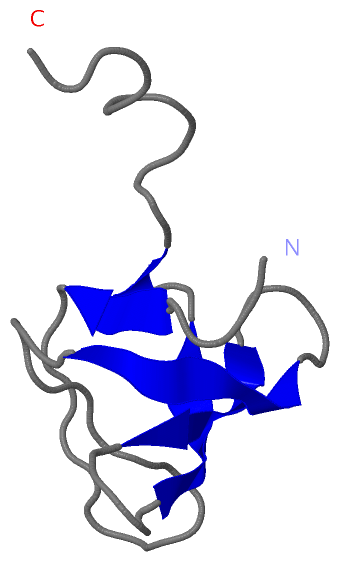
(-)NMR Structure - model 1
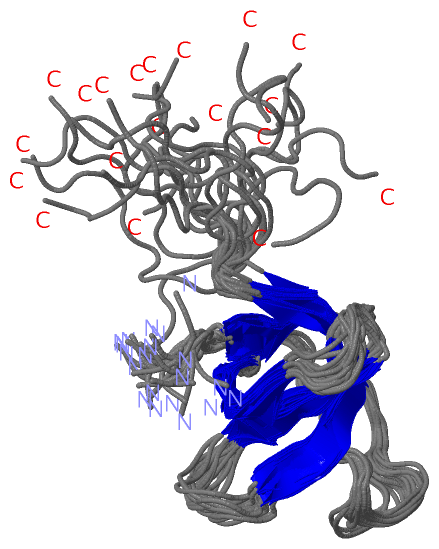
(-)NMR Structure - all models
collapse expand < >
Image NMR Structure - model 1
NMR Structure - model 1  (Jmol Viewer)
Image NMR Structure - all models
NMR Structure - all models  (Jmol Viewer)

(-) Description

Title :  NMR STRUCTURE OF THE SH3 DOMAIN FROM THE TEC PROTEIN TYROSINE KINASE
 
Authors :  T. D. Mulhern, S. E. Pursglove, G. W. Booker
Date :  28 Aug 01  (Deposition) - 28 Nov 01  (Release) - 24 Feb 09  (Revision)
Method :  SOLUTION NMR
Resolution :  NOT APPLICABLE
Chains :  NMR Structure  :  A  (20x)
Keywords :  Transferase, Tyrosine-Protein Kinase, Atp-Binding, Sh3 Domain, Phosphorylation (Keyword Search: [Gene Ontology, PubMed, Web (Google))
 
Reference :  S. E. Pursglove, T. D. Mulhern, J. P. Mackay, M. G. Hinds, G. W. Booker
The Solution Structure And Intramolecular Associations Of The Tec Kinase Src Homology 3 Domain.
J. Biol. Chem. V. 277 755 2002
PubMed-ID: 11684687  |  Reference-DOI: 10.1074/JBC.M108318200

(-) Compounds

Molecule 1 - TYROSINE-PROTEIN KINASE TEC
    ChainsA
    EC Number2.7.1.112
    EngineeredYES
    Expression SystemESCHERICHIA COLI
    Expression System Cell LineBL21(DE3)
    Expression System PlasmidPGEX-4T-2
    Expression System Taxid469008
    FragmentSH3 DOMAIN (181-245)
    Organism CommonMOUSE
    Organism ScientificMUS MUSCULUS
    Organism Taxid10090
    Other DetailsN-TERMINAL GLY-SER FROM GLUTATHIONE S-TRANSFERASE FUSION PARTNER
    Other Details - SourceGST-FUSION

 Structural Features

(-) Chains, Units

  
NMR Structure (20x)

Summary Information (see also Sequences/Alignments below)

(-) Ligands, Modified Residues, Ions  (0, 0)

(no "Ligand,Modified Residues,Ions" information available for 1GL5)

(-) Sites  (0, 0)

(no "Site" information available for 1GL5)

(-) SS Bonds  (0, 0)

(no "SS Bond" information available for 1GL5)

(-) Cis Peptide Bonds  (0, 0)

(no "Cis Peptide Bond" information available for 1GL5)

 Sequence-Structure Mapping

(-) SAPs(SNPs)/Variants  (0, 0)

(no "SAP(SNP)/Variant" information available for 1GL5)

(-) PROSITE Motifs  (1, 1)

NMR Structure (1, 1)
 PROSITEUniProtKBPDB
No.IDACDescriptionIDLocationCountLocation
1SH3PS50002 Src homology 3 (SH3) domain profile.TEC_MOUSE178-238  1A:181-238

(-) Exons   (0, 0)

(no "Exon" information available for 1GL5)

(-) Sequences/Alignments

NMR Structure
   Reformat: Number of residues per line =  ('0' or empty: single-line sequence representation)
  Number of residues per labelling interval =   
  UniProt sequence: complete  aligned part    
   Show mapping: SCOP domains CATH domains Pfam domains Secondary structure (by author)
SAPs(SNPs) PROSITE motifs Exons
(details for a mapped element are shown in a popup box when the mouse pointer rests over it)
Chain A from PDB  Type:PROTEIN  Length:67
 aligned with TEC_MOUSE | P24604 from UniProtKB/Swiss-Prot  Length:630

    Alignment length:118
                                   137       147       157       167       177       187       197       207       217       227       237        
            TEC_MOUSE   128 GSYQCCRQTEKLAPGCEKYNLFESSIRKTLPPAPEIKKRRPPPPIPPEEENTEEIVVAMYDFQATEAHDLRLERGQEYIILEKNDLHWWRARDKYGSEGYIPSNYVTGKKSNNLDQYE 245
               SCOP domains d1                                                   gl5a_ A: tyrosine kinase tec                                      SCOP domains
               CATH domains 1g                                                   l5A00 A:179-245 SH3 Domains                                       CATH domains
               Pfam domains ---------------------------------------------------------------------------------------------------------------------- Pfam domains
         Sec.struct. author ..---------------------------------------------------..eee..................eeeeee.....eeeee.....eeeee...ee........... Sec.struct. author
                 SAPs(SNPs) ---------------------------------------------------------------------------------------------------------------------- SAPs(SNPs)
                    PROSITE --------------------------------------------------SH3  PDB: A:181-238 UniProt: 178-238                         ------- PROSITE
                 Transcript ---------------------------------------------------------------------------------------------------------------------- Transcript
                 1gl5 A 179 GS---------------------------------------------------EIVVAMYDFQATEAHDLRLERGQEYIILEKNDLHWWRARDKYGSEGYIPSNYVTGKKSNNLDQYD 245
                             |       -         -         -         -         -   |   187       197       207       217       227       237        
                             |                                                 181                                                                
                           180                                                                                                                    

   Legend:   → Mismatch (orange background)
  - → Gap (green background, '-', border residues have a numbering label)
    → Modified Residue (blue background, lower-case, 'x' indicates undefined single-letter code, labelled with number + name)
  x → Chemical Group (purple background, 'x', labelled with number + name, e.g. ACE or NH2)
  extra numbering lines below/above indicate numbering irregularities and modified residue names etc., number ends below/above '|'

 Classification and Annotation

(-) SCOP Domains  (1, 1)

NMR Structure

(-) CATH Domains  (1, 1)

NMR Structure
(-)
Class: Mainly Beta (13760)

(-) Pfam Domains  (0, 0)

(no "Pfam Domain" information available for 1GL5)

(-) Gene Ontology  (35, 35)

NMR Structure(hide GO term definitions)
Chain A   (TEC_MOUSE | P24604)
molecular function
    GO:0005524    ATP binding    Interacting selectively and non-covalently with ATP, adenosine 5'-triphosphate, a universally important coenzyme and enzyme regulator.
    GO:0016301    kinase activity    Catalysis of the transfer of a phosphate group, usually from ATP, to a substrate molecule.
    GO:0008289    lipid binding    Interacting selectively and non-covalently with a lipid.
    GO:0046872    metal ion binding    Interacting selectively and non-covalently with any metal ion.
    GO:0004715    non-membrane spanning protein tyrosine kinase activity    Catalysis of the reaction: ATP + protein L-tyrosine = ADP + protein L-tyrosine phosphate by a non-membrane spanning protein.
    GO:0000166    nucleotide binding    Interacting selectively and non-covalently with a nucleotide, any compound consisting of a nucleoside that is esterified with (ortho)phosphate or an oligophosphate at any hydroxyl group on the ribose or deoxyribose.
    GO:0005515    protein binding    Interacting selectively and non-covalently with any protein or protein complex (a complex of two or more proteins that may include other nonprotein molecules).
    GO:0004672    protein kinase activity    Catalysis of the phosphorylation of an amino acid residue in a protein, usually according to the reaction: a protein + ATP = a phosphoprotein + ADP.
    GO:0004713    protein tyrosine kinase activity    Catalysis of the reaction: ATP + a protein tyrosine = ADP + protein tyrosine phosphate.
    GO:0005102    receptor binding    Interacting selectively and non-covalently with one or more specific sites on a receptor molecule, a macromolecule that undergoes combination with a hormone, neurotransmitter, drug or intracellular messenger to initiate a change in cell function.
    GO:0016740    transferase activity    Catalysis of the transfer of a group, e.g. a methyl group, glycosyl group, acyl group, phosphorus-containing, or other groups, from one compound (generally regarded as the donor) to another compound (generally regarded as the acceptor). Transferase is the systematic name for any enzyme of EC class 2.
biological process
    GO:0050853    B cell receptor signaling pathway    A series of molecular signals initiated by the cross-linking of an antigen receptor on a B cell.
    GO:0038095    Fc-epsilon receptor signaling pathway    A series of molecular signals initiated by the binding of the Fc portion of immunoglobulin E (IgE) to an Fc-epsilon receptor on the surface of a signal-receiving cell, and ending with regulation of a downstream cellular process, e.g. transcription. The Fc portion of an immunoglobulin is its C-terminal constant region.
    GO:0002250    adaptive immune response    An immune response mediated by cells expressing specific receptors for antigen produced through a somatic diversification process, and allowing for an enhanced secondary response to subsequent exposures to the same antigen (immunological memory).
    GO:0030154    cell differentiation    The process in which relatively unspecialized cells, e.g. embryonic or regenerative cells, acquire specialized structural and/or functional features that characterize the cells, tissues, or organs of the mature organism or some other relatively stable phase of the organism's life history. Differentiation includes the processes involved in commitment of a cell to a specific fate and its subsequent development to the mature state.
    GO:0002376    immune system process    Any process involved in the development or functioning of the immune system, an organismal system for calibrated responses to potential internal or invasive threats.
    GO:0045087    innate immune response    Innate immune responses are defense responses mediated by germline encoded components that directly recognize components of potential pathogens.
    GO:0007229    integrin-mediated signaling pathway    A series of molecular signals initiated by the binding of extracellular ligand to an integrin on the surface of a target cell, and ending with regulation of a downstream cellular process, e.g. transcription.
    GO:0035556    intracellular signal transduction    The process in which a signal is passed on to downstream components within the cell, which become activated themselves to further propagate the signal and finally trigger a change in the function or state of the cell.
    GO:0038083    peptidyl-tyrosine autophosphorylation    The phosphorylation by a protein of one or more of its own tyrosine amino acid residues, or a tyrosine residue on an identical protein.
    GO:0018108    peptidyl-tyrosine phosphorylation    The phosphorylation of peptidyl-tyrosine to form peptidyl-O4'-phospho-L-tyrosine.
    GO:0016310    phosphorylation    The process of introducing a phosphate group into a molecule, usually with the formation of a phosphoric ester, a phosphoric anhydride or a phosphoric amide.
    GO:0050731    positive regulation of peptidyl-tyrosine phosphorylation    Any process that activates or increases the frequency, rate or extent of the phosphorylation of peptidyl-tyrosine.
    GO:0006468    protein phosphorylation    The process of introducing a phosphate group on to a protein.
    GO:0042127    regulation of cell proliferation    Any process that modulates the frequency, rate or extent of cell proliferation.
    GO:0010543    regulation of platelet activation    Any process that modulates the rate or frequency of platelet activation. Platelet activation is a series of progressive, overlapping events triggered by exposure of the platelets to subendothelial tissue.
    GO:0042246    tissue regeneration    The regrowth of lost or destroyed tissues.
    GO:0007169    transmembrane receptor protein tyrosine kinase signaling pathway    A series of molecular signals initiated by the binding of an extracellular ligand to a receptor on the surface of the target cell where the receptor possesses tyrosine kinase activity, and ending with regulation of a downstream cellular process, e.g. transcription.
cellular component
    GO:0005911    cell-cell junction    A cell junction that forms a connection between two or more cells in a multicellular organism; excludes direct cytoplasmic junctions such as ring canals.
    GO:0005737    cytoplasm    All of the contents of a cell excluding the plasma membrane and nucleus, but including other subcellular structures.
    GO:0005856    cytoskeleton    Any of the various filamentous elements that form the internal framework of cells, and typically remain after treatment of the cells with mild detergent to remove membrane constituents and soluble components of the cytoplasm. The term embraces intermediate filaments, microfilaments, microtubules, the microtrabecular lattice, and other structures characterized by a polymeric filamentous nature and long-range order within the cell. The various elements of the cytoskeleton not only serve in the maintenance of cellular shape but also have roles in other cellular functions, including cellular movement, cell division, endocytosis, and movement of organelles.
    GO:0005829    cytosol    The part of the cytoplasm that does not contain organelles but which does contain other particulate matter, such as protein complexes.
    GO:0031234    extrinsic component of cytoplasmic side of plasma membrane    The component of a plasma membrane consisting of gene products and protein complexes that are loosely bound to its cytoplasmic surface, but not integrated into the hydrophobic region.
    GO:0016020    membrane    A lipid bilayer along with all the proteins and protein complexes embedded in it an attached to it.
    GO:0005886    plasma membrane    The membrane surrounding a cell that separates the cell from its external environment. It consists of a phospholipid bilayer and associated proteins.

 Visualization

(-) Interactive Views

NMR Structure
  Complete Structure
    Jena3D(integrated viewing of ligand, site, SAP, PROSITE, SCOP information)
    WebMol | AstexViewer[tm]@PDBe
(Java Applets, require no local installation except for Java; loading may be slow)
    STRAP
(Java WebStart application, automatic local installation, requires Java; full application with system access!)
    RasMol
(require local installation)
    Molscript (VRML)
(requires installation of a VRML viewer; select preferred view via VRML and generate a mono or stereo PDF format file)
 
  Ligands, Modified Residues, Ions
(no "Ligands, Modified Residues, Ions" information available for 1gl5)
 
  Sites
(no "Sites" information available for 1gl5)
 
  Cis Peptide Bonds
(no "Cis Peptide Bonds" information available for 1gl5)
 

(-) Still Images

Jmol
  protein: cartoon or spacefill or dots and stick; nucleic acid: cartoon and stick; ligands: spacefill; active site: stick
Molscript
  protein, nucleic acid: cartoon; ligands: spacefill; active site: ball and stick

 Databases and Analysis Tools

(-) Databases

Access by PDB/NDB ID
  1gl5
    Family and Domain InformationProDom | SYSTERS
    General Structural InformationGlycoscienceDB | MMDB | NDB | OCA | PDB | PDBe | PDBj | PDBsum | PDBWiki | PQS | PROTEOPEDIA
    Orientation in MembranesOPM
    Protein SurfaceSURFACE
    Secondary StructureDSSP (structure derived) | HSSP (homology derived)
    Structural GenomicsGeneCensus
    Structural NeighboursCE | VAST
    Structure ClassificationCATH | Dali | SCOP
    Validation and Original DataBMRB Data View | BMRB Restraints Grid | EDS | PROCHECK | RECOORD | WHAT_CHECK
 
Access by UniProt ID/Accession number
  TEC_MOUSE | P24604
    Comparative Protein Structure ModelsModBase
    Genomic InformationEnsembl
    Protein-protein InteractionDIP
    Sequence, Family and Domain InformationInterPro | Pfam | SMART | UniProtKB/SwissProt
 
Access by Enzyme Classificator   (EC Number)
  2.7.1.112
    General Enzyme InformationBRENDA | EC-PDB | Enzyme | IntEnz
    PathwayKEGG | MetaCyc
 
Access by Disease Identifier   (MIM ID)
  (no 'MIM ID' available)
    Disease InformationOMIM
 
Access by GenAge ID
  (no 'GenAge ID' available)
    Age Related InformationGenAge

(-) Analysis Tools

Access by PDB/NDB ID
    Domain InformationXDom
    Interatomic Contacts of Structural UnitsCSU
    Ligand-protein ContactsLPC
    Protein CavitiescastP
    Sequence and Secondary StructurePDBCartoon
    Structure AlignmentSTRAP(Java WebStart application, automatic local installation, requires Java; full application with system access!)
    Structure and Sequence BrowserSTING
 
Access by UniProt ID/Accession number
  TEC_MOUSE | P24604
    Protein Disorder PredictionDisEMBL | FoldIndex | GLOBPLOT (for more information see DisProt)

 Related Entries

(-) Entries Sharing at Least One Protein Chain (UniProt ID)

(no "Entries Sharing at Least One Protein Chain" available for 1GL5)

(-) Related Entries Specified in the PDB File

(no "Related Entries Specified in the PDB File" available for 1GL5)