Show PDB file:   
         Plain Text   HTML   (compressed file size)
QuickSearch:   
by PDB,NDB,UniProt,PROSITE Code or Search Term(s)  
(-)NMR Structure - model 1
(-)NMR Structure - all models
collapse expand < >
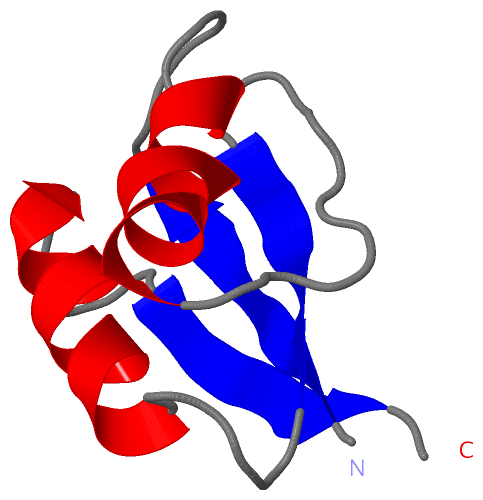
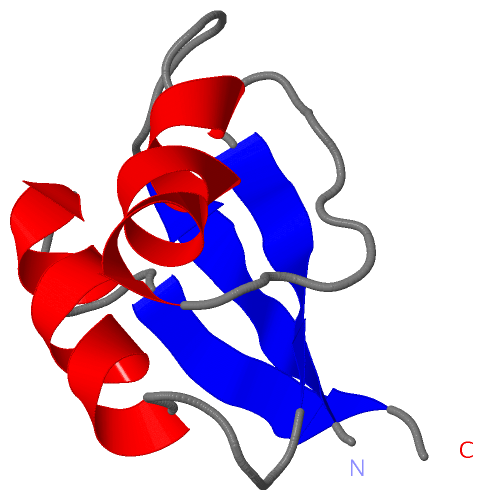
Image NMR Structure - model 1
NMR Structure - model 1  (Jmol Viewer)
Image NMR Structure - all models
NMR Structure - all models  (Jmol Viewer)

(-) Description

Title :  CHEY-BINDING DOMAIN OF CHEA (RESIDUES 159-227), NMR, MINIMIZED AVERAGE STRUCTURE
 
Authors :  M. M. Mcevoy, F. W. Dahlquist
Date :  06 Feb 96  (Deposition) - 11 Jul 96  (Release) - 24 Feb 09  (Revision)
Method :  SOLUTION NMR
Resolution :  NOT APPLICABLE
Chains :  NMR Structure  :  A
Keywords :  Kinase, Signal Transduction, Chemotaxis (Keyword Search: [Gene Ontology, PubMed, Web (Google))
 
Reference :  M. M. Mcevoy, D. R. Muhandiram, L. E. Kay, F. W. Dahlquist
Structure And Dynamics Of A Chey-Binding Domain Of The Chemotaxis Kinase Chea Determined By Nuclear Magnetic Resonance Spectroscopy.
Biochemistry V. 35 5633 1996
PubMed-ID: 8639521  |  Reference-DOI: 10.1021/BI952707H
(for further references see the PDB file header)

(-) Compounds

Molecule 1 - CHEA
    ChainsA
    EngineeredYES
    Expression SystemTAC PROMOTER
    Expression System GeneCHEA (RESIDUES 124-257)
    Expression System PlasmidPTM22
    FragmentCHEY-BINDING DOMAIN, RESIDUES 159 - 227
    GeneCHEA (RESIDUES 124-257)
    Organism ScientificESCHERICHIA COLI
    Organism Taxid562
    SynonymP2 DOMAIN OF CHEA

 Structural Features

(-) Chains, Units

  
NMR Structure 

Summary Information (see also Sequences/Alignments below)

(-) Ligands, Modified Residues, Ions  (0, 0)

(no "Ligand,Modified Residues,Ions" information available for 1FWP)

(-) Sites  (0, 0)

(no "Site" information available for 1FWP)

(-) SS Bonds  (0, 0)

(no "SS Bond" information available for 1FWP)

(-) Cis Peptide Bonds  (0, 0)

(no "Cis Peptide Bond" information available for 1FWP)

 Sequence-Structure Mapping

(-) SAPs(SNPs)/Variants  (0, 0)

(no "SAP(SNP)/Variant" information available for 1FWP)

(-) PROSITE Motifs  (0, 0)

(no "PROSITE Motif" information available for 1FWP)

(-) Exons   (0, 0)

(no "Exon" information available for 1FWP)

(-) Sequences/Alignments

NMR Structure
   Reformat: Number of residues per line =  ('0' or empty: single-line sequence representation)
  Number of residues per labelling interval =   
  UniProt sequence: complete  aligned part    
   Show mapping: SCOP domains CATH domains Pfam domains Secondary structure (by author)
SAPs(SNPs) PROSITE motifs Exons
(details for a mapped element are shown in a popup box when the mouse pointer rests over it)
Chain A from PDB  Type:PROTEIN  Length:69
 aligned with CHEA_ECOLI | P07363 from UniProtKB/Swiss-Prot  Length:654

    Alignment length:69
                                   168       178       188       198       208       218         
           CHEA_ECOLI   159 PRRIILSRLKAGEVDLLEEELGHLTTLTDVVKGADSLSAILPGDIAEDDITAVLCFVIEADQITFETVE 227
               SCOP domains d1fwpa_ A: CheY-binding domain of CheA                                SCOP domains
               CATH domains 1fwpA00 A:1-69  [code=3.30.70.400, no name defined]                   CATH domains
               Pfam domains --------------------------------------------------------------------- Pfam domains
         Sec.struct. author .eeeeee......hhhhhhhhhhh...........eeeeee.....hhhhhhhhhhh.....eeeee.. Sec.struct. author
                 SAPs(SNPs) --------------------------------------------------------------------- SAPs(SNPs)
                    PROSITE --------------------------------------------------------------------- PROSITE
                 Transcript --------------------------------------------------------------------- Transcript
                 1fwp A   1 PRRIILSRLKAGEVDLLEEELGHLTTLTDVVKGADSLSAILPGDIAEDDITAVLCFVIEADQITFETVE  69
                                    10        20        30        40        50        60         

   Legend:   → Mismatch (orange background)
  - → Gap (green background, '-', border residues have a numbering label)
    → Modified Residue (blue background, lower-case, 'x' indicates undefined single-letter code, labelled with number + name)
  x → Chemical Group (purple background, 'x', labelled with number + name, e.g. ACE or NH2)
  extra numbering lines below/above indicate numbering irregularities and modified residue names etc., number ends below/above '|'

 Classification and Annotation

(-) SCOP Domains  (1, 1)

NMR Structure

(-) CATH Domains  (1, 1)

NMR Structure
(-)
Class: Alpha Beta (26913)

(-) Pfam Domains  (0, 0)

(no "Pfam Domain" information available for 1FWP)

(-) Gene Ontology  (22, 22)

NMR Structure(hide GO term definitions)
Chain A   (CHEA_ECOLI | P07363)
molecular function
    GO:0005524    ATP binding    Interacting selectively and non-covalently with ATP, adenosine 5'-triphosphate, a universally important coenzyme and enzyme regulator.
    GO:0016301    kinase activity    Catalysis of the transfer of a phosphate group, usually from ATP, to a substrate molecule.
    GO:0000166    nucleotide binding    Interacting selectively and non-covalently with a nucleotide, any compound consisting of a nucleoside that is esterified with (ortho)phosphate or an oligophosphate at any hydroxyl group on the ribose or deoxyribose.
    GO:0000155    phosphorelay sensor kinase activity    Catalysis of the phosphorylation of a histidine residue in response to detection of an extracellular signal such as a chemical ligand or change in environment, to initiate a change in cell state or activity. The two-component sensor is a histidine kinase that autophosphorylates a histidine residue in its active site. The phosphate is then transferred to an aspartate residue in a downstream response regulator, to trigger a response.
    GO:0005515    protein binding    Interacting selectively and non-covalently with any protein or protein complex (a complex of two or more proteins that may include other nonprotein molecules).
    GO:0004673    protein histidine kinase activity    Catalysis of the reaction: ATP + protein L-histidine = ADP + protein phospho-L-histidine.
    GO:0004871    signal transducer activity    Conveys a signal across a cell to trigger a change in cell function or state. A signal is a physical entity or change in state that is used to transfer information in order to trigger a response.
    GO:0016740    transferase activity    Catalysis of the transfer of a group, e.g. a methyl group, glycosyl group, acyl group, phosphorus-containing, or other groups, from one compound (generally regarded as the donor) to another compound (generally regarded as the acceptor). Transferase is the systematic name for any enzyme of EC class 2.
    GO:0016772    transferase activity, transferring phosphorus-containing groups    Catalysis of the transfer of a phosphorus-containing group from one compound (donor) to another (acceptor).
biological process
    GO:0006935    chemotaxis    The directed movement of a motile cell or organism, or the directed growth of a cell guided by a specific chemical concentration gradient. Movement may be towards a higher concentration (positive chemotaxis) or towards a lower concentration (negative chemotaxis).
    GO:0051649    establishment of localization in cell    Any process, occuring in a cell, that localizes a substance or cellular component. This may occur via movement, tethering or selective degradation.
    GO:0031400    negative regulation of protein modification process    Any process that stops, prevents, or reduces the frequency, rate or extent of the covalent alteration of one or more amino acid residues within a protein.
    GO:0018106    peptidyl-histidine phosphorylation    The phosphorylation of peptidyl-histidine to form peptidyl-1'-phospho-L-histidine (otherwise known as tau-phosphohistidine, tele-phosphohistidine) or peptidyl-3'-phospho-L-histidine (otherwise known as pi-phosphohistidine, pros-phosphohistidine).
    GO:0000160    phosphorelay signal transduction system    A conserved series of molecular signals found in prokaryotes and eukaryotes; involves autophosphorylation of a histidine kinase and the transfer of the phosphate group to an aspartate that then acts as a phospho-donor to response regulator proteins.
    GO:0016310    phosphorylation    The process of introducing a phosphate group into a molecule, usually with the formation of a phosphoric ester, a phosphoric anhydride or a phosphoric amide.
    GO:0035307    positive regulation of protein dephosphorylation    Any process that activates or increases the frequency, rate or extent of removal of phosphate groups from a protein.
    GO:0046777    protein autophosphorylation    The phosphorylation by a protein of one or more of its own amino acid residues (cis-autophosphorylation), or residues on an identical protein (trans-autophosphorylation).
    GO:0007165    signal transduction    The cellular process in which a signal is conveyed to trigger a change in the activity or state of a cell. Signal transduction begins with reception of a signal (e.g. a ligand binding to a receptor or receptor activation by a stimulus such as light), or for signal transduction in the absence of ligand, signal-withdrawal or the activity of a constitutively active receptor. Signal transduction ends with regulation of a downstream cellular process, e.g. regulation of transcription or regulation of a metabolic process. Signal transduction covers signaling from receptors located on the surface of the cell and signaling via molecules located within the cell. For signaling between cells, signal transduction is restricted to events at and within the receiving cell.
    GO:0023014    signal transduction by protein phosphorylation    A process in which the transfer of one or more phosphate groups to a substrate transmits a signal to the phosphorylated substrate.
cellular component
    GO:0005737    cytoplasm    All of the contents of a cell excluding the plasma membrane and nucleus, but including other subcellular structures.
    GO:0005829    cytosol    The part of the cytoplasm that does not contain organelles but which does contain other particulate matter, such as protein complexes.
    GO:0005886    plasma membrane    The membrane surrounding a cell that separates the cell from its external environment. It consists of a phospholipid bilayer and associated proteins.

 Visualization

(-) Interactive Views

NMR Structure
  Complete Structure
    Jena3D(integrated viewing of ligand, site, SAP, PROSITE, SCOP information)
    WebMol | AstexViewer[tm]@PDBe
(Java Applets, require no local installation except for Java; loading may be slow)
    STRAP
(Java WebStart application, automatic local installation, requires Java; full application with system access!)
    RasMol
(require local installation)
    Molscript (VRML)
(requires installation of a VRML viewer; select preferred view via VRML and generate a mono or stereo PDF format file)
 
  Ligands, Modified Residues, Ions
(no "Ligands, Modified Residues, Ions" information available for 1fwp)
 
  Sites
(no "Sites" information available for 1fwp)
 
  Cis Peptide Bonds
(no "Cis Peptide Bonds" information available for 1fwp)
 

(-) Still Images

Jmol
  protein: cartoon or spacefill or dots and stick; nucleic acid: cartoon and stick; ligands: spacefill; active site: stick
Molscript
  protein, nucleic acid: cartoon; ligands: spacefill; active site: ball and stick

 Databases and Analysis Tools

(-) Databases

Access by PDB/NDB ID
  1fwp
    Family and Domain InformationProDom | SYSTERS
    General Structural InformationGlycoscienceDB | MMDB | NDB | OCA | PDB | PDBe | PDBj | PDBsum | PDBWiki | PQS | PROTEOPEDIA
    Orientation in MembranesOPM
    Protein SurfaceSURFACE
    Secondary StructureDSSP (structure derived) | HSSP (homology derived)
    Structural GenomicsGeneCensus
    Structural NeighboursCE | VAST
    Structure ClassificationCATH | Dali | SCOP
    Validation and Original DataBMRB Data View | BMRB Restraints Grid | EDS | PROCHECK | RECOORD | WHAT_CHECK
 
Access by UniProt ID/Accession number
  CHEA_ECOLI | P07363
    Comparative Protein Structure ModelsModBase
    Genomic InformationEnsembl
    Protein-protein InteractionDIP
    Sequence, Family and Domain InformationInterPro | Pfam | SMART | UniProtKB/SwissProt
 
Access by Enzyme Classificator   (EC Number)
  (no 'Enzyme Classificator' available)
    General Enzyme InformationBRENDA | EC-PDB | Enzyme | IntEnz
    PathwayKEGG | MetaCyc
 
Access by Disease Identifier   (MIM ID)
  (no 'MIM ID' available)
    Disease InformationOMIM
 
Access by GenAge ID
  (no 'GenAge ID' available)
    Age Related InformationGenAge

(-) Analysis Tools

Access by PDB/NDB ID
    Domain InformationXDom
    Interatomic Contacts of Structural UnitsCSU
    Ligand-protein ContactsLPC
    Protein CavitiescastP
    Sequence and Secondary StructurePDBCartoon
    Structure AlignmentSTRAP(Java WebStart application, automatic local installation, requires Java; full application with system access!)
    Structure and Sequence BrowserSTING
 
Access by UniProt ID/Accession number
  CHEA_ECOLI | P07363
    Protein Disorder PredictionDisEMBL | FoldIndex | GLOBPLOT (for more information see DisProt)

 Related Entries

(-) Entries Sharing at Least One Protein Chain (UniProt ID)

UniProtKB/Swiss-Prot
        CHEA_ECOLI | P073631a0o 1eay 1ffg 1ffs 1ffw 2lp4

(-) Related Entries Specified in the PDB File

(no "Related Entries Specified in the PDB File" available for 1FWP)