Show PDB file:   
         Plain Text   HTML   (compressed file size)
QuickSearch:   
by PDB,NDB,UniProt,PROSITE Code or Search Term(s)  
(-)NMR Structure - manually
(-)NMR Structure - model 1
(-)NMR Structure - all models
collapse expand < >
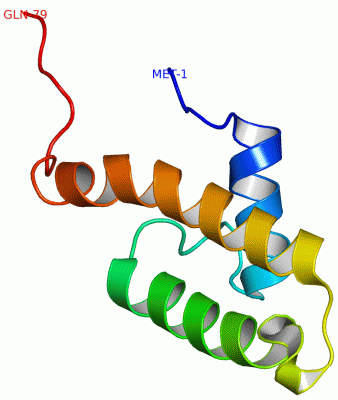
Image NMR Structure - manually
NMR Structure - manually  (Jmol Viewer)
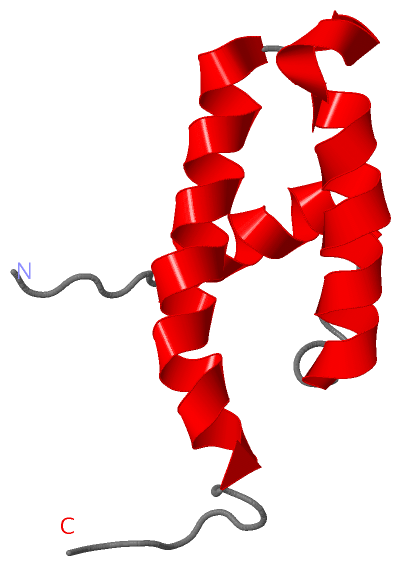
Image NMR Structure - model 1
NMR Structure - model 1  (Jmol Viewer)
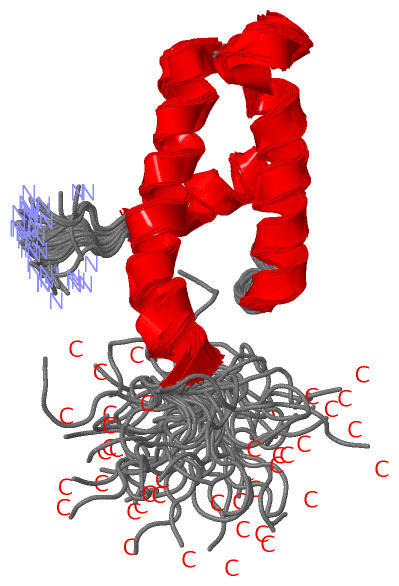
Image NMR Structure - all models
NMR Structure - all models  (Jmol Viewer)

(-) Description

Title :  NMR STRUCTURE OF THE N-TERMINAL J DOMAIN OF MURINE POLYOMAVIRUS T ANTIGENS.
 
Authors :  M. V. Berjanskii, M. I. Riley, A. Xie, V. Semenchenko, W. R. Folk, S. R. Van Doren
Date :  13 Jul 00  (Deposition) - 22 Nov 00  (Release) - 24 Feb 09  (Revision)
Method :  SOLUTION NMR
Resolution :  NOT APPLICABLE
Chains :  NMR Structure  :  A  (47x)
Keywords :  J Domain, Hpd Motif, Anti-Parallel Hairpin Of Helices, Viral Protein (Keyword Search: [Gene Ontology, PubMed, Web (Google))
 
Reference :  M. V. Berjanskii, M. I. Riley, A. Xie, V. Semenchenko, W. R. Folk, S. R. Van Doren
Nmr Structure Of The N-Terminal J Domain Of Murine Polyomavirus T Antigens. Implications For Dnaj-Like Domains And For Mutations Of T Antigens.
J. Biol. Chem. V. 275 36094 2000
PubMed-ID: 10950962  |  Reference-DOI: 10.1074/JBC.M006572200
(for further references see the PDB file header)

(-) Compounds

Molecule 1 - LARGE T ANTIGEN
    ChainsA
    EngineeredYES
    Expression SystemESCHERICHIA COLI
    Expression System PlasmidPET15B
    Expression System Taxid562
    Expression System Vector TypePLASMID
    FragmentN-TERMINAL DOMAIN
    Organism ScientificMURINE POLYOMAVIRUS
    Organism Taxid10634

 Structural Features

(-) Chains, Units

  
NMR Structure (47x)

Summary Information (see also Sequences/Alignments below)

(-) Ligands, Modified Residues, Ions  (0, 0)

(no "Ligand,Modified Residues,Ions" information available for 1FAF)

(-) Sites  (0, 0)

(no "Site" information available for 1FAF)

(-) SS Bonds  (0, 0)

(no "SS Bond" information available for 1FAF)

(-) Cis Peptide Bonds  (0, 0)

(no "Cis Peptide Bond" information available for 1FAF)

 Sequence-Structure Mapping

(-) SAPs(SNPs)/Variants  (0, 0)

(no "SAP(SNP)/Variant" information available for 1FAF)

(-) PROSITE Motifs  (0, 0)

(no "PROSITE Motif" information available for 1FAF)

(-) Exons   (0, 0)

(no "Exon" information available for 1FAF)

(-) Sequences/Alignments

NMR Structure
   Reformat: Number of residues per line =  ('0' or empty: single-line sequence representation)
  Number of residues per labelling interval =   
  UniProt sequence: complete  aligned part    
   Show mapping: SCOP domains CATH domains Pfam domains Secondary structure (by author)
SAPs(SNPs) PROSITE motifs Exons
(details for a mapped element are shown in a popup box when the mouse pointer rests over it)
Chain A from PDB  Type:PROTEIN  Length:79
 aligned with LT_POVM3 | P03074 from UniProtKB/Swiss-Prot  Length:782

    Alignment length:79
                                    10        20        30        40        50        60        70         
              LT_POVM3    1 MDRVLSRADKERLLELLKLPRQLWGDFGRMQQAYKQQSLLLHPDKGGSHALMQELNSLWGTFKTEVYNLRMNLGGTGFQ 79
               SCOP domains d1fafa_ A: Large T antigen, the N-terminal J domain                             SCOP domains
               CATH domains 1fafA00 A:1-79  [code=1.10.287.110, no name defined]                            CATH domains
               Pfam domains ------------------------------------------------------------------------------- Pfam domains
         Sec.struct. author .....hhhhhhhhhhhhh.......hhhhhhhhhhhhhhhhhhhhh.hhhhhhhhhhhhhhhhhhhhhhh......... Sec.struct. author
                 SAPs(SNPs) ------------------------------------------------------------------------------- SAPs(SNPs)
                    PROSITE ------------------------------------------------------------------------------- PROSITE
                 Transcript ------------------------------------------------------------------------------- Transcript
                  1faf A  1 MDRVLSRADKERLLELLKLPRQLWGDFGRMQQAYKQQSLLLHPDKGGSHALMQELNSLWGTFKTEVYNLRMNLGGTGFQ 79
                                    10        20        30        40        50        60        70         

   Legend:   → Mismatch (orange background)
  - → Gap (green background, '-', border residues have a numbering label)
    → Modified Residue (blue background, lower-case, 'x' indicates undefined single-letter code, labelled with number + name)
  x → Chemical Group (purple background, 'x', labelled with number + name, e.g. ACE or NH2)
  extra numbering lines below/above indicate numbering irregularities and modified residue names etc., number ends below/above '|'

 Classification and Annotation

(-) SCOP Domains  (1, 1)

NMR Structure

(-) CATH Domains  (1, 1)

NMR Structure

(-) Pfam Domains  (0, 0)

(no "Pfam Domain" information available for 1FAF)

(-) Gene Ontology  (15, 15)

NMR Structure(hide GO term definitions)
Chain A   (LT_POVM3 | P03074)
molecular function
    GO:0005524    ATP binding    Interacting selectively and non-covalently with ATP, adenosine 5'-triphosphate, a universally important coenzyme and enzyme regulator.
    GO:0003677    DNA binding    Any molecular function by which a gene product interacts selectively and non-covalently with DNA (deoxyribonucleic acid).
    GO:0003688    DNA replication origin binding    Interacting selectively and non-covalently with the DNA replication origin, a unique DNA sequence of a replicon at which DNA replication is initiated and proceeds bidirectionally or unidirectionally.
    GO:0016787    hydrolase activity    Catalysis of the hydrolysis of various bonds, e.g. C-O, C-N, C-C, phosphoric anhydride bonds, etc. Hydrolase is the systematic name for any enzyme of EC class 3.
    GO:0046872    metal ion binding    Interacting selectively and non-covalently with any metal ion.
    GO:0000166    nucleotide binding    Interacting selectively and non-covalently with a nucleotide, any compound consisting of a nucleoside that is esterified with (ortho)phosphate or an oligophosphate at any hydroxyl group on the ribose or deoxyribose.
biological process
    GO:0006260    DNA replication    The cellular metabolic process in which a cell duplicates one or more molecules of DNA. DNA replication begins when specific sequences, known as origins of replication, are recognized and bound by initiation proteins, and ends when the original DNA molecule has been completely duplicated and the copies topologically separated. The unit of replication usually corresponds to the genome of the cell, an organelle, or a virus. The template for replication can either be an existing DNA molecule or RNA.
    GO:0030683    evasion or tolerance by virus of host immune response    Any process, either active or passive, by which a virus avoids the effects of the host organism's immune response. The host is defined as the larger of the organisms involved in a symbiotic interaction.
    GO:0039645    modulation by virus of host G1/S transition checkpoint    Any viral process that modulates the frequency, rate or extent of the host cell G1/S transition checkpoint.
    GO:0060153    modulation by virus of host cell cycle    Any viral process that modulates the rate or extent of progression through the cell cycle.
    GO:0039576    suppression by virus of host JAK1 activity    Any process in which a virus stops, prevents, or reduces the frequency, rate or extent of host JAK1 (Janus Kinase 1) activity. In the host, binding of a ligand to a receptor triggers activation of JAK proteins, which phosphorylate tyrosine residues on the receptor creating sites for STAT proteins to bind, which are in turn phosphorylated and activated by JAK proteins. By blocking JAK1 activity, many viruses block the host signal transduction pathway.
    GO:0039503    suppression by virus of host innate immune response    Any process in which a virus stops, prevents, or reduces the frequency, rate or extent of the innate immune response of the host organism, the host's first line of defense.
    GO:0039502    suppression by virus of host type I interferon-mediated signaling pathway    Any process in which a virus stops, prevents, or reduces the frequency, rate or extent of type I interferon-mediated signaling in the host organism. Type I interferons include the interferon-alpha, beta, delta, episilon, zeta, kappa, tau, and omega gene families.
    GO:0016032    viral process    A multi-organism process in which a virus is a participant. The other participant is the host. Includes infection of a host cell, replication of the viral genome, and assembly of progeny virus particles. In some cases the viral genetic material may integrate into the host genome and only subsequently, under particular circumstances, 'complete' its life cycle.
cellular component
    GO:0042025    host cell nucleus    A membrane-bounded organelle as it is found in the host cell in which chromosomes are housed and replicated. The host is defined as the larger of the organisms involved in a symbiotic interaction.

 Visualization

(-) Interactive Views

NMR Structure
  Complete Structure
    Jena3D(integrated viewing of ligand, site, SAP, PROSITE, SCOP information)
    WebMol | AstexViewer[tm]@PDBe
(Java Applets, require no local installation except for Java; loading may be slow)
    STRAP
(Java WebStart application, automatic local installation, requires Java; full application with system access!)
    RasMol
(require local installation)
    Molscript (VRML)
(requires installation of a VRML viewer; select preferred view via VRML and generate a mono or stereo PDF format file)
 
  Ligands, Modified Residues, Ions
(no "Ligands, Modified Residues, Ions" information available for 1faf)
 
  Sites
(no "Sites" information available for 1faf)
 
  Cis Peptide Bonds
(no "Cis Peptide Bonds" information available for 1faf)
 

(-) Still Images

Jmol
  protein: cartoon or spacefill or dots and stick; nucleic acid: cartoon and stick; ligands: spacefill; active site: stick
Molscript
  protein, nucleic acid: cartoon; ligands: spacefill; active site: ball and stick

 Databases and Analysis Tools

(-) Databases

Access by PDB/NDB ID
  1faf
    Family and Domain InformationProDom | SYSTERS
    General Structural InformationGlycoscienceDB | MMDB | NDB | OCA | PDB | PDBe | PDBj | PDBsum | PDBWiki | PQS | PROTEOPEDIA
    Orientation in MembranesOPM
    Protein SurfaceSURFACE
    Secondary StructureDSSP (structure derived) | HSSP (homology derived)
    Structural GenomicsGeneCensus
    Structural NeighboursCE | VAST
    Structure ClassificationCATH | Dali | SCOP
    Validation and Original DataBMRB Data View | BMRB Restraints Grid | EDS | PROCHECK | RECOORD | WHAT_CHECK
 
Access by UniProt ID/Accession number
  LT_POVM3 | P03074
    Comparative Protein Structure ModelsModBase
    Genomic InformationEnsembl
    Protein-protein InteractionDIP
    Sequence, Family and Domain InformationInterPro | Pfam | SMART | UniProtKB/SwissProt
 
Access by Enzyme Classificator   (EC Number)
  (no 'Enzyme Classificator' available)
    General Enzyme InformationBRENDA | EC-PDB | Enzyme | IntEnz
    PathwayKEGG | MetaCyc
 
Access by Disease Identifier   (MIM ID)
  (no 'MIM ID' available)
    Disease InformationOMIM
 
Access by GenAge ID
  (no 'GenAge ID' available)
    Age Related InformationGenAge

(-) Analysis Tools

Access by PDB/NDB ID
    Domain InformationXDom
    Interatomic Contacts of Structural UnitsCSU
    Ligand-protein ContactsLPC
    Protein CavitiescastP
    Sequence and Secondary StructurePDBCartoon
    Structure AlignmentSTRAP(Java WebStart application, automatic local installation, requires Java; full application with system access!)
    Structure and Sequence BrowserSTING
 
Access by UniProt ID/Accession number
  LT_POVM3 | P03074
    Protein Disorder PredictionDisEMBL | FoldIndex | GLOBPLOT (for more information see DisProt)

 Related Entries

(-) Entries Sharing at Least One Protein Chain (UniProt ID)

UniProtKB/Swiss-Prot
        LT_POVM3 | P030744fb3

(-) Related Entries Specified in the PDB File

(no "Related Entries Specified in the PDB File" available for 1FAF)