Show PDB file:   
         Plain Text   HTML   (compressed file size)
QuickSearch:   
by PDB,NDB,UniProt,PROSITE Code or Search Term(s)  
(-)Asym./Biol. Unit - manually
(-)Asym./Biol. Unit
(-)Asym./Biol. Unit - sites
collapse expand < >
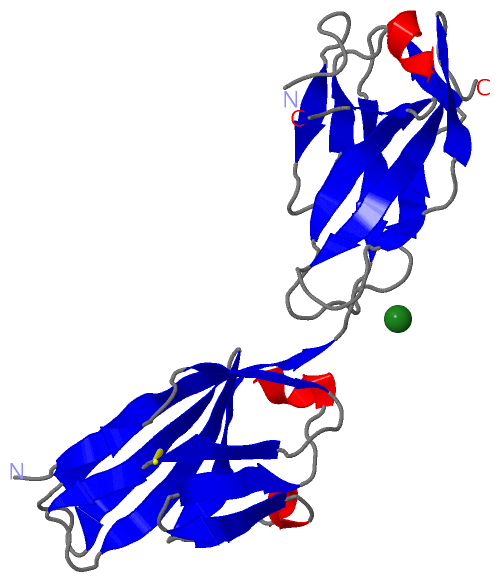
Image Asym./Biol. Unit - manually
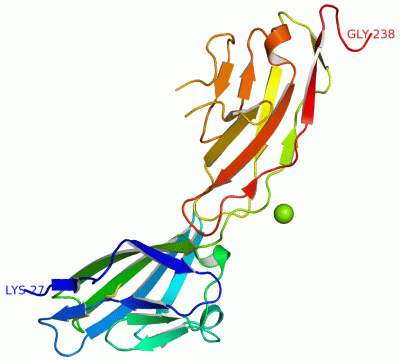
Asym./Biol. Unit - manually  (Jmol Viewer)
Image Asym./Biol. Unit
Asym./Biol. Unit  (Jmol Viewer)
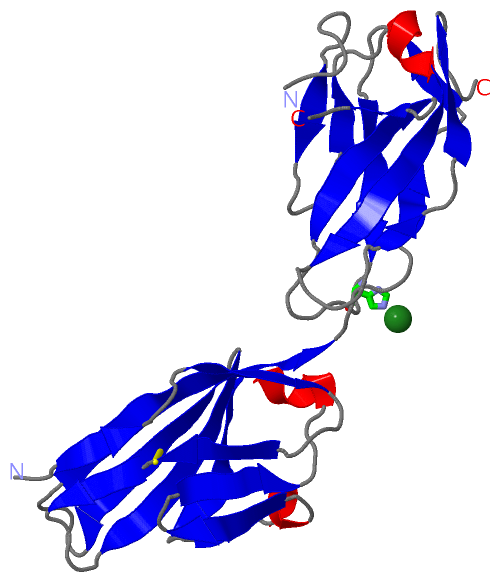
Image Asym./Biol. Unit - sites
Asym./Biol. Unit - sites  (Jmol Viewer)

(-) Description

Title :  SOLUBLE PART OF THE JUNCTION ADHESION MOLECULE FROM MOUSE
 
Authors :  D. Kostrewa, M. Brockhaus, A. D'Arcy, G. Dale, G. Bazzoni, E. Dejana, F. Winkler, M. Hennig
Date :  07 Jul 00  (Deposition) - 10 Jan 01  (Release) - 24 Feb 09  (Revision)
Method :  X-RAY DIFFRACTION
Resolution :  2.50
Chains :  Asym./Biol. Unit :  A
Keywords :  Immunoglobulin Superfamily, Beta-Sandwich Fold, Cell Adhesion (Keyword Search: [Gene Ontology, PubMed, Web (Google))
 
Reference :  D. Kostrewa, M. Brockhaus, A. D'Arcy, G. E. Dale, P. Nelboeck, G. Schmid, F. Mueller, G. Bazzoni, E. Dejana, T. Bartfai, F. K. Winkler, M. Hennig
X-Ray Structure Of Junctional Adhesion Molecule: Structural Basis For Homophilic Adhesion Via A Novel Dimerization Motif.
Embo J. V. 20 4391 2001
PubMed-ID: 11500366  |  Reference-DOI: 10.1093/EMBOJ/20.16.4391
(for further references see the PDB file header)

(-) Compounds

Molecule 1 - JUNCTION ADHESION MOLECULE
    ChainsA
    EngineeredYES
    Expression SystemSPODOPTERA FRUGIPERDA
    Expression System Cell LineSF9
    Expression System CommonFALL ARMYWORM
    Expression System Taxid7108
    Expression System Vector TypeBACULOVIRUS
    Organism CommonHOUSE MOUSE
    Organism ScientificMUS MUSCULUS
    Organism Taxid10090

 Structural Features

(-) Chains, Units

  1
Asymmetric/Biological Unit A

Summary Information (see also Sequences/Alignments below)

(-) Ligands, Modified Residues, Ions  (1, 1)

Asymmetric/Biological Unit (1, 1)
No.NameCountTypeFull Name
1MG1Ligand/IonMAGNESIUM ION

(-) Sites  (1, 1)

Asymmetric Unit (1, 1)
No.NameEvidenceResiduesDescription
1AC1SOFTWAREHIS A:155 , HOH A:255 , HOH A:281 , HOH A:288 , HOH A:307 , HOH A:311BINDING SITE FOR RESIDUE MG A 250

(-) SS Bonds  (2, 2)

Asymmetric/Biological Unit
No.Residues
1A:49 -A:108
2A:152 -A:212

(-) Cis Peptide Bonds  (2, 2)

Asymmetric/Biological Unit
No.Residues
1Ser A:158 -Pro A:159
2Asp A:200 -Pro A:201

 Sequence-Structure Mapping

(-) SAPs(SNPs)/Variants  (0, 0)

(no "SAP(SNP)/Variant" information available for 1F97)

(-) PROSITE Motifs  (0, 0)

(no "PROSITE Motif" information available for 1F97)

(-) Exons   (0, 0)

(no "Exon" information available for 1F97)

(-) Sequences/Alignments

Asymmetric/Biological Unit
   Reformat: Number of residues per line =  ('0' or empty: single-line sequence representation)
  Number of residues per labelling interval =   
  UniProt sequence: complete  aligned part    
   Show mapping: SCOP domains CATH domains Pfam domains Secondary structure (by author)
SAPs(SNPs) PROSITE motifs Exons
(details for a mapped element are shown in a popup box when the mouse pointer rests over it)
Chain A from PDB  Type:PROTEIN  Length:207
 aligned with JAM1_MOUSE | O88792 from UniProtKB/Swiss-Prot  Length:300

    Alignment length:212
                                    36        46        56        66        76        86        96       106       116       126       136       146       156       166       176       186       196       206       216       226       236  
           JAM1_MOUSE    27 KGSVYTAQSDVQVPENESIKLTCTYSGFSSPRVEWKFVQGSTTALVCYNSQITAPYADRVTFSSSGITFSSVTRKDNGEYTCMVSEEGGQNYGEVSIHLTVLVPPSKPTISVPSSVTIGNRAVLTCSEHDGSPPSEYSWFKDGISMLTADAKKTRAFMNSSFTIDPKSGDLIFDPVTAFDSGEYYCQAQNGYGTAMRSEAAHMDAVELNVGG 238
               SCOP domains d1f97a1 A:27-128 Junction adhesion molecule, JAM, N-terminal domain                                   d1f97a2 A:129-238 Junction adhesion molecule,      JAM, C-terminal domain                                      SCOP domains
               CATH domains 1f97A01 A:27-128 Immunoglobulins                                                                      1f97A02 A:129-238 Immunoglobulins                                                                              CATH domains
               Pfam domains -------------------------------------------------------------------------------------------------------------------------------------------------------------------------------------------------------------------- Pfam domains
         Sec.struct. author ..eee....eeeee....eeee.eee....eeeeeeeee..eeeeeee..ee.hhhh..eeee..eeee...hhhhheeeeeeeee.....eeeeeeeeeee......eee...eee....eeeeee........eeeeee..ee...-----........eee......eee...hhhhheeeeeeee......ee...eeeeee...... Sec.struct. author
                 SAPs(SNPs) -------------------------------------------------------------------------------------------------------------------------------------------------------------------------------------------------------------------- SAPs(SNPs)
                    PROSITE -------------------------------------------------------------------------------------------------------------------------------------------------------------------------------------------------------------------- PROSITE
                 Transcript -------------------------------------------------------------------------------------------------------------------------------------------------------------------------------------------------------------------- Transcript
                 1f97 A  27 KGSVYTAQSDVQVPENESIKLTCTYSGFSSPRVEWKFVQGSTTALVCYNSQITAPYADRVTFSSSGITFSSVTRKDNGEYTCMVSEEGGQNYGEVSIHLTVLVPPSKPTISVPSSVTIGNRAVLTCSEHDGSPPSEYSWFKDGISMLT-----TRAFMNSSFTIDPKSGDLIFDPVTAFDSGEYYCQAQNGYGTAMRSEAAHMDAVELNVGG 238
                                    36        46        56        66        76        86        96       106       116       126       136       146       156       166       | -   |   186       196       206       216       226       236  
                                                                                                                                                                             174   180                                                          

   Legend:   → Mismatch (orange background)
  - → Gap (green background, '-', border residues have a numbering label)
    → Modified Residue (blue background, lower-case, 'x' indicates undefined single-letter code, labelled with number + name)
  x → Chemical Group (purple background, 'x', labelled with number + name, e.g. ACE or NH2)
  extra numbering lines below/above indicate numbering irregularities and modified residue names etc., number ends below/above '|'

 Classification and Annotation

(-) SCOP Domains  (2, 2)

Asymmetric/Biological Unit

(-) CATH Domains  (1, 2)

Asymmetric/Biological Unit
(-)
Class: Mainly Beta (13760)

(-) Pfam Domains  (0, 0)

(no "Pfam Domain" information available for 1F97)

(-) Gene Ontology  (26, 26)

Asymmetric/Biological Unit(hide GO term definitions)
Chain A   (JAM1_MOUSE | O88792)
molecular function
    GO:0030165    PDZ domain binding    Interacting selectively and non-covalently with a PDZ domain of a protein, a domain found in diverse signaling proteins.
biological process
    GO:0031032    actomyosin structure organization    A process that is carried out at the cellular level which results in the assembly, arrangement of constituent parts, or disassembly of cytoskeletal structures containing both actin and myosin or paramyosin. The myosin may be organized into filaments.
    GO:0007155    cell adhesion    The attachment of a cell, either to another cell or to an underlying substrate such as the extracellular matrix, via cell adhesion molecules.
    GO:0030154    cell differentiation    The process in which relatively unspecialized cells, e.g. embryonic or regenerative cells, acquire specialized structural and/or functional features that characterize the cells, tissues, or organs of the mature organism or some other relatively stable phase of the organism's life history. Differentiation includes the processes involved in commitment of a cell to a specific fate and its subsequent development to the mature state.
    GO:0030855    epithelial cell differentiation    The process in which a relatively unspecialized cell acquires specialized features of an epithelial cell, any of the cells making up an epithelium.
    GO:0090557    establishment of endothelial intestinal barrier    The establishment of a barrier between endothelial cell layers of the intestine to exert specific and selective control over the passage of water and solutes, thus allowing formation and maintenance of compartments that differ in fluid and solute composition.
    GO:0090002    establishment of protein localization to plasma membrane    The directed movement of a protein to a specific location in the plasma membrane.
    GO:0050892    intestinal absorption    Any process in which nutrients are taken up from the contents of the intestine.
    GO:0034260    negative regulation of GTPase activity    Any process that stops or reduces the rate of GTP hydrolysis by a GTPase.
    GO:0043547    positive regulation of GTPase activity    Any process that activates or increases the activity of a GTPase.
    GO:0045777    positive regulation of blood pressure    Any process in which the force of blood traveling through the circulatory system is increased.
    GO:2000249    regulation of actin cytoskeleton reorganization    Any process that modulates the frequency, rate or extent of actin cytoskeleton reorganization.
    GO:0001817    regulation of cytokine production    Any process that modulates the frequency, rate, or extent of production of a cytokine.
    GO:0090559    regulation of membrane permeability    Any process that modulates the frequency, rate or extent of the passage or uptake of molecules by a membrane.
    GO:0009314    response to radiation    Any process that results in a change in state or activity of a cell or an organism (in terms of movement, secretion, enzyme production, gene expression, etc.) as a result of an electromagnetic radiation stimulus. Electromagnetic radiation is a propagating wave in space with electric and magnetic components. These components oscillate at right angles to each other and to the direction of propagation.
    GO:0016032    viral process    A multi-organism process in which a virus is a participant. The other participant is the host. Includes infection of a host cell, replication of the viral genome, and assembly of progeny virus particles. In some cases the viral genetic material may integrate into the host genome and only subsequently, under particular circumstances, 'complete' its life cycle.
cellular component
    GO:0005923    bicellular tight junction    An occluding cell-cell junction that is composed of a branching network of sealing strands that completely encircles the apical end of each cell in an epithelial sheet; the outer leaflets of the two interacting plasma membranes are seen to be tightly apposed where sealing strands are present. Each sealing strand is composed of a long row of transmembrane adhesion proteins embedded in each of the two interacting plasma membranes.
    GO:0030054    cell junction    A cellular component that forms a specialized region of connection between two or more cells or between a cell and the extracellular matrix. At a cell junction, anchoring proteins extend through the plasma membrane to link cytoskeletal proteins in one cell to cytoskeletal proteins in neighboring cells or to proteins in the extracellular matrix.
    GO:0005911    cell-cell junction    A cell junction that forms a connection between two or more cells in a multicellular organism; excludes direct cytoplasmic junctions such as ring canals.
    GO:0031410    cytoplasmic vesicle    A vesicle found in the cytoplasm of a cell.
    GO:0070062    extracellular exosome    A vesicle that is released into the extracellular region by fusion of the limiting endosomal membrane of a multivesicular body with the plasma membrane. Extracellular exosomes, also simply called exosomes, have a diameter of about 40-100 nm.
    GO:0016021    integral component of membrane    The component of a membrane consisting of the gene products and protein complexes having at least some part of their peptide sequence embedded in the hydrophobic region of the membrane.
    GO:0016020    membrane    A lipid bilayer along with all the proteins and protein complexes embedded in it an attached to it.
    GO:0015630    microtubule cytoskeleton    The part of the cytoskeleton (the internal framework of a cell) composed of microtubules and associated proteins.
    GO:0005886    plasma membrane    The membrane surrounding a cell that separates the cell from its external environment. It consists of a phospholipid bilayer and associated proteins.
    GO:0036057    slit diaphragm    A specialized cell-cell junction found between the interdigitating foot processes of the glomerular epithelium (the podocytes) in the vertebrate kidney, which is adapted for facilitating glomerular filtration.

 Visualization

(-) Interactive Views

Asymmetric/Biological Unit
  Complete Structure
    Jena3D(integrated viewing of ligand, site, SAP, PROSITE, SCOP information)
    WebMol | AstexViewer[tm]@PDBe
(Java Applets, require no local installation except for Java; loading may be slow)
    STRAP
(Java WebStart application, automatic local installation, requires Java; full application with system access!)
    RasMol
(require local installation)
    Molscript (VRML)
(requires installation of a VRML viewer; select preferred view via VRML and generate a mono or stereo PDF format file)
 
  Ligands, Modified Residues, Ions
    MG  [ RasMol | Jena3D ]  +environment [ RasMol | Jena3D ]
 
  Sites
    AC1  [ RasMol ]  +environment [ RasMol ]
 
  Cis Peptide Bonds
    Asp A:200 - Pro A:201   [ RasMol ]  
    Ser A:158 - Pro A:159   [ RasMol ]  
 

(-) Still Images

Jmol
  protein: cartoon or spacefill or dots and stick; nucleic acid: cartoon and stick; ligands: spacefill; active site: stick
Molscript
  protein, nucleic acid: cartoon; ligands: spacefill; active site: ball and stick

 Databases and Analysis Tools

(-) Databases

Access by PDB/NDB ID
  1f97
    Family and Domain InformationProDom | SYSTERS
    General Structural InformationGlycoscienceDB | MMDB | NDB | OCA | PDB | PDBe | PDBj | PDBsum | PDBWiki | PQS | PROTEOPEDIA
    Orientation in MembranesOPM
    Protein SurfaceSURFACE
    Secondary StructureDSSP (structure derived) | HSSP (homology derived)
    Structural GenomicsGeneCensus
    Structural NeighboursCE | VAST
    Structure ClassificationCATH | Dali | SCOP
    Validation and Original DataBMRB Data View | BMRB Restraints Grid | EDS | PROCHECK | RECOORD | WHAT_CHECK
 
Access by UniProt ID/Accession number
  JAM1_MOUSE | O88792
    Comparative Protein Structure ModelsModBase
    Genomic InformationEnsembl
    Protein-protein InteractionDIP
    Sequence, Family and Domain InformationInterPro | Pfam | SMART | UniProtKB/SwissProt
 
Access by Enzyme Classificator   (EC Number)
  (no 'Enzyme Classificator' available)
    General Enzyme InformationBRENDA | EC-PDB | Enzyme | IntEnz
    PathwayKEGG | MetaCyc
 
Access by Disease Identifier   (MIM ID)
  (no 'MIM ID' available)
    Disease InformationOMIM
 
Access by GenAge ID
  (no 'GenAge ID' available)
    Age Related InformationGenAge

(-) Analysis Tools

Access by PDB/NDB ID
    Domain InformationXDom
    Interatomic Contacts of Structural UnitsCSU
    Ligand-protein ContactsLPC
    Protein CavitiescastP
    Sequence and Secondary StructurePDBCartoon
    Structure AlignmentSTRAP(Java WebStart application, automatic local installation, requires Java; full application with system access!)
    Structure and Sequence BrowserSTING
 
Access by UniProt ID/Accession number
  JAM1_MOUSE | O88792
    Protein Disorder PredictionDisEMBL | FoldIndex | GLOBPLOT (for more information see DisProt)

 Related Entries

(-) Entries Sharing at Least One Protein Chain (UniProt ID)

(no "Entries Sharing at Least One Protein Chain" available for 1F97)

(-) Related Entries Specified in the PDB File

(no "Related Entries Specified in the PDB File" available for 1F97)