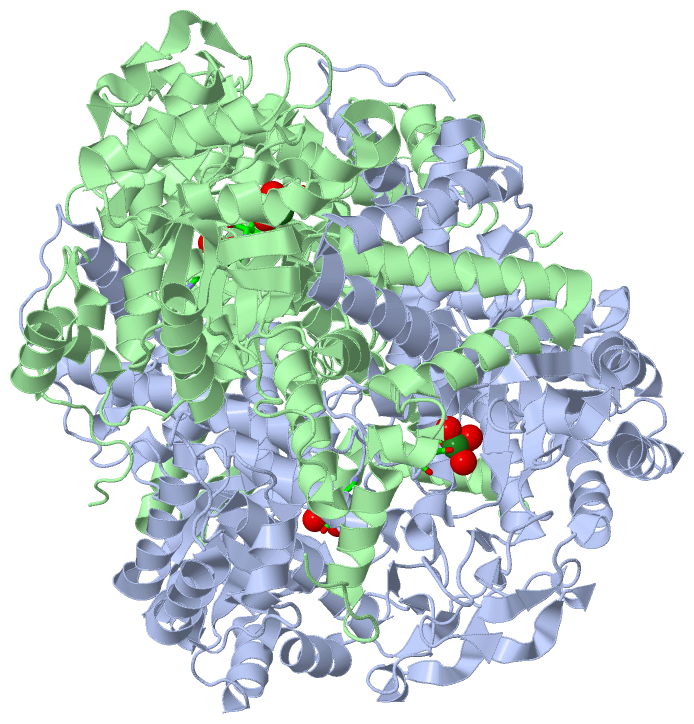
Asymmetric Unit(hide GO term definitions)
Chain A,B ( ACEA_MYCTU | P9WKK7)
| molecular function |
|---|
| | GO:0003824 | | catalytic activity | | Catalysis of a biochemical reaction at physiological temperatures. In biologically catalyzed reactions, the reactants are known as substrates, and the catalysts are naturally occurring macromolecular substances known as enzymes. Enzymes possess specific binding sites for substrates, and are usually composed wholly or largely of protein, but RNA that has catalytic activity (ribozyme) is often also regarded as enzymatic. |
| | GO:0004451 | | isocitrate lyase activity | | Catalysis of the reaction: isocitrate = glyoxylate + succinate. |
| | GO:0016829 | | lyase activity | | Catalysis of the cleavage of C-C, C-O, C-N and other bonds by other means than by hydrolysis or oxidation, or conversely adding a group to a double bond. They differ from other enzymes in that two substrates are involved in one reaction direction, but only one in the other direction. When acting on the single substrate, a molecule is eliminated and this generates either a new double bond or a new ring. |
| | GO:0046872 | | metal ion binding | | Interacting selectively and non-covalently with any metal ion. |
| | GO:0046421 | | methylisocitrate lyase activity | | Catalysis of the reaction: (2S,3R)-3-hydroxybutane-1,2,3-tricarboxylate = pyruvate + succinate. |
| | GO:0046912 | | transferase activity, transferring acyl groups, acyl groups converted into alkyl on transfer | | Catalysis of the transfer of an acyl group from one compound (donor) to another (acceptor), with the acyl group being converted into alkyl on transfer. |
| biological process |
|---|
| | GO:0019752 | | carboxylic acid metabolic process | | The chemical reactions and pathways involving carboxylic acids, any organic acid containing one or more carboxyl (COOH) groups or anions (COO-). |
| | GO:0071456 | | cellular response to hypoxia | | Any process that results in a change in state or activity of a cell (in terms of movement, secretion, enzyme production, gene expression, etc.) as a result of a stimulus indicating lowered oxygen tension. Hypoxia, defined as a decline in O2 levels below normoxic levels of 20.8 - 20.95%, results in metabolic adaptation at both the cellular and organismal level. |
| | GO:0006097 | | glyoxylate cycle | | A modification of the TCA cycle occurring in some plants and microorganisms, in which isocitrate is cleaved to glyoxylate and succinate. Glyoxylate can then react with acetyl-CoA to form malate. |
| | GO:0006102 | | isocitrate metabolic process | | The chemical reactions and pathways involving isocitrate, the anion of isocitric acid, 1-hydroxy-1,2,3-propanetricarboxylic acid. Isocitrate is an important intermediate in the TCA cycle and the glycoxylate cycle. |
| | GO:0075141 | | maintenance of symbiont tolerance to host environment | | Any process that contributes to the maintenance of a physiologic state in which the symbiont immune system does not react destructively against the components of its host organism. The host is defined as the larger of the organisms involved in a symbiotic interaction. |
| | GO:0008152 | | metabolic process | | The chemical reactions and pathways, including anabolism and catabolism, by which living organisms transform chemical substances. Metabolic processes typically transform small molecules, but also include macromolecular processes such as DNA repair and replication, and protein synthesis and degradation. |
| | GO:0009405 | | pathogenesis | | The set of specific processes that generate the ability of an organism to induce an abnormal, generally detrimental state in another organism. |
| | GO:0010034 | | response to acetate | | Any process that results in a change in state or activity of a cell or an organism (in terms of movement, secretion, enzyme production, gene expression, etc.) as a result of an acetate stimulus. |
| | GO:0001101 | | response to acid chemical | | Any process that results in a change in state or activity of a cell or an organism (in terms of movement, secretion, enzyme production, gene expression, etc.) as a result of a stimulus by the chemical structure of the anion portion of a dissociated acid (rather than the acid acting as a proton donor). The acid chemical may be in gaseous, liquid or solid form. |
| | GO:0070542 | | response to fatty acid | | Any process that results in a change in state or activity of a cell or an organism (in terms of movement, secretion, enzyme production, gene expression, etc.) as a result of a fatty acid stimulus. |
| | GO:0052572 | | response to host immune response | | Any process that results in a change in state or activity of a cell or an organism (in terms of movement, secretion, enzyme production, gene expression, etc.) as a result of detecting the immune response of the host organism. The host is defined as the larger of the organisms involved in a symbiotic interaction. |
| | GO:0006099 | | tricarboxylic acid cycle | | A nearly universal metabolic pathway in which the acetyl group of acetyl coenzyme A is effectively oxidized to two CO2 and four pairs of electrons are transferred to coenzymes. The acetyl group combines with oxaloacetate to form citrate, which undergoes successive transformations to isocitrate, 2-oxoglutarate, succinyl-CoA, succinate, fumarate, malate, and oxaloacetate again, thus completing the cycle. In eukaryotes the tricarboxylic acid is confined to the mitochondria. See also glyoxylate cycle. |
| cellular component |
|---|
| | GO:0005829 | | cytosol | | The part of the cytoplasm that does not contain organelles but which does contain other particulate matter, such as protein complexes. |
| | GO:0005886 | | plasma membrane | | The membrane surrounding a cell that separates the cell from its external environment. It consists of a phospholipid bilayer and associated proteins. |
Chain A,B ( ACEA1_MYCTO | P9WKK6)
| molecular function |
|---|
| | GO:0003824 | | catalytic activity | | Catalysis of a biochemical reaction at physiological temperatures. In biologically catalyzed reactions, the reactants are known as substrates, and the catalysts are naturally occurring macromolecular substances known as enzymes. Enzymes possess specific binding sites for substrates, and are usually composed wholly or largely of protein, but RNA that has catalytic activity (ribozyme) is often also regarded as enzymatic. |
| | GO:0004451 | | isocitrate lyase activity | | Catalysis of the reaction: isocitrate = glyoxylate + succinate. |
| | GO:0016829 | | lyase activity | | Catalysis of the cleavage of C-C, C-O, C-N and other bonds by other means than by hydrolysis or oxidation, or conversely adding a group to a double bond. They differ from other enzymes in that two substrates are involved in one reaction direction, but only one in the other direction. When acting on the single substrate, a molecule is eliminated and this generates either a new double bond or a new ring. |
| | GO:0046872 | | metal ion binding | | Interacting selectively and non-covalently with any metal ion. |
| | GO:0046421 | | methylisocitrate lyase activity | | Catalysis of the reaction: (2S,3R)-3-hydroxybutane-1,2,3-tricarboxylate = pyruvate + succinate. |
| biological process |
|---|
| | GO:0019752 | | carboxylic acid metabolic process | | The chemical reactions and pathways involving carboxylic acids, any organic acid containing one or more carboxyl (COOH) groups or anions (COO-). |
| | GO:0006097 | | glyoxylate cycle | | A modification of the TCA cycle occurring in some plants and microorganisms, in which isocitrate is cleaved to glyoxylate and succinate. Glyoxylate can then react with acetyl-CoA to form malate. |
| | GO:0008152 | | metabolic process | | The chemical reactions and pathways, including anabolism and catabolism, by which living organisms transform chemical substances. Metabolic processes typically transform small molecules, but also include macromolecular processes such as DNA repair and replication, and protein synthesis and degradation. |
| | GO:0006099 | | tricarboxylic acid cycle | | A nearly universal metabolic pathway in which the acetyl group of acetyl coenzyme A is effectively oxidized to two CO2 and four pairs of electrons are transferred to coenzymes. The acetyl group combines with oxaloacetate to form citrate, which undergoes successive transformations to isocitrate, 2-oxoglutarate, succinyl-CoA, succinate, fumarate, malate, and oxaloacetate again, thus completing the cycle. In eukaryotes the tricarboxylic acid is confined to the mitochondria. See also glyoxylate cycle. |
|

 Description