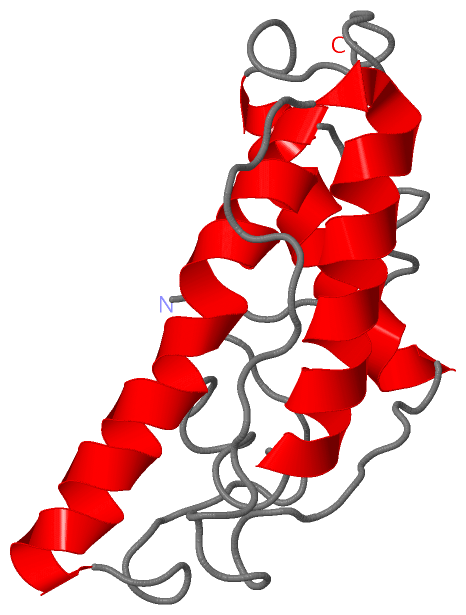
Show PDB file:   
         Plain Text   HTML   (compressed file size)
QuickSearch:   
by PDB,NDB,UniProt,PROSITE Code or Search Term(s)  
(-)Asym./Biol. Unit
collapse expand < >
Image Asym./Biol. Unit
Asym./Biol. Unit  (Jmol Viewer)

(-) Description

Title :  CRYSTAL STRUCTURE OF A PYRIMIDINE DIMER SPECIFIC EXCISION REPAIR ENZYME FROM BACTERIOPHAGE T4: REFINEMENT AT 1.45 ANGSTROMS AND X-RAY ANALYSIS OF THE THREE ACTIVE SITE MUTANTS
 
Authors :  D. G. Vassylyev, M. Ariyoshi, O. Matsumoto, K. Katayanagi, E. Ohtsuka, K. Morikawa
Date :  08 Aug 94  (Deposition) - 15 Oct 94  (Release) - 24 Feb 09  (Revision)
Method :  X-RAY DIFFRACTION
Resolution :  2.20
Chains :  Asym./Biol. Unit :  A
Keywords :  Endonuclease (Keyword Search: [Gene Ontology, PubMed, Web (Google))
 
Reference :  K. Morikawa, M. Ariyoshi, D. G. Vassylyev, O. Matsumoto, K. Katayanagi, E. Ohtsuka
Crystal Structure Of A Pyrimidine Dimer-Specific Excision Repair Enzyme From Bacteriophage T4: Refinement At 1. 45 A And X-Ray Analysis Of The Three Active Site Mutants.
J. Mol. Biol. V. 249 360 1995
PubMed-ID: 7783199  |  Reference-DOI: 10.1006/JMBI.1995.0302
(for further references see the PDB file header)

(-) Compounds

Molecule 1 - ENDONUCLEASE V
    ChainsA
    EC Number3.1.25.1
    EngineeredYES
    Organism ScientificENTEROBACTERIA PHAGE T4
    Organism Taxid10665

 Structural Features

(-) Chains, Units

  1
Asymmetric/Biological Unit A

Summary Information (see also Sequences/Alignments below)

(-) Ligands, Modified Residues, Ions  (0, 0)

(no "Ligand,Modified Residues,Ions" information available for 1ENI)

(-) Sites  (0, 0)

(no "Site" information available for 1ENI)

(-) SS Bonds  (0, 0)

(no "SS Bond" information available for 1ENI)

(-) Cis Peptide Bonds  (0, 0)

(no "Cis Peptide Bond" information available for 1ENI)

 Sequence-Structure Mapping

(-) SAPs(SNPs)/Variants  (0, 0)

(no "SAP(SNP)/Variant" information available for 1ENI)

(-) PROSITE Motifs  (0, 0)

(no "PROSITE Motif" information available for 1ENI)

(-) Exons   (0, 0)

(no "Exon" information available for 1ENI)

(-) Sequences/Alignments

Asymmetric/Biological Unit
   Reformat: Number of residues per line =  ('0' or empty: single-line sequence representation)
  Number of residues per labelling interval =   
  UniProt sequence: complete  aligned part    
   Show mapping: SCOP domains CATH domains Pfam domains Secondary structure (by author)
SAPs(SNPs) PROSITE motifs Exons
(details for a mapped element are shown in a popup box when the mouse pointer rests over it)
Chain A from PDB  Type:PROTEIN  Length:137
 aligned with END5_BPT4 | P04418 from UniProtKB/Swiss-Prot  Length:138

    Alignment length:137
                                    11        21        31        41        51        61        71        81        91       101       111       121       131       
            END5_BPT4     2 TRINLTLVSELADQHLMAEYRELPRVFGAVRKHVANGKRVRDFKISPTFILGAGHVTFFYDKLEFLRKRQIELIAECLKRGFNIKDTTVQDISDIPQEFRGDYIPHEASIAISQARLDEKIAQRPTWYKYYGKAIYA 138
               SCOP domains d1enia_ A: T4 endonuclease V                                                                                                              SCOP domains
               CATH domains 1eniA00 A:2-138 Endonuclease V                                                                                                            CATH domains
               Pfam domains ----------------------------------------------------------------------------------------------------------------------------------------- Pfam domains
         Sec.struct. author ............hhhhhhhhhhhhhhhhhhhhhhhhh.........................hhhhhhhhhhhhhhhhhhh.........................hhhhhhhhhhhhhhhhh.............. Sec.struct. author
                 SAPs(SNPs) ----------------------------------------------------------------------------------------------------------------------------------------- SAPs(SNPs)
                    PROSITE ----------------------------------------------------------------------------------------------------------------------------------------- PROSITE
                 Transcript ----------------------------------------------------------------------------------------------------------------------------------------- Transcript
                 1eni A   2 TQINLTLVSELADQHLMAEYRELPRVFGAVRKHVANGKRVRDFKISPTFILGAGHVTFFYDKLEFLRKRQIELIAECLKRGFNIKDTTVQDISDIPQEFRGDYIPHEASIAISQARLDEKIAQRPTWYKYYGKAIYA 138
                                    11        21        31        41        51        61        71        81        91       101       111       121       131       

   Legend:   → Mismatch (orange background)
  - → Gap (green background, '-', border residues have a numbering label)
    → Modified Residue (blue background, lower-case, 'x' indicates undefined single-letter code, labelled with number + name)
  x → Chemical Group (purple background, 'x', labelled with number + name, e.g. ACE or NH2)
  extra numbering lines below/above indicate numbering irregularities and modified residue names etc., number ends below/above '|'

 Classification and Annotation

(-) SCOP Domains  (1, 1)

Asymmetric/Biological Unit

(-) CATH Domains  (1, 1)

Asymmetric/Biological Unit

(-) Pfam Domains  (0, 0)

(no "Pfam Domain" information available for 1ENI)

(-) Gene Ontology  (13, 13)

Asymmetric/Biological Unit(hide GO term definitions)
Chain A   (END5_BPT4 | P04418)
molecular function
    GO:0003906    DNA-(apurinic or apyrimidinic site) lyase activity    Catalysis of the cleavage of the C-O-P bond 3' to the apurinic or apyrimidinic site in DNA by a beta-elimination reaction, leaving a 3'-terminal unsaturated sugar and a product with a terminal 5'-phosphate.
    GO:0003824    catalytic activity    Catalysis of a biochemical reaction at physiological temperatures. In biologically catalyzed reactions, the reactants are known as substrates, and the catalysts are naturally occurring macromolecular substances known as enzymes. Enzymes possess specific binding sites for substrates, and are usually composed wholly or largely of protein, but RNA that has catalytic activity (ribozyme) is often also regarded as enzymatic.
    GO:0033959    deoxyribodipyrimidine endonucleosidase activity    Catalysis of the cleavage of the N-glycosidic bond between the 5'-pyrimidine residue in cyclobutadipyrimidine (in DNA) and the corresponding deoxy-D-ribose residue.
    GO:0004519    endonuclease activity    Catalysis of the hydrolysis of ester linkages within nucleic acids by creating internal breaks.
    GO:0016787    hydrolase activity    Catalysis of the hydrolysis of various bonds, e.g. C-O, C-N, C-C, phosphoric anhydride bonds, etc. Hydrolase is the systematic name for any enzyme of EC class 3.
    GO:0016798    hydrolase activity, acting on glycosyl bonds    Catalysis of the hydrolysis of any glycosyl bond.
    GO:0016829    lyase activity    Catalysis of the cleavage of C-C, C-O, C-N and other bonds by other means than by hydrolysis or oxidation, or conversely adding a group to a double bond. They differ from other enzymes in that two substrates are involved in one reaction direction, but only one in the other direction. When acting on the single substrate, a molecule is eliminated and this generates either a new double bond or a new ring.
    GO:0004518    nuclease activity    Catalysis of the hydrolysis of ester linkages within nucleic acids.
    GO:0000704    pyrimidine dimer DNA N-glycosylase activity    Catalysis of the removal of pyrimidine dimers by removing the 5' pyrimidine of the dimer by cleaving the N-C1' glycosidic bond between the 5' pyrimidine of the dimer and the deoxyribose sugar. The reaction releases the 5' pyrimidine of the dimer and leaves an apurinic (AP) site. The reaction involves the formation of a covalent enzyme substrate intermediate. Release of the enzyme and free base by a beta-elimination or a beta, gamma-elimination mechanism results in the cleavage of the DNA backbone 3' of the apyrimidinic (AP) site.
biological process
    GO:0006281    DNA repair    The process of restoring DNA after damage. Genomes are subject to damage by chemical and physical agents in the environment (e.g. UV and ionizing radiations, chemical mutagens, fungal and bacterial toxins, etc.) and by free radicals or alkylating agents endogenously generated in metabolism. DNA is also damaged because of errors during its replication. A variety of different DNA repair pathways have been reported that include direct reversal, base excision repair, nucleotide excision repair, photoreactivation, bypass, double-strand break repair pathway, and mismatch repair pathway.
    GO:0006974    cellular response to DNA damage stimulus    Any process that results in a change in state or activity of a cell (in terms of movement, secretion, enzyme production, gene expression, etc.) as a result of a stimulus indicating damage to its DNA from environmental insults or errors during metabolism.
    GO:0008152    metabolic process    The chemical reactions and pathways, including anabolism and catabolism, by which living organisms transform chemical substances. Metabolic processes typically transform small molecules, but also include macromolecular processes such as DNA repair and replication, and protein synthesis and degradation.
    GO:0090305    nucleic acid phosphodiester bond hydrolysis    The nucleic acid metabolic process in which the phosphodiester bonds between nucleotides are cleaved by hydrolysis.

 Visualization

(-) Interactive Views

Asymmetric/Biological Unit
  Complete Structure
    Jena3D(integrated viewing of ligand, site, SAP, PROSITE, SCOP information)
    WebMol | AstexViewer[tm]@PDBe
(Java Applets, require no local installation except for Java; loading may be slow)
    STRAP
(Java WebStart application, automatic local installation, requires Java; full application with system access!)
    RasMol
(require local installation)
    Molscript (VRML)
(requires installation of a VRML viewer; select preferred view via VRML and generate a mono or stereo PDF format file)
 
  Ligands, Modified Residues, Ions
(no "Ligands, Modified Residues, Ions" information available for 1eni)
 
  Sites
(no "Sites" information available for 1eni)
 
  Cis Peptide Bonds
(no "Cis Peptide Bonds" information available for 1eni)
 

(-) Still Images

Jmol
  protein: cartoon or spacefill or dots and stick; nucleic acid: cartoon and stick; ligands: spacefill; active site: stick
Molscript
  protein, nucleic acid: cartoon; ligands: spacefill; active site: ball and stick

 Databases and Analysis Tools

(-) Databases

Access by PDB/NDB ID
  1eni
    Family and Domain InformationProDom | SYSTERS
    General Structural InformationGlycoscienceDB | MMDB | NDB | OCA | PDB | PDBe | PDBj | PDBsum | PDBWiki | PQS | PROTEOPEDIA
    Orientation in MembranesOPM
    Protein SurfaceSURFACE
    Secondary StructureDSSP (structure derived) | HSSP (homology derived)
    Structural GenomicsGeneCensus
    Structural NeighboursCE | VAST
    Structure ClassificationCATH | Dali | SCOP
    Validation and Original DataBMRB Data View | BMRB Restraints Grid | EDS | PROCHECK | RECOORD | WHAT_CHECK
 
Access by UniProt ID/Accession number
  END5_BPT4 | P04418
    Comparative Protein Structure ModelsModBase
    Genomic InformationEnsembl
    Protein-protein InteractionDIP
    Sequence, Family and Domain InformationInterPro | Pfam | SMART | UniProtKB/SwissProt
 
Access by Enzyme Classificator   (EC Number)
  3.1.25.1
    General Enzyme InformationBRENDA | EC-PDB | Enzyme | IntEnz
    PathwayKEGG | MetaCyc
 
Access by Disease Identifier   (MIM ID)
  (no 'MIM ID' available)
    Disease InformationOMIM
 
Access by GenAge ID
  (no 'GenAge ID' available)
    Age Related InformationGenAge

(-) Analysis Tools

Access by PDB/NDB ID
    Domain InformationXDom
    Interatomic Contacts of Structural UnitsCSU
    Ligand-protein ContactsLPC
    Protein CavitiescastP
    Sequence and Secondary StructurePDBCartoon
    Structure AlignmentSTRAP(Java WebStart application, automatic local installation, requires Java; full application with system access!)
    Structure and Sequence BrowserSTING
 
Access by UniProt ID/Accession number
  END5_BPT4 | P04418
    Protein Disorder PredictionDisEMBL | FoldIndex | GLOBPLOT (for more information see DisProt)

 Related Entries

(-) Entries Sharing at Least One Protein Chain (UniProt ID)

UniProtKB/Swiss-Prot
        END5_BPT4 | P044181enj 1enk 1vas 2end 2fcc

(-) Related Entries Specified in the PDB File

(no "Related Entries Specified in the PDB File" available for 1ENI)