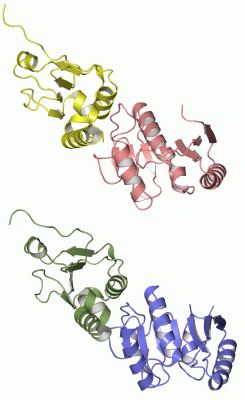
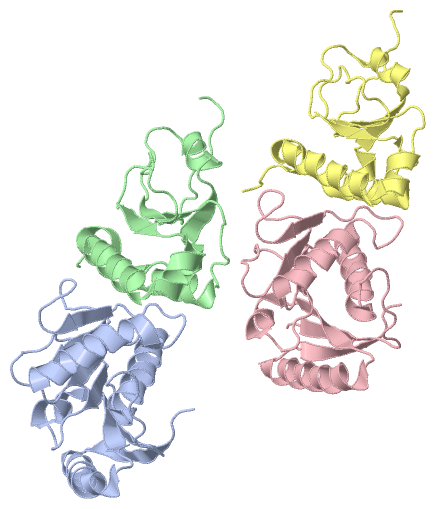
Asymmetric Unit(hide GO term definitions)
Chain A,C ( HOLC_ECOLI | P28905)
| molecular function |
|---|
| | GO:0003677 | | DNA binding | | Any molecular function by which a gene product interacts selectively and non-covalently with DNA (deoxyribonucleic acid). |
| | GO:0003887 | | DNA-directed DNA polymerase activity | | Catalysis of the reaction: deoxynucleoside triphosphate + DNA(n) = diphosphate + DNA(n+1); the synthesis of DNA from deoxyribonucleotide triphosphates in the presence of a DNA template and a 3'hydroxyl group. |
| | GO:0016779 | | nucleotidyltransferase activity | | Catalysis of the transfer of a nucleotidyl group to a reactant. |
| | GO:0005515 | | protein binding | | Interacting selectively and non-covalently with any protein or protein complex (a complex of two or more proteins that may include other nonprotein molecules). |
| | GO:0016740 | | transferase activity | | Catalysis of the transfer of a group, e.g. a methyl group, glycosyl group, acyl group, phosphorus-containing, or other groups, from one compound (generally regarded as the donor) to another compound (generally regarded as the acceptor). Transferase is the systematic name for any enzyme of EC class 2. |
| biological process |
|---|
| | GO:0071897 | | DNA biosynthetic process | | The cellular DNA metabolic process resulting in the formation of DNA, deoxyribonucleic acid, one of the two main types of nucleic acid, consisting of a long unbranched macromolecule formed from one or two strands of linked deoxyribonucleotides, the 3'-phosphate group of each constituent deoxyribonucleotide being joined in 3',5'-phosphodiester linkage to the 5'-hydroxyl group of the deoxyribose moiety of the next one. |
| | GO:0006260 | | DNA replication | | The cellular metabolic process in which a cell duplicates one or more molecules of DNA. DNA replication begins when specific sequences, known as origins of replication, are recognized and bound by initiation proteins, and ends when the original DNA molecule has been completely duplicated and the copies topologically separated. The unit of replication usually corresponds to the genome of the cell, an organelle, or a virus. The template for replication can either be an existing DNA molecule or RNA. |
| | GO:0032298 | | positive regulation of DNA-dependent DNA replication initiation | | Any process that activates or increases the frequency, rate or extent of initiation of DNA-dependent DNA replication. |
| cellular component |
|---|
| | GO:0043847 | | DNA polymerase III, clamp loader chi/psi subcomplex | | A dimer composed of the chi and psi subunits which is a subassembly of the DNA polymerase III clamp loader complex and serves as a bridge between the DnaX complex and the single-stranded DNA-binding protein (SSB). |
Chain B,D ( HOLD_ECOLI | P28632)
| molecular function |
|---|
| | GO:0008408 | | 3'-5' exonuclease activity | | Catalysis of the hydrolysis of ester linkages within nucleic acids by removing nucleotide residues from the 3' end. |
| | GO:0003887 | | DNA-directed DNA polymerase activity | | Catalysis of the reaction: deoxynucleoside triphosphate + DNA(n) = diphosphate + DNA(n+1); the synthesis of DNA from deoxyribonucleotide triphosphates in the presence of a DNA template and a 3'hydroxyl group. |
| | GO:0016779 | | nucleotidyltransferase activity | | Catalysis of the transfer of a nucleotidyl group to a reactant. |
| | GO:0005515 | | protein binding | | Interacting selectively and non-covalently with any protein or protein complex (a complex of two or more proteins that may include other nonprotein molecules). |
| | GO:0016740 | | transferase activity | | Catalysis of the transfer of a group, e.g. a methyl group, glycosyl group, acyl group, phosphorus-containing, or other groups, from one compound (generally regarded as the donor) to another compound (generally regarded as the acceptor). Transferase is the systematic name for any enzyme of EC class 2. |
| biological process |
|---|
| | GO:0071897 | | DNA biosynthetic process | | The cellular DNA metabolic process resulting in the formation of DNA, deoxyribonucleic acid, one of the two main types of nucleic acid, consisting of a long unbranched macromolecule formed from one or two strands of linked deoxyribonucleotides, the 3'-phosphate group of each constituent deoxyribonucleotide being joined in 3',5'-phosphodiester linkage to the 5'-hydroxyl group of the deoxyribose moiety of the next one. |
| | GO:0006260 | | DNA replication | | The cellular metabolic process in which a cell duplicates one or more molecules of DNA. DNA replication begins when specific sequences, known as origins of replication, are recognized and bound by initiation proteins, and ends when the original DNA molecule has been completely duplicated and the copies topologically separated. The unit of replication usually corresponds to the genome of the cell, an organelle, or a virus. The template for replication can either be an existing DNA molecule or RNA. |
| | GO:0090305 | | nucleic acid phosphodiester bond hydrolysis | | The nucleic acid metabolic process in which the phosphodiester bonds between nucleotides are cleaved by hydrolysis. |
|

 Description