Show PDB file:   
         Plain Text   HTML   (compressed file size)
QuickSearch:   
by PDB,NDB,UniProt,PROSITE Code or Search Term(s)  
(-)NMR Structure - model 1
(-)NMR Structure - all models
collapse expand < >
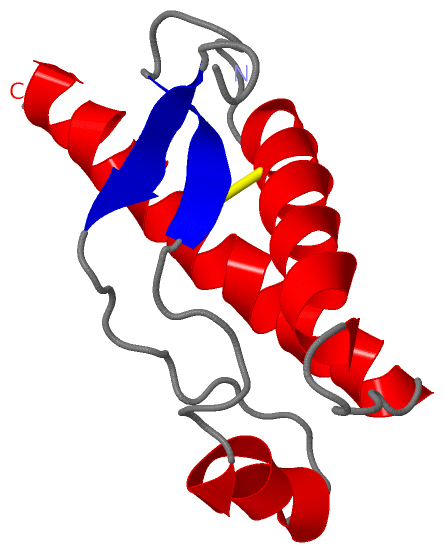
Image NMR Structure - model 1
NMR Structure - model 1  (Jmol Viewer)
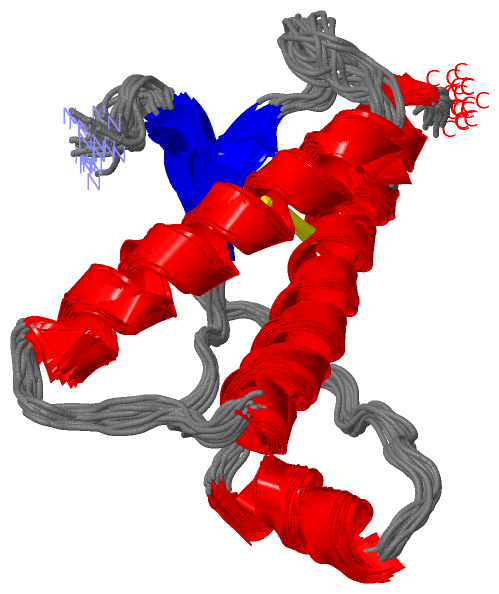
Image NMR Structure - all models
NMR Structure - all models  (Jmol Viewer)

(-) Description

Title :  BOVINE PRION PROTEIN FRAGMENT 121-230
 
Authors :  F. Lopez-Garcia, R. Zahn, R. Riek, M. Billeter, K. Wuthrich
Date :  15 Dec 99  (Deposition) - 13 Feb 07  (Release) - 24 Feb 09  (Revision)
Method :  SOLUTION NMR
Resolution :  NOT APPLICABLE
Chains :  NMR Structure  :  A  (20x)
Keywords :  Prion Protein, Prion, Brain, Repeat (Keyword Search: [Gene Ontology, PubMed, Web (Google))
 
Reference :  F. Lopez-Garcia, R. Zahn, R. Riek, K. Wuthrich
Nmr Structure Of The Bovine Prion Protein
Proc. Natl. Acad. Sci. Usa V. 97 8334 2000
PubMed-ID: 10899999  |  Reference-DOI: 10.1073/PNAS.97.15.8334

(-) Compounds

Molecule 1 - PRION PROTEIN
    Cellular LocationEXTRACELLULAR
    ChainsA
    EngineeredYES
    Expression SystemESCHERICHIA COLI
    Expression System Cellular LocationCYTOPLASM
    Expression System PlasmidPRSET A
    Expression System StrainBL21(DE3)
    Expression System Taxid469008
    FragmentRESIDUES 121-230
    GenePRNP
    MutationYES
    OrganBRAIN
    Organism CommonBOVINE
    Organism ScientificBOS TAURUS
    Organism Taxid9913
    SynonymPRP, MAJOR PRION PROTEIN

 Structural Features

(-) Chains, Units

  
NMR Structure (20x)

Summary Information (see also Sequences/Alignments below)

(-) Ligands, Modified Residues, Ions  (0, 0)

(no "Ligand,Modified Residues,Ions" information available for 1DWZ)

(-) Sites  (0, 0)

(no "Site" information available for 1DWZ)

(-) SS Bonds  (1, 1)

NMR Structure
No.Residues
1A:179 -A:214

(-) Cis Peptide Bonds  (0, 0)

(no "Cis Peptide Bond" information available for 1DWZ)

 Sequence-Structure Mapping

(-) SAPs(SNPs)/Variants  (3, 3)

NMR Structure (3, 3)
  dbSNPPDB
No.SourceVariant IDVariantUniProt IDStatusIDChainVariant
1UniProtVAR_PRIO_BOVIN_003 *S154NPRIO_BOVIN  ---  ---AS143N
2UniProtVAR_PRIO_BOVIN_004 *E211KPRIO_BOVIN  ---  ---AE200K
3UniProtVAR_PRIO_BOVIN_005 *Q234RPRIO_BOVIN  ---  ---AQ223R
   * ID not provided by source

  SNP/SAP Summary Statistics (UniProtKB/Swiss-Prot)

(-) PROSITE Motifs  (1, 1)

NMR Structure (1, 1)
 PROSITEUniProtKBPDB
No.IDACDescriptionIDLocationCountLocation
1PRION_2PS00706 Prion protein signature 2.PRIO_BOVIN211-229  1A:200-218

(-) Exons   (1, 1)

NMR Structure (1, 1)
 ENSEMBLUniProtKBPDB
No.Transcript IDExonExon IDGenome LocationLengthIDLocationLengthCountLocationLength
1.1ENSBTAT000000402921ENSBTAE00000340808chr13:47214467-4721451953PRIO_BOVIN-00--
1.2ENSBTAT000000402922ENSBTAE00000340806chr13:47216955-4721705298PRIO_BOVIN-00--
1.3ENSBTAT000000402923ENSBTAE00000310243chr13:47230279-472343694091PRIO_BOVIN1-2682681A:124-227104

(-) Sequences/Alignments

NMR Structure
   Reformat: Number of residues per line =  ('0' or empty: single-line sequence representation)
  Number of residues per labelling interval =   
  UniProt sequence: complete  aligned part    
   Show mapping: SCOP domains CATH domains Pfam domains Secondary structure (by author)
SAPs(SNPs) PROSITE motifs Exons
(details for a mapped element are shown in a popup box when the mouse pointer rests over it)
Chain A from PDB  Type:PROTEIN  Length:104
 aligned with PRIO_BOVIN | P10279 from UniProtKB/Swiss-Prot  Length:264

    Alignment length:104
                                   144       154       164       174       184       194       204       214       224       234    
           PRIO_BOVIN   135 GLGGYMLGSAMSRPLIHFGSDYEDRYYRENMHRYPNQVYYRPVDQYSNQNNFVHDCVNITVKEHTVTTTTKGENFTETDIKMMERVVEQMCITQYQRESQAYYQ 238
               SCOP domains d1dwza_ A: Prion protein domain                                                                          SCOP domains
               CATH domains 1dwzA00 A:124-227 Major Prion Protein                                                                    CATH domains
               Pfam domains -------------------------------------------------------------------------------------------------------- Pfam domains
         Sec.struct. author ....eeee............hhhhhhhhh........eeee........hhhhhhhhhhhhhhhhhhhh.......hhhhhhhhhhhhhhhhhhhhhhhhhh.. Sec.struct. author
                 SAPs(SNPs) -------------------N--------------------------------------------------------K----------------------R---- SAPs(SNPs)
                    PROSITE ----------------------------------------------------------------------------PRION_2            --------- PROSITE
               Transcript 1 Exon 1.3  PDB: A:124-227 UniProt: 1-268 [INCOMPLETE]                                                     Transcript 1
                 1dwz A 124 GLGGYMLGSAMSRPLIHFGSDYEDRYYRENMHRYPNQVYYRPVDQYSNQNNFVHDCVNITVKEHTVTTTTKGENFTETDIKMMERVVEQMCITQYQRESQAYYQ 227
                                   133       143       153       163       173       183       193       203       213       223    

   Legend:   → Mismatch (orange background)
  - → Gap (green background, '-', border residues have a numbering label)
    → Modified Residue (blue background, lower-case, 'x' indicates undefined single-letter code, labelled with number + name)
  x → Chemical Group (purple background, 'x', labelled with number + name, e.g. ACE or NH2)
  extra numbering lines below/above indicate numbering irregularities and modified residue names etc., number ends below/above '|'

 Classification and Annotation

(-) SCOP Domains  (1, 1)

NMR Structure

(-) CATH Domains  (1, 1)

NMR Structure

(-) Pfam Domains  (0, 0)

(no "Pfam Domain" information available for 1DWZ)

(-) Gene Ontology  (29, 29)

NMR Structure(hide GO term definitions)
Chain A   (PRIO_BOVIN | P10279)
molecular function
    GO:0005507    copper ion binding    Interacting selectively and non-covalently with copper (Cu) ions.
    GO:0042802    identical protein binding    Interacting selectively and non-covalently with an identical protein or proteins.
    GO:0046872    metal ion binding    Interacting selectively and non-covalently with any metal ion.
    GO:0008017    microtubule binding    Interacting selectively and non-covalently with microtubules, filaments composed of tubulin monomers.
    GO:0005515    protein binding    Interacting selectively and non-covalently with any protein or protein complex (a complex of two or more proteins that may include other nonprotein molecules).
    GO:0015631    tubulin binding    Interacting selectively and non-covalently with monomeric or multimeric forms of tubulin, including microtubules.
biological process
    GO:0071280    cellular response to copper ion    Any process that results in a change in state or activity of a cell (in terms of movement, secretion, enzyme production, gene expression, etc.) as a result of a copper ion stimulus.
    GO:0035690    cellular response to drug    Any process that results in a change in state or activity of a cell (in terms of movement, secretion, enzyme production, gene expression, etc.) as a result of a drug stimulus. A drug is a substance used in the diagnosis, treatment or prevention of a disease.
    GO:0050860    negative regulation of T cell receptor signaling pathway    Any process that stops, prevents, or reduces the frequency, rate or extent of signaling pathways initiated by the cross-linking of an antigen receptor on a T cell.
    GO:0046007    negative regulation of activated T cell proliferation    Any process that stops, prevents or reduces the rate or extent of activated T cell proliferation.
    GO:0043066    negative regulation of apoptotic process    Any process that stops, prevents, or reduces the frequency, rate or extent of cell death by apoptotic process.
    GO:0070885    negative regulation of calcineurin-NFAT signaling cascade    Any process that stops, prevents, or reduces the frequency, rate or extent of the calcineurin-NFAT signaling cascade.
    GO:0032689    negative regulation of interferon-gamma production    Any process that stops, prevents, or reduces the frequency, rate, or extent of interferon-gamma production. Interferon-gamma is also known as type II interferon.
    GO:0032700    negative regulation of interleukin-17 production    Any process that stops, prevents, or reduces the frequency, rate, or extent of production of any member of the interleukin-17 family of cytokines.
    GO:0032703    negative regulation of interleukin-2 production    Any process that stops, prevents, or reduces the frequency, rate, or extent of interleukin-2 production.
    GO:0001933    negative regulation of protein phosphorylation    Any process that stops, prevents or reduces the rate of addition of phosphate groups to amino acids within a protein.
    GO:0043433    negative regulation of sequence-specific DNA binding transcription factor activity    Any process that stops, prevents, or reduces the frequency, rate or extent of the activity of a transcription factor, any factor involved in the initiation or regulation of transcription.
    GO:0051260    protein homooligomerization    The process of creating protein oligomers, compounds composed of a small number, usually between three and ten, of identical component monomers. Oligomers may be formed by the polymerization of a number of monomers or the depolymerization of a large protein polymer.
    GO:1901379    regulation of potassium ion transmembrane transport    Any process that modulates the frequency, rate or extent of potassium ion transmembrane transport.
    GO:0032880    regulation of protein localization    Any process that modulates the frequency, rate or extent of any process in which a protein is transported to, or maintained in, a specific location.
    GO:0006979    response to oxidative stress    Any process that results in a change in state or activity of a cell or an organism (in terms of movement, secretion, enzyme production, gene expression, etc.) as a result of oxidative stress, a state often resulting from exposure to high levels of reactive oxygen species, e.g. superoxide anions, hydrogen peroxide (H2O2), and hydroxyl radicals.
cellular component
    GO:0005794    Golgi apparatus    A compound membranous cytoplasmic organelle of eukaryotic cells, consisting of flattened, ribosome-free vesicles arranged in a more or less regular stack. The Golgi apparatus differs from the endoplasmic reticulum in often having slightly thicker membranes, appearing in sections as a characteristic shallow semicircle so that the convex side (cis or entry face) abuts the endoplasmic reticulum, secretory vesicles emerging from the concave side (trans or exit face). In vertebrate cells there is usually one such organelle, while in invertebrates and plants, where they are known usually as dictyosomes, there may be several scattered in the cytoplasm. The Golgi apparatus processes proteins produced on the ribosomes of the rough endoplasmic reticulum; such processing includes modification of the core oligosaccharides of glycoproteins, and the sorting and packaging of proteins for transport to a variety of cellular locations. Three different regions of the Golgi are now recognized both in terms of structure and function: cis, in the vicinity of the cis face, trans, in the vicinity of the trans face, and medial, lying between the cis and trans regions.
    GO:0031225    anchored component of membrane    The component of a membrane consisting of the gene products that are tethered to the membrane only by a covalently attached anchor, such as a lipid group that is embedded in the membrane. Gene products with peptide sequences that are embedded in the membrane are excluded from this grouping.
    GO:0009986    cell surface    The external part of the cell wall and/or plasma membrane.
    GO:0005783    endoplasmic reticulum    The irregular network of unit membranes, visible only by electron microscopy, that occurs in the cytoplasm of many eukaryotic cells. The membranes form a complex meshwork of tubular channels, which are often expanded into slitlike cavities called cisternae. The ER takes two forms, rough (or granular), with ribosomes adhering to the outer surface, and smooth (with no ribosomes attached).
    GO:0070062    extracellular exosome    A vesicle that is released into the extracellular region by fusion of the limiting endosomal membrane of a multivesicular body with the plasma membrane. Extracellular exosomes, also simply called exosomes, have a diameter of about 40-100 nm.
    GO:0016020    membrane    A lipid bilayer along with all the proteins and protein complexes embedded in it an attached to it.
    GO:0045121    membrane raft    Any of the small (10-200 nm), heterogeneous, highly dynamic, sterol- and sphingolipid-enriched membrane domains that compartmentalize cellular processes. Small rafts can sometimes be stabilized to form larger platforms through protein-protein and protein-lipid interactions.
    GO:0005886    plasma membrane    The membrane surrounding a cell that separates the cell from its external environment. It consists of a phospholipid bilayer and associated proteins.

 Visualization

(-) Interactive Views

NMR Structure
  Complete Structure
    Jena3D(integrated viewing of ligand, site, SAP, PROSITE, SCOP information)
    WebMol | AstexViewer[tm]@PDBe
(Java Applets, require no local installation except for Java; loading may be slow)
    STRAP
(Java WebStart application, automatic local installation, requires Java; full application with system access!)
    RasMol
(require local installation)
    Molscript (VRML)
(requires installation of a VRML viewer; select preferred view via VRML and generate a mono or stereo PDF format file)
 
  Ligands, Modified Residues, Ions
(no "Ligands, Modified Residues, Ions" information available for 1dwz)
 
  Sites
(no "Sites" information available for 1dwz)
 
  Cis Peptide Bonds
(no "Cis Peptide Bonds" information available for 1dwz)
 

(-) Still Images

Jmol
  protein: cartoon or spacefill or dots and stick; nucleic acid: cartoon and stick; ligands: spacefill; active site: stick
Molscript
  protein, nucleic acid: cartoon; ligands: spacefill; active site: ball and stick

 Databases and Analysis Tools

(-) Databases

Access by PDB/NDB ID
  1dwz
    Family and Domain InformationProDom | SYSTERS
    General Structural InformationGlycoscienceDB | MMDB | NDB | OCA | PDB | PDBe | PDBj | PDBsum | PDBWiki | PQS | PROTEOPEDIA
    Orientation in MembranesOPM
    Protein SurfaceSURFACE
    Secondary StructureDSSP (structure derived) | HSSP (homology derived)
    Structural GenomicsGeneCensus
    Structural NeighboursCE | VAST
    Structure ClassificationCATH | Dali | SCOP
    Validation and Original DataBMRB Data View | BMRB Restraints Grid | EDS | PROCHECK | RECOORD | WHAT_CHECK
 
Access by UniProt ID/Accession number
  PRIO_BOVIN | P10279
    Comparative Protein Structure ModelsModBase
    Genomic InformationEnsembl
    Protein-protein InteractionDIP
    Sequence, Family and Domain InformationInterPro | Pfam | SMART | UniProtKB/SwissProt
 
Access by Enzyme Classificator   (EC Number)
  (no 'Enzyme Classificator' available)
    General Enzyme InformationBRENDA | EC-PDB | Enzyme | IntEnz
    PathwayKEGG | MetaCyc
 
Access by Disease Identifier   (MIM ID)
  (no 'MIM ID' available)
    Disease InformationOMIM
 
Access by GenAge ID
  (no 'GenAge ID' available)
    Age Related InformationGenAge

(-) Analysis Tools

Access by PDB/NDB ID
    Domain InformationXDom
    Interatomic Contacts of Structural UnitsCSU
    Ligand-protein ContactsLPC
    Protein CavitiescastP
    Sequence and Secondary StructurePDBCartoon
    Structure AlignmentSTRAP(Java WebStart application, automatic local installation, requires Java; full application with system access!)
    Structure and Sequence BrowserSTING
 
Access by UniProt ID/Accession number
  PRIO_BOVIN | P10279
    Protein Disorder PredictionDisEMBL | FoldIndex | GLOBPLOT (for more information see DisProt)

 Related Entries

(-) Entries Sharing at Least One Protein Chain (UniProt ID)

UniProtKB/Swiss-Prot
        PRIO_BOVIN | P102791dwy 1dx0 1dx1 1skh 2hh0 2rsk 2ru7 4yx2

(-) Related Entries Specified in the PDB File

1ag2 PRION PROTEIN DOMAIN PRP(121-231) FROM MOUSE, NMR, MINIMIZED AVERAGE STRUCTURE
1b10 SOLUTION NMR STRUCTURE OF RECOMBINANT SYRIAN HAMSTER PRION PROTEIN RPRP(90-231), 25 STRUCTURES
1dwy BOVINE PRION PROTEIN FRAGMENT 121-230 NMR,REPRESENTATIVE MINIMIZED STRUCTURE
1dx0 BOVINE PRION PROTEIN NMR, REPRESENTATIVE MINIMIZED STRUCTURE
1dx1 BOVINE PRION PROTEIN NMR, 20 STRUCTURES
1qlx HUMAN PRION PROTEIN RESIDUES 23-230 NMR, REPRESENTATIVE STRUCTURE
1qm0 HUMAN PRION PROTEIN FRAGMENT 90-230 NMR, REPRESENTATIVE STRUCTURE
1qm1 HUMAN PRION PROTEIN FRAGMENT 90-230 NMR, 20 STRUCTURES
1qm2 HUMAN PRION PROTEIN FRAGMENT 121-230 NMR, REPRESENTATIVE STRUCTURE
1qm3 HUMAN PRION PROTEIN FRAGMENT 121-230 NMR, 20 STRUCTURES