Show PDB file:   
         Plain Text   HTML   (compressed file size)
QuickSearch:   
by PDB,NDB,UniProt,PROSITE Code or Search Term(s)  
(-)Asymmetric Unit
(-)Biological Unit 1
(-)Biological Unit 2
collapse expand < >
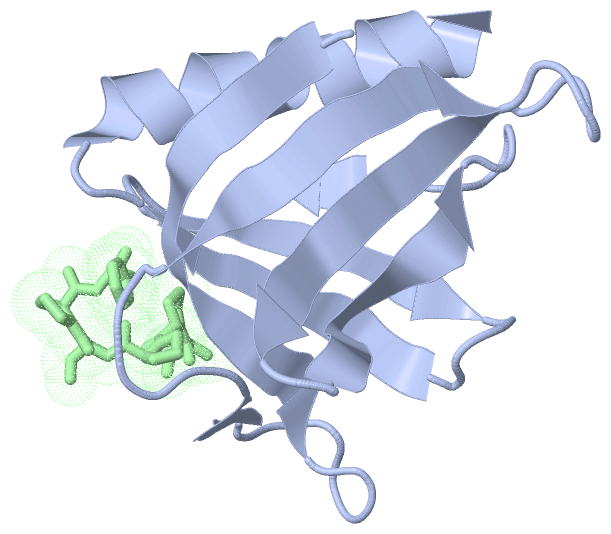
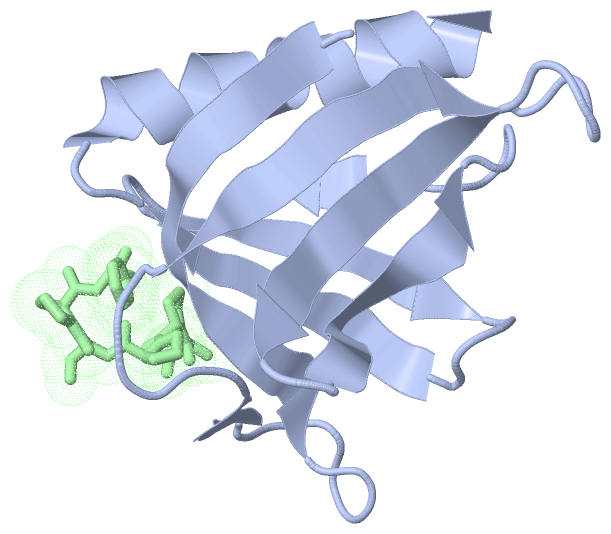
Image Asymmetric Unit
Asymmetric Unit  (Jmol Viewer)
Image Biological Unit 1
Biological Unit 1  (Jmol Viewer)
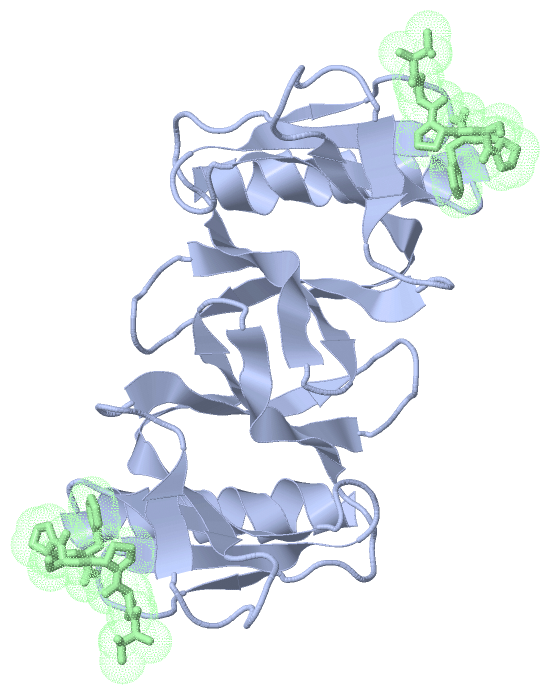
Image Biological Unit 2
Biological Unit 2  (Jmol Viewer)

(-) Description

Title :  CRYSTAL STRUCTURE OF THE HOMER EVH1 DOMAIN WITH BOUND MGLUR PEPTIDE
 
Authors :  J. Beneken, J. C. Tu, B. Xiao, P. F. Worley, D. J. Leahy
Date :  11 Nov 99  (Deposition) - 10 May 00  (Release) - 24 Feb 09  (Revision)
Method :  X-RAY DIFFRACTION
Resolution :  1.90
Chains :  Asym. Unit :  A,B
Biol. Unit 1:  A,B  (1x)
Biol. Unit 2:  A,B  (2x)
Keywords :  Protein-Ligand Complex, Polyproline Recognition, Beta Turn, Signaling Protein (Keyword Search: [Gene Ontology, PubMed, Web (Google))
 
Reference :  J. Beneken, J. C. Tu, B. Xiao, M. Nuriya, J. P. Yuan, P. F. Worley, D. J. Leahy
Structure Of The Homer Evh1 Domain-Peptide Complex Reveals A New Twist In Polyproline Recognition.
Neuron V. 26 143 2000
PubMed-ID: 10798399  |  Reference-DOI: 10.1016/S0896-6273(00)81145-9
(for further references see the PDB file header)

(-) Compounds

Molecule 1 - GLGF-DOMAIN PROTEIN HOMER
    ChainsA
    EngineeredYES
    Expression SystemESCHERICHIA COLI
    Expression System PlasmidPGEX
    Expression System Taxid562
    Expression System Vector TypePLASMID
    FragmentHOMER EVH1 RESIDUES 1-111
    OrganBRAIN
    Organism CommonNORWAY RAT
    Organism ScientificRATTUS NORVEGICUS
    Organism Taxid10116
 
Molecule 2 - METABOTROPIC GLUTAMATE RECEPTOR MGLUR5
    ChainsB
    EngineeredYES
    FragmentMGLUR DERIVED PEPTIDE TPPSPF
    Other DetailsTHIS PEPTIDE WAS CHEMICALLY SYNTHESIZED. THE SEQUENCE OF THIS PEPTIDE NATURALLY OCCURS IN NORWAY RAT (RATTUS NORVEGICUS)
    SyntheticYES

 Structural Features

(-) Chains, Units

  12
Asymmetric Unit AB
Biological Unit 1 (1x)AB
Biological Unit 2 (2x)AB

Summary Information (see also Sequences/Alignments below)

(-) Ligands, Modified Residues, Ions  (0, 0)

(no "Ligand,Modified Residues,Ions" information available for 1DDV)

(-) Sites  (0, 0)

(no "Site" information available for 1DDV)

(-) SS Bonds  (0, 0)

(no "SS Bond" information available for 1DDV)

(-) Cis Peptide Bonds  (1, 1)

Asymmetric Unit
No.Residues
1Ser B:1004 -Pro B:1005

 Sequence-Structure Mapping

(-) SAPs(SNPs)/Variants  (0, 0)

(no "SAP(SNP)/Variant" information available for 1DDV)

(-) PROSITE Motifs  (0, 0)

(no "PROSITE Motif" information available for 1DDV)

(-) Exons   (0, 0)

(no "Exon" information available for 1DDV)

(-) Sequences/Alignments

Asymmetric Unit
   Reformat: Number of residues per line =  ('0' or empty: single-line sequence representation)
  Number of residues per labelling interval =   
  UniProt sequence: complete  aligned part    
   Show mapping: SCOP domains CATH domains Pfam domains Secondary structure (by author)
SAPs(SNPs) PROSITE motifs Exons
(details for a mapped element are shown in a popup box when the mouse pointer rests over it)
Chain A from PDB  Type:PROTEIN  Length:104
 aligned with HOME1_RAT | Q9Z214 from UniProtKB/Swiss-Prot  Length:366

    Alignment length:104
                                    15        25        35        45        55        65        75        85        95       105    
           HOME1_RAT      6 IFSTRAHVFQIDPNTKKNWVPTSKHAVTVSYFYDSTRNVYRIISLDGSKAIINSTITPNMTFTKTSQKFGQWADSRANTVYGLGFSSEHHLSKFAEKFQEFKEA  109
               SCOP domains d1ddva_ A: Homer                                                                                         SCOP domains
               CATH domains 1ddvA00 A:6-109 Pleckstrin-homology domain (PH domain)/Phosphotyrosine-binding domain (PTB)              CATH domains
               Pfam domains -------------------------------------------------------------------------------------------------------- Pfam domains
         Sec.struct. author .eeeeeeeeee.......eee.....eeeeeee......eeeeeee..eeeeeee......ee.....eeeeee....eeeeee..hhhhhhhhhhhhhhhhh. Sec.struct. author
                 SAPs(SNPs) -------------------------------------------------------------------------------------------------------- SAPs(SNPs)
                    PROSITE -------------------------------------------------------------------------------------------------------- PROSITE
                 Transcript -------------------------------------------------------------------------------------------------------- Transcript
                1ddv A    6 IFSTRAHVFQIDPNTKKNWVPTSKHAVTVSYFYDSTRNVYRIISLDGSKAIINSTITPNMTFTKTSQKFGQWADSRANTVYGLGFSSEHHLSKFAEKFQEFKEA  109
                                    15        25        35        45        55        65        75        85        95       105    

Chain B from PDB  Type:PROTEIN  Length:6
 aligned with GRM5_RAT | P31424 from UniProtKB/Swiss-Prot  Length:1203

    Alignment length:6
            GRM5_RAT   1155 TPPSPF 1160
               SCOP domains ------ SCOP domains
               CATH domains ------ CATH domains
               Pfam domains ------ Pfam domains
         Sec.struct. author ...... Sec.struct. author
                 SAPs(SNPs) ------ SAPs(SNPs)
                    PROSITE ------ PROSITE
                 Transcript ------ Transcript
                1ddv B 1001 TPPSPF 1006

   Legend:   → Mismatch (orange background)
  - → Gap (green background, '-', border residues have a numbering label)
    → Modified Residue (blue background, lower-case, 'x' indicates undefined single-letter code, labelled with number + name)
  x → Chemical Group (purple background, 'x', labelled with number + name, e.g. ACE or NH2)
  extra numbering lines below/above indicate numbering irregularities and modified residue names etc., number ends below/above '|'

 Classification and Annotation

(-) SCOP Domains  (1, 1)

Asymmetric Unit

(-) CATH Domains  (1, 1)

Asymmetric Unit
(-)
Class: Mainly Beta (13760)

(-) Pfam Domains  (0, 0)

(no "Pfam Domain" information available for 1DDV)

(-) Gene Ontology  (50, 57)

Asymmetric Unit(hide GO term definitions)
Chain A   (HOME1_RAT | Q9Z214)
molecular function
    GO:0035256    G-protein coupled glutamate receptor binding    Interacting selectively and non-covalently with a G-protein coupled glutamate receptor (a metabotropic glutamate receptor).
    GO:0042802    identical protein binding    Interacting selectively and non-covalently with an identical protein or proteins.
    GO:0005515    protein binding    Interacting selectively and non-covalently with any protein or protein complex (a complex of two or more proteins that may include other nonprotein molecules).
    GO:0032947    protein complex scaffold activity    A structural molecule activity that provides a physical support for the assembly of a multiprotein complex. The scaffold may or may not be part of the final complex.
    GO:0046982    protein heterodimerization activity    Interacting selectively and non-covalently with a nonidentical protein to form a heterodimer.
    GO:0005102    receptor binding    Interacting selectively and non-covalently with one or more specific sites on a receptor molecule, a macromolecule that undergoes combination with a hormone, neurotransmitter, drug or intracellular messenger to initiate a change in cell function.
    GO:0097110    scaffold protein binding    Interacting selectively and non-covalently with a scaffold protein. Scaffold proteins are crucial regulators of many key signaling pathways. Although not strictly defined in function, they are known to interact and/or bind with multiple members of a signaling pathway, tethering them into complexes.
    GO:0031802    type 5 metabotropic glutamate receptor binding    Interacting selectively and non-covalently with a type 5 metabotropic glutamate receptor.
biological process
    GO:0007216    G-protein coupled glutamate receptor signaling pathway    A series of molecular signals initiated by glutamate binding to a glutamate receptor on the surface of the target cell, and proceeding with the activated receptor promoting the exchange of GDP for GTP on the alpha-subunit of an associated heterotrimeric G-protein complex. Ends with regulation of a downstream cellular process, e.g. transcription.
    GO:0007623    circadian rhythm    Any biological process in an organism that recurs with a regularity of approximately 24 hours.
    GO:0035418    protein localization to synapse    Any process in which a protein is transported to, and/or maintained at the synapse, the junction between a nerve fiber of one neuron and another neuron or muscle fiber or glial cell.
    GO:0042220    response to cocaine    Any process that results in a change in state or activity of a cell or an organism (in terms of movement, secretion, enzyme production, gene expression, etc.) as a result of a cocaine stimulus. Cocaine is a crystalline alkaloid obtained from the leaves of the coca plant.
    GO:0035094    response to nicotine    Any process that results in a change in state or activity of a cell or an organism (in terms of movement, secretion, enzyme production, gene expression, etc.) as a result of a nicotine stimulus.
cellular component
    GO:0030054    cell junction    A cellular component that forms a specialized region of connection between two or more cells or between a cell and the extracellular matrix. At a cell junction, anchoring proteins extend through the plasma membrane to link cytoskeletal proteins in one cell to cytoskeletal proteins in neighboring cells or to proteins in the extracellular matrix.
    GO:0005737    cytoplasm    All of the contents of a cell excluding the plasma membrane and nucleus, but including other subcellular structures.
    GO:0030425    dendrite    A neuron projection that has a short, tapering, often branched, morphology, receives and integrates signals from other neurons or from sensory stimuli, and conducts a nerve impulse towards the axon or the cell body. In most neurons, the impulse is conveyed from dendrites to axon via the cell body, but in some types of unipolar neuron, the impulse does not travel via the cell body.
    GO:0043198    dendritic shaft    Cylindric portion of the dendrite, directly stemming from the perikaryon, and carrying the dendritic spines.
    GO:0060076    excitatory synapse    A synapse in which an action potential in the presynaptic cell increases the probability of an action potential occurring in the postsynaptic cell.
    GO:0016020    membrane    A lipid bilayer along with all the proteins and protein complexes embedded in it an attached to it.
    GO:0043005    neuron projection    A prolongation or process extending from a nerve cell, e.g. an axon or dendrite.
    GO:0043025    neuronal cell body    The portion of a neuron that includes the nucleus, but excludes cell projections such as axons and dendrites.
    GO:0005886    plasma membrane    The membrane surrounding a cell that separates the cell from its external environment. It consists of a phospholipid bilayer and associated proteins.
    GO:0014069    postsynaptic density of dendrite    An electron dense network of proteins within and adjacent to the postsynaptic membrane of the dendrite of asymetric synapses. Its major components include neurotransmitter receptors and the proteins that spatially and functionally organize them such as anchoring and scaffolding molecules, signaling enzymes and cytoskeletal components.
    GO:0045211    postsynaptic membrane    A specialized area of membrane facing the presynaptic membrane on the tip of the nerve ending and separated from it by a minute cleft (the synaptic cleft). Neurotransmitters cross the synaptic cleft and transmit the signal to the postsynaptic membrane.
    GO:0045202    synapse    The junction between a nerve fiber of one neuron and another neuron, muscle fiber or glial cell. As the nerve fiber approaches the synapse it enlarges into a specialized structure, the presynaptic nerve ending, which contains mitochondria and synaptic vesicles. At the tip of the nerve ending is the presynaptic membrane; facing it, and separated from it by a minute cleft (the synaptic cleft) is a specialized area of membrane on the receiving cell, known as the postsynaptic membrane. In response to the arrival of nerve impulses, the presynaptic nerve ending secretes molecules of neurotransmitters into the synaptic cleft. These diffuse across the cleft and transmit the signal to the postsynaptic membrane.

Chain B   (GRM5_RAT | P31424)
molecular function
    GO:0031687    A2A adenosine receptor binding    Interacting selectively and non-covalently with an A2A adenosine receptor.
    GO:0004930    G-protein coupled receptor activity    Combining with an extracellular signal and transmitting the signal across the membrane by activating an associated G-protein; promotes the exchange of GDP for GTP on the alpha subunit of a heterotrimeric G-protein complex.
    GO:0030165    PDZ domain binding    Interacting selectively and non-covalently with a PDZ domain of a protein, a domain found in diverse signaling proteins.
    GO:0001639    PLC activating G-protein coupled glutamate receptor activity    A G-protein coupled receptor that binds glutamate and is linked to the inositol 1,4,5-trisphosphate/calcium signaling system.
    GO:0005516    calmodulin binding    Interacting selectively and non-covalently with calmodulin, a calcium-binding protein with many roles, both in the calcium-bound and calcium-free states.
    GO:0008066    glutamate receptor activity    Combining with glutamate and transmitting the signal from one side of the membrane to the other to initiate a change in cell activity.
    GO:0005515    protein binding    Interacting selectively and non-covalently with any protein or protein complex (a complex of two or more proteins that may include other nonprotein molecules).
    GO:0004871    signal transducer activity    Conveys a signal across a cell to trigger a change in cell function or state. A signal is a physical entity or change in state that is used to transfer information in order to trigger a response.
biological process
    GO:0007216    G-protein coupled glutamate receptor signaling pathway    A series of molecular signals initiated by glutamate binding to a glutamate receptor on the surface of the target cell, and proceeding with the activated receptor promoting the exchange of GDP for GTP on the alpha-subunit of an associated heterotrimeric G-protein complex. Ends with regulation of a downstream cellular process, e.g. transcription.
    GO:0007186    G-protein coupled receptor signaling pathway    A series of molecular signals that proceeds with an activated receptor promoting the exchange of GDP for GTP on the alpha-subunit of an associated heterotrimeric G-protein complex. The GTP-bound activated alpha-G-protein then dissociates from the beta- and gamma-subunits to further transmit the signal within the cell. The pathway begins with receptor-ligand interaction, or for basal GPCR signaling the pathway begins with the receptor activating its G protein in the absence of an agonist, and ends with regulation of a downstream cellular process, e.g. transcription. The pathway can start from the plasma membrane, Golgi or nuclear membrane (PMID:24568158 and PMID:16902576).
    GO:0000185    activation of MAPKKK activity    Any process that initiates the activity of the inactive enzyme MAP kinase kinase kinase (MAPKKK).
    GO:0007268    chemical synaptic transmission    The vesicular release of classical neurotransmitter molecules from a presynapse, across a chemical synapse, the subsequent activation of neurotransmitter receptors at the postsynapse of a target cell (neuron, muscle, or secretory cell) and the effects of this activation on the postsynaptic membrane potential and ionic composition of the postsynaptic cytosol. This process encompasses both spontaneous and evoked release of neurotransmitter and all parts of synaptic vesicle exocytosis. Evoked transmission starts with the arrival of an action potential at the presynapse.
    GO:0002029    desensitization of G-protein coupled receptor protein signaling pathway    The process that stops, prevents, or reduces the frequency, rate or extent of G-protein coupled receptor protein signaling pathway activity after prolonged stimulation with an agonist of the pathway.
    GO:0040013    negative regulation of locomotion    Any process that stops, prevents, or reduces the frequency, rate or extent of locomotion of a cell or organism.
    GO:0048015    phosphatidylinositol-mediated signaling    A series of molecular signals in which a cell uses a phosphatidylinositol-mediated signaling to convert a signal into a response. Phosphatidylinositols include phosphatidylinositol (PtdIns) and its phosphorylated derivatives.
    GO:0007206    phospholipase C-activating G-protein coupled glutamate receptor signaling pathway    The series of molecular signals generated as a consequence of a G-protein coupled glutamate receptor binding to its physiological ligand, where the pathway proceeds with activation of phospholipase C (PLC) and a subsequent release of inositol trisphosphate (IP3) and diacylglycerol (DAG).
    GO:0051482    positive regulation of cytosolic calcium ion concentration involved in phospholipase C-activating G-protein coupled signaling pathway    Any process that increases the concentration of calcium ions in the cytosol that occurs as part of a PLC-activating G-protein coupled receptor signaling pathway. G-protein-activated PLC hydrolyses phosphatidylinositol-bisphosphate (PIP2) to release diacylglycerol (DAG) and inositol trisphosphate (IP3). IP3 then binds to calcium release channels in the endoplasmic reticulum (ER) to trigger calcium ion release into the cytosol.
    GO:0048170    positive regulation of long-term neuronal synaptic plasticity    A process that increases long-term neuronal synaptic plasticity, the ability of neuronal synapses to change long-term as circumstances require. Long-term neuronal synaptic plasticity generally involves increase or decrease in actual synapse numbers.
    GO:0007205    protein kinase C-activating G-protein coupled receptor signaling pathway    The series of molecular signals generated as a consequence of a G-protein coupled receptor binding to its physiological ligand, where the pathway proceeds with activation of protein kinase C (PKC). PKC is activated by second messengers including diacylglycerol (DAG).
    GO:0006468    protein phosphorylation    The process of introducing a phosphate group on to a protein.
    GO:0051966    regulation of synaptic transmission, glutamatergic    Any process that modulates the frequency, rate or extent of glutamatergic synaptic transmission, the process of communication from a neuron to another neuron across a synapse using the neurotransmitter glutamate.
    GO:0006355    regulation of transcription, DNA-templated    Any process that modulates the frequency, rate or extent of cellular DNA-templated transcription.
    GO:0007165    signal transduction    The cellular process in which a signal is conveyed to trigger a change in the activity or state of a cell. Signal transduction begins with reception of a signal (e.g. a ligand binding to a receptor or receptor activation by a stimulus such as light), or for signal transduction in the absence of ligand, signal-withdrawal or the activity of a constitutively active receptor. Signal transduction ends with regulation of a downstream cellular process, e.g. regulation of transcription or regulation of a metabolic process. Signal transduction covers signaling from receptors located on the surface of the cell and signaling via molecules located within the cell. For signaling between cells, signal transduction is restricted to events at and within the receiving cell.
cellular component
    GO:0097449    astrocyte projection    A prolongation or process extending from the soma of an astrocyte and wrapping around neurons.
    GO:0043198    dendritic shaft    Cylindric portion of the dendrite, directly stemming from the perikaryon, and carrying the dendritic spines.
    GO:0043197    dendritic spine    A small, membranous protrusion from a dendrite that forms a postsynaptic compartment - typically receiving input from a single presynapse. They function as partially isolated biochemical and an electrical compartments. Spine morphology is variable including "thin", "stubby", "mushroom", and "branched", with a continuum of intermediate morphologies. They typically terminate in a bulb shape, linked to the dendritic shaft by a restriction. Spine remodeling is though to be involved in synaptic plasticity.
    GO:0016021    integral component of membrane    The component of a membrane consisting of the gene products and protein complexes having at least some part of their peptide sequence embedded in the hydrophobic region of the membrane.
    GO:0005887    integral component of plasma membrane    The component of the plasma membrane consisting of the gene products and protein complexes having at least some part of their peptide sequence embedded in the hydrophobic region of the membrane.
    GO:0016020    membrane    A lipid bilayer along with all the proteins and protein complexes embedded in it an attached to it.
    GO:0005886    plasma membrane    The membrane surrounding a cell that separates the cell from its external environment. It consists of a phospholipid bilayer and associated proteins.
    GO:0014069    postsynaptic density of dendrite    An electron dense network of proteins within and adjacent to the postsynaptic membrane of the dendrite of asymetric synapses. Its major components include neurotransmitter receptors and the proteins that spatially and functionally organize them such as anchoring and scaffolding molecules, signaling enzymes and cytoskeletal components.
    GO:0045211    postsynaptic membrane    A specialized area of membrane facing the presynaptic membrane on the tip of the nerve ending and separated from it by a minute cleft (the synaptic cleft). Neurotransmitters cross the synaptic cleft and transmit the signal to the postsynaptic membrane.

 Visualization

(-) Interactive Views

Asymmetric Unit
  Complete Structure
    Jena3D(integrated viewing of ligand, site, SAP, PROSITE, SCOP information)
    WebMol | AstexViewer[tm]@PDBe
(Java Applets, require no local installation except for Java; loading may be slow)
    STRAP
(Java WebStart application, automatic local installation, requires Java; full application with system access!)
    RasMol
(require local installation)
    Molscript (VRML)
(requires installation of a VRML viewer; select preferred view via VRML and generate a mono or stereo PDF format file)
 
  Ligands, Modified Residues, Ions
(no "Ligands, Modified Residues, Ions" information available for 1ddv)
 
  Sites
(no "Sites" information available for 1ddv)
 
  Cis Peptide Bonds
    Ser B:1004 - Pro B:1005   [ RasMol ]  
 
Biological Units
  Complete Structure
    Biological Unit 1  [ Jena3D ]
    Biological Unit 2  [ Jena3D ]

(-) Still Images

Jmol
  protein: cartoon or spacefill or dots and stick; nucleic acid: cartoon and stick; ligands: spacefill; active site: stick
Molscript
  protein, nucleic acid: cartoon; ligands: spacefill; active site: ball and stick

 Databases and Analysis Tools

(-) Databases

Access by PDB/NDB ID
  1ddv
    Family and Domain InformationProDom | SYSTERS
    General Structural InformationGlycoscienceDB | MMDB | NDB | OCA | PDB | PDBe | PDBj | PDBsum | PDBWiki | PQS | PROTEOPEDIA
    Orientation in MembranesOPM
    Protein SurfaceSURFACE
    Secondary StructureDSSP (structure derived) | HSSP (homology derived)
    Structural GenomicsGeneCensus
    Structural NeighboursCE | VAST
    Structure ClassificationCATH | Dali | SCOP
    Validation and Original DataBMRB Data View | BMRB Restraints Grid | EDS | PROCHECK | RECOORD | WHAT_CHECK
 
Access by UniProt ID/Accession number
  GRM5_RAT | P31424
    Comparative Protein Structure ModelsModBase
    Genomic InformationEnsembl
    Protein-protein InteractionDIP
    Sequence, Family and Domain InformationInterPro | Pfam | SMART | UniProtKB/SwissProt
  HOME1_RAT | Q9Z214
    Comparative Protein Structure ModelsModBase
    Genomic InformationEnsembl
    Protein-protein InteractionDIP
    Sequence, Family and Domain InformationInterPro | Pfam | SMART | UniProtKB/SwissProt
 
Access by Enzyme Classificator   (EC Number)
  (no 'Enzyme Classificator' available)
    General Enzyme InformationBRENDA | EC-PDB | Enzyme | IntEnz
    PathwayKEGG | MetaCyc
 
Access by Disease Identifier   (MIM ID)
  (no 'MIM ID' available)
    Disease InformationOMIM
 
Access by GenAge ID
  (no 'GenAge ID' available)
    Age Related InformationGenAge

(-) Analysis Tools

Access by PDB/NDB ID
    Domain InformationXDom
    Interatomic Contacts of Structural UnitsCSU
    Ligand-protein ContactsLPC
    Protein CavitiescastP
    Sequence and Secondary StructurePDBCartoon
    Structure AlignmentSTRAP(Java WebStart application, automatic local installation, requires Java; full application with system access!)
    Structure and Sequence BrowserSTING
 
Access by UniProt ID/Accession number
  GRM5_RAT | P31424
    Protein Disorder PredictionDisEMBL | FoldIndex | GLOBPLOT (for more information see DisProt)
  HOME1_RAT | Q9Z214
    Protein Disorder PredictionDisEMBL | FoldIndex | GLOBPLOT (for more information see DisProt)

 Related Entries

(-) Entries Sharing at Least One Protein Chain (UniProt ID)

UniProtKB/Swiss-Prot
        HOME1_RAT | Q9Z2141ddw 1i2h 3cve

(-) Related Entries Specified in the PDB File

1ddw HOMER EVH1 DOMAIN UNLIGANDED