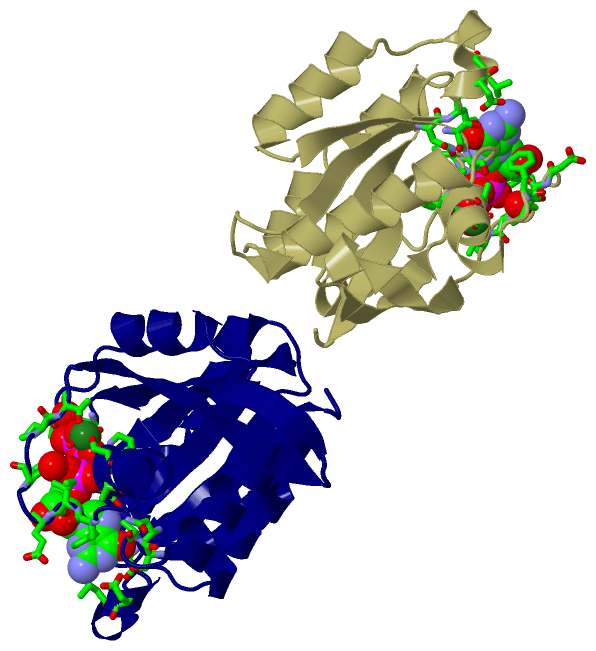
| molecular function |
|---|
| | GO:0005525 | | GTP binding | | Interacting selectively and non-covalently with GTP, guanosine triphosphate. |
| | GO:0003924 | | GTPase activity | | Catalysis of the reaction: GTP + H2O = GDP + phosphate. |
| | GO:0000166 | | nucleotide binding | | Interacting selectively and non-covalently with a nucleotide, any compound consisting of a nucleoside that is esterified with (ortho)phosphate or an oligophosphate at any hydroxyl group on the ribose or deoxyribose. |
| | GO:0005515 | | protein binding | | Interacting selectively and non-covalently with any protein or protein complex (a complex of two or more proteins that may include other nonprotein molecules). |
| biological process |
|---|
| | GO:0032486 | | Rap protein signal transduction | | A series of molecular signals within the cell that are mediated by a member of the Rap family of proteins switching to a GTP-bound active state. |
| | GO:0031532 | | actin cytoskeleton reorganization | | A process that is carried out at the cellular level which results in dynamic structural changes to the arrangement of constituent parts of cytoskeletal structures comprising actin filaments and their associated proteins. |
| | GO:0034613 | | cellular protein localization | | Any process in which a protein is transported to, and/or maintained in, a specific location at the level of a cell. Localization at the cellular level encompasses movement within the cell, from within the cell to the cell surface, or from one location to another at the surface of a cell. |
| | GO:0035690 | | cellular response to drug | | Any process that results in a change in state or activity of a cell (in terms of movement, secretion, enzyme production, gene expression, etc.) as a result of a drug stimulus. A drug is a substance used in the diagnosis, treatment or prevention of a disease. |
| | GO:0045198 | | establishment of epithelial cell apical/basal polarity | | The specification and formation of the apicobasal polarity of an epithelial cell. |
| | GO:0045184 | | establishment of protein localization | | The directed movement of a protein to a specific location. |
| | GO:0030033 | | microvillus assembly | | Formation of a microvillus, a thin cylindrical membrane-covered projection on the surface of a cell. |
| | GO:0030336 | | negative regulation of cell migration | | Any process that stops, prevents, or reduces the frequency, rate or extent of cell migration. |
| | GO:0031954 | | positive regulation of protein autophosphorylation | | Any process that activates or increases the frequency, rate or extent of the phosphorylation by a protein of one or more of its own residues. |
| | GO:0001934 | | positive regulation of protein phosphorylation | | Any process that activates or increases the frequency, rate or extent of addition of phosphate groups to amino acids within a protein. |
| | GO:0072659 | | protein localization to plasma membrane | | A process in which a protein is transported to, or maintained in, a specific location in the plasma membrane. |
| | GO:0046328 | | regulation of JNK cascade | | Any process that modulates the frequency, rate or extent of signal transduction mediated by the JNK cascade. |
| | GO:0048814 | | regulation of dendrite morphogenesis | | Any process that modulates the frequency, rate or extent of dendrite morphogenesis. |
| | GO:0007165 | | signal transduction | | The cellular process in which a signal is conveyed to trigger a change in the activity or state of a cell. Signal transduction begins with reception of a signal (e.g. a ligand binding to a receptor or receptor activation by a stimulus such as light), or for signal transduction in the absence of ligand, signal-withdrawal or the activity of a constitutively active receptor. Signal transduction ends with regulation of a downstream cellular process, e.g. regulation of transcription or regulation of a metabolic process. Signal transduction covers signaling from receptors located on the surface of the cell and signaling via molecules located within the cell. For signaling between cells, signal transduction is restricted to events at and within the receiving cell. |
| | GO:0007264 | | small GTPase mediated signal transduction | | Any series of molecular signals in which a small monomeric GTPase relays one or more of the signals. |
| cellular component |
|---|
| | GO:0005829 | | cytosol | | The part of the cytoplasm that does not contain organelles but which does contain other particulate matter, such as protein complexes. |
| | GO:0005768 | | endosome | | A vacuole to which materials ingested by endocytosis are delivered. |
| | GO:0070062 | | extracellular exosome | | A vesicle that is released into the extracellular region by fusion of the limiting endosomal membrane of a multivesicular body with the plasma membrane. Extracellular exosomes, also simply called exosomes, have a diameter of about 40-100 nm. |
| | GO:0016020 | | membrane | | A lipid bilayer along with all the proteins and protein complexes embedded in it an attached to it. |
| | GO:0030496 | | midbody | | A thin cytoplasmic bridge formed between daughter cells at the end of cytokinesis. The midbody forms where the contractile ring constricts, and may persist for some time before finally breaking to complete cytokinesis. |
| | GO:0005886 | | plasma membrane | | The membrane surrounding a cell that separates the cell from its external environment. It consists of a phospholipid bilayer and associated proteins. |
| | GO:0055037 | | recycling endosome | | An organelle consisting of a network of tubules that functions in targeting molecules, such as receptors transporters and lipids, to the plasma membrane. |
| | GO:0055038 | | recycling endosome membrane | | The lipid bilayer surrounding a recycling endosome. |

 Description