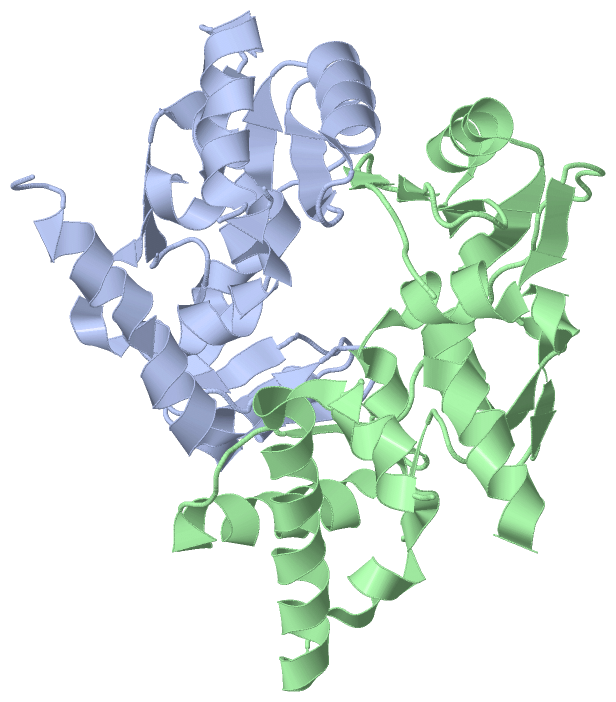
Asymmetric/Biological Unit(hide GO term definitions)
Chain A ( SMC1A_MOUSE | Q9CU62)
| molecular function |
|---|
| | GO:0005524 | | ATP binding | | Interacting selectively and non-covalently with ATP, adenosine 5'-triphosphate, a universally important coenzyme and enzyme regulator. |
| | GO:0003682 | | chromatin binding | | Interacting selectively and non-covalently with chromatin, the network of fibers of DNA, protein, and sometimes RNA, that make up the chromosomes of the eukaryotic nucleus during interphase. |
| | GO:0036033 | | mediator complex binding | | Interacting selectively and non-covalently with a mediator complex. The mediator complex is a protein complex that interacts with the carboxy-terminal domain of the largest subunit of RNA polymerase II and plays an active role in transducing the signal from a transcription factor to the transcriptional machinery. The Saccharomyces complex contains several identifiable subcomplexes: a head domain comprising Srb2, -4, and -5, Med6, -8, and -11, and Rox3 proteins; a middle domain comprising Med1, -4, and -7, Nut1 and -2, Cse2, Rgr1, Soh1, and Srb7 proteins; a tail consisting of Gal11p, Med2p, Pgd1p, and Sin4p; and a regulatory subcomplex comprising Ssn2, -3, and -8, and Srb8 proteins. Metazoan mediator complexes have similar modular structures and include homologs of yeast Srb and Med proteins. |
| | GO:0000166 | | nucleotide binding | | Interacting selectively and non-covalently with a nucleotide, any compound consisting of a nucleoside that is esterified with (ortho)phosphate or an oligophosphate at any hydroxyl group on the ribose or deoxyribose. |
| | GO:0005515 | | protein binding | | Interacting selectively and non-covalently with any protein or protein complex (a complex of two or more proteins that may include other nonprotein molecules). |
| | GO:0046982 | | protein heterodimerization activity | | Interacting selectively and non-covalently with a nonidentical protein to form a heterodimer. |
| biological process |
|---|
| | GO:0006281 | | DNA repair | | The process of restoring DNA after damage. Genomes are subject to damage by chemical and physical agents in the environment (e.g. UV and ionizing radiations, chemical mutagens, fungal and bacterial toxins, etc.) and by free radicals or alkylating agents endogenously generated in metabolism. DNA is also damaged because of errors during its replication. A variety of different DNA repair pathways have been reported that include direct reversal, base excision repair, nucleotide excision repair, photoreactivation, bypass, double-strand break repair pathway, and mismatch repair pathway. |
| | GO:0007049 | | cell cycle | | The progression of biochemical and morphological phases and events that occur in a cell during successive cell replication or nuclear replication events. Canonically, the cell cycle comprises the replication and segregation of genetic material followed by the division of the cell, but in endocycles or syncytial cells nuclear replication or nuclear division may not be followed by cell division. |
| | GO:0051301 | | cell division | | The process resulting in division and partitioning of components of a cell to form more cells; may or may not be accompanied by the physical separation of a cell into distinct, individually membrane-bounded daughter cells. |
| | GO:0006974 | | cellular response to DNA damage stimulus | | Any process that results in a change in state or activity of a cell (in terms of movement, secretion, enzyme production, gene expression, etc.) as a result of a stimulus indicating damage to its DNA from environmental insults or errors during metabolism. |
| | GO:0051276 | | chromosome organization | | A process that is carried out at the cellular level that results in the assembly, arrangement of constituent parts, or disassembly of chromosomes, structures composed of a very long molecule of DNA and associated proteins that carries hereditary information. This term covers covalent modifications at the molecular level as well as spatial relationships among the major components of a chromosome. |
| | GO:0051321 | | meiotic cell cycle | | Progression through the phases of the meiotic cell cycle, in which canonically a cell replicates to produce four offspring with half the chromosomal content of the progenitor cell via two nuclear divisions. |
| | GO:0007093 | | mitotic cell cycle checkpoint | | A cell cycle checkpoint that ensures accurate chromosome replication and segregation by preventing progression through a mitotic cell cycle until conditions are suitable for the cell to proceed to the next stage. |
| | GO:0007064 | | mitotic sister chromatid cohesion | | The cell cycle process in which the sister chromatids of a replicated chromosome are joined along the entire length of the chromosome, from their formation in S phase through metaphase during a mitotic cell cycle. This cohesion cycle is critical for high fidelity chromosome transmission. |
| | GO:0032876 | | negative regulation of DNA endoreduplication | | Any process that stops, prevents, or reduces the frequency, rate or extent of DNA endoreduplication. |
| | GO:0009314 | | response to radiation | | Any process that results in a change in state or activity of a cell or an organism (in terms of movement, secretion, enzyme production, gene expression, etc.) as a result of an electromagnetic radiation stimulus. Electromagnetic radiation is a propagating wave in space with electric and magnetic components. These components oscillate at right angles to each other and to the direction of propagation. |
| | GO:0042770 | | signal transduction in response to DNA damage | | A cascade of processes induced by the detection of DNA damage within a cell. |
| | GO:0007062 | | sister chromatid cohesion | | The cell cycle process in which the sister chromatids of a replicated chromosome become tethered to each other. |
| | GO:0019827 | | stem cell population maintenance | | The process by which an organism or tissue maintains a population of stem cells of a single type. This can be achieved by a number of mechanisms: stem cell asymmetric division maintains stem cell numbers; stem cell symmetric division increases them; maintenance of a stem cell niche maintains the conditions for commitment to the stem cell fate for some types of stem cell; stem cells may arise de novo from other cell types. |
| cellular component |
|---|
| | GO:0005694 | | chromosome | | A structure composed of a very long molecule of DNA and associated proteins (e.g. histones) that carries hereditary information. |
| | GO:0000775 | | chromosome, centromeric region | | The region of a chromosome that includes the centromeric DNA and associated proteins. In monocentric chromosomes, this region corresponds to a single area of the chromosome, whereas in holocentric chromosomes, it is evenly distributed along the chromosome. |
| | GO:0005737 | | cytoplasm | | All of the contents of a cell excluding the plasma membrane and nucleus, but including other subcellular structures. |
| | GO:0000776 | | kinetochore | | A multisubunit complex that is located at the centromeric region of DNA and provides an attachment point for the spindle microtubules. |
| | GO:0030893 | | meiotic cohesin complex | | A cohesin complex that mediates sister chromatid cohesion during meiosis; has a subunit composition distinct from that of the mitotic cohesin complex. |
| | GO:0005654 | | nucleoplasm | | That part of the nuclear content other than the chromosomes or the nucleolus. |
| | GO:0005634 | | nucleus | | A membrane-bounded organelle of eukaryotic cells in which chromosomes are housed and replicated. In most cells, the nucleus contains all of the cell's chromosomes except the organellar chromosomes, and is the site of RNA synthesis and processing. In some species, or in specialized cell types, RNA metabolism or DNA replication may be absent. |
Chain B ( SMC3_MOUSE | Q9CW03)
| molecular function |
|---|
| | GO:0005524 | | ATP binding | | Interacting selectively and non-covalently with ATP, adenosine 5'-triphosphate, a universally important coenzyme and enzyme regulator. |
| | GO:0003682 | | chromatin binding | | Interacting selectively and non-covalently with chromatin, the network of fibers of DNA, protein, and sometimes RNA, that make up the chromosomes of the eukaryotic nucleus during interphase. |
| | GO:0036033 | | mediator complex binding | | Interacting selectively and non-covalently with a mediator complex. The mediator complex is a protein complex that interacts with the carboxy-terminal domain of the largest subunit of RNA polymerase II and plays an active role in transducing the signal from a transcription factor to the transcriptional machinery. The Saccharomyces complex contains several identifiable subcomplexes: a head domain comprising Srb2, -4, and -5, Med6, -8, and -11, and Rox3 proteins; a middle domain comprising Med1, -4, and -7, Nut1 and -2, Cse2, Rgr1, Soh1, and Srb7 proteins; a tail consisting of Gal11p, Med2p, Pgd1p, and Sin4p; and a regulatory subcomplex comprising Ssn2, -3, and -8, and Srb8 proteins. Metazoan mediator complexes have similar modular structures and include homologs of yeast Srb and Med proteins. |
| | GO:0000166 | | nucleotide binding | | Interacting selectively and non-covalently with a nucleotide, any compound consisting of a nucleoside that is esterified with (ortho)phosphate or an oligophosphate at any hydroxyl group on the ribose or deoxyribose. |
| | GO:0005515 | | protein binding | | Interacting selectively and non-covalently with any protein or protein complex (a complex of two or more proteins that may include other nonprotein molecules). |
| | GO:0046982 | | protein heterodimerization activity | | Interacting selectively and non-covalently with a nonidentical protein to form a heterodimer. |
| biological process |
|---|
| | GO:0006281 | | DNA repair | | The process of restoring DNA after damage. Genomes are subject to damage by chemical and physical agents in the environment (e.g. UV and ionizing radiations, chemical mutagens, fungal and bacterial toxins, etc.) and by free radicals or alkylating agents endogenously generated in metabolism. DNA is also damaged because of errors during its replication. A variety of different DNA repair pathways have been reported that include direct reversal, base excision repair, nucleotide excision repair, photoreactivation, bypass, double-strand break repair pathway, and mismatch repair pathway. |
| | GO:0007049 | | cell cycle | | The progression of biochemical and morphological phases and events that occur in a cell during successive cell replication or nuclear replication events. Canonically, the cell cycle comprises the replication and segregation of genetic material followed by the division of the cell, but in endocycles or syncytial cells nuclear replication or nuclear division may not be followed by cell division. |
| | GO:0051301 | | cell division | | The process resulting in division and partitioning of components of a cell to form more cells; may or may not be accompanied by the physical separation of a cell into distinct, individually membrane-bounded daughter cells. |
| | GO:0006974 | | cellular response to DNA damage stimulus | | Any process that results in a change in state or activity of a cell (in terms of movement, secretion, enzyme production, gene expression, etc.) as a result of a stimulus indicating damage to its DNA from environmental insults or errors during metabolism. |
| | GO:0051276 | | chromosome organization | | A process that is carried out at the cellular level that results in the assembly, arrangement of constituent parts, or disassembly of chromosomes, structures composed of a very long molecule of DNA and associated proteins that carries hereditary information. This term covers covalent modifications at the molecular level as well as spatial relationships among the major components of a chromosome. |
| | GO:0051321 | | meiotic cell cycle | | Progression through the phases of the meiotic cell cycle, in which canonically a cell replicates to produce four offspring with half the chromosomal content of the progenitor cell via two nuclear divisions. |
| | GO:0007064 | | mitotic sister chromatid cohesion | | The cell cycle process in which the sister chromatids of a replicated chromosome are joined along the entire length of the chromosome, from their formation in S phase through metaphase during a mitotic cell cycle. This cohesion cycle is critical for high fidelity chromosome transmission. |
| | GO:0007052 | | mitotic spindle organization | | A process that is carried out at the cellular level which results in the assembly, arrangement of constituent parts, or disassembly of the microtubule spindle during a mitotic cell cycle. |
| | GO:0032876 | | negative regulation of DNA endoreduplication | | Any process that stops, prevents, or reduces the frequency, rate or extent of DNA endoreduplication. |
| | GO:0006275 | | regulation of DNA replication | | Any process that modulates the frequency, rate or extent of DNA replication. |
| | GO:0007165 | | signal transduction | | The cellular process in which a signal is conveyed to trigger a change in the activity or state of a cell. Signal transduction begins with reception of a signal (e.g. a ligand binding to a receptor or receptor activation by a stimulus such as light), or for signal transduction in the absence of ligand, signal-withdrawal or the activity of a constitutively active receptor. Signal transduction ends with regulation of a downstream cellular process, e.g. regulation of transcription or regulation of a metabolic process. Signal transduction covers signaling from receptors located on the surface of the cell and signaling via molecules located within the cell. For signaling between cells, signal transduction is restricted to events at and within the receiving cell. |
| | GO:0007062 | | sister chromatid cohesion | | The cell cycle process in which the sister chromatids of a replicated chromosome become tethered to each other. |
| | GO:0019827 | | stem cell population maintenance | | The process by which an organism or tissue maintains a population of stem cells of a single type. This can be achieved by a number of mechanisms: stem cell asymmetric division maintains stem cell numbers; stem cell symmetric division increases them; maintenance of a stem cell niche maintains the conditions for commitment to the stem cell fate for some types of stem cell; stem cells may arise de novo from other cell types. |
| cellular component |
|---|
| | GO:0005604 | | basement membrane | | A thin layer of dense material found in various animal tissues interposed between the cells and the adjacent connective tissue. It consists of the basal lamina plus an associated layer of reticulin fibers. |
| | GO:0000785 | | chromatin | | The ordered and organized complex of DNA, protein, and sometimes RNA, that forms the chromosome. |
| | GO:0005694 | | chromosome | | A structure composed of a very long molecule of DNA and associated proteins (e.g. histones) that carries hereditary information. |
| | GO:0000775 | | chromosome, centromeric region | | The region of a chromosome that includes the centromeric DNA and associated proteins. In monocentric chromosomes, this region corresponds to a single area of the chromosome, whereas in holocentric chromosomes, it is evenly distributed along the chromosome. |
| | GO:0005737 | | cytoplasm | | All of the contents of a cell excluding the plasma membrane and nucleus, but including other subcellular structures. |
| | GO:0000800 | | lateral element | | A proteinaceous core found between sister chromatids during meiotic prophase. |
| | GO:0030893 | | meiotic cohesin complex | | A cohesin complex that mediates sister chromatid cohesion during meiosis; has a subunit composition distinct from that of the mitotic cohesin complex. |
| | GO:0016363 | | nuclear matrix | | The dense fibrillar network lying on the inner side of the nuclear membrane. |
| | GO:0034991 | | nuclear meiotic cohesin complex | | A cohesin complex that mediates sister chromatid cohesion in the nucleus during meiosis; has a subunit composition distinct from that of the mitotic cohesin complex. |
| | GO:0005654 | | nucleoplasm | | That part of the nuclear content other than the chromosomes or the nucleolus. |
| | GO:0005634 | | nucleus | | A membrane-bounded organelle of eukaryotic cells in which chromosomes are housed and replicated. In most cells, the nucleus contains all of the cell's chromosomes except the organellar chromosomes, and is the site of RNA synthesis and processing. In some species, or in specialized cell types, RNA metabolism or DNA replication may be absent. |
| | GO:0000922 | | spindle pole | | Either of the ends of a spindle, where spindle microtubules are organized; usually contains a microtubule organizing center and accessory molecules, spindle microtubules and astral microtubules. |
|

 Description