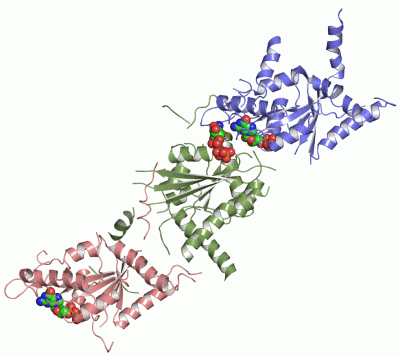
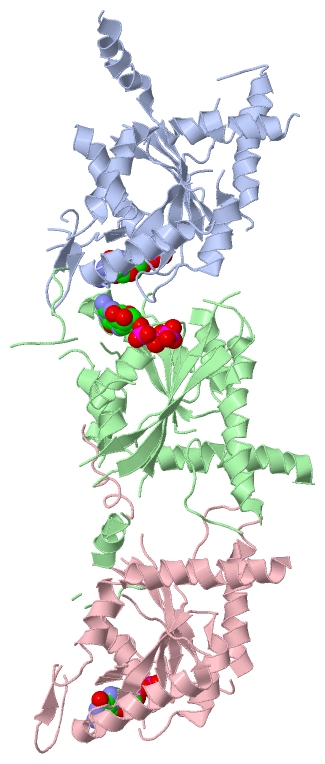
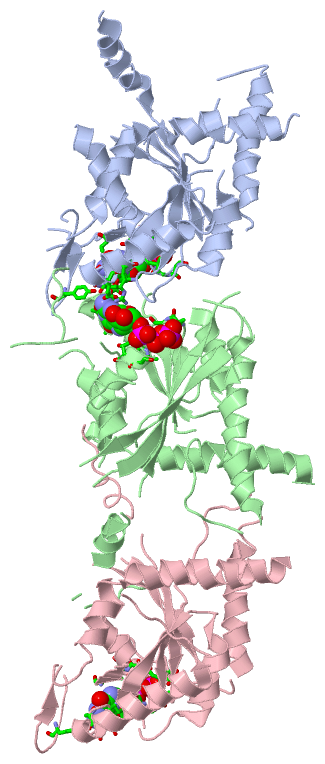
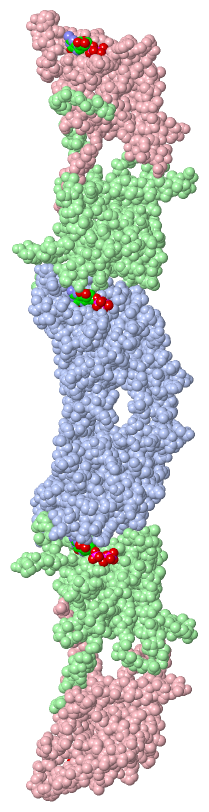
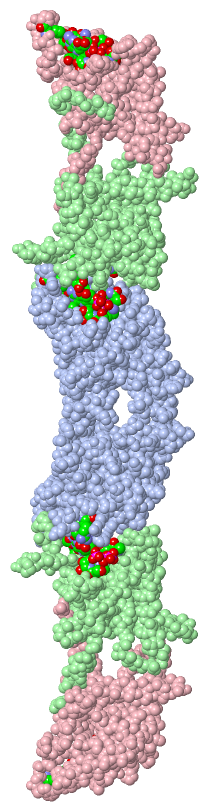
Asymmetric Unit(hide GO term definitions)
Chain A ( SEPT2_HUMAN | Q15019)
| molecular function |
|---|
| | GO:0005525 | | GTP binding | | Interacting selectively and non-covalently with GTP, guanosine triphosphate. |
| | GO:0030234 | | enzyme regulator activity | | Binds to and modulates the activity of an enzyme. |
| | GO:0000166 | | nucleotide binding | | Interacting selectively and non-covalently with a nucleotide, any compound consisting of a nucleoside that is esterified with (ortho)phosphate or an oligophosphate at any hydroxyl group on the ribose or deoxyribose. |
| | GO:0005515 | | protein binding | | Interacting selectively and non-covalently with any protein or protein complex (a complex of two or more proteins that may include other nonprotein molecules). |
| | GO:0032947 | | protein complex scaffold activity | | A structural molecule activity that provides a physical support for the assembly of a multiprotein complex. The scaffold may or may not be part of the final complex. |
| biological process |
|---|
| | GO:0007049 | | cell cycle | | The progression of biochemical and morphological phases and events that occur in a cell during successive cell replication or nuclear replication events. Canonically, the cell cycle comprises the replication and segregation of genetic material followed by the division of the cell, but in endocycles or syncytial cells nuclear replication or nuclear division may not be followed by cell division. |
| | GO:0051301 | | cell division | | The process resulting in division and partitioning of components of a cell to form more cells; may or may not be accompanied by the physical separation of a cell into distinct, individually membrane-bounded daughter cells. |
| | GO:0031175 | | neuron projection development | | The process whose specific outcome is the progression of a neuron projection over time, from its formation to the mature structure. A neuron projection is any process extending from a neural cell, such as axons or dendrites (collectively called neurites). |
| | GO:0002036 | | regulation of L-glutamate transport | | Any process that modulates the frequency, rate or extent of L-glutamate transport. |
| | GO:0050790 | | regulation of catalytic activity | | Any process that modulates the activity of an enzyme. |
| | GO:0032880 | | regulation of protein localization | | Any process that modulates the frequency, rate or extent of any process in which a protein is transported to, or maintained in, a specific location. |
| | GO:0007224 | | smoothened signaling pathway | | A series of molecular signals generated as a consequence of activation of the transmembrane protein Smoothened. |
| cellular component |
|---|
| | GO:0015629 | | actin cytoskeleton | | The part of the cytoskeleton (the internal framework of a cell) composed of actin and associated proteins. Includes actin cytoskeleton-associated complexes. |
| | GO:0005930 | | axoneme | | The bundle of microtubules and associated proteins that forms the core of cilia (also called flagella) in eukaryotic cells and is responsible for their movements. |
| | GO:0005938 | | cell cortex | | The region of a cell that lies just beneath the plasma membrane and often, but not always, contains a network of actin filaments and associated proteins. |
| | GO:0042995 | | cell projection | | A prolongation or process extending from a cell, e.g. a flagellum or axon. |
| | GO:0009986 | | cell surface | | The external part of the cell wall and/or plasma membrane. |
| | GO:0005694 | | chromosome | | A structure composed of a very long molecule of DNA and associated proteins (e.g. histones) that carries hereditary information. |
| | GO:0000775 | | chromosome, centromeric region | | The region of a chromosome that includes the centromeric DNA and associated proteins. In monocentric chromosomes, this region corresponds to a single area of the chromosome, whereas in holocentric chromosomes, it is evenly distributed along the chromosome. |
| | GO:0060170 | | ciliary membrane | | The portion of the plasma membrane surrounding a cilium. |
| | GO:0035869 | | ciliary transition zone | | A region of the cilium between the basal body and proximal segment that is characterized by Y-shaped assemblages that connect axonemal microtubules to the ciliary membrane. The ciliary transition zone appears to function as a gate that controls ciliary membrane composition and separates the cytosol from the ciliary plasm. |
| | GO:0032154 | | cleavage furrow | | The cleavage furrow is a plasma membrane invagination at the cell division site. The cleavage furrow begins as a shallow groove and eventually deepens to divide the cytoplasm. |
| | GO:0000777 | | condensed chromosome kinetochore | | A multisubunit complex that is located at the centromeric region of a condensed chromosome and provides an attachment point for the spindle microtubules. |
| | GO:0005737 | | cytoplasm | | All of the contents of a cell excluding the plasma membrane and nucleus, but including other subcellular structures. |
| | GO:0005856 | | cytoskeleton | | Any of the various filamentous elements that form the internal framework of cells, and typically remain after treatment of the cells with mild detergent to remove membrane constituents and soluble components of the cytoplasm. The term embraces intermediate filaments, microfilaments, microtubules, the microtrabecular lattice, and other structures characterized by a polymeric filamentous nature and long-range order within the cell. The various elements of the cytoskeleton not only serve in the maintenance of cellular shape but also have roles in other cellular functions, including cellular movement, cell division, endocytosis, and movement of organelles. |
| | GO:0000145 | | exocyst | | A protein complex peripherally associated with the plasma membrane that determines where vesicles dock and fuse. At least eight complex components are conserved between yeast and mammals. |
| | GO:0070062 | | extracellular exosome | | A vesicle that is released into the extracellular region by fusion of the limiting endosomal membrane of a multivesicular body with the plasma membrane. Extracellular exosomes, also simply called exosomes, have a diameter of about 40-100 nm. |
| | GO:0000776 | | kinetochore | | A multisubunit complex that is located at the centromeric region of DNA and provides an attachment point for the spindle microtubules. |
| | GO:0016020 | | membrane | | A lipid bilayer along with all the proteins and protein complexes embedded in it an attached to it. |
| | GO:0030496 | | midbody | | A thin cytoplasmic bridge formed between daughter cells at the end of cytokinesis. The midbody forms where the contractile ring constricts, and may persist for some time before finally breaking to complete cytokinesis. |
| | GO:0043209 | | myelin sheath | | An electrically insulating fatty layer that surrounds the axons of many neurons. It is an outgrowth of glial cells: Schwann cells supply the myelin for peripheral neurons while oligodendrocytes supply it to those of the central nervous system. |
| | GO:0005730 | | nucleolus | | A small, dense body one or more of which are present in the nucleus of eukaryotic cells. It is rich in RNA and protein, is not bounded by a limiting membrane, and is not seen during mitosis. Its prime function is the transcription of the nucleolar DNA into 45S ribosomal-precursor RNA, the processing of this RNA into 5.8S, 18S, and 28S components of ribosomal RNA, and the association of these components with 5S RNA and proteins synthesized outside the nucleolus. This association results in the formation of ribonucleoprotein precursors; these pass into the cytoplasm and mature into the 40S and 60S subunits of the ribosome. |
| | GO:0005634 | | nucleus | | A membrane-bounded organelle of eukaryotic cells in which chromosomes are housed and replicated. In most cells, the nucleus contains all of the cell's chromosomes except the organellar chromosomes, and is the site of RNA synthesis and processing. In some species, or in specialized cell types, RNA metabolism or DNA replication may be absent. |
| | GO:0048471 | | perinuclear region of cytoplasm | | Cytoplasm situated near, or occurring around, the nucleus. |
| | GO:0032391 | | photoreceptor connecting cilium | | The portion of the photoreceptor cell cilium linking the photoreceptor inner and outer segments. It's considered to be equivalent to the ciliary transition zone. |
| | GO:0005886 | | plasma membrane | | The membrane surrounding a cell that separates the cell from its external environment. It consists of a phospholipid bilayer and associated proteins. |
| | GO:0031105 | | septin complex | | A protein complex containing septins. Typically, these complexes contain multiple septins and are oligomeric. |
| | GO:0005819 | | spindle | | The array of microtubules and associated molecules that forms between opposite poles of a eukaryotic cell during mitosis or meiosis and serves to move the duplicated chromosomes apart. |
| | GO:0045202 | | synapse | | The junction between a nerve fiber of one neuron and another neuron, muscle fiber or glial cell. As the nerve fiber approaches the synapse it enlarges into a specialized structure, the presynaptic nerve ending, which contains mitochondria and synaptic vesicles. At the tip of the nerve ending is the presynaptic membrane; facing it, and separated from it by a minute cleft (the synaptic cleft) is a specialized area of membrane on the receiving cell, known as the postsynaptic membrane. In response to the arrival of nerve impulses, the presynaptic nerve ending secretes molecules of neurotransmitters into the synaptic cleft. These diffuse across the cleft and transmit the signal to the postsynaptic membrane. |
Chain B ( SEPT6_HUMAN | Q14141)
| molecular function |
|---|
| | GO:0005525 | | GTP binding | | Interacting selectively and non-covalently with GTP, guanosine triphosphate. |
| | GO:0000166 | | nucleotide binding | | Interacting selectively and non-covalently with a nucleotide, any compound consisting of a nucleoside that is esterified with (ortho)phosphate or an oligophosphate at any hydroxyl group on the ribose or deoxyribose. |
| | GO:0005515 | | protein binding | | Interacting selectively and non-covalently with any protein or protein complex (a complex of two or more proteins that may include other nonprotein molecules). |
| biological process |
|---|
| | GO:0007049 | | cell cycle | | The progression of biochemical and morphological phases and events that occur in a cell during successive cell replication or nuclear replication events. Canonically, the cell cycle comprises the replication and segregation of genetic material followed by the division of the cell, but in endocycles or syncytial cells nuclear replication or nuclear division may not be followed by cell division. |
| | GO:0051301 | | cell division | | The process resulting in division and partitioning of components of a cell to form more cells; may or may not be accompanied by the physical separation of a cell into distinct, individually membrane-bounded daughter cells. |
| | GO:0000910 | | cytokinesis | | The division of the cytoplasm and the plasma membrane of a cell and its partitioning into two daughter cells. |
| | GO:0016032 | | viral process | | A multi-organism process in which a virus is a participant. The other participant is the host. Includes infection of a host cell, replication of the viral genome, and assembly of progeny virus particles. In some cases the viral genetic material may integrate into the host genome and only subsequently, under particular circumstances, 'complete' its life cycle. |
| cellular component |
|---|
| | GO:0043679 | | axon terminus | | Terminal inflated portion of the axon, containing the specialized apparatus necessary to release neurotransmitters. The axon terminus is considered to be the whole region of thickening and the terminal button is a specialized region of it. |
| | GO:0005694 | | chromosome | | A structure composed of a very long molecule of DNA and associated proteins (e.g. histones) that carries hereditary information. |
| | GO:0000775 | | chromosome, centromeric region | | The region of a chromosome that includes the centromeric DNA and associated proteins. In monocentric chromosomes, this region corresponds to a single area of the chromosome, whereas in holocentric chromosomes, it is evenly distributed along the chromosome. |
| | GO:0032154 | | cleavage furrow | | The cleavage furrow is a plasma membrane invagination at the cell division site. The cleavage furrow begins as a shallow groove and eventually deepens to divide the cytoplasm. |
| | GO:0000777 | | condensed chromosome kinetochore | | A multisubunit complex that is located at the centromeric region of a condensed chromosome and provides an attachment point for the spindle microtubules. |
| | GO:0005737 | | cytoplasm | | All of the contents of a cell excluding the plasma membrane and nucleus, but including other subcellular structures. |
| | GO:0005856 | | cytoskeleton | | Any of the various filamentous elements that form the internal framework of cells, and typically remain after treatment of the cells with mild detergent to remove membrane constituents and soluble components of the cytoplasm. The term embraces intermediate filaments, microfilaments, microtubules, the microtrabecular lattice, and other structures characterized by a polymeric filamentous nature and long-range order within the cell. The various elements of the cytoskeleton not only serve in the maintenance of cellular shape but also have roles in other cellular functions, including cellular movement, cell division, endocytosis, and movement of organelles. |
| | GO:0000776 | | kinetochore | | A multisubunit complex that is located at the centromeric region of DNA and provides an attachment point for the spindle microtubules. |
| | GO:0030496 | | midbody | | A thin cytoplasmic bridge formed between daughter cells at the end of cytokinesis. The midbody forms where the contractile ring constricts, and may persist for some time before finally breaking to complete cytokinesis. |
| | GO:0031105 | | septin complex | | A protein complex containing septins. Typically, these complexes contain multiple septins and are oligomeric. |
| | GO:0005819 | | spindle | | The array of microtubules and associated molecules that forms between opposite poles of a eukaryotic cell during mitosis or meiosis and serves to move the duplicated chromosomes apart. |
| | GO:0008021 | | synaptic vesicle | | A secretory organelle, typically 50 nm in diameter, of presynaptic nerve terminals; accumulates in high concentrations of neurotransmitters and secretes these into the synaptic cleft by fusion with the 'active zone' of the presynaptic plasma membrane. |
Chain C ( SEPT7_HUMAN | Q16181)
| molecular function |
|---|
| | GO:0005525 | | GTP binding | | Interacting selectively and non-covalently with GTP, guanosine triphosphate. |
| | GO:0042802 | | identical protein binding | | Interacting selectively and non-covalently with an identical protein or proteins. |
| | GO:0000166 | | nucleotide binding | | Interacting selectively and non-covalently with a nucleotide, any compound consisting of a nucleoside that is esterified with (ortho)phosphate or an oligophosphate at any hydroxyl group on the ribose or deoxyribose. |
| | GO:0005515 | | protein binding | | Interacting selectively and non-covalently with any protein or protein complex (a complex of two or more proteins that may include other nonprotein molecules). |
| | GO:0005198 | | structural molecule activity | | The action of a molecule that contributes to the structural integrity of a complex or its assembly within or outside a cell. |
| biological process |
|---|
| | GO:0007049 | | cell cycle | | The progression of biochemical and morphological phases and events that occur in a cell during successive cell replication or nuclear replication events. Canonically, the cell cycle comprises the replication and segregation of genetic material followed by the division of the cell, but in endocycles or syncytial cells nuclear replication or nuclear division may not be followed by cell division. |
| | GO:0051301 | | cell division | | The process resulting in division and partitioning of components of a cell to form more cells; may or may not be accompanied by the physical separation of a cell into distinct, individually membrane-bounded daughter cells. |
| | GO:0060271 | | cilium assembly | | The assembly of a cilium, a specialized eukaryotic organelle that consists of a filiform extrusion of the cell surface. Each cilium is bounded by an extrusion of the cytoplasmic membrane, and contains a regular longitudinal array of microtubules, anchored basally in a centriole. |
| | GO:0000910 | | cytokinesis | | The division of the cytoplasm and the plasma membrane of a cell and its partitioning into two daughter cells. |
| | GO:1902857 | | positive regulation of non-motile cilium assembly | | Any process that activates or increases the frequency, rate or extent of non-motile cilium assembly. |
| | GO:0051291 | | protein heterooligomerization | | The process of creating protein oligomers, compounds composed of a small number, usually between three and ten, of component monomers that are not all identical. Oligomers may be formed by the polymerization of a number of monomers or the depolymerization of a large protein polymer. |
| | GO:0016476 | | regulation of embryonic cell shape | | Any process that modulates the surface configuration of an embryonic cell. |
| cellular component |
|---|
| | GO:0015629 | | actin cytoskeleton | | The part of the cytoskeleton (the internal framework of a cell) composed of actin and associated proteins. Includes actin cytoskeleton-associated complexes. |
| | GO:0016324 | | apical plasma membrane | | The region of the plasma membrane located at the apical end of the cell. |
| | GO:0005930 | | axoneme | | The bundle of microtubules and associated proteins that forms the core of cilia (also called flagella) in eukaryotic cells and is responsible for their movements. |
| | GO:0042995 | | cell projection | | A prolongation or process extending from a cell, e.g. a flagellum or axon. |
| | GO:0005694 | | chromosome | | A structure composed of a very long molecule of DNA and associated proteins (e.g. histones) that carries hereditary information. |
| | GO:0000775 | | chromosome, centromeric region | | The region of a chromosome that includes the centromeric DNA and associated proteins. In monocentric chromosomes, this region corresponds to a single area of the chromosome, whereas in holocentric chromosomes, it is evenly distributed along the chromosome. |
| | GO:0005929 | | cilium | | A specialized eukaryotic organelle that consists of a filiform extrusion of the cell surface and of some cytoplasmic parts. Each cilium is largely bounded by an extrusion of the cytoplasmic (plasma) membrane, and contains a regular longitudinal array of microtubules, anchored to a basal body. |
| | GO:0032154 | | cleavage furrow | | The cleavage furrow is a plasma membrane invagination at the cell division site. The cleavage furrow begins as a shallow groove and eventually deepens to divide the cytoplasm. |
| | GO:0000777 | | condensed chromosome kinetochore | | A multisubunit complex that is located at the centromeric region of a condensed chromosome and provides an attachment point for the spindle microtubules. |
| | GO:0005737 | | cytoplasm | | All of the contents of a cell excluding the plasma membrane and nucleus, but including other subcellular structures. |
| | GO:0005856 | | cytoskeleton | | Any of the various filamentous elements that form the internal framework of cells, and typically remain after treatment of the cells with mild detergent to remove membrane constituents and soluble components of the cytoplasm. The term embraces intermediate filaments, microfilaments, microtubules, the microtrabecular lattice, and other structures characterized by a polymeric filamentous nature and long-range order within the cell. The various elements of the cytoskeleton not only serve in the maintenance of cellular shape but also have roles in other cellular functions, including cellular movement, cell division, endocytosis, and movement of organelles. |
| | GO:0005829 | | cytosol | | The part of the cytoplasm that does not contain organelles but which does contain other particulate matter, such as protein complexes. |
| | GO:0070062 | | extracellular exosome | | A vesicle that is released into the extracellular region by fusion of the limiting endosomal membrane of a multivesicular body with the plasma membrane. Extracellular exosomes, also simply called exosomes, have a diameter of about 40-100 nm. |
| | GO:0000776 | | kinetochore | | A multisubunit complex that is located at the centromeric region of DNA and provides an attachment point for the spindle microtubules. |
| | GO:0015630 | | microtubule cytoskeleton | | The part of the cytoskeleton (the internal framework of a cell) composed of microtubules and associated proteins. |
| | GO:0030496 | | midbody | | A thin cytoplasmic bridge formed between daughter cells at the end of cytokinesis. The midbody forms where the contractile ring constricts, and may persist for some time before finally breaking to complete cytokinesis. |
| | GO:0005730 | | nucleolus | | A small, dense body one or more of which are present in the nucleus of eukaryotic cells. It is rich in RNA and protein, is not bounded by a limiting membrane, and is not seen during mitosis. Its prime function is the transcription of the nucleolar DNA into 45S ribosomal-precursor RNA, the processing of this RNA into 5.8S, 18S, and 28S components of ribosomal RNA, and the association of these components with 5S RNA and proteins synthesized outside the nucleolus. This association results in the formation of ribonucleoprotein precursors; these pass into the cytoplasm and mature into the 40S and 60S subunits of the ribosome. |
| | GO:0005634 | | nucleus | | A membrane-bounded organelle of eukaryotic cells in which chromosomes are housed and replicated. In most cells, the nucleus contains all of the cell's chromosomes except the organellar chromosomes, and is the site of RNA synthesis and processing. In some species, or in specialized cell types, RNA metabolism or DNA replication may be absent. |
| | GO:0005886 | | plasma membrane | | The membrane surrounding a cell that separates the cell from its external environment. It consists of a phospholipid bilayer and associated proteins. |
| | GO:0031105 | | septin complex | | A protein complex containing septins. Typically, these complexes contain multiple septins and are oligomeric. |
| | GO:0005819 | | spindle | | The array of microtubules and associated molecules that forms between opposite poles of a eukaryotic cell during mitosis or meiosis and serves to move the duplicated chromosomes apart. |
| | GO:0001725 | | stress fiber | | A contractile actin filament bundle that consists of short actin filaments with alternating polarity, cross-linked by alpha-actinin and possibly other actin bundling proteins, and with myosin present in a periodic distribution along the fiber. |
|

 Description