Show PDB file:   
         Plain Text   HTML   (compressed file size)
QuickSearch:   
by PDB,NDB,UniProt,PROSITE Code or Search Term(s)  
(-)Asym./Biol. Unit - manually
(-)Asym./Biol. Unit
(-)Asym./Biol. Unit - sites
collapse expand < >
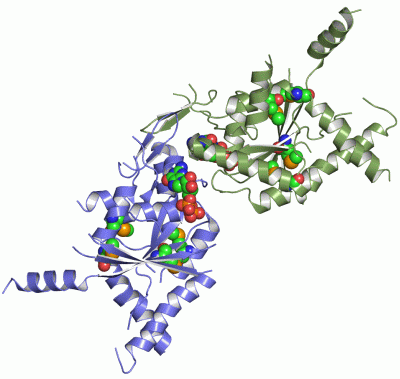
Image Asym./Biol. Unit - manually
Asym./Biol. Unit - manually  (Jmol Viewer)
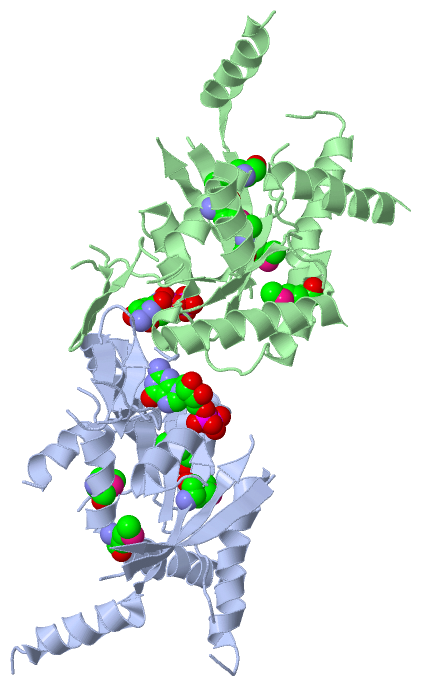
Image Asym./Biol. Unit
Asym./Biol. Unit  (Jmol Viewer)
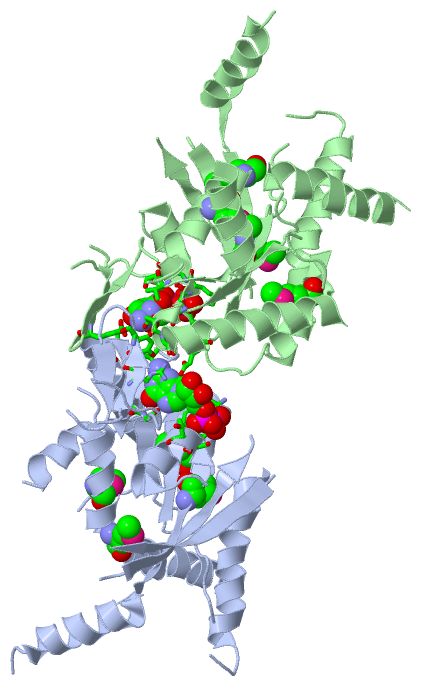
Image Asym./Biol. Unit - sites
Asym./Biol. Unit - sites  (Jmol Viewer)

(-) Description

Title :  CRYSTAL STRUCTURE OF SEPT2 G-DOMAIN
 
Authors :  M. Sirajuddin, A. Wittinghofer
Date :  14 Jun 07  (Deposition) - 07 Aug 07  (Release) - 24 Feb 09  (Revision)
Method :  X-RAY DIFFRACTION
Resolution :  3.40
Chains :  Asym./Biol. Unit :  A,B
Keywords :  Septin2-Gdp, Biological Dimer, Cell Cycle, Cell Division, Gtp-Binding, Nucleotide-Binding, Phosphorylation, Structural Protein (Keyword Search: [Gene Ontology, PubMed, Web (Google)] )
 
Reference :  M. Sirajuddin, M. Farkasovsky, F. Hauer, D. Kuhlmann, I. G. Macara, M. Weyand, H. Stark, A. Wittinghofer
Structural Insight Into Filament Formation By Mammalian Septins.
Nature V. 449 311 2007
PubMed-ID: 17637674  |  Reference-DOI: 10.1038/NATURE06052
(for further references see the PDB file header)

(-) Compounds

Molecule 1 - SEPTIN-2
    Chains: A, B
    Engineered: YES
    Expression System: ESCHERICHIA COLI
    Expression System Plasmid: PGEX6P1
    Expression System Strain: BL31
    Expression System Taxid: 562
    Expression System Vector Type: PLASMID
    Gene: SEPT2, DIFF6, KIAA0158, NEDD5
    Organism Common: HUMAN
    Organism Scientific: HOMO SAPIENS
    Organism Taxid: 9606
    Strain: BL21
    Synonym: PROTEIN NEDD5

 Structural Features

(-) Chains, Units

  12
Asymmetric/Biological Unit : AB

Summary Information (see also Sequences/Alignments below)

(-) Ligands, Modified Residues, Ions  (2, 10)

Asymmetric/Biological Unit (2, 10)
No.NameCountTypeFull Name
1GDP2Ligand/IonGUANOSINE-5'-DIPHOSPHATE
2MSE8Mod. Amino AcidSELENOMETHIONINE

(-) Sites  (2, 2)

Asymmetric Unit (2, 2)
No.NameEvidenceResiduesDescription
1AC1SOFTWAREGLY A:47 , LEU A:48 , GLY A:49 , LYS A:50 , SER A:51 , THR A:52 , LYS A:183 , ASP A:185 , VAL A:240 , GLY A:241 , ARG A:256 , TYR A:258 , THR B:186 , GLU B:191BINDING SITE FOR RESIDUE GDP A 316
2AC2SOFTWARETHR A:186 , GLU A:191 , GLY B:47 , LEU B:48 , GLY B:49 , LYS B:50 , SER B:51 , THR B:52 , LYS B:183 , ASP B:185 , VAL B:240 , GLY B:241 , TYR B:258BINDING SITE FOR RESIDUE GDP B 316

(-) SS Bonds  (0, 0)

(no "SS Bond" information available for 2QA5)

(-) Cis Peptide Bonds  (4, 4)

Asymmetric/Biological Unit
No.Residues
1Ser A:46 -Gly A:47
2Ile A:235 -Pro A:236
3Ser B:46 -Gly B:47
4Ile B:235 -Pro B:236

 Sequence-Structure Mapping

(-) SAPs(SNPs)/Variants  (0, 0)

(no "SAP(SNP)/Variant" information available for 2QA5)

(-) PROSITE Motifs  (1, 2)

Asymmetric/Biological Unit (1, 2)
 PROSITEUniProtKBPDB
No.IDACDescriptionIDLocationCountLocation
1G_SEPTINPS51719 Septin-type guanine nucleotide-binding (G) domain profile.SEPT2_HUMAN34-306
 
  2A:34-304
B:34-304

(-) Exons   (8, 16)

Asymmetric/Biological Unit (8, 16)
 ENSEMBLUniProtKBPDB
No.Transcript IDExonExon IDGenome LocationLengthIDLocationLengthCountLocationLength
1.1aENST000003919731aENSE00001916200chr2:242254515-242255025511SEPT2_HUMAN-00--
1.7dENST000003919737dENSE00002165908chr2:242263631-24226365626SEPT2_HUMAN1-330--
1.9cENST000003919739cENSE00001592925chr2:242265408-242265528121SEPT2_HUMAN4-44412A:20-44
B:20-44
25
25
1.10dENST0000039197310dENSE00002190005chr2:242274541-24227462787SEPT2_HUMAN44-73302A:44-62
B:44-62
19
19
1.11hENST0000039197311hENSE00001140497chr2:242275390-242275513124SEPT2_HUMAN73-114422A:78-102 (gaps)
B:78-101 (gaps)
25
24
1.13hENST0000039197313hENSE00001140494chr2:242276797-242276931135SEPT2_HUMAN114-159462A:116-158 (gaps)
B:116-159 (gaps)
43
44
1.13qENST0000039197313qENSE00001140486chr2:242277088-242277205118SEPT2_HUMAN159-198402A:160-198 (gaps)
B:159-198 (gaps)
39
40
1.14dENST0000039197314dENSE00001140480chr2:242282407-242282508102SEPT2_HUMAN199-232342A:199-232 (gaps)
B:199-232 (gaps)
34
34
1.15cENST0000039197315cENSE00001140474chr2:242283167-242283312146SEPT2_HUMAN233-281492A:233-281 (gaps)
B:233-281 (gaps)
49
49
1.16aENST0000039197316aENSE00001140465chr2:242285581-24228566484SEPT2_HUMAN281-309292A:281-304
B:281-304
24
24
1.17aENST0000039197317aENSE00001140455chr2:242287549-24228760658SEPT2_HUMAN309-328200--
1.18aENST0000039197318aENSE00001147389chr2:242289488-242289618131SEPT2_HUMAN329-361330--
1.19dENST0000039197319dENSE00001557502chr2:242291382-2422934392058SEPT2_HUMAN-00--

(-) Sequences/Alignments

Asymmetric/Biological Unit
   Reformat: Number of residues per line =  ('0' or empty: single-line sequence representation)
  Number of residues per labelling interval =   
  UniProt sequence: complete  aligned part    
   Show mapping: SCOP domains CATH domains Pfam domains Secondary structure (by author)
SAPs(SNPs) PROSITE motifs Exons
(details for a mapped element are shown in a popup box when the mouse pointer rests over it)
Chain A from PDB  Type:PROTEIN  Length:233
 aligned with SEPT2_HUMAN | Q15019 from UniProtKB/Swiss-Prot  Length:361

    Alignment length:285
                                    29        39        49        59        69        79        89        99       109       119       129       139       149       159       169       179       189       199       209       219       229       239       249       259       269       279       289       299     
          SEPT2_HUMAN    20 FANLPNQVHRKSVKKGFEFTLMVVGESGLGKSTLINSLFLTDLYPERVIPGAAEKIERTVQIEASTVEIEERGVKLRLTVVDTPGYGDAINCRDCFKTIISYIDEQFERYLHDESGLNRRHIIDNRVHCCFYFISPFGHGLKPLDVAFMKAIHNKVNIVPVIAKADTLTLKERERLKKRILDEIEEHNIKIYHLPDAESDEDEDFKEQTRLLKASIPFSVVGSNQLIEAKGKKVRGRLYPWGVVEVENPEHNDFLKLRTMLITHMQDLQEVTQDLHYENFRSERL 304
               SCOP domains --------------------------------------------------------------------------------------------------------------------------------------------------------------------------------------------------------------------------------------------------------------------------------------------- SCOP domains
               CATH domains --------------------------------------------------------------------------------------------------------------------------------------------------------------------------------------------------------------------------------------------------------------------------------------------- CATH domains
               Pfam domains --------------------------------------------------------------------------------------------------------------------------------------------------------------------------------------------------------------------------------------------------------------------------------------------- Pfam domains
         Sec.struct. author ..hhhhhhhhhhhhhheeeeeeee.....hhhhhhhhhhh...---------------.eeeeeeeee.-..eeeeeeeee..-------------hhhhhhhhhhhhhhhhhhh....--.......eeeeee.....-.hhhhhhhhhhhh.-..eeeee.hhhhhhhhhhhhhhhhhhhhhhhh-.......------------.hhhhhhhh.ee.........-----..eee....eee....-..hhhhhhhhhhhh.hhhhhhhhhhhhhhhhhhhh Sec.struct. author
                 SAPs(SNPs) --------------------------------------------------------------------------------------------------------------------------------------------------------------------------------------------------------------------------------------------------------------------------------------------- SAPs(SNPs)
                    PROSITE --------------G_SEPTIN  PDB: A:34-304 UniProt: 34-306                                                                                                                                                                                                                                         PROSITE
           Transcript 1 (1) ------------------------Exon 1.10d  PDB: A:44-62      ----------------------------------------Exon 1.13h  PDB: A:116-158 (gaps) [INCOMPLETE]---------------------------------------Exon 1.14d  PDB: A:199-232 (gaps) Exon 1.15c  PDB: A:233-281 (gaps)                ----------------------- Transcript 1 (1)
           Transcript 1 (2) Exon 1.9c  PDB: A:20-44  ----------------------------Exon 1.11h  PDB: A:78-102 (gaps)          --------------------------------------------Exon 1.13q  PDB: A:160-198 (gaps)       ----------------------------------------------------------------------------------Exon 1.16a [INCOMPLETE]  Transcript 1 (2)
                 2qa5 A  20 FANLPNQVHRKSVKKGFEFTLmVVGESGLGKSTLINSLFLTDL---------------TVQIEASTVEI-ERGVKLRLTVVDT-------------KTIISYIDEQFERYLHDESGLNR--IIDNRVHCCFYFISPFGH-LKPLDVAFmKAIHN-VNIVPVIAKADTLTLKERERLKKRILDEIEEH-IKIYHLP------------QTRLLKASIPFSVVGSNQLIE-----VRGRLYPWGVVEVENP-HNDFLKLRTmLITHmQDLQEVTQDLHYENFRSERL 304
                                    29        39 |      49        59  |      -        79        |-|       99  |      -      |119       129        |- |     149        |-|      169   | | 179       189       199      |209    |    -       229       239       | -   |   259        |-|      279    |  289       299     
                                                41-MSE               62              78        88 |         102           116                   138  |              158 |     168-MSE3 |                            206 |   214          227                 247   253            268 |      279-MSE|                    
                                                                                                 90                                                141                160            175                              208                                                           270           284-MSE                

Chain B from PDB  Type:PROTEIN  Length:234
 aligned with SEPT2_HUMAN | Q15019 from UniProtKB/Swiss-Prot  Length:361

    Alignment length:285
                                    29        39        49        59        69        79        89        99       109       119       129       139       149       159       169       179       189       199       209       219       229       239       249       259       269       279       289       299     
          SEPT2_HUMAN    20 FANLPNQVHRKSVKKGFEFTLMVVGESGLGKSTLINSLFLTDLYPERVIPGAAEKIERTVQIEASTVEIEERGVKLRLTVVDTPGYGDAINCRDCFKTIISYIDEQFERYLHDESGLNRRHIIDNRVHCCFYFISPFGHGLKPLDVAFMKAIHNKVNIVPVIAKADTLTLKERERLKKRILDEIEEHNIKIYHLPDAESDEDEDFKEQTRLLKASIPFSVVGSNQLIEAKGKKVRGRLYPWGVVEVENPEHNDFLKLRTMLITHMQDLQEVTQDLHYENFRSERL 304
               SCOP domains --------------------------------------------------------------------------------------------------------------------------------------------------------------------------------------------------------------------------------------------------------------------------------------------- SCOP domains
               CATH domains --------------------------------------------------------------------------------------------------------------------------------------------------------------------------------------------------------------------------------------------------------------------------------------------- CATH domains
           Pfam domains (1) --------------Septin-2qa5B01 B:34-304                                                                                                                                                                                                                                                         Pfam domains (1)
           Pfam domains (2) --------------Septin-2qa5B02 B:34-304                                                                                                                                                                                                                                                         Pfam domains (2)
         Sec.struct. author .hhhhhhhhhhhhhhh.eeeeeee.....hhhhhhhhhh....---------------.eeeeeeee..---.eeeeeeee.--------------hhhhhhhhhhhhhhhhhhh.....-.......eeeeee.......hhhhhhhhhhhh.-..eeeee.hhhhhhhhhhhhhhhhhhhhhhhh-.......---------hhhhhhhhhhhh.ee........------..eeee..eeee....-..hhhhhhhhhhhh.hhhhhhhhhhhhhhhhhhh. Sec.struct. author
                 SAPs(SNPs) --------------------------------------------------------------------------------------------------------------------------------------------------------------------------------------------------------------------------------------------------------------------------------------------- SAPs(SNPs)
                    PROSITE --------------G_SEPTIN  PDB: B:34-304 UniProt: 34-306                                                                                                                                                                                                                                         PROSITE
           Transcript 1 (1) ------------------------Exon 1.10d  PDB: B:44-62      ----------------------------------------Exon 1.13h  PDB: B:116-159 (gaps) [INCOMPLETE]---------------------------------------Exon 1.14d  PDB: B:199-232 (gaps) Exon 1.15c  PDB: B:233-281 (gaps)                ----------------------- Transcript 1 (1)
           Transcript 1 (2) Exon 1.9c  PDB: B:20-44  ----------------------------Exon 1.11h  PDB: B:78-101 (gaps)          --------------------------------------------Exon 1.13q  PDB: B:159-198 (gaps)       ----------------------------------------------------------------------------------Exon 1.16a [INCOMPLETE]  Transcript 1 (2)
                 2qa5 B  20 FANLPNQVHRKSVKKGFEFTLmVVGESGLGKSTLINSLFLTDL---------------TVQIEASTVEI---GVKLRLTVVD--------------KTIISYIDEQFERYLHDESGLNRR-IIDNRVHCCFYFISPFGHGLKPLDVAFmKAIHN-VNIVPVIAKADTLTLKERERLKKRILDEIEEH-IKIYHLP---------FKEQTRLLKASIPFSVVGSNQLI------VRGRLYPWGVVEVENP-HNDFLKLRTmLITHmQDLQEVTQDLHYENFRSERL 304
                                    29        39 |      49        59  |      -        79        |-  |     99 |       -      |119       129       139 |     149       159       169   | | 179       189       199      |209    |    -    |  229       239      |  -   |   259        |-|      279    |  289       299     
                                                41-MSE               62              78        88  92      101            116                    139 |                        168-MSE3 |                            206 |   214       224                   246    253            268 |      279-MSE|                    
                                                                                                                                                   141                               175                              208                                                           270           284-MSE                

   Legend:   → Mismatch (orange background)
  - → Gap (green background, '-', border residues have a numbering label)
    → Modified Residue (blue background, lower-case, 'x' indicates undefined single-letter code, labelled with number + name)
  x → Chemical Group (purple background, 'x', labelled with number + name, e.g. ACE or NH2)
  extra numbering lines below/above indicate numbering irregularities and modified residue names etc., number ends below/above '|'

 Classification and Annotation

(-) SCOP Domains  (0, 0)

(no "SCOP Domain" information available for 2QA5)

(-) CATH Domains  (0, 0)

(no "CATH Domain" information available for 2QA5)

(-) Pfam Domains  (1, 2)

Asymmetric/Biological Unit

(-) Gene Ontology  (39, 39)

Asymmetric/Biological Unit(hide GO term definitions)
Chain A,B   (SEPT2_HUMAN | Q15019)
molecular function
    GO:0005525    GTP binding    Interacting selectively and non-covalently with GTP, guanosine triphosphate.
    GO:0030234    enzyme regulator activity    Binds to and modulates the activity of an enzyme.
    GO:0000166    nucleotide binding    Interacting selectively and non-covalently with a nucleotide, any compound consisting of a nucleoside that is esterified with (ortho)phosphate or an oligophosphate at any hydroxyl group on the ribose or deoxyribose.
    GO:0005515    protein binding    Interacting selectively and non-covalently with any protein or protein complex (a complex of two or more proteins that may include other nonprotein molecules).
    GO:0032947    protein complex scaffold activity    A structural molecule activity that provides a physical support for the assembly of a multiprotein complex. The scaffold may or may not be part of the final complex.
biological process
    GO:0007049    cell cycle    The progression of biochemical and morphological phases and events that occur in a cell during successive cell replication or nuclear replication events. Canonically, the cell cycle comprises the replication and segregation of genetic material followed by the division of the cell, but in endocycles or syncytial cells nuclear replication or nuclear division may not be followed by cell division.
    GO:0051301    cell division    The process resulting in division and partitioning of components of a cell to form more cells; may or may not be accompanied by the physical separation of a cell into distinct, individually membrane-bounded daughter cells.
    GO:0031175    neuron projection development    The process whose specific outcome is the progression of a neuron projection over time, from its formation to the mature structure. A neuron projection is any process extending from a neural cell, such as axons or dendrites (collectively called neurites).
    GO:0002036    regulation of L-glutamate transport    Any process that modulates the frequency, rate or extent of L-glutamate transport.
    GO:0050790    regulation of catalytic activity    Any process that modulates the activity of an enzyme.
    GO:0032880    regulation of protein localization    Any process that modulates the frequency, rate or extent of any process in which a protein is transported to, or maintained in, a specific location.
    GO:0007224    smoothened signaling pathway    A series of molecular signals generated as a consequence of activation of the transmembrane protein Smoothened.
cellular component
    GO:0015629    actin cytoskeleton    The part of the cytoskeleton (the internal framework of a cell) composed of actin and associated proteins. Includes actin cytoskeleton-associated complexes.
    GO:0005930    axoneme    The bundle of microtubules and associated proteins that forms the core of cilia (also called flagella) in eukaryotic cells and is responsible for their movements.
    GO:0005938    cell cortex    The region of a cell that lies just beneath the plasma membrane and often, but not always, contains a network of actin filaments and associated proteins.
    GO:0042995    cell projection    A prolongation or process extending from a cell, e.g. a flagellum or axon.
    GO:0009986    cell surface    The external part of the cell wall and/or plasma membrane.
    GO:0005694    chromosome    A structure composed of a very long molecule of DNA and associated proteins (e.g. histones) that carries hereditary information.
    GO:0000775    chromosome, centromeric region    The region of a chromosome that includes the centromeric DNA and associated proteins. In monocentric chromosomes, this region corresponds to a single area of the chromosome, whereas in holocentric chromosomes, it is evenly distributed along the chromosome.
    GO:0060170    ciliary membrane    The portion of the plasma membrane surrounding a cilium.
    GO:0035869    ciliary transition zone    A region of the cilium between the basal body and proximal segment that is characterized by Y-shaped assemblages that connect axonemal microtubules to the ciliary membrane. The ciliary transition zone appears to function as a gate that controls ciliary membrane composition and separates the cytosol from the ciliary plasm.
    GO:0032154    cleavage furrow    The cleavage furrow is a plasma membrane invagination at the cell division site. The cleavage furrow begins as a shallow groove and eventually deepens to divide the cytoplasm.
    GO:0000777    condensed chromosome kinetochore    A multisubunit complex that is located at the centromeric region of a condensed chromosome and provides an attachment point for the spindle microtubules.
    GO:0005737    cytoplasm    All of the contents of a cell excluding the plasma membrane and nucleus, but including other subcellular structures.
    GO:0005856    cytoskeleton    Any of the various filamentous elements that form the internal framework of cells, and typically remain after treatment of the cells with mild detergent to remove membrane constituents and soluble components of the cytoplasm. The term embraces intermediate filaments, microfilaments, microtubules, the microtrabecular lattice, and other structures characterized by a polymeric filamentous nature and long-range order within the cell. The various elements of the cytoskeleton not only serve in the maintenance of cellular shape but also have roles in other cellular functions, including cellular movement, cell division, endocytosis, and movement of organelles.
    GO:0000145    exocyst    A protein complex peripherally associated with the plasma membrane that determines where vesicles dock and fuse. At least eight complex components are conserved between yeast and mammals.
    GO:0070062    extracellular exosome    A vesicle that is released into the extracellular region by fusion of the limiting endosomal membrane of a multivesicular body with the plasma membrane. Extracellular exosomes, also simply called exosomes, have a diameter of about 40-100 nm.
    GO:0000776    kinetochore    A multisubunit complex that is located at the centromeric region of DNA and provides an attachment point for the spindle microtubules.
    GO:0016020    membrane    A lipid bilayer along with all the proteins and protein complexes embedded in it an attached to it.
    GO:0030496    midbody    A thin cytoplasmic bridge formed between daughter cells at the end of cytokinesis. The midbody forms where the contractile ring constricts, and may persist for some time before finally breaking to complete cytokinesis.
    GO:0043209    myelin sheath    An electrically insulating fatty layer that surrounds the axons of many neurons. It is an outgrowth of glial cells: Schwann cells supply the myelin for peripheral neurons while oligodendrocytes supply it to those of the central nervous system.
    GO:0005730    nucleolus    A small, dense body one or more of which are present in the nucleus of eukaryotic cells. It is rich in RNA and protein, is not bounded by a limiting membrane, and is not seen during mitosis. Its prime function is the transcription of the nucleolar DNA into 45S ribosomal-precursor RNA, the processing of this RNA into 5.8S, 18S, and 28S components of ribosomal RNA, and the association of these components with 5S RNA and proteins synthesized outside the nucleolus. This association results in the formation of ribonucleoprotein precursors; these pass into the cytoplasm and mature into the 40S and 60S subunits of the ribosome.
    GO:0005634    nucleus    A membrane-bounded organelle of eukaryotic cells in which chromosomes are housed and replicated. In most cells, the nucleus contains all of the cell's chromosomes except the organellar chromosomes, and is the site of RNA synthesis and processing. In some species, or in specialized cell types, RNA metabolism or DNA replication may be absent.
    GO:0048471    perinuclear region of cytoplasm    Cytoplasm situated near, or occurring around, the nucleus.
    GO:0032391    photoreceptor connecting cilium    The portion of the photoreceptor cell cilium linking the photoreceptor inner and outer segments. It's considered to be equivalent to the ciliary transition zone.
    GO:0005886    plasma membrane    The membrane surrounding a cell that separates the cell from its external environment. It consists of a phospholipid bilayer and associated proteins.
    GO:0031105    septin complex    A protein complex containing septins. Typically, these complexes contain multiple septins and are oligomeric.
    GO:0005819    spindle    The array of microtubules and associated molecules that forms between opposite poles of a eukaryotic cell during mitosis or meiosis and serves to move the duplicated chromosomes apart.
    GO:0045202    synapse    The junction between a nerve fiber of one neuron and another neuron, muscle fiber or glial cell. As the nerve fiber approaches the synapse it enlarges into a specialized structure, the presynaptic nerve ending, which contains mitochondria and synaptic vesicles. At the tip of the nerve ending is the presynaptic membrane; facing it, and separated from it by a minute cleft (the synaptic cleft) is a specialized area of membrane on the receiving cell, known as the postsynaptic membrane. In response to the arrival of nerve impulses, the presynaptic nerve ending secretes molecules of neurotransmitters into the synaptic cleft. These diffuse across the cleft and transmit the signal to the postsynaptic membrane.

 Visualization

(-) Interactive Views

Asymmetric/Biological Unit
  Complete Structure
    Jena3D(integrated viewing of ligand, site, SAP, PROSITE, SCOP information)
    WebMol | AstexViewer[tm]@PDBe
(Java Applets, require no local installation except for Java; loading may be slow)
    STRAP
(Java WebStart application, automatic local installation, requires Java; full application with system access!)
    RasMol
(require local installation)
    Molscript (VRML)
(requires installation of a VRML viewer; select preferred view via VRML and generate a mono or stereo PDF format file)
 
  Ligands, Modified Residues, Ions
    GDP  [ RasMol | Jena3D ]  +environment [ RasMol | Jena3D ]
    MSE  [ RasMol | Jena3D ]  +environment [ RasMol | Jena3D ]
 
  Sites
    AC1  [ RasMol ]  +environment [ RasMol ]
    AC2  [ RasMol ]  +environment [ RasMol ]
 
  Cis Peptide Bonds
    Ile A:235 - Pro A:236   [ RasMol ]  
    Ile B:235 - Pro B:236   [ RasMol ]  
    Ser A:46 - Gly A:47   [ RasMol ]  
    Ser B:46 - Gly B:47   [ RasMol ]  
 

(-) Still Images

Jmol
  protein: cartoon or spacefill or dots and stick; nucleic acid: cartoon and stick; ligands: spacefill; active site: stick
Molscript
  protein, nucleic acid: cartoon; ligands: spacefill; active site: ball and stick

 Databases and Analysis Tools

(-) Databases

Access by PDB/NDB ID
  2qa5
    Family and Domain Information: ProDom | SYSTERS
    General Structural Information: GlycoscienceDB | MMDB | NDB | OCA | PDB | PDBe | PDBj | PDBsum | PDBWiki | PQS | PROTEOPEDIA
    Orientation in Membranes: OPM
    Protein Surface: SURFACE
    Secondary Structure: DSSP (structure derived) | HSSP (homology derived)
    Structural Genomics: GeneCensus
    Structural Neighbours: CE | VAST
    Structure Classification: CATH | Dali | SCOP
    Validation and Original Data: BMRB Data View | BMRB Restraints Grid | EDS | PROCHECK | RECOORD | WHAT_CHECK
 
Access by UniProt ID/Accession number
  SEPT2_HUMAN | Q15019
    Comparative Protein Structure Models: ModBase
    Genomic Information: Ensembl
    Protein-protein Interaction: DIP
    Sequence, Family and Domain Information: InterPro | Pfam | SMART | UniProtKB/SwissProt
 
Access by Enzyme Classificator   (EC Number)
  (no 'Enzyme Classificator' available)
    General Enzyme Information: BRENDA | EC-PDB | Enzyme | IntEnz
    Pathway: KEGG | MetaCyc
 
Access by Disease Identifier   (MIM ID)
  (no 'MIM ID' available)
    Disease Information: OMIM
 
Access by GenAge ID
  (no 'GenAge ID' available)
    Age Related Information: GenAge

(-) Analysis Tools

Access by PDB/NDB ID
    Domain Information: XDom
    Interatomic Contacts of Structural Units: CSU
    Ligand-protein Contacts: LPC
    Protein Cavities: castP
    Sequence and Secondary Structure: PDBCartoon
    Structure Alignment: STRAP(Java WebStart application, automatic local installation, requires Java; full application with system access!)
    Structure and Sequence Browser: STING
 
Access by UniProt ID/Accession number
  SEPT2_HUMAN | Q15019
    Protein Disorder Prediction: DisEMBL | FoldIndex | GLOBPLOT (for more information see DisProt)

 Related Entries

(-) Entries Sharing at Least One Protein Chain (UniProt ID)

UniProtKB/Swiss-Prot
        SEPT2_HUMAN | Q15019: 2qag 2qnr

(-) Related Entries Specified in the PDB File

2qag CRYSTAL STRUCTURE OF HUMAN SEPTIN TRIMER 2/6/7