Show PDB file:   
         Plain Text   HTML   (compressed file size)
QuickSearch:   
by PDB,NDB,UniProt,PROSITE Code or Search Term(s)  
(-)NMR Structure - model 1
(-)NMR Structure - all models
collapse expand < >
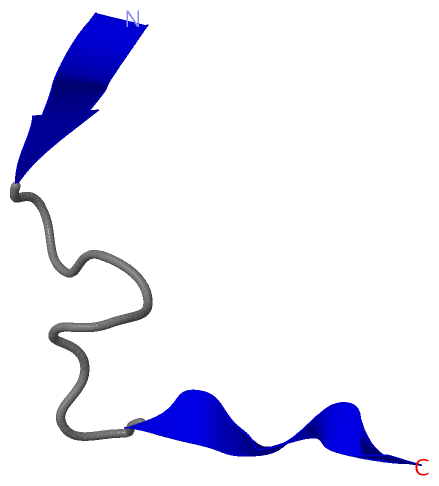
Image NMR Structure - model 1
NMR Structure - model 1  (Jmol Viewer)
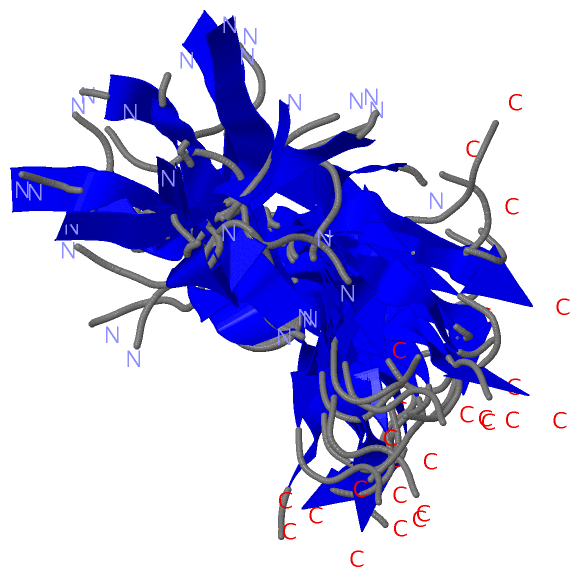
Image NMR Structure - all models
NMR Structure - all models  (Jmol Viewer)

(-) Description

Title :  NS5A308
 
Authors :  R. Montserret, A. Badillo, X. Hanoulle, G. Lippens, F. Penin
Date :  27 Feb 13  (Deposition) - 05 Mar 14  (Release) - 05 Mar 14  (Revision)
Method :  SOLUTION NMR
Resolution :  NOT APPLICABLE
Chains :  NMR Structure  :  A  (28x)
NMR Structure *:  A  (1x)
Keywords :  Hepatitis C Virus, Ns5A Protein, Domain 2, Intrinsically Disordered Protein, Viral Protein (Keyword Search: [Gene Ontology, PubMed, Web (Google))
 
Reference :  R. Montserret, A. Badillo, X. Hanoulle, G. Lippens, F. Penin
Ns5A308
To Be Published
PubMed: search

(-) Compounds

Molecule 1 - NS5A PROTEIN
    ChainsA
    EngineeredYES
    Expression SystemESCHERICHIA COLI
    Expression System PlasmidPT7-7
    Expression System Taxid562
    Expression System Vector TypePLASMID
    FragmentUNP RESIDUES 2280-2301
    Organism ScientificHEPATITIS C VIRUS
    Organism Taxid333284
    Other Details15N 13C LABELED SAMPLE
    StrainCON 1

 Structural Features

(-) Chains, Units

  1
NMR Structure (28x)A
NMR Structure * (1x)A

Summary Information (see also Sequences/Alignments below)

(-) Ligands, Modified Residues, Ions  (0, 0)

(no "Ligand,Modified Residues,Ions" information available for 2M5L)

(-) Sites  (0, 0)

(no "Site" information available for 2M5L)

(-) SS Bonds  (0, 0)

(no "SS Bond" information available for 2M5L)

(-) Cis Peptide Bonds  (0, 0)

(no "Cis Peptide Bond" information available for 2M5L)

 Sequence-Structure Mapping

(-) SAPs(SNPs)/Variants  (0, 0)

(no "SAP(SNP)/Variant" information available for 2M5L)

(-) PROSITE Motifs  (0, 0)

(no "PROSITE Motif" information available for 2M5L)

(-) Exons   (0, 0)

(no "Exon" information available for 2M5L)

(-) Sequences/Alignments

NMR Structure
   Reformat: Number of residues per line =  ('0' or empty: single-line sequence representation)
  Number of residues per labelling interval =   
  UniProt sequence: complete  aligned part    
   Show mapping: SCOP domains CATH domains Pfam domains Secondary structure (by author)
SAPs(SNPs) PROSITE motifs Exons
(details for a mapped element are shown in a popup box when the mouse pointer rests over it)
Chain A from PDB  Type:PROTEIN  Length:20
 aligned with Q9WIK7_9HEPC | Q9WIK7 from UniProtKB/TrEMBL  Length:3012

    Alignment length:20
                                  2291      2301
        Q9WIK7_9HEPC   2282 KFPRAMPIWARPDYNPPLLE 2301
               SCOP domains -------------------- SCOP domains
               CATH domains -------------------- CATH domains
               Pfam domains -------------------- Pfam domains
         Sec.struct. author .................... Sec.struct. author
                 SAPs(SNPs) -------------------- SAPs(SNPs)
                    PROSITE -------------------- PROSITE
                 Transcript -------------------- Transcript
                2m5l A  308 KFPRAMPIWARPDYNPPLLE  327
                                   317       327

   Legend:   → Mismatch (orange background)
  - → Gap (green background, '-', border residues have a numbering label)
    → Modified Residue (blue background, lower-case, 'x' indicates undefined single-letter code, labelled with number + name)
  x → Chemical Group (purple background, 'x', labelled with number + name, e.g. ACE or NH2)
  extra numbering lines below/above indicate numbering irregularities and modified residue names etc., number ends below/above '|'

 Classification and Annotation

(-) SCOP Domains  (0, 0)

(no "SCOP Domain" information available for 2M5L)

(-) CATH Domains  (0, 0)

(no "CATH Domain" information available for 2M5L)

(-) Pfam Domains  (0, 0)

(no "Pfam Domain" information available for 2M5L)

(-) Gene Ontology  (30, 30)

NMR Structure(hide GO term definitions)
Chain A   (Q9WIK7_9HEPC | Q9WIK7)
molecular function
    GO:0005524    ATP binding    Interacting selectively and non-covalently with ATP, adenosine 5'-triphosphate, a universally important coenzyme and enzyme regulator.
    GO:0008026    ATP-dependent helicase activity    Catalysis of the reaction: ATP + H2O = ADP + phosphate, to drive the unwinding of a DNA or RNA helix.
    GO:0003723    RNA binding    Interacting selectively and non-covalently with an RNA molecule or a portion thereof.
    GO:0003968    RNA-directed 5'-3' RNA polymerase activity    Catalysis of the reaction: nucleoside triphosphate + RNA(n) = diphosphate + RNA(n+1); uses an RNA template, i.e. the catalysis of RNA-template-directed extension of the 3'-end of an RNA strand by one nucleotide at a time.
    GO:0004197    cysteine-type endopeptidase activity    Catalysis of the hydrolysis of internal, alpha-peptide bonds in a polypeptide chain by a mechanism in which the sulfhydryl group of a cysteine residue at the active center acts as a nucleophile.
    GO:0004386    helicase activity    Catalysis of the reaction: NTP + H2O = NDP + phosphate, to drive the unwinding of a DNA or RNA helix.
    GO:0016787    hydrolase activity    Catalysis of the hydrolysis of various bonds, e.g. C-O, C-N, C-C, phosphoric anhydride bonds, etc. Hydrolase is the systematic name for any enzyme of EC class 3.
    GO:0017111    nucleoside-triphosphatase activity    Catalysis of the reaction: a nucleoside triphosphate + H2O = nucleoside diphosphate + phosphate.
    GO:0000166    nucleotide binding    Interacting selectively and non-covalently with a nucleotide, any compound consisting of a nucleoside that is esterified with (ortho)phosphate or an oligophosphate at any hydroxyl group on the ribose or deoxyribose.
    GO:0016779    nucleotidyltransferase activity    Catalysis of the transfer of a nucleotidyl group to a reactant.
    GO:0004252    serine-type endopeptidase activity    Catalysis of the hydrolysis of internal, alpha-peptide bonds in a polypeptide chain by a catalytic mechanism that involves a catalytic triad consisting of a serine nucleophile that is activated by a proton relay involving an acidic residue (e.g. aspartate or glutamate) and a basic residue (usually histidine).
    GO:0008236    serine-type peptidase activity    Catalysis of the hydrolysis of peptide bonds in a polypeptide chain by a catalytic mechanism that involves a catalytic triad consisting of a serine nucleophile that is activated by a proton relay involving an acidic residue (e.g. aspartate or glutamate) and a basic residue (usually histidine).
    GO:0005198    structural molecule activity    The action of a molecule that contributes to the structural integrity of a complex or its assembly within or outside a cell.
    GO:0016740    transferase activity    Catalysis of the transfer of a group, e.g. a methyl group, glycosyl group, acyl group, phosphorus-containing, or other groups, from one compound (generally regarded as the donor) to another compound (generally regarded as the acceptor). Transferase is the systematic name for any enzyme of EC class 2.
    GO:0008270    zinc ion binding    Interacting selectively and non-covalently with zinc (Zn) ions.
biological process
    GO:0039520    induction by virus of host autophagy    Any process in which a virus activates or increases the frequency, rate or extent of autophagy in the host.
    GO:0006508    proteolysis    The hydrolysis of proteins into smaller polypeptides and/or amino acids by cleavage of their peptide bonds.
    GO:0001172    transcription, RNA-templated    The cellular synthesis of RNA on a template of RNA.
    GO:0019087    transformation of host cell by virus    Any virus-induced change in the morphological, biochemical, or growth parameters of a cell.
    GO:0039694    viral RNA genome replication    The replication of a viral RNA genome.
    GO:0046718    viral entry into host cell    The process that occurs after viral attachment by which a virus, or viral nucleic acid, breaches the plasma membrane or cell envelope and enters the host cell. The process ends when the viral nucleic acid is released into the host cell cytoplasm.
    GO:0019079    viral genome replication    Any process involved directly in viral genome replication, including viral nucleotide metabolism.
    GO:0016032    viral process    A multi-organism process in which a virus is a participant. The other participant is the host. Includes infection of a host cell, replication of the viral genome, and assembly of progeny virus particles. In some cases the viral genetic material may integrate into the host genome and only subsequently, under particular circumstances, 'complete' its life cycle.
    GO:0019062    virion attachment to host cell    The process by which a virion protein binds to molecules on the host cellular surface or host cell surface projection.
cellular component
    GO:0033644    host cell membrane    Double layer of lipid molecules as it encloses host cells, and, in eukaryotes, many organelles; may be a single or double lipid bilayer; also includes associated proteins. The host is defined as the larger of the organisms involved in a symbiotic interaction.
    GO:0016021    integral component of membrane    The component of a membrane consisting of the gene products and protein complexes having at least some part of their peptide sequence embedded in the hydrophobic region of the membrane.
    GO:0016020    membrane    A lipid bilayer along with all the proteins and protein complexes embedded in it an attached to it.
    GO:0019028    viral capsid    The protein coat that surrounds the infective nucleic acid in some virus particles. It comprises numerous regularly arranged subunits, or capsomeres.
    GO:0019031    viral envelope    The lipid bilayer of a virion that surrounds the protein capsid. May also contain glycoproteins.
    GO:0019012    virion    The complete fully infectious extracellular virus particle.

 Visualization

(-) Interactive Views

NMR Structure
  Complete Structure
    Jena3D(integrated viewing of ligand, site, SAP, PROSITE, SCOP information)
    WebMol | AstexViewer[tm]@PDBe
(Java Applets, require no local installation except for Java; loading may be slow)
    STRAP
(Java WebStart application, automatic local installation, requires Java; full application with system access!)
    RasMol
(require local installation)
    Molscript (VRML)
(requires installation of a VRML viewer; select preferred view via VRML and generate a mono or stereo PDF format file)
 
  Ligands, Modified Residues, Ions
(no "Ligands, Modified Residues, Ions" information available for 2m5l)
 
  Sites
(no "Sites" information available for 2m5l)
 
  Cis Peptide Bonds
(no "Cis Peptide Bonds" information available for 2m5l)
 

(-) Still Images

Jmol
  protein: cartoon or spacefill or dots and stick; nucleic acid: cartoon and stick; ligands: spacefill; active site: stick
Molscript
  protein, nucleic acid: cartoon; ligands: spacefill; active site: ball and stick

 Databases and Analysis Tools

(-) Databases

Access by PDB/NDB ID
  2m5l
    Family and Domain InformationProDom | SYSTERS
    General Structural InformationGlycoscienceDB | MMDB | NDB | OCA | PDB | PDBe | PDBj | PDBsum | PDBWiki | PQS | PROTEOPEDIA
    Orientation in MembranesOPM
    Protein SurfaceSURFACE
    Secondary StructureDSSP (structure derived) | HSSP (homology derived)
    Structural GenomicsGeneCensus
    Structural NeighboursCE | VAST
    Structure ClassificationCATH | Dali | SCOP
    Validation and Original DataBMRB Data View | BMRB Restraints Grid | EDS | PROCHECK | RECOORD | WHAT_CHECK
 
Access by UniProt ID/Accession number
  Q9WIK7_9HEPC | Q9WIK7
    Comparative Protein Structure ModelsModBase
    Genomic InformationEnsembl
    Protein-protein InteractionDIP
    Sequence, Family and Domain InformationInterPro | Pfam | SMART | UniProtKB/TrEMBL
 
Access by Enzyme Classificator   (EC Number)
  (no 'Enzyme Classificator' available)
    General Enzyme InformationBRENDA | EC-PDB | Enzyme | IntEnz
    PathwayKEGG | MetaCyc
 
Access by Disease Identifier   (MIM ID)
  (no 'MIM ID' available)
    Disease InformationOMIM
 
Access by GenAge ID
  (no 'GenAge ID' available)
    Age Related InformationGenAge

(-) Analysis Tools

Access by PDB/NDB ID
    Domain InformationXDom
    Interatomic Contacts of Structural UnitsCSU
    Ligand-protein ContactsLPC
    Protein CavitiescastP
    Sequence and Secondary StructurePDBCartoon
    Structure AlignmentSTRAP(Java WebStart application, automatic local installation, requires Java; full application with system access!)
    Structure and Sequence BrowserSTING
 
Access by UniProt ID/Accession number
  Q9WIK7_9HEPC | Q9WIK7
    Protein Disorder PredictionDisEMBL | FoldIndex | GLOBPLOT (for more information see DisProt)

 Related Entries

(-) Entries Sharing at Least One Protein Chain (UniProt ID)

(no "Entries Sharing at Least One Protein Chain" available for 2M5L)

(-) Related Entries Specified in the PDB File

(no "Related Entries Specified in the PDB File" available for 2M5L)