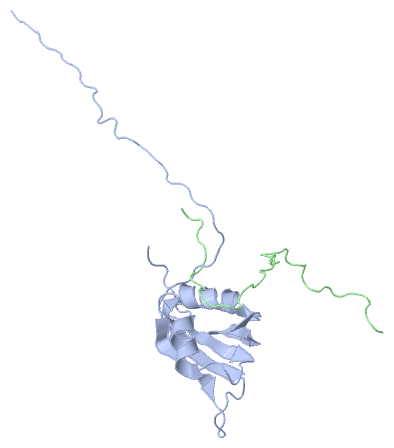
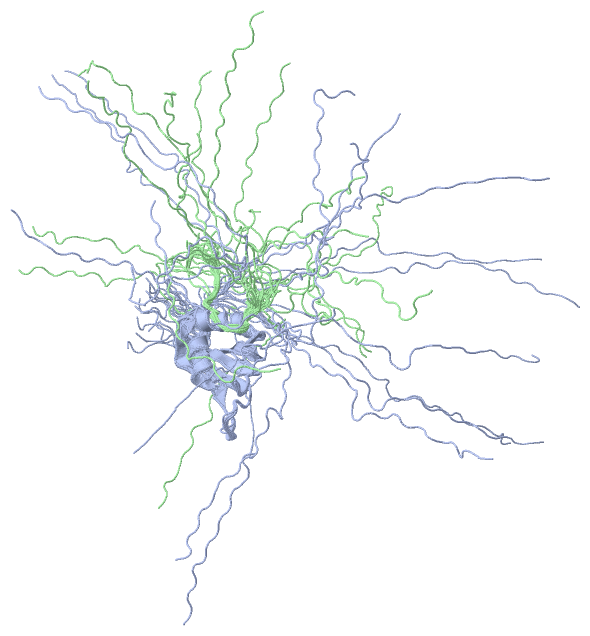
NMR Structure(hide GO term definitions)
Chain A ( ALRF2_MOUSE | Q9JJW6)
| molecular function |
|---|
| | GO:0003723 | | RNA binding | | Interacting selectively and non-covalently with an RNA molecule or a portion thereof. |
| | GO:0003676 | | nucleic acid binding | | Interacting selectively and non-covalently with any nucleic acid. |
| | GO:0000166 | | nucleotide binding | | Interacting selectively and non-covalently with a nucleotide, any compound consisting of a nucleoside that is esterified with (ortho)phosphate or an oligophosphate at any hydroxyl group on the ribose or deoxyribose. |
| | GO:0003697 | | single-stranded DNA binding | | Interacting selectively and non-covalently with single-stranded DNA. |
| biological process |
|---|
| | GO:0008380 | | RNA splicing | | The process of removing sections of the primary RNA transcript to remove sequences not present in the mature form of the RNA and joining the remaining sections to form the mature form of the RNA. |
| | GO:0006397 | | mRNA processing | | Any process involved in the conversion of a primary mRNA transcript into one or more mature mRNA(s) prior to translation into polypeptide. |
| | GO:0051028 | | mRNA transport | | The directed movement of mRNA, messenger ribonucleic acid, into, out of or within a cell, or between cells, by means of some agent such as a transporter or pore. |
| | GO:0006810 | | transport | | The directed movement of substances (such as macromolecules, small molecules, ions) or cellular components (such as complexes and organelles) into, out of or within a cell, or between cells, or within a multicellular organism by means of some agent such as a transporter, pore or motor protein. |
| cellular component |
|---|
| | GO:0005575 | | cellular_component | | The part of a cell, extracellular environment or virus in which a gene product is located. A gene product may be located in one or more parts of a cell and its location may be as specific as a particular macromolecular complex, that is, a stable, persistent association of macromolecules that function together. |
| | GO:0005737 | | cytoplasm | | All of the contents of a cell excluding the plasma membrane and nucleus, but including other subcellular structures. |
| | GO:0005634 | | nucleus | | A membrane-bounded organelle of eukaryotic cells in which chromosomes are housed and replicated. In most cells, the nucleus contains all of the cell's chromosomes except the organellar chromosomes, and is the site of RNA synthesis and processing. In some species, or in specialized cell types, RNA metabolism or DNA replication may be absent. |
| | GO:0005681 | | spliceosomal complex | | Any of a series of ribonucleoprotein complexes that contain snRNA(s) and small nuclear ribonucleoproteins (snRNPs), and are formed sequentially during the spliceosomal splicing of one or more substrate RNAs, and which also contain the RNA substrate(s) from the initial target RNAs of splicing, the splicing intermediate RNA(s), to the final RNA products. During cis-splicing, the initial target RNA is a single, contiguous RNA transcript, whether mRNA, snoRNA, etc., and the released products are a spliced RNA and an excised intron, generally as a lariat structure. During trans-splicing, there are two initial substrate RNAs, the spliced leader RNA and a pre-mRNA. |
Chain B ( ICP27_HHV11 | P10238)
| molecular function |
|---|
| | GO:0003723 | | RNA binding | | Interacting selectively and non-covalently with an RNA molecule or a portion thereof. |
| | GO:0046872 | | metal ion binding | | Interacting selectively and non-covalently with any metal ion. |
| | GO:0005515 | | protein binding | | Interacting selectively and non-covalently with any protein or protein complex (a complex of two or more proteins that may include other nonprotein molecules). |
| biological process |
|---|
| | GO:0039652 | | activation by virus of host NF-kappaB transcription factor activity | | Any process in which a virus starts, promotes, or enhances the activity of the host transcription factor NF-kappaB. |
| | GO:0039645 | | modulation by virus of host G1/S transition checkpoint | | Any viral process that modulates the frequency, rate or extent of the host cell G1/S transition checkpoint. |
| | GO:0060153 | | modulation by virus of host cell cycle | | Any viral process that modulates the rate or extent of progression through the cell cycle. |
| | GO:0006355 | | regulation of transcription, DNA-templated | | Any process that modulates the frequency, rate or extent of cellular DNA-templated transcription. |
| | GO:0039657 | | suppression by virus of host gene expression | | Any process in which a virus stops, prevents, or reduces the frequency, rate or extent of gene expression in the host organism. Gene expression is the process in which a gene's coding sequence is converted into a mature gene product or products (proteins or RNA). This includes the production of an RNA transcript as well as any processing to produce a mature RNA product or an mRNA (for protein-coding genes) and the translation of that mRNA into protein. Some protein processing events may be included when they are required to form an active form of a product from an inactive precursor form. |
| | GO:0039524 | | suppression by virus of host mRNA processing | | Any process in which a virus stops, prevents, or reduces the frequency, rate or extent of mRNA processing in the host cell. mRNA processing is the conversion of a primary mRNA transcript into one or more mature mRNA(s) prior to translation into polypeptide. |
| | GO:0006351 | | transcription, DNA-templated | | The cellular synthesis of RNA on a template of DNA. |
| | GO:0016032 | | viral process | | A multi-organism process in which a virus is a participant. The other participant is the host. Includes infection of a host cell, replication of the viral genome, and assembly of progeny virus particles. In some cases the viral genetic material may integrate into the host genome and only subsequently, under particular circumstances, 'complete' its life cycle. |
| cellular component |
|---|
| | GO:0030430 | | host cell cytoplasm | | The cytoplasm of a host cell. |
| | GO:0042025 | | host cell nucleus | | A membrane-bounded organelle as it is found in the host cell in which chromosomes are housed and replicated. The host is defined as the larger of the organisms involved in a symbiotic interaction. |
|

 Description