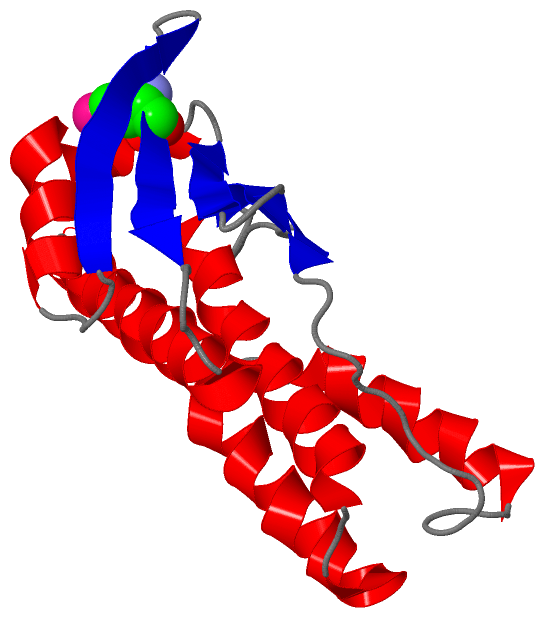
Show PDB file:   
         Plain Text   HTML   (compressed file size)
QuickSearch:   
by PDB,NDB,UniProt,PROSITE Code or Search Term(s)  
(-)Asym./Biol. Unit
collapse expand < >
Image Asym./Biol. Unit
Asym./Biol. Unit  (Jmol Viewer)

(-) Description

Title :  CRYSTAL STRUCTURE OF C-TERMINAL DOMAIN OF TRANSCRIPTION-REPAIR COUPLING FACTOR
 
Authors :  U. A. Ramagopal, R. Toro, M. Gilmore, K. Bain, M. Iizuka, S. Wasserman, L J. M. Sauder, S. K. Burley, S. C. Almo, New York Sgx Research Center Structural Genomics (Nysgxrc)
Date :  31 Jul 07  (Deposition) - 11 Sep 07  (Release) - 13 Jul 11  (Revision)
Method :  X-RAY DIFFRACTION
Resolution :  3.10
Chains :  Asym./Biol. Unit :  A
Keywords :  Structural Genomics, Transcription-Repair, Psi-2, Protein Structure Initiative, New York Sgx Research Center For Structural Genomics, Nysgxrc, Atp-Binding, Helicase, Hydrolase, Nucleotide-Binding, Transcription (Keyword Search: [Gene Ontology, PubMed, Web (Google))
 
Reference :  U. A. Ramagopal, R. Toro, M. Gilmore, K. Bain, M. Iizuka, S. Wasserman, L. Rodgers, J. M. Sauder, S. K. Burley, S. C. Almo
Structure Of C-Terminal Domain Of Transcription-Repair Coupling Factor.
To Be Published
PubMed: search

(-) Compounds

Molecule 1 - TRANSCRIPTION-REPAIR COUPLING FACTOR
    AtccBAA-255
    ChainsA
    EngineeredYES
    Expression SystemESCHERICHIA COLI BL21(DE3)
    Expression System PlasmidBS-PSGX4(BC)
    Expression System StrainBL21(DE3)
    Expression System Taxid469008
    Expression System Vector TypePLASMID
    GeneMFD, SPR0006
    Organism ScientificSTREPTOCOCCUS PNEUMONIAE
    Organism Taxid171101
    StrainR6

 Structural Features

(-) Chains, Units

  1
Asymmetric/Biological Unit A

Summary Information (see also Sequences/Alignments below)

(-) Ligands, Modified Residues, Ions  (1, 1)

Asymmetric/Biological Unit (1, 1)
No.NameCountTypeFull Name
1MSE1Mod. Amino AcidSELENOMETHIONINE

(-) Sites  (0, 0)

(no "Site" information available for 2QSR)

(-) SS Bonds  (0, 0)

(no "SS Bond" information available for 2QSR)

(-) Cis Peptide Bonds  (0, 0)

(no "Cis Peptide Bond" information available for 2QSR)

 Sequence-Structure Mapping

(-) SAPs(SNPs)/Variants  (0, 0)

(no "SAP(SNP)/Variant" information available for 2QSR)

(-) PROSITE Motifs  (0, 0)

(no "PROSITE Motif" information available for 2QSR)

(-) Exons   (0, 0)

(no "Exon" information available for 2QSR)

(-) Sequences/Alignments

Asymmetric/Biological Unit
   Reformat: Number of residues per line =  ('0' or empty: single-line sequence representation)
  Number of residues per labelling interval =   
  UniProt sequence: complete  aligned part    
   Show mapping: SCOP domains CATH domains Pfam domains Secondary structure (by author)
SAPs(SNPs) PROSITE motifs Exons
(details for a mapped element are shown in a popup box when the mouse pointer rests over it)
Chain A from PDB  Type:PROTEIN  Length:161
 aligned with Q8DRQ1_STRR6 | Q8DRQ1 from UniProtKB/TrEMBL  Length:1169

    Alignment length:161
                                  1014      1024      1034      1044      1054      1064      1074      1084      1094      1104      1114      1124      1134      1144      1154      1164 
        Q8DRQ1_STRR6   1005 NTRTKGNAELILQIDAYLPDTYISDQRHKIEIYKKIRQIDNRVNYEELQEELIDRFGEYPDVVAYLLEIGLVKSYLDKVFVQRVERKDNKITIQFEKVTQRLFLAQDYFKALSVTNLKAGIAENKGLMELVFDVQNKKDYEILEGLLIFGESLLEIKESKE 1165
               SCOP domains ----------------------------------------------------------------------------------------------------------------------------------------------------------------- SCOP domains
               CATH domains ----------------------------------------------------------------------------------------------------------------------------------------------------------------- CATH domains
               Pfam domains ----------TRCF-2qsrA01 A:1015-1115                                                                             -------------------------------------------------- Pfam domains
         Sec.struct. author ........eee.............hhhhhhhhhhhhhh..hhhhhhhhhhhhhhhhh..hhhhhhhhhhhhhhhhhhhh.eeeeee...eeeeee..hhhhhhhhhhhhhhhh....eeeeeee..eeeeeee....hhhhhhhhhhhhhhhhhhhhhh.. Sec.struct. author
                 SAPs(SNPs) ----------------------------------------------------------------------------------------------------------------------------------------------------------------- SAPs(SNPs)
                    PROSITE ----------------------------------------------------------------------------------------------------------------------------------------------------------------- PROSITE
                 Transcript ----------------------------------------------------------------------------------------------------------------------------------------------------------------- Transcript
                2qsr A 1005 SLRTKGNAELILQIDAYLPDTYISDQRHKIEIYKKIRQIDNRVNYEELQEELIDRFGEYPDVVAYLLEIGLVKSYLDKVFVQRVERKDNKITIQFEKVTQRLFLAQDYFKALSVTNLKAGIAENKGLmELVFDVQNKKDYEILEGLLIFGESLLEIKESKE 1165
                                  1014      1024      1034      1044      1054      1064      1074      1084      1094      1104      1114      1124      1134      1144      1154      1164 
                                                                                                                                                        1132-MSE                             

   Legend:   → Mismatch (orange background)
  - → Gap (green background, '-', border residues have a numbering label)
    → Modified Residue (blue background, lower-case, 'x' indicates undefined single-letter code, labelled with number + name)
  x → Chemical Group (purple background, 'x', labelled with number + name, e.g. ACE or NH2)
  extra numbering lines below/above indicate numbering irregularities and modified residue names etc., number ends below/above '|'

 Classification and Annotation

(-) SCOP Domains  (0, 0)

(no "SCOP Domain" information available for 2QSR)

(-) CATH Domains  (0, 0)

(no "CATH Domain" information available for 2QSR)

(-) Pfam Domains  (1, 1)

Asymmetric/Biological Unit

(-) Gene Ontology  (12, 12)

Asymmetric/Biological Unit(hide GO term definitions)
Chain A   (Q8DRQ1_STRR6 | Q8DRQ1)
molecular function
    GO:0005524    ATP binding    Interacting selectively and non-covalently with ATP, adenosine 5'-triphosphate, a universally important coenzyme and enzyme regulator.
    GO:0003677    DNA binding    Any molecular function by which a gene product interacts selectively and non-covalently with DNA (deoxyribonucleic acid).
    GO:0003684    damaged DNA binding    Interacting selectively and non-covalently with damaged DNA.
    GO:0004386    helicase activity    Catalysis of the reaction: NTP + H2O = NDP + phosphate, to drive the unwinding of a DNA or RNA helix.
    GO:0016787    hydrolase activity    Catalysis of the hydrolysis of various bonds, e.g. C-O, C-N, C-C, phosphoric anhydride bonds, etc. Hydrolase is the systematic name for any enzyme of EC class 3.
    GO:0003676    nucleic acid binding    Interacting selectively and non-covalently with any nucleic acid.
    GO:0000166    nucleotide binding    Interacting selectively and non-covalently with a nucleotide, any compound consisting of a nucleoside that is esterified with (ortho)phosphate or an oligophosphate at any hydroxyl group on the ribose or deoxyribose.
biological process
    GO:0006281    DNA repair    The process of restoring DNA after damage. Genomes are subject to damage by chemical and physical agents in the environment (e.g. UV and ionizing radiations, chemical mutagens, fungal and bacterial toxins, etc.) and by free radicals or alkylating agents endogenously generated in metabolism. DNA is also damaged because of errors during its replication. A variety of different DNA repair pathways have been reported that include direct reversal, base excision repair, nucleotide excision repair, photoreactivation, bypass, double-strand break repair pathway, and mismatch repair pathway.
    GO:0006974    cellular response to DNA damage stimulus    Any process that results in a change in state or activity of a cell (in terms of movement, secretion, enzyme production, gene expression, etc.) as a result of a stimulus indicating damage to its DNA from environmental insults or errors during metabolism.
    GO:0006355    regulation of transcription, DNA-templated    Any process that modulates the frequency, rate or extent of cellular DNA-templated transcription.
    GO:0000716    transcription-coupled nucleotide-excision repair, DNA damage recognition    The identification of lesions on the actively transcribed strand of the DNA duplex as well as a small subset of lesions not recognized by the general nucleotide-excision repair pathway.
cellular component
    GO:0005737    cytoplasm    All of the contents of a cell excluding the plasma membrane and nucleus, but including other subcellular structures.

 Visualization

(-) Interactive Views

Asymmetric/Biological Unit
  Complete Structure
    Jena3D(integrated viewing of ligand, site, SAP, PROSITE, SCOP information)
    WebMol | AstexViewer[tm]@PDBe
(Java Applets, require no local installation except for Java; loading may be slow)
    STRAP
(Java WebStart application, automatic local installation, requires Java; full application with system access!)
    RasMol
(require local installation)
    Molscript (VRML)
(requires installation of a VRML viewer; select preferred view via VRML and generate a mono or stereo PDF format file)
 
  Ligands, Modified Residues, Ions
    MSE  [ RasMol | Jena3D ]  +environment [ RasMol | Jena3D ]
 
  Sites
(no "Sites" information available for 2qsr)
 
  Cis Peptide Bonds
(no "Cis Peptide Bonds" information available for 2qsr)
 

(-) Still Images

Jmol
  protein: cartoon or spacefill or dots and stick; nucleic acid: cartoon and stick; ligands: spacefill; active site: stick
Molscript
  protein, nucleic acid: cartoon; ligands: spacefill; active site: ball and stick

 Databases and Analysis Tools

(-) Databases

Access by PDB/NDB ID
  2qsr
    Family and Domain InformationProDom | SYSTERS
    General Structural InformationGlycoscienceDB | MMDB | NDB | OCA | PDB | PDBe | PDBj | PDBsum | PDBWiki | PQS | PROTEOPEDIA
    Orientation in MembranesOPM
    Protein SurfaceSURFACE
    Secondary StructureDSSP (structure derived) | HSSP (homology derived)
    Structural GenomicsGeneCensus
    Structural NeighboursCE | VAST
    Structure ClassificationCATH | Dali | SCOP
    Validation and Original DataBMRB Data View | BMRB Restraints Grid | EDS | PROCHECK | RECOORD | WHAT_CHECK
 
Access by UniProt ID/Accession number
  Q8DRQ1_STRR6 | Q8DRQ1
    Comparative Protein Structure ModelsModBase
    Genomic InformationEnsembl
    Protein-protein InteractionDIP
    Sequence, Family and Domain InformationInterPro | Pfam | SMART | UniProtKB/TrEMBL
 
Access by Enzyme Classificator   (EC Number)
  (no 'Enzyme Classificator' available)
    General Enzyme InformationBRENDA | EC-PDB | Enzyme | IntEnz
    PathwayKEGG | MetaCyc
 
Access by Disease Identifier   (MIM ID)
  (no 'MIM ID' available)
    Disease InformationOMIM
 
Access by GenAge ID
  (no 'GenAge ID' available)
    Age Related InformationGenAge

(-) Analysis Tools

Access by PDB/NDB ID
    Domain InformationXDom
    Interatomic Contacts of Structural UnitsCSU
    Ligand-protein ContactsLPC
    Protein CavitiescastP
    Sequence and Secondary StructurePDBCartoon
    Structure AlignmentSTRAP(Java WebStart application, automatic local installation, requires Java; full application with system access!)
    Structure and Sequence BrowserSTING
 
Access by UniProt ID/Accession number
  Q8DRQ1_STRR6 | Q8DRQ1
    Protein Disorder PredictionDisEMBL | FoldIndex | GLOBPLOT (for more information see DisProt)

 Related Entries

(-) Entries Sharing at Least One Protein Chain (UniProt ID)

(no "Entries Sharing at Least One Protein Chain" available for 2QSR)

(-) Related Entries Specified in the PDB File

(no "Related Entries Specified in the PDB File" available for 2QSR)